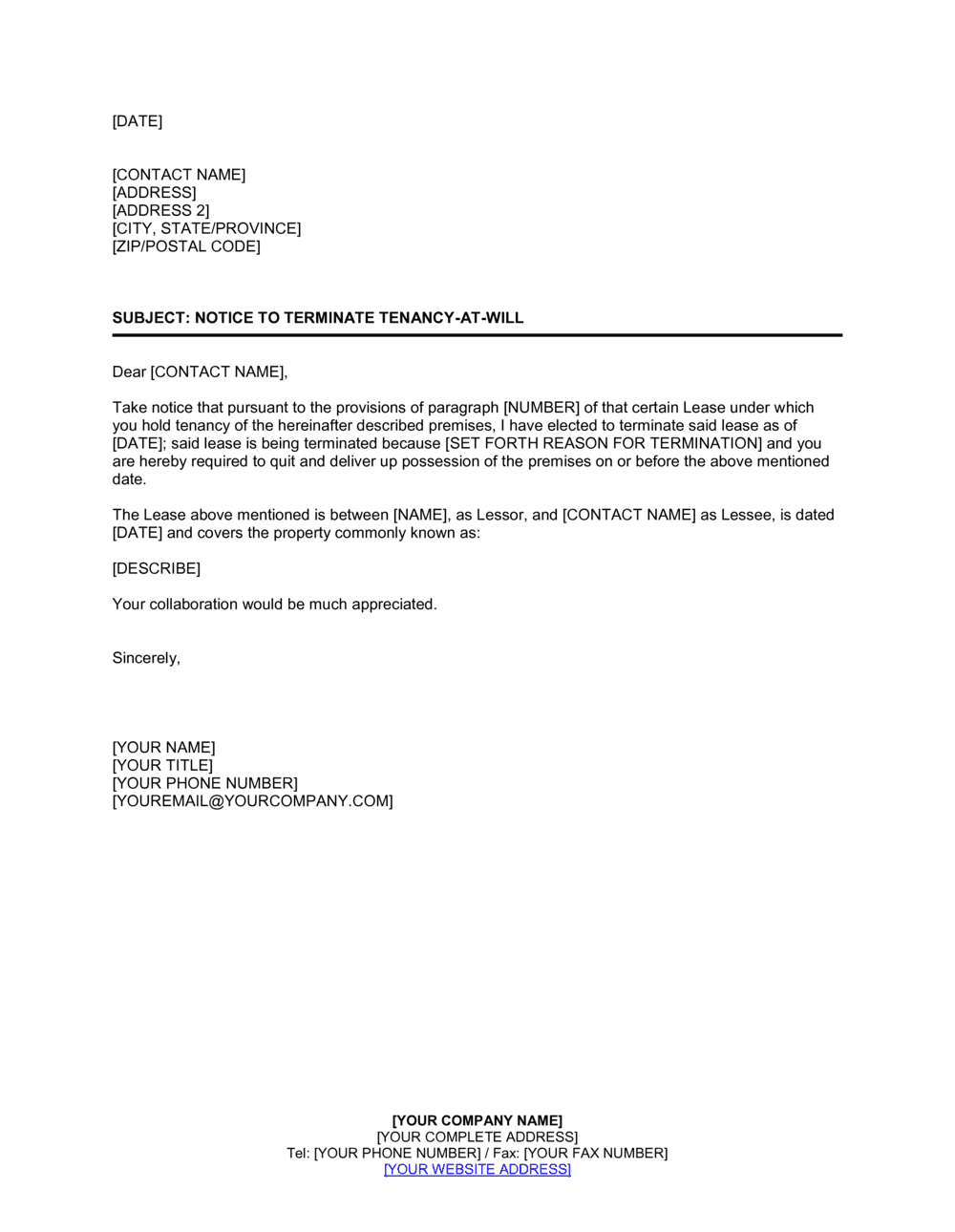
Notice to Terminate Tenancy_At-Will by Landlord Template

Free Word download β€’ Edit online β€’ Save & share with Drive β€’ Export to PDF

1 pageβ€’15–25 min to fillβ€’Difficulty: Standard
Learn more ↓
FreeNotice to Terminate Tenancy_At-Will by Landlord Template

At a glance

What it is
A Notice to Terminate Tenancy at Will by Landlord is a formal written notice a property owner serves on a tenant occupying a property without a fixed-term lease, informing them that their tenancy is ending and stating the date by which they must vacate. This free Word download lets you fill in the property address, required notice period, and move-out instructions, then print or deliver the notice in minutes.
When you need it
Use it when you need to end a month-to-month or at-will tenancy β€” whether to reclaim the property, sell it, renovate it, or address a situation where no fixed-term lease is in place. It is also used when a fixed-term lease has expired and the tenant has continued occupying under an implied month-to-month arrangement.
What's inside
Landlord and tenant identification, property address, notice date, required notice period, termination date, vacate instructions, move-out condition requirements, and landlord signature block.

What is a Notice to Terminate Tenancy at Will by Landlord?

A Notice to Terminate Tenancy at Will by Landlord is a formal written notice a property owner serves on a tenant who occupies a property under a month-to-month or implied tenancy β€” one with no fixed end date β€” informing them that the rental arrangement is ending and specifying the date by which they must vacate. It is not an eviction filing or a court document; it is the required first step that triggers the notice period and, upon expiry, gives the landlord legal standing to pursue further action if the tenant remains. The notice identifies both parties, states the property address, confirms the statutory notice period being given, sets a specific quit date, and instructs the tenant on move-out obligations and security deposit handling.

Why You Need This Document

Without a written, properly served termination notice, a landlord cannot legally compel an at-will tenant to vacate, regardless of the circumstances. Courts in every jurisdiction require proof that formal notice was given with the correct notice period before they will hear an unlawful detainer or eviction case β€” and a defective notice restarts the entire timeline. Beyond the legal requirement, a written notice creates a clear record of the termination date, the instructions given, and the method of delivery, protecting the landlord if the tenant later claims they were unaware the tenancy was ending or disputes the move-out timeline. This template gives individual landlords and property managers a ready-to-use, professionally formatted notice that covers every required element, so the notice period starts running from the moment it is delivered.

Which variant fits your situation?

If your situation is…Use this template
Tenant has a fixed-term lease that has not yet expiredNotice of Non-Renewal of Lease
Tenant has violated lease terms or caused damageNotice to Cure or Quit
Tenant has failed to pay rentNotice to Pay Rent or Quit
Tenant is terminating their own at-will tenancyNotice to Terminate Tenancy at Will by Tenant
Commercial tenant holding over after lease expiryCommercial Lease Termination Notice
Mutual agreement to end tenancy on a negotiated dateLease Termination Agreement
Landlord seeking to formalize full eviction proceedingsEviction Notice

Common mistakes to avoid

❌ Using the drafting date instead of the delivery date

Why it matters: The notice period runs from delivery, not drafting. A notice drafted on the 1st but delivered on the 5th and dated the 1st may set an invalid quit date that falls short of the statutory minimum.

Fix: Date the notice on the day it is actually delivered. If you are not certain of the delivery date in advance, leave the date blank and fill it in at the moment of service.
❌ Serving only one co-tenant when multiple are named

Why it matters: A tenancy with two or more named tenants generally requires notice to each. Serving only one may allow the un-served tenant to claim the notice was legally defective.

Fix: Identify all tenants by full legal name in the notice and serve a copy to each named occupant at the property address.

❌ Setting a quit date that does not align with the rent cycle

Why it matters: Several states require the termination date to coincide with the end of a rental period. A mid-month quit date in a monthly tenancy may be legally invalid, restarting your timeline.

Fix: Confirm whether your jurisdiction requires cycle-aligned termination dates and set the quit date to the last day of the applicable rental period.

❌ Threatening unauthorized penalties for holding over

Why it matters: Citing specific unauthorized fines or penalty amounts beyond what local law permits can be characterized as harassment, exposing the landlord to counterclaims.

Fix: Limit consequences language to 'all remedies available under applicable law' rather than specifying dollar amounts not expressly authorized by statute.

The 9 key clauses, explained

Header and date

In plain language: States the document title, the date the notice is issued, and establishes the formal record of when the notice period begins to run.

Sample language
NOTICE TO TERMINATE TENANCY AT WILL Date: [DATE] From: [LANDLORD NAME], [LANDLORD ADDRESS]

Common mistake: Using the date the letter is drafted rather than the date it is delivered. The notice period starts on the delivery date; a mismatch can invalidate the calculated quit date.

Landlord and tenant identification

In plain language: Names the landlord (or property manager acting on their behalf) and the tenant(s) to whom the notice is directed, using full legal names.

Sample language
To: [TENANT FULL NAME(S)] [PROPERTY ADDRESS, UNIT NUMBER, CITY, STATE, ZIP]

Common mistake: Naming only one tenant when the lease lists multiple occupants. Each named tenant should be identified to prevent claims of improper service.

Property description

In plain language: Identifies the specific rental premises being vacated by full address, including unit or suite number where applicable.

Sample language
RE: Premises located at [STREET ADDRESS], [UNIT/APT #], [CITY], [STATE] [ZIP CODE] ('Premises').

Common mistake: Using a partial address that omits the unit number in a multi-unit building, creating ambiguity about which premises the notice applies to.

Statement of termination

In plain language: The operative paragraph declaring that the tenancy is terminated and specifying the statutory notice period being given.

Sample language
Please be advised that your tenancy at the above-referenced Premises is hereby terminated. This notice constitutes [30] days' written notice of termination as required by applicable law.

Common mistake: Failing to cite the applicable notice period or referencing the wrong statutory minimum. Always confirm the required period under the law of the state or province where the property is located.

Quit date

In plain language: States the specific calendar date by which the tenant must fully vacate the premises and return all keys and access devices.

Sample language
You are required to vacate and surrender possession of the Premises on or before [TERMINATION DATE] ('Quit Date').

Common mistake: Setting a quit date that falls before the statutory notice period has elapsed. Count forward from the confirmed delivery date, not the drafting date.

Move-out condition requirements

In plain language: Instructs the tenant to leave the property clean and in its original condition, ordinary wear and tear excepted, and to remove all personal belongings.

Sample language
On or before the Quit Date, you must remove all personal property, return all keys and access devices, and leave the Premises in clean condition, ordinary wear and tear excepted.

Common mistake: Omitting the 'ordinary wear and tear excepted' qualifier. Without it, tenants may dispute the entire move-out condition requirement as unreasonably strict.

Security deposit notice

In plain language: References the security deposit and informs the tenant of the statutory timeline and process for its return after vacating.

Sample language
Your security deposit of $[AMOUNT] will be handled in accordance with [STATE] law. An itemized accounting and any remaining balance will be provided within [X] days of your vacating the Premises.

Common mistake: Stating a specific return deadline that does not match the applicable statute. Security deposit return periods vary from 14 to 45 days by jurisdiction β€” using the wrong number creates liability.

Consequences of failure to vacate

In plain language: Advises the tenant that remaining in the property past the quit date may result in legal action and liability for holdover rent or damages.

Sample language
Should you fail to vacate the Premises by the Quit Date, [LANDLORD NAME] reserves all rights available under applicable law, including the commencement of unlawful detainer proceedings and recovery of holdover damages.

Common mistake: Threatening specific monetary penalties that are not authorized by local law. Stick to referencing 'all rights available under applicable law' rather than quoting a specific figure.

Landlord signature block

In plain language: Identifies the landlord or authorized property manager, provides contact information for questions, and provides a signature line.

Sample language
Sincerely, [LANDLORD / AUTHORIZED AGENT NAME] [ADDRESS] [PHONE] [EMAIL] Signature: _______________________

Common mistake: Signing as an individual when the property is held by an LLC or corporation. The signatory should be identified as '[NAME], [TITLE], on behalf of [ENTITY NAME]' to preserve the entity's liability protection.

How to fill it out

  1. 1

    Confirm the required notice period for your jurisdiction

    Look up the minimum statutory notice period for terminating a month-to-month tenancy in the state or province where the property is located. Common minimums are 30 days, but some jurisdictions require 60 or 90 days for long-term tenants.

    πŸ’‘ Many states require that the notice period align with the rental payment period β€” if rent is due on the 1st, the quit date must also be the 1st of a month, not a mid-month date.

  2. 2

    Enter all party and property details

    Fill in the landlord's full legal name (or entity name and authorized signatory), all tenant names listed on the lease or rental agreement, and the complete property address including unit number.

    πŸ’‘ If the property is owned by an LLC or trust, use the entity's name as the landlord and sign as an authorized representative to maintain liability protection.

  3. 3

    Set the notice date and calculate the quit date

    Use the date of delivery β€” not drafting β€” as the notice date. Count forward the required number of days from that date to determine the quit date. Enter both dates explicitly in the notice.

    πŸ’‘ If you are mailing the notice, add 3–5 business days to account for postal delivery before starting the notice period count.

  4. 4

    Complete the move-out and security deposit sections

    Fill in the security deposit amount and the applicable statutory return period for your jurisdiction. Review the move-out condition clause and adjust any property-specific requirements.

    πŸ’‘ Keep a copy of your jurisdiction's security deposit statute on file. Misstating the return deadline in the notice can expose you to double or triple damages in some states.

  5. 5

    Sign the notice and prepare delivery

    Sign the notice as the landlord or authorized agent. Prepare to serve it by personal delivery or certified mail with return receipt to create a verifiable delivery record.

    πŸ’‘ In many jurisdictions, posting the notice on the main entry door plus mailing a copy ('post and mail') is also an accepted method of service β€” check local rules before relying on it.

  6. 6

    Serve the notice and retain proof of delivery

    Deliver or mail the notice and retain proof β€” a signed acknowledgment from the tenant, the certified mail receipt, or a process server's affidavit. File a copy with the property's records.

    πŸ’‘ Do not rely solely on email delivery unless your jurisdiction expressly permits it. Physical delivery is the most defensible method if the tenant later disputes receipt.

Frequently asked questions

What is a tenancy at will?

A tenancy at will is a rental arrangement with no fixed end date that either the landlord or tenant may terminate by giving proper advance written notice. The most common form is a month-to-month tenancy that automatically renews each month until notice is served. It can also arise when a fixed-term lease expires and the tenant continues paying rent without signing a renewal.

How much notice must a landlord give to terminate a tenancy at will?

The required notice period is set by statute and varies by jurisdiction. Thirty days is the most common minimum in US states, but some states require 60 days for tenants who have lived in the property for more than one year, and a few require 90 days. In Canada, provincial requirements range from 1 to 3 rental periods. Always confirm the applicable minimum for the property's specific location before issuing the notice.

Does a notice to terminate tenancy at will need to be signed?

Most jurisdictions do not require a formal signature for the notice to be legally valid, but signing it provides clear evidence of who issued it and in what capacity. If the property is owned by a business entity, the signatory should be identified as an authorized representative of that entity. Including a signature is strongly recommended as a matter of professional practice.

How should the notice be delivered to the tenant?

Accepted delivery methods typically include personal delivery, certified mail with return receipt, and posting on the main entry door combined with mailing a copy. Email delivery is generally not recognized as legally sufficient in most jurisdictions unless the lease or local law expressly permits it. Retaining proof of delivery β€” a signed acknowledgment, mail receipt, or affidavit of service β€” is essential if the tenant later disputes receipt.

What happens if the tenant refuses to leave after the quit date?

A tenant who remains in the property past the quit date becomes a holdover tenant. The landlord may then file an unlawful detainer or eviction proceeding in the local housing court. In some jurisdictions, a landlord who accepts rent from a holdover tenant may inadvertently create a new monthly tenancy, restarting the notice requirement β€” avoid accepting payment after the quit date unless you intend to renew the tenancy.

Can a landlord terminate a tenancy at will for any reason?

In most US states, a landlord can terminate a month-to-month tenancy without stating a reason, provided proper notice is given. However, some cities and states with just-cause eviction ordinances require the landlord to cite a specific permitted reason β€” such as owner move-in, renovation, or sale. Check local ordinances, especially in California, New York, Oregon, and Washington, where just-cause rules are common.

Is this notice the same as an eviction notice?

No. A notice to terminate tenancy at will is a formal request to vacate at the end of the notice period β€” it is not a court order and does not remove the tenant from the property. An eviction notice (or unlawful detainer summons) is a court-issued document that begins legal proceedings to compel removal. If the tenant complies with the termination notice and vacates, no eviction filing is needed.

What should the landlord do after the tenant vacates?

Conduct a documented move-out inspection, noting any damage beyond ordinary wear and tear with dated photographs. Return the security deposit β€” along with an itemized written accounting of any deductions β€” within the statutory deadline for the jurisdiction. Retaining inspection records and all correspondence protects the landlord if the tenant later disputes deductions.

Can this notice be used for commercial tenancies?

This template is designed primarily for residential at-will tenancies. Commercial month-to-month tenancies can also be terminated by notice, but commercial lease law varies significantly from residential law β€” notice periods, required content, and delivery rules may differ. For commercial properties, review the specific terms of any existing agreement and consult local commercial real estate practice before relying solely on this template.

How this compares to alternatives

vs Notice to Terminate Tenancy at Will by Tenant

The tenant-side notice is issued by the occupant to inform the landlord they are ending the tenancy and vacating. This landlord-side notice runs in the opposite direction β€” the property owner is directing the tenant to leave. Both require the same statutory notice period, but the initiating party and the operative instructions differ.

vs Eviction Notice

An eviction notice is served when the tenant has breached the lease β€” most commonly by non-payment of rent β€” and demands cure or vacating within a short period (often 3–5 days). A notice to terminate tenancy at will does not allege any breach; it simply ends a month-to-month arrangement with the full statutory notice period.

vs Lease Termination Agreement

A lease termination agreement is a mutual, signed document in which both landlord and tenant agree to end the tenancy on a specific date, often with negotiated terms around deposit return or early release from obligations. A notice to terminate is a unilateral document β€” the landlord acts alone and the tenant's agreement is not required.

vs Notice of Non-Renewal of Lease

A notice of non-renewal is used when a fixed-term lease is expiring and the landlord does not wish to renew it. A notice to terminate tenancy at will is used when no fixed-term lease exists β€” the tenancy is already month-to-month or implied. The triggering circumstance distinguishes the two, even though both result in the tenant vacating.

Industry-specific considerations

Residential Real Estate

Most commonly used by individual landlords and property managers ending month-to-month tenancies before a sale, renovation, or owner move-in.

Property Management

Property management firms use standardized versions of this notice across multi-unit portfolios to maintain consistent, compliant termination procedures.

Commercial Real Estate

Applied to commercial tenants occupying space on an implied or holdover month-to-month basis after a fixed-term commercial lease has expired.

Legal and Estate Services

Executors and trustees managing estate properties issue this notice to tenants when the property must be vacated as part of probate or asset liquidation.

Template vs pro β€” what fits your needs?

PathBest forCostTime
Use the templateIndividual landlords and property managers ending standard month-to-month residential tenanciesFree10–15 minutes
Template + professional reviewLandlords in just-cause eviction cities, long-tenured tenants, or multi-unit buildings with local rent-control rules$100–$300 (paralegal or tenant law attorney review)1–2 business days
Custom draftedComplex commercial holdover situations, high-value properties, or tenancies with disputed terms$400–$1,500 (real estate attorney)3–7 business days

Glossary

Tenancy at Will
A rental arrangement with no fixed end date that either party may terminate by giving proper advance notice, typically governed by state or provincial statute.
Month-to-Month Tenancy
The most common form of tenancy at will, renewing automatically each month until one party provides written notice of termination.
Notice Period
The minimum number of days' advance written notice a landlord must give before the tenancy ends, set by local statute β€” typically 30 days but varying by jurisdiction.
Holdover Tenant
A tenant who remains in the property after the tenancy has legally ended, potentially creating an implied new tenancy or grounds for formal eviction proceedings.
Quit Date
The specific calendar date stated in the notice by which the tenant must vacate the premises and return possession to the landlord.
Security Deposit
A sum held by the landlord against unpaid rent or property damage, typically subject to statutory return deadlines after the tenant vacates.
Constructive Notice
Serving the notice in a legally recognized manner β€” personal delivery, certified mail, or posting β€” so the tenant cannot claim they did not receive it.
Unlawful Detainer
A formal court action a landlord files to remove a tenant who has refused to vacate after a valid termination notice has expired.
Periodic Tenancy
A tenancy that runs for repeating periods β€” weekly, monthly, or yearly β€” and continues automatically until a valid termination notice is served.
Implied Tenancy
A rental arrangement created by conduct rather than a written agreement β€” for example, when a landlord continues accepting rent after a lease expires.

Part of your Business Operating System

This document is one of 3,000+ business & legal templates included in Business in a Box.

  • Fill-in-the-blanks β€” ready in minutes
  • 100% customizable Word document
  • Compatible with all office suites
  • Export to PDF and share electronically

Create your document in 3 simple steps.

From template to signed document β€” all inside one Business Operating System.
1
Download or open template

Access over 3,000+ business and legal templates for any business task, project or initiative.

2
Edit and fill in the blanks with AI

Customize your ready-made business document template and save it in the cloud.

3
Save, Share, Send, Sign

Share your files and folders with your team. Create a space of seamless collaboration.

Save time, save money, and create top-quality documents.

β˜…β˜…β˜…β˜…β˜…

"Fantastic value! I'm not sure how I'd do without it. It's worth its weight in gold and paid back for itself many times."

Managing Director Β· Mall Farm
Robert Whalley
Managing Director, Mall Farm Proprietary Limited
β˜…β˜…β˜…β˜…β˜…

"I have been using Business in a Box for years. It has been the most useful source of templates I have encountered. I recommend it to anyone."

Business Owner Β· 4+ years
Dr Michael John Freestone
Business Owner
β˜…β˜…β˜…β˜…β˜…

"It has been a life saver so many times I have lost count. Business in a Box has saved me so much time and as you know, time is money."

Owner Β· Upstate Web
David G. Moore Jr.
Owner, Upstate Web

Run your business with a system β€” not scattered tools

Stop downloading documents. Start operating with clarity. Business in a Box gives you the Business Operating System used by over 250,000 companies worldwide to structure, run, and grow their business.

Start freeΒ Β·Β No credit card required