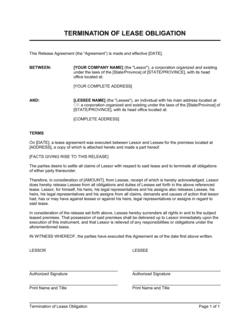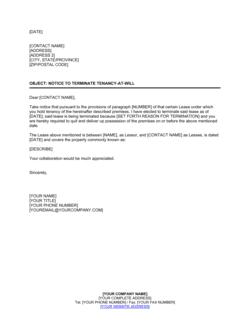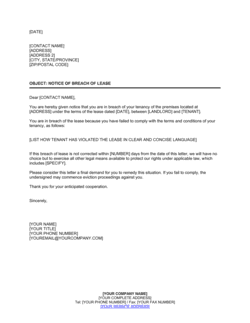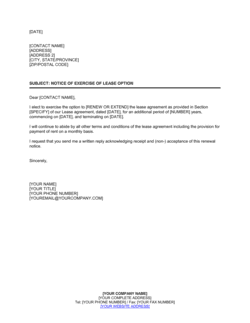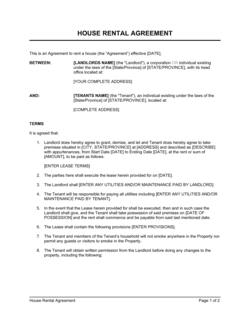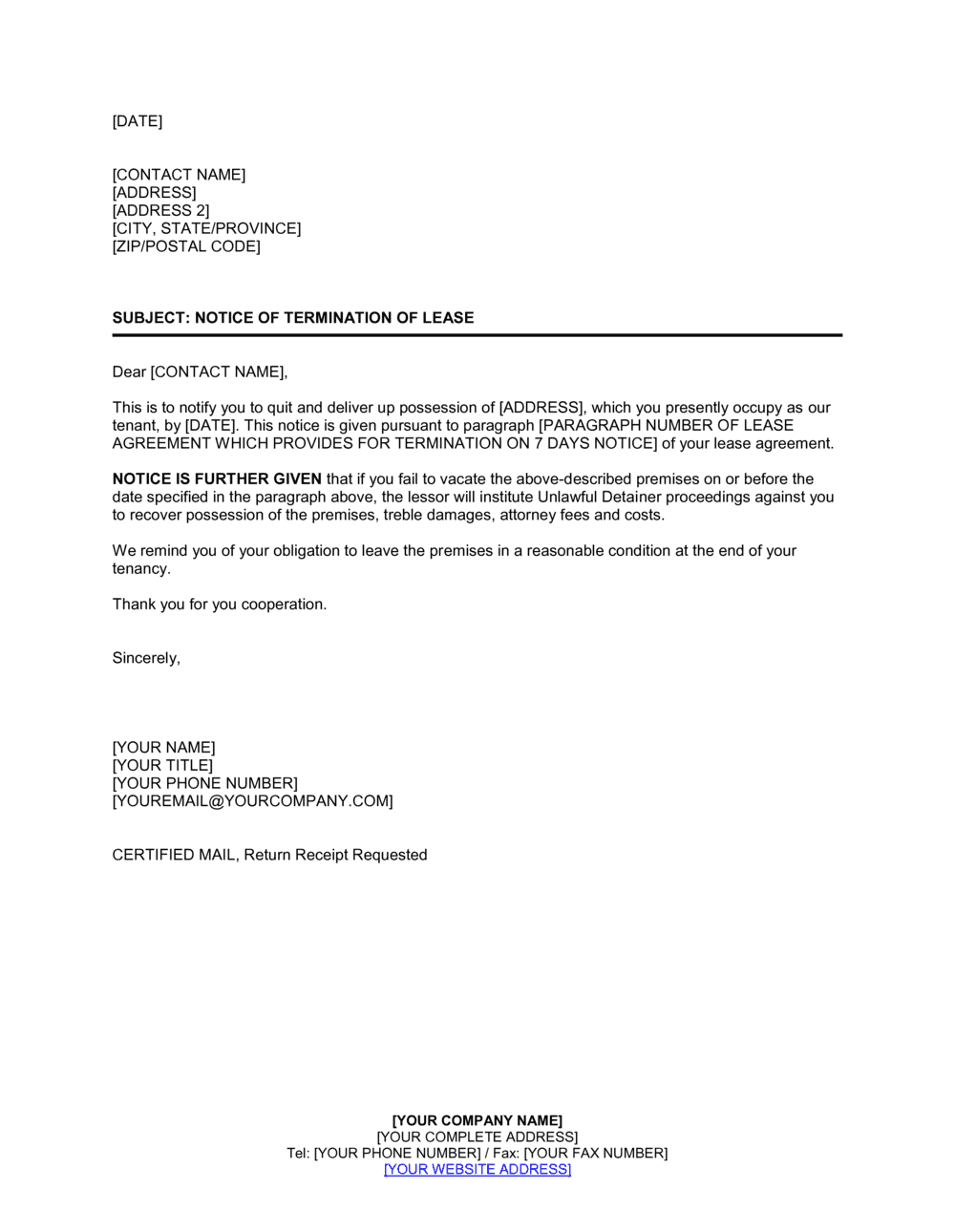
Landlord Notice of Termination of Lease Template

Free Word download β€’ Edit online β€’ Save & share with Drive β€’ Export to PDF

1 pageβ€’15–25 min to fillβ€’Difficulty: Standard
Learn more ↓
FreeLandlord Notice of Termination of Lease Template

At a glance

What it is
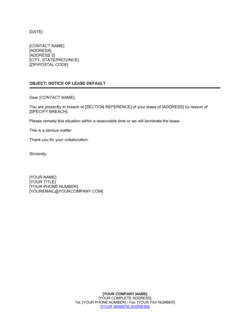
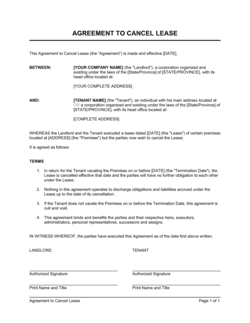
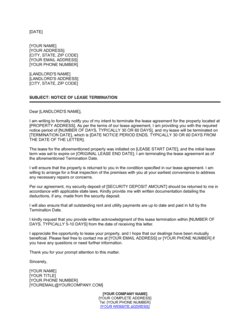
A Landlord Notice of Termination of Lease is a formal written notice a landlord delivers to a tenant to end a rental agreement. This free Word download lets you fill in the property address, the legal basis for termination, the effective date, and move-out requirements β€” then print or email it to the tenant within minutes.
When you need it
Use it when a fixed-term lease reaches its end date, when the required notice period for a month-to-month tenancy has been triggered, or when the tenant has breached the lease and you need a documented record of the termination demand.
What's inside
Party and property identification, reference to the underlying lease, stated basis for termination, effective termination date, move-out instructions, security deposit return timeline, and landlord contact details for key handover.

What is a Landlord Notice of Termination of Lease?

A Landlord Notice of Termination of Lease is a formal written communication a property owner or manager delivers to a tenant to end a rental agreement on a specified date. It references the original lease by execution date, states the legal basis for termination β€” whether that is the natural expiry of a fixed term, the conclusion of a required notice period for a periodic tenancy, or a tenant breach β€” and sets out the effective date by which the tenant must vacate and return possession of the property. Unlike a casual email or verbal conversation, a properly drafted termination notice creates a documented paper trail that is legally required in most jurisdictions and essential if the matter escalates to eviction proceedings.

Why You Need This Document

Ending a tenancy without a properly written and served notice exposes a landlord to costly delays. In most jurisdictions, a landlord cannot file for eviction until a valid termination notice has been served and the notice period has fully elapsed β€” meaning every week spent on an informal or defective notice is a week added to the total timeline. A notice that omits the statutory basis, uses the wrong notice period, or is served by an unaccepted method is void on its face, forcing the landlord to start over while the tenant remains in the unit. Beyond legal compliance, a written notice with clear move-out instructions, security deposit language, and outstanding rent provisions dramatically reduces post-tenancy disputes over condition, deposit deductions, and final charges. This template gives you a ready-to-complete notice that covers every required component β€” so you can serve it correctly the first time.

Which variant fits your situation?

If your situation is…Use this template
Ending a fixed-term lease at its natural expiry dateLandlord Notice of Termination of Lease
Terminating a month-to-month tenancy with required noticeMonth-to-Month Lease Termination Notice
Tenant has not paid rent and you need to demand payment or vacateNotice to Pay Rent or Quit
Tenant has breached a lease term other than non-paymentNotice to Cure or Quit
Tenant wishes to end the lease early on their own initiativeTenant Notice of Termination of Lease
Both parties agree to end the lease before the expiry dateLease Termination Agreement
Notifying a commercial tenant of non-renewal at end of termCommercial Lease Non-Renewal Notice

Common mistakes to avoid

❌ Setting an effective date shorter than the statutory minimum

Why it matters: A notice with an insufficient notice period is void on its face. The landlord must re-serve a corrected notice and restart the notice clock, extending the process by weeks.

Fix: Look up the minimum notice period for the termination reason in the specific jurisdiction before entering any date, then add delivery time on top.
❌ Using informal language or an email instead of a formal written notice

Why it matters: A text message or informal email rarely satisfies the 'written notice' requirement under residential tenancy statutes and cannot be used as evidence in an eviction proceeding.

Fix: Use a formal notice document, sign it, and serve it by a method the jurisdiction accepts β€” personal delivery or certified mail β€” with proof of service retained.

❌ Stating a vague or incomplete basis for termination

Why it matters: Notices citing 'lease violations' without specifics are routinely challenged, leaving the landlord to start over with a corrected notice while the tenancy and costs continue.

Fix: State the exact ground: lease expiry date, elapsed notice period, or a specific breach with dates and details. Quote the relevant lease clause number if applicable.

❌ Sending the notice before verifying local cure period requirements

Why it matters: Many jurisdictions require landlords to give tenants a written opportunity to cure a breach before issuing a termination notice. Skipping this step can render the termination invalid.

Fix: For breach-based terminations, issue a notice to cure first. Only serve the termination notice if the cure period expires without the tenant remedying the breach.

The 9 key clauses, explained

Parties and property identification

In plain language: Names the landlord and tenant as they appear in the original lease and states the full civic address of the rental unit or property being vacated.

Sample language
This Notice of Termination of Lease is issued by [LANDLORD FULL NAME / COMPANY NAME] ('Landlord') to [TENANT FULL NAME(S)] ('Tenant') regarding the residential premises located at [PROPERTY ADDRESS], [CITY], [STATE/PROVINCE] [ZIP/POSTAL CODE].

Common mistake: Using a nickname or informal business name instead of the exact legal name on the lease β€” a mismatch can invalidate service of the notice in some jurisdictions.

Reference to the underlying lease

In plain language: Cites the original lease agreement by its execution date so the notice is unambiguously tied to the specific contract being terminated.

Sample language
This notice relates to the Lease Agreement executed on [LEASE DATE] between Landlord and Tenant ('Lease').

Common mistake: Omitting the lease date entirely, which leaves room for a tenant to argue the notice applies to a different or amended agreement.

Basis for termination

In plain language: States the legal reason for ending the tenancy β€” end of fixed term, expiry of notice period, or a specific breach β€” so the basis is documented in writing.

Sample language
Landlord hereby terminates the Lease on the grounds that: [select one β€” (a) the Lease term expires on [DATE]; (b) the required [X]-day notice period has elapsed; (c) Tenant has materially breached the Lease by [DESCRIBE BREACH]].

Common mistake: Citing a vague reason like 'lease issues' instead of a specific ground. Vague notices are routinely challenged, and the landlord must re-serve a corrected notice β€” restarting the notice clock.

Effective termination date

In plain language: States the exact calendar date on which the tenancy ends and the tenant must have fully vacated and returned keys.

Sample language
The tenancy shall terminate, and Tenant must vacate the Premises no later than [TERMINATION DATE] ('Effective Date').

Common mistake: Setting an effective date that is fewer days away than the statutory minimum notice period for the jurisdiction β€” the notice is legally void and must be reissued.

Move-out instructions

In plain language: Specifies what the tenant must do before vacating: clean the unit, remove all belongings, patch nail holes or other minor damage, and return all keys and access devices.

Sample language
On or before the Effective Date, Tenant shall: (a) remove all personal belongings from the Premises; (b) return all keys, fobs, and parking passes to Landlord at [ADDRESS / CONTACT]; and (c) leave the Premises in the same condition as at move-in, reasonable wear and tear excepted.

Common mistake: Skipping move-out instructions entirely, leaving disputes about condition and key return to be resolved verbally β€” making it harder to justify security deposit deductions later.

Security deposit return timeline

In plain language: Reminds the tenant when and how the security deposit will be returned, and that deductions will be itemized in writing as required by local law.

Sample language
Landlord will return the security deposit of $[AMOUNT], less any deductions for unpaid rent or damages beyond normal wear and tear, within [X] days of the Effective Date as required by applicable law. An itemized statement will accompany any deduction.

Common mistake: Promising a specific dollar refund before the move-out inspection is complete β€” this waives the right to claim deductions for damage discovered at handover.

Outstanding rent and charges

In plain language: Notes that all rent and other charges due under the lease through the effective date remain payable and are not waived by the termination notice.

Sample language
This Notice does not waive any amounts owed by Tenant under the Lease. All rent and charges accrued through the Effective Date remain due and payable in full.

Common mistake: Issuing a termination notice without this clause, which some tenants interpret as a rent forgiveness for the final period.

Consequences of failure to vacate

In plain language: Advises the tenant that remaining in the property after the effective date will result in legal action for possession and may expose them to holdover penalties.

Sample language
If Tenant fails to vacate the Premises by the Effective Date, Landlord will pursue all legal remedies available, including an unlawful detainer / eviction action, and Tenant may be liable for holdover rent at [X]% of the monthly rate.

Common mistake: Omitting this clause and instead contacting the tenant informally after the date passes β€” informal follow-up delays formal proceedings and extends the holdover period unnecessarily.

Landlord contact and signature block

In plain language: Provides the landlord's name, mailing address, phone number, and email for questions about the notice, key return, and deposit, followed by the landlord's signature and date.

Sample language
Questions regarding this Notice should be directed to: [LANDLORD NAME], [ADDRESS], [PHONE], [EMAIL]. Signed: _________________________ [LANDLORD NAME], Date: [DATE].

Common mistake: Sending an unsigned notice β€” tenants and their lawyers routinely challenge unsigned notices as informal communications rather than legal instruments.

How to fill it out

  1. 1

    Confirm the required notice period for your jurisdiction

    Before filling in any dates, look up the statutory minimum notice period for your state, province, or municipality. Most jurisdictions require 30 days for month-to-month tenancies; some require 60 or 90 days depending on tenancy length or termination reason.

    πŸ’‘ Check your original lease β€” it may set a longer notice period than the statutory minimum, and the longer of the two applies.

  2. 2

    Enter full legal names and the property address

    Use the landlord's and tenant's names exactly as they appear on the signed lease. Enter the complete civic address of the rental unit, including unit number if applicable.

    πŸ’‘ If the property is held by an LLC or corporation, use the entity's legal name as landlord β€” not the individual owner's personal name.

  3. 3

    Reference the lease by its execution date

    Enter the date the original lease was signed in the reference clause. If the lease was amended or renewed, reference the most recent agreement date.

    πŸ’‘ Attach a copy of the lease cover page to the notice to eliminate any dispute about which agreement is being terminated.

  4. 4

    Select and complete the basis for termination

    Choose the correct ground: end of fixed term, expiry of notice period, or tenant breach. For breach, describe the specific violation β€” non-payment of rent since [DATE], unauthorized pet, unauthorized subletting β€” with enough detail to be unambiguous.

    πŸ’‘ If the termination is for breach, check whether your jurisdiction requires a cure period notice (notice to cure or quit) before you can issue a full termination.

  5. 5

    Calculate and enter the effective termination date

    Count forward from today by the required notice period and enter the resulting calendar date. Confirm the date lands on a business day if your jurisdiction requires it.

    πŸ’‘ Add two to three days to account for postal delivery if you are serving by mail β€” most jurisdictions add three to five days to the notice clock for mailed service.

  6. 6

    Complete the move-out and security deposit sections

    Fill in the deposit amount, your local statutory return period (typically 14 to 30 days), and the address where keys should be returned. Add any property-specific move-out requirements such as professional cleaning or carpet shampooing if stated in the lease.

    πŸ’‘ Do not promise a specific deposit refund amount here β€” you have not yet inspected the unit.

  7. 7

    Sign, date, and serve the notice using an accepted method

    Sign and date the notice, then deliver it by a method your jurisdiction recognizes β€” personal delivery, certified mail with return receipt, or posting on the door plus mailing, depending on local rules. Keep proof of service on file.

    πŸ’‘ Send a photo of the posted notice and a scan of the certified mail receipt to your own email immediately after service β€” this creates a timestamped record.

Frequently asked questions

What is a landlord notice of termination of lease?

A landlord notice of termination of lease is a formal written document a property owner or manager delivers to a tenant to end a rental agreement on a specified date. It identifies the parties, references the underlying lease, states the legal basis for termination, sets the effective date, and outlines what the tenant must do before vacating. It creates a documented record that is essential if eviction proceedings become necessary.

How much notice does a landlord have to give to terminate a lease?

The required notice period depends on jurisdiction, lease type, and the reason for termination. In most US states, 30 days is the minimum for month-to-month tenancies; California requires 60 days for tenants who have lived there more than one year. Canadian provinces typically require 60 days for residential tenancies. Fixed-term leases often require notice before the end date to prevent automatic renewal. Always check local statute and the lease itself β€” the longer of the two applies.

Does a landlord need a reason to terminate a lease?

For month-to-month or periodic tenancies, most US states allow no-fault termination with proper notice. However, many cities and states β€” including California, Oregon, Washington, and New York β€” have "just cause" eviction laws requiring a specific reason even for no-fault terminations. In Canada and the UK, landlords generally need a recognized ground for termination. Always verify local rules before issuing a no-fault notice.

Can a landlord terminate a lease before it expires?

A landlord can typically terminate a fixed-term lease early only if the tenant has materially breached the lease β€” for example, by failing to pay rent, causing significant damage, or engaging in illegal activity. Ending a fixed-term lease without cause before the expiry date generally exposes the landlord to liability for the tenant's losses. Some leases include an early termination clause allowing either party to exit with notice and a fee.

What happens if the tenant does not vacate after receiving the notice?

If the tenant remains in the property after the effective termination date, the tenancy becomes a holdover tenancy. The landlord's next step is typically to file an unlawful detainer or eviction action in local court. The landlord cannot physically remove the tenant or their belongings, change the locks, or shut off utilities without a court order β€” doing so constitutes an illegal "self-help" eviction and exposes the landlord to significant liability.

How should a landlord serve a termination notice?

Accepted service methods vary by jurisdiction but typically include personal delivery to the tenant, certified mail with return receipt requested, or posting on the front door plus mailing a copy. Some jurisdictions allow email if the tenant has agreed to electronic service in the lease. Always retain proof of service β€” a signed acknowledgment, certified mail receipt, or photo β€” because it will be required if eviction proceedings are filed.

Does a landlord notice of termination need to be signed?

Yes. An unsigned notice is routinely challenged as an informal communication rather than a legal instrument. The landlord or their authorized property manager should sign and date the notice before service. If the property is owned by an entity such as an LLC, the signatory should include their title to confirm they are authorized to act on behalf of the owner.

What is the difference between a notice to vacate and a notice of termination of lease?

The terms are often used interchangeably, but a notice of termination of lease formally ends the contractual tenancy, while a notice to vacate may refer more narrowly to the demand that the tenant physically leave the premises. In practice, a well-drafted landlord termination notice accomplishes both β€” it terminates the lease agreement and directs the tenant to vacate by the effective date.

How this compares to alternatives

vs Tenant Notice of Termination of Lease

A tenant notice is issued by the renter to the landlord to end the tenancy voluntarily. A landlord notice is issued by the property owner to the tenant. The required notice periods, grounds, and legal consequences differ β€” tenants generally have fewer restrictions on voluntary departure, while landlords must meet jurisdiction-specific grounds and notice requirements.

vs Lease Termination Agreement

A lease termination agreement is a mutual, signed document where both landlord and tenant agree to end the lease early on negotiated terms β€” including move-out date, deposit return, and any compensation. A landlord notice of termination is a unilateral action. Use the agreement when both parties consent; use this notice when only the landlord is initiating the end of tenancy.

vs Eviction Notice

An eviction notice is typically a court-process document or a pay-or-quit demand used after a breach or non-payment of rent, often with a short cure window of 3 to 14 days. A termination notice ends the tenancy formally with the full statutory notice period and is used whether or not there is a breach. An eviction notice is often the step that follows an ignored termination notice.

vs Lease Renewal Agreement

A lease renewal agreement extends the tenancy on new or updated terms. A termination notice does the opposite β€” it formally ends the tenancy on a specific date. Landlords often send a termination notice and a renewal offer simultaneously to give the tenant the option to either vacate or re-sign.

Industry-specific considerations

Residential property management

High volume of notices across a portfolio means a standardized template with consistent statutory language reduces legal exposure and processing time per unit.

Commercial real estate

Commercial leases often have longer notice periods (60–180 days), specific reinstatement obligations, and restoration clauses that must be referenced in the termination notice.

Short-term and vacation rentals

Longer-term vacation rental guests who overstay may transition into tenancy in some jurisdictions, requiring a formal termination notice before removal.

Real estate investment

Investors acquiring tenanted properties often need to issue termination notices to prepare units for sale or renovation, coordinating notice timing with closing dates.

Template vs pro β€” what fits your needs?

PathBest forCostTime
Use the templateIndividual landlords and property managers handling standard residential or commercial lease endingsFree10–15 minutes
Template + professional reviewLandlords in heavily regulated cities with just-cause eviction laws or tenants likely to dispute the notice$150–$400 for a one-hour lawyer review1–2 days
Custom draftedComplex commercial lease terminations, high-value properties, or notices that will immediately precede litigation$500–$1,500+3–7 days

Glossary

Notice Period
The minimum number of days or months a landlord must give a tenant before a termination takes effect, as set by the lease or local law.
Effective Date
The specific calendar date on which the lease ends and the tenant is required to vacate the property.
Cure Period
A window of time β€” typically 3 to 30 days β€” given to a tenant to fix a lease violation before termination proceeds.
Holdover Tenancy
A situation where a tenant remains in the unit after the lease has expired without executing a new agreement, often converting the tenancy to month-to-month.
Security Deposit
Funds collected from the tenant at the start of the lease, held by the landlord, and returned minus documented deductions within the period required by local law.
Unlawful Detainer
A legal action a landlord may file to remove a tenant who remains in the property after a valid termination notice has expired.
Quiet Enjoyment
The tenant's right to use the property without interference from the landlord β€” relevant because a landlord cannot harass a tenant as a substitute for proper notice.
Material Breach
A significant violation of lease terms β€” such as unauthorized subletting, property damage, or illegal activity β€” that may justify immediate or shortened notice.
Proof of Service
Documentation showing that a notice was delivered to the tenant through a legally accepted method, such as personal delivery, certified mail, or posting.

Part of your Business Operating System

This document is one of 3,000+ business & legal templates included in Business in a Box.

  • Fill-in-the-blanks β€” ready in minutes
  • 100% customizable Word document
  • Compatible with all office suites
  • Export to PDF and share electronically

Create your document in 3 simple steps.

From template to signed document β€” all inside one Business Operating System.
1
Download or open template

Access over 3,000+ business and legal templates for any business task, project or initiative.

2
Edit and fill in the blanks with AI

Customize your ready-made business document template and save it in the cloud.

3
Save, Share, Send, Sign

Share your files and folders with your team. Create a space of seamless collaboration.

Save time, save money, and create top-quality documents.

β˜…β˜…β˜…β˜…β˜…

"Fantastic value! I'm not sure how I'd do without it. It's worth its weight in gold and paid back for itself many times."

Managing Director Β· Mall Farm
Robert Whalley
Managing Director, Mall Farm Proprietary Limited
β˜…β˜…β˜…β˜…β˜…

"I have been using Business in a Box for years. It has been the most useful source of templates I have encountered. I recommend it to anyone."

Business Owner Β· 4+ years
Dr Michael John Freestone
Business Owner
β˜…β˜…β˜…β˜…β˜…

"It has been a life saver so many times I have lost count. Business in a Box has saved me so much time and as you know, time is money."

Owner Β· Upstate Web
David G. Moore Jr.
Owner, Upstate Web

Run your business with a system β€” not scattered tools

Stop downloading documents. Start operating with clarity. Business in a Box gives you the Business Operating System used by over 250,000 companies worldwide to structure, run, and grow their business.

Free Forever PlanΒ Β·Β No credit card required