No-Fault Attendance Policy Template

Free Word download β€’ Edit online β€’ Save & share with Drive β€’ Export to PDF

3 pagesβ€’20–25 min to fillβ€’Difficulty: Standard
Learn more ↓
FreeNo-Fault Attendance Policy Template

At a glance

What it is
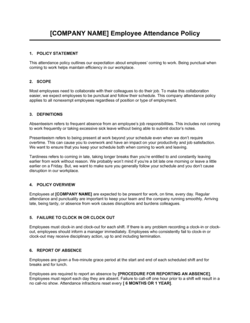
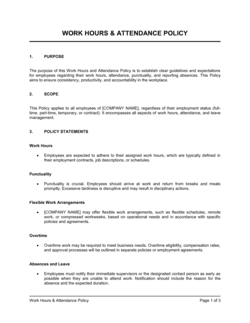
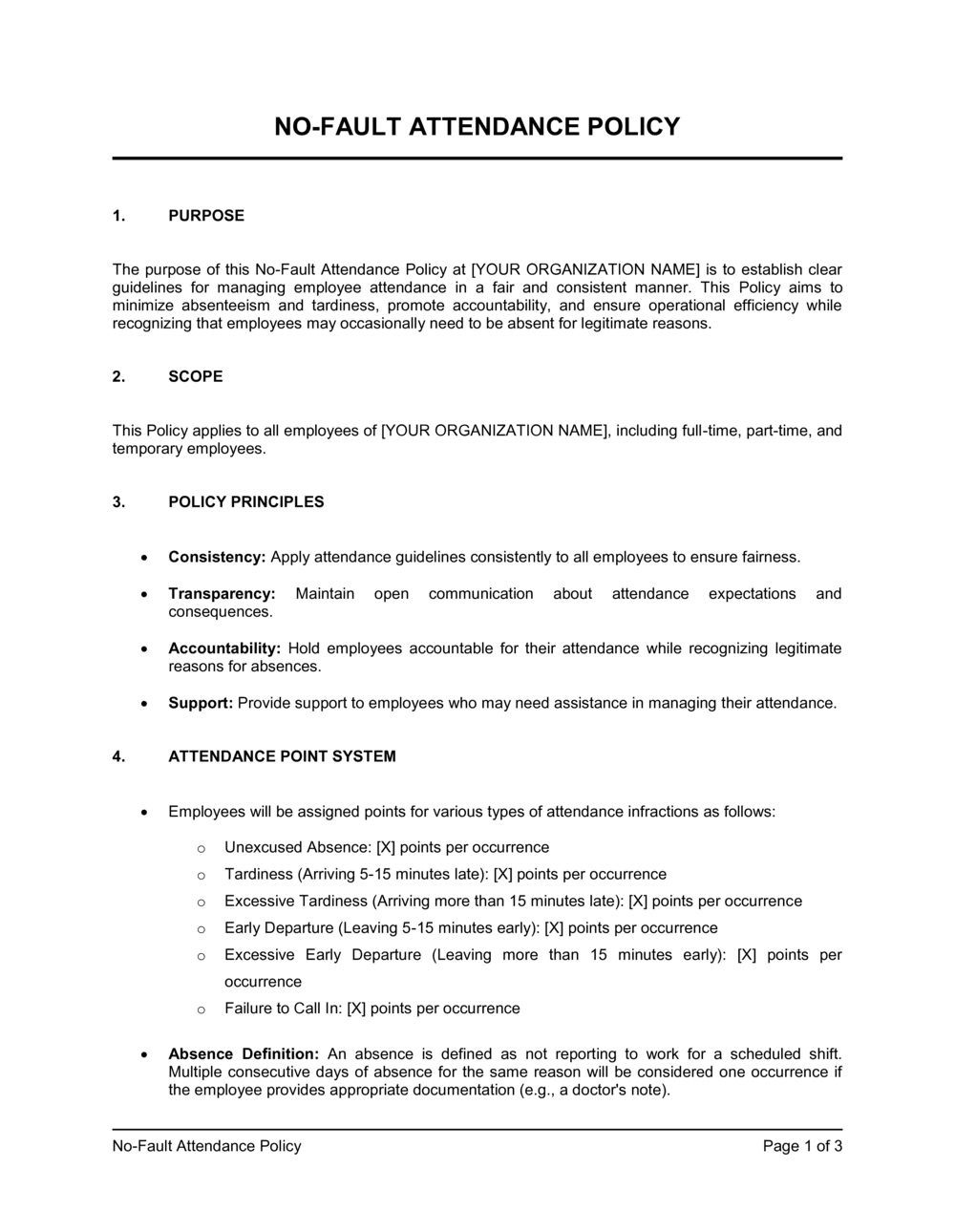
A No Fault Attendance Policy is a formal workplace document that tracks employee absences and tardiness using a point-based system, without assigning blame for the reason behind each occurrence. Each unplanned absence or late arrival accumulates a set number of points, and progressive discipline is triggered automatically when an employee reaches defined thresholds. This free Word download gives you a ready-to-edit policy you can tailor to your workforce and export as PDF for distribution and acknowledgment.
When you need it
Use it when absenteeism is affecting productivity, when managers are inconsistently applying attendance rules, or when you need a documented, defensible process before disciplining or terminating an employee for attendance-related issues.
What's inside
A purpose statement, scope, point accumulation table, absence and tardiness definitions, protected leave exemptions, progressive discipline schedule, reset provisions, and an employee acknowledgment section.

What is a No Fault Attendance Policy?

A No Fault Attendance Policy is a formal workplace document that tracks employee absences and late arrivals using a predetermined point system, assigning a fixed number of points to each occurrence regardless of the reason given. When an employee's accumulated points reach defined thresholds, progressive discipline steps β€” verbal warning, written warning, suspension, or termination β€” are triggered automatically. The "no fault" designation does not mean absences go unpunished; it means the reason for the absence is not factored into whether a point is recorded, only into whether the absence qualifies for a protected leave exemption. This removes managerial subjectivity from day-to-day attendance decisions and creates a consistent, auditable record that supports every disciplinary action taken under the policy.

Why You Need This Document

Without a written attendance policy, managers apply their own standards β€” one supervisor logs every tardy, another ignores all but the most egregious absences β€” and employees in the same role face different consequences for the same behavior. That inconsistency is one of the most common triggers for disparate-treatment complaints and wrongful-termination claims. A documented no fault system closes that gap: every occurrence is logged the same way, every threshold triggers the same response, and every termination decision rests on a paper trail that can be produced in a hearing. For industries where a single absent employee disrupts an entire shift β€” manufacturing, healthcare, retail β€” the financial cost of unmanaged absenteeism accumulates fast. A clear, pre-communicated policy changes employee behavior before the costs compound, and gives HR the defensible foundation needed to act when it does not.

Which variant fits your situation?

If your situation is…Use this template
Hourly workforce with shift-coverage requirementsNo Fault Attendance Policy (Hourly)
Salaried office or hybrid workforceEmployee Attendance and Punctuality Policy
Workforce where FMLA or ADA leave is a frequent considerationNo Fault Attendance Policy with Protected Leave Addendum
Remote or distributed team with flexible schedulingRemote Work Attendance and Availability Policy
Construction or field service crewsJobsite Attendance and Reporting Policy
Union-represented workforce subject to a collective agreementAttendance Policy (Unionized Workforce)
Healthcare or emergency-services staff with mandatory coverageHealthcare Attendance and Call-Out Policy

Common mistakes to avoid

❌ Assigning points to protected leave absences

Why it matters: Applying points to FMLA, ADA, or workers' compensation absences exposes the company to federal interference and retaliation claims, regardless of intent. Courts have awarded back pay and damages in cases where point systems failed to carve out protected leave.

Fix: Add an explicit protected leave exemption section to the policy and train supervisors to flag qualifying absences for HR review before logging a point.

❌ No documentation trail for individual occurrences

Why it matters: An attendance-based termination with no written occurrence log is nearly indefensible. Without dates, times, and supervisor signatures for each event, the employee can dispute the point total and the company has nothing to produce in a hearing.

Fix: Require supervisors to log every occurrence in the HRIS within 24 hours, with a manager note confirming the absence was unplanned and not protected.

❌ Setting discipline thresholds too high for the policy to change behavior

Why it matters: If termination is only triggered at 15 or 20 points and absences earn 1 point each, a chronically absent employee can miss work 15 times over 12 months before any real consequence arrives β€” undermining the policy's deterrent effect.

Fix: Calibrate thresholds to your actual absenteeism baseline. A first written warning at 4–6 points over a rolling 12 months is the most common effective range for hourly environments.

❌ Applying the policy inconsistently across departments

Why it matters: If one manager logs every tardy and another ignores them, employees in the strict department can file disparate-treatment complaints. Inconsistency is one of the most common reasons attendance-based terminations are overturned.

Fix: Designate HR as the final point-logging authority, not individual supervisors. Supervisors report the occurrence; HR validates it and enters it into the system.

❌ Omitting the at-will disclaimer from the acknowledgment form

Why it matters: A signed policy document that describes a step-by-step process before termination can be interpreted by employees β€” and some courts β€” as an implied promise that they will not be fired except by following those exact steps.

Fix: Include a clear statement on the acknowledgment form that the policy does not constitute a contract of employment and does not alter the employee's at-will status.

❌ Never updating the policy after initial rollout

Why it matters: Protected leave laws change frequently at the state and local level. A policy written in 2020 may now fail to exempt leave categories that have since been added by statute, creating automatic liability.

Fix: Review the policy at least annually and after any significant change to federal, state, or local leave laws in your operating jurisdictions. Document each review with a version date.

The 9 key sections, explained

Purpose and scope

Definitions

Point accumulation table

Progressive discipline schedule

Protected leave exemptions

Call-out and notification procedure

Point reset and good-attendance provisions

Documentation and recordkeeping

Employee acknowledgment

How to fill it out

  1. 1

    Define the scope and covered employee groups

    Identify which employee classifications the policy covers β€” hourly non-exempt, part-time, seasonal, or all staff. If you have both hourly and salaried employees, note that salaried staff follow a separate process.

    πŸ’‘ Restricting the policy to non-exempt hourly employees first lets you pilot the system before rolling it out company-wide.

  2. 2

    Set point values for each occurrence type

    Fill in the point accumulation table with values that reflect the relative severity of each event. A no call/no show should carry at least twice the points of a standard absence.

    πŸ’‘ A common starting point: 1 point for an absence, 0.5 for a tardy, and 2 for a no call/no show. Adjust up or down based on your industry's tolerance for coverage gaps.

  3. 3

    Establish discipline thresholds

    Enter the point totals that trigger each disciplinary step. Space them evenly so employees receive multiple warnings before termination, and so the first warning arrives early enough to prompt a behavioral change.

    πŸ’‘ Map your thresholds against your actual absenteeism data before finalizing. If your average employee already has 4 points, a first-warning threshold of 3 will immediately put most of your workforce in discipline.

  4. 4

    List all protected leave exemptions

    Review applicable federal and state/provincial laws and list every protected leave category that must be excluded from point accumulation. Reference your FMLA, ADA, and state leave policies by name.

    πŸ’‘ Have your HR or legal team confirm the exemption list matches current law in every state or province where you have employees β€” protected leave categories vary by jurisdiction.

  5. 5

    Write the call-out procedure

    Specify the notification method (phone call), the advance notice window (e.g., 60 minutes before shift start), the person to contact (direct supervisor, then backup), and the consequence for skipping the step.

    πŸ’‘ Name a specific backup contact for situations where the direct supervisor is unreachable. A policy that says 'call your supervisor' with no backup creates an excuse for a missed notification.

  6. 6

    Configure the point reset rules

    Enter the consecutive-months threshold and the number of points removed or zeroed at each reset milestone. Confirm the reset period is long enough to deter gaming.

    πŸ’‘ A 12-month rolling window for full resets is the industry standard for most hourly environments. Six months is appropriate only for roles with very low absence tolerance.

  7. 7

    Distribute and collect signed acknowledgments

    Send the policy to all covered employees and collect a signed acknowledgment form from each one. Store signed copies in personnel files for the duration of employment plus the applicable records-retention period.

    πŸ’‘ Use an electronic signature or HRIS acknowledgment workflow to automate collection and create a timestamp β€” paper forms get lost and undated signatures are hard to rely on in disputes.

  8. 8

    Train supervisors before rollout

    Walk supervisors through the point table, logging procedure, and discipline schedule before the effective date. Inconsistent application by one manager can expose the company to disparate-treatment claims even if the written policy is sound.

    πŸ’‘ Run one 30-minute walkthrough session with all supervisors and document attendance. That training log becomes part of your defense if a discipline decision is later challenged.

Frequently asked questions

What is a no fault attendance policy?

A no fault attendance policy is a workplace rule that assigns a fixed number of points to each unplanned absence or late arrival, regardless of the reason the employee gives. Progressive discipline is triggered automatically when points reach defined thresholds. The system removes managerial subjectivity from attendance tracking, making it easier to apply rules consistently and document decisions for HR and legal purposes.

What is a typical point value for different types of absences?

The most common structure assigns 1 point for a full or partial unplanned absence, 0.5 points for a tardy of up to 30 minutes, 1 point for a tardy longer than 30 minutes, and 2 points for a no call/no show. These values are not legally mandated and can be adjusted to reflect your industry's coverage requirements β€” some manufacturing and healthcare environments use higher point values to reflect the operational cost of a single absence.

What absences must be exempt from a no fault attendance policy?

At minimum, the following must be exempt: FMLA-qualifying leave, ADA reasonable accommodations, workers' compensation absences, military leave under USERRA, and jury duty. Many states and provinces add additional protected categories β€” paid sick leave, domestic violence leave, school activity leave, and bereavement leave are common examples. Always review state and local law for the jurisdictions where your employees work.

How does the point reset provision work?

A point reset provision reduces or zeroes an employee's accumulated points after a defined period of good attendance β€” typically 6 or 12 consecutive months without a new occurrence. For example, an employee with 4 points who goes 12 months without a new absence would return to 0, allowing them to start fresh. The reset period should be long enough to prevent employees from gaming the system by spacing absences just beyond the reset window.

Can a no fault attendance policy be used to terminate an employee?

Yes, provided the policy was communicated in writing before the absences occurred, each occurrence was documented consistently, progressive discipline steps were followed, and no protected leave absences were included in the point total. Attendance-based terminations are among the most defensible when the policy has a clear paper trail and has been applied equally across all employees in the same classification.

Do I need to get employees to sign the attendance policy?

Having employees sign an acknowledgment form is strongly recommended, though not universally required by law. A signed acknowledgment proves the employee received and understood the policy before any disciplinary action was taken β€” a critical defense element if a termination is later challenged. Include an at-will disclaimer on the acknowledgment to avoid any implied-contract interpretation.

How often should a no fault attendance policy be reviewed?

Review the policy at least once per year and after any significant change to federal, state, or local leave laws in your operating locations. Protected leave categories have expanded significantly in many states over the past five years. Each review should be documented with a version date, and updated copies should be redistributed to all covered employees with a new acknowledgment signature.

What is the difference between a no fault attendance policy and a traditional attendance policy?

A traditional attendance policy gives managers discretion to evaluate the reason for each absence and decide whether discipline is warranted. A no fault policy removes that discretion β€” points are logged automatically based on the type of event, not the explanation. No fault systems reduce favoritism and inconsistency, create a cleaner documentation trail, and make discipline decisions easier to defend β€” but they require more rigorous protected-leave tracking to avoid legal exposure.

How this compares to alternatives

vs Traditional Attendance Policy

A traditional attendance policy gives managers discretion to weigh the reason for each absence before deciding on discipline. A no fault policy assigns points automatically, removing that discretion. No fault systems are more consistent and easier to defend but require stricter protected-leave exemption tracking to avoid legal exposure.

vs Employee Disciplinary Action Form

A disciplinary action form documents a single specific incident of misconduct or policy violation. A no fault attendance policy is the governing rule that determines when disciplinary action is required and what form it takes. The policy drives the process; the form captures the output at each threshold.

vs Employee Handbook

An employee handbook is a comprehensive document covering all workplace policies. A no fault attendance policy is a standalone document that provides enough operational detail β€” point tables, thresholds, reset rules, exemptions β€” to be used independently by supervisors and HR. The standalone version is easier to update without reissuing the full handbook.

vs Remote Work Attendance Policy

A remote work attendance policy governs availability, response times, and virtual check-in requirements for distributed employees. A no fault attendance policy is designed for shift-based or scheduled on-site work where physical presence at a defined time is the measurable standard. Hybrid workforces may need both.

Industry-specific considerations

Manufacturing

A single unplanned absence on a production line can halt output for an entire shift, making point-based systems with strict thresholds and fast escalation the standard approach.

Retail and hospitality

High-volume hourly workforces with predictable shift schedules benefit from no fault systems that hold all employees to the same standard regardless of role or seniority.

Healthcare

Mandatory staffing ratios mean a single call-out triggers costly agency fill-ins; healthcare employers often use higher point values for no call/no show events and shorter reset windows.

Professional services

Less common for salaried staff but widely used for support and administrative hourly roles where client-facing coverage requirements make attendance predictability critical.

Template vs pro β€” what fits your needs?

PathBest forCostTime
Use the templateHR managers and small business owners implementing a standard point-based attendance system for an hourly workforceFree1–2 hours to customize and distribute
Template + professional reviewEmployers with staff in multiple states or provinces where protected leave laws vary significantly$200–$500 for an HR consultant or employment attorney review2–5 business days
Custom draftedUnionized workforces, healthcare employers with mandatory staffing ratios, or companies with recent FMLA or ADA litigation history$800–$2,500+1–3 weeks

Glossary

No Fault System
An attendance tracking method that assigns points for each absence or tardiness occurrence regardless of the reason given, removing managerial discretion from the initial recording.
Occurrence
A single unplanned absence or late-arrival event that earns points under the policy, whether it lasts one hour or three days.
Point Threshold
The total number of accumulated points at which a specific disciplinary action β€” verbal warning, written warning, suspension, or termination β€” is triggered.
Progressive Discipline
A structured sequence of increasingly serious consequences applied as an employee continues to violate a policy, documented at each step.
Protected Leave
Absences covered by law β€” such as FMLA, ADA accommodations, workers' compensation, jury duty, or military leave β€” that must be exempted from point accumulation.
Point Reset
A provision that reduces or zeroes an employee's accumulated points after a defined period of good attendance, typically 6 or 12 months.
Call-Out Procedure
The required steps an employee must follow to notify their supervisor before an unplanned absence, including the minimum advance notice window.
Tardy
Arriving at the workplace or clocking in after the scheduled start time, typically defined as any arrival more than a set number of minutes late (e.g., 5 or 7 minutes).
No Call / No Show
An absence where the employee neither appears for their scheduled shift nor notifies the employer within the required call-out window β€” typically assessed at a higher point value than a standard absence.
Rolling 12-Month Period
A tracking window that looks back exactly 12 months from the current date rather than resetting on January 1, preventing employees from timing absences around a calendar reset.

Part of your Business Operating System

This document is one of 3,000+ business & legal templates included in Business in a Box.

  • Fill-in-the-blanks β€” ready in minutes
  • 100% customizable Word document
  • Compatible with all office suites
  • Export to PDF and share electronically

Create your document in 3 simple steps.

From template to signed document β€” all inside one Business Operating System.
1
Download or open template

Access over 3,000+ business and legal templates for any business task, project or initiative.

2
Edit and fill in the blanks with AI

Customize your ready-made business document template and save it in the cloud.

3
Save, Share, Send, Sign

Share your files and folders with your team. Create a space of seamless collaboration.

Save time, save money, and create top-quality documents.

β˜…β˜…β˜…β˜…β˜…

"Fantastic value! I'm not sure how I'd do without it. It's worth its weight in gold and paid back for itself many times."

Managing Director Β· Mall Farm
Robert Whalley
Managing Director, Mall Farm Proprietary Limited
β˜…β˜…β˜…β˜…β˜…

"I have been using Business in a Box for years. It has been the most useful source of templates I have encountered. I recommend it to anyone."

Business Owner Β· 4+ years
Dr Michael John Freestone
Business Owner
β˜…β˜…β˜…β˜…β˜…

"It has been a life saver so many times I have lost count. Business in a Box has saved me so much time and as you know, time is money."

Owner Β· Upstate Web
David G. Moore Jr.
Owner, Upstate Web

Run your business with a system β€” not scattered tools

Stop downloading documents. Start operating with clarity. Business in a Box gives you the Business Operating System used by over 250,000 companies worldwide to structure, run, and grow their business.

Free Forever PlanΒ Β·Β No credit card required