1
Identify both parties accurately
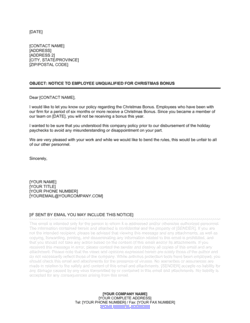
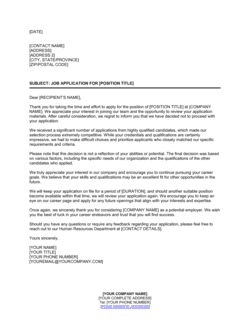
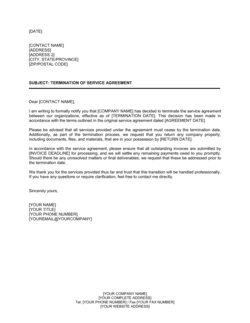
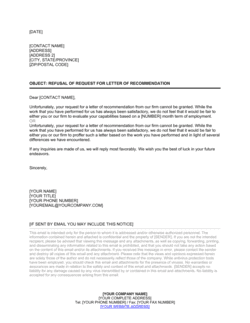
Enter the company's full registered legal name and the recipient's full legal name or entity name. Include the role each party played — for example, 'applicant,' 'vendor,' or 'claimant' — and reference the specific application, engagement, or experience being reviewed.
💡 Cross-check the recipient's name against the original application or agreement to avoid spelling errors that can create ambiguity in dispute proceedings.
2
State the negative decision clearly and unambiguously
Write the decision in direct language — 'Company has determined it will not proceed' — with a specific effective date. Avoid language that suggests the decision is provisional, temporary, or subject to automatic reversal.
💡 If there is any genuine possibility of reconsideration, address it explicitly in the appeal clause — do not bury it in the decision statement.
3
Document the factual basis with specifics and dates
List each observation, performance shortfall, or negative experience event with the date it occurred and the source document (evaluation log, assessment report, site visit record). Attach the underlying record as an exhibit where possible.
💡 Each factual basis item should be verifiable by a third party from your records alone — if you cannot point to a contemporaneous document, the basis is hard to defend.
4
Reference the evaluation criteria or standards
Cite the specific benchmark, job description, service level agreement, or evaluation rubric the recipient was measured against. State the precise requirement they failed to meet.
💡 If your evaluation criteria document does not yet exist in written form, create it before issuing the negative response — post-hoc criteria are a significant legal vulnerability.
5
Include the non-discriminatory basis declaration
Complete the declaration confirming the decision is based solely on documented experience and objective criteria. List the protected characteristics relevant to your jurisdiction in the clause.
💡 For employment-related decisions in the US, include all nine EEOC protected classes. For EU decisions, include the protected grounds under Directive 2000/43/EC and Directive 2000/78/EC.
6
Set appeal rights and deadlines precisely
Decide whether a right of appeal exists and, if so, specify the process, the contact point, the deadline in calendar days, and the grounds on which reconsideration will be considered (e.g., new evidence, procedural error).
💡 A 14-day appeal window is standard for most internal processes; extend to 30 days when the recipient is an organization that may need to consult counsel.
7
Check for regulatory notice obligations
Before finalizing, confirm whether the decision triggers a statutory notice requirement — FCRA adverse action notices for US employment or credit decisions based on consumer reports, ECOA notices for credit denials, or equivalent requirements in your jurisdiction.
💡 In the US, FCRA adverse action notices must include the name of the consumer reporting agency used, the right to request the report, and the right to dispute inaccuracies — failure carries per-violation penalties.
8
Execute, retain, and confirm delivery
Have the authorized signatory sign the document, date it, deliver it to the recipient by a method that creates a delivery record (email with read receipt, certified mail, or courier), and file the signed original with supporting evaluation materials in your records system for the retention period specified.
💡 Send by both email and physical mail for high-stakes decisions — if the recipient later claims non-receipt, you need at least one verifiable delivery record.