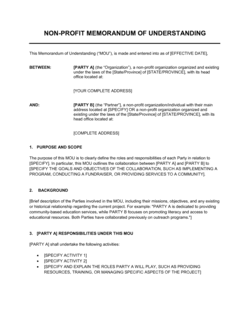
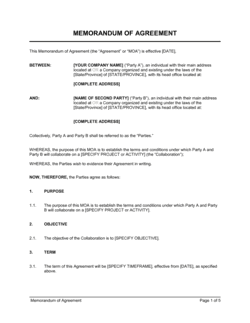
Memorandum of Understanding Template

Free Word download β€’ Edit online β€’ Save & share with Drive β€’ Export to PDF

2 pagesβ€’20–30 min to fillβ€’Difficulty: Standardβ€’Signature requiredβ€’Legal review recommended
Learn more ↓
FreeMemorandum of Understanding Template

At a glance

What it is
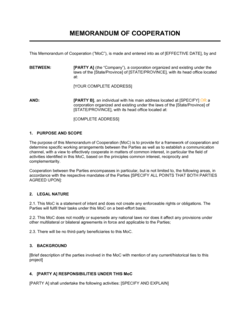
A Memorandum of Understanding (MOU) is a written document that records the mutual intent of two or more parties before they commit to a definitive contract. This free Word download gives you a professionally structured template you can edit online and export as PDF β€” covering purpose, key terms, exclusivity, confidentiality, and the binding status of each clause, so all parties enter negotiations from the same documented baseline.
When you need it
Use it when two parties want to formalize their shared intent to collaborate, partner, or transact before the full legal contract is drafted β€” typically during M&A due diligence, joint venture formation, government partnerships, or major procurement negotiations. It is also commonly used to record grant arrangements and inter-agency agreements where a formal contract would be disproportionate.
What's inside
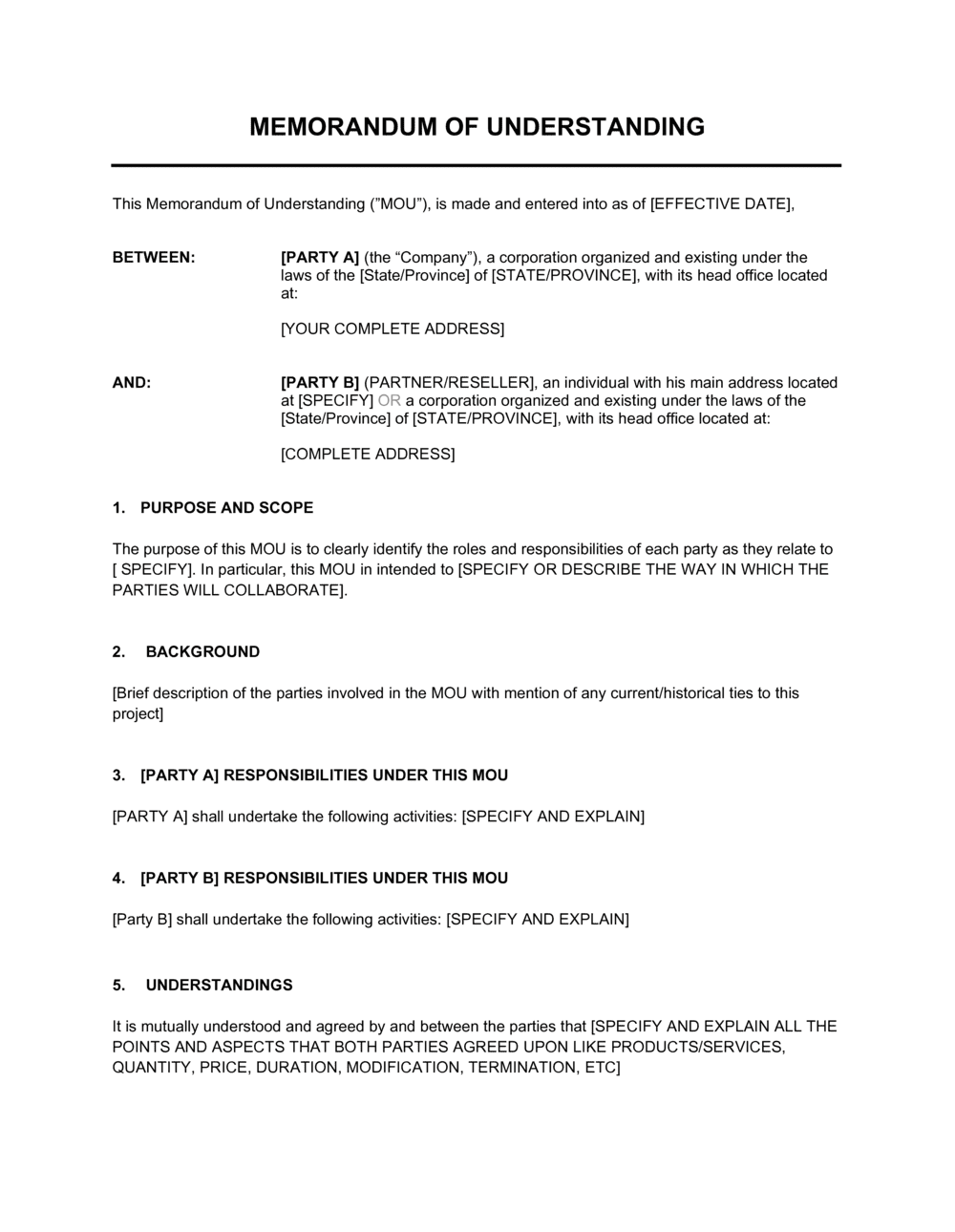
Purpose and background, description of the proposed arrangement, roles and responsibilities of each party, exclusivity and no-shop provisions, confidentiality obligations, binding vs. non-binding clause designations, term and termination, and governing law. Each section uses plain-English placeholders so you can adapt it to your specific transaction in minutes.

What is a Memorandum of Understanding?

A Memorandum of Understanding (MOU) is a written document that records the mutual intent of two or more parties before they enter into a definitive, binding contract. It sets out the broad terms of a proposed arrangement β€” purpose, roles, exclusivity, and confidentiality β€” and gives both sides a documented baseline from which to negotiate. Unlike a full contract, the non-binding portions of an MOU create no enforceable obligations; however, specific clauses such as exclusivity and confidentiality are typically designated as binding, making an MOU a hybrid instrument that is neither a simple handshake nor a fully committed contract. MOUs are used in M&A transactions, joint venture formation, government partnerships, research collaborations, and major procurement negotiations.

Why You Need This Document

Entering sensitive negotiations without an MOU exposes both parties to significant practical and legal risk. Without a documented record of agreed terms, the party that invested more time and resources has no protection if the other side walks away and takes that deal to a competitor β€” or worse, uses confidential information disclosed during talks. An MOU's exclusivity clause creates an enforceable obligation not to shop the deal to third parties during negotiations, protecting the time and cost of due diligence. Its confidentiality clause protects trade secrets, financial data, and strategic plans shared at the table. And by recording the parties' intent in writing, an MOU reduces the risk of disputes about what was agreed if the definitive contract is later challenged. This template gives you a professionally structured starting point that correctly separates binding from non-binding provisions β€” the single most important drafting decision in any MOU β€” so you can enter negotiations with confidence and legal clarity.

Which variant fits your situation?

If your situation is…Use this template
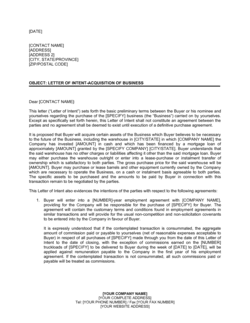
Recording broad intent before an M&A transactionLetter of Intent (Acquisition)
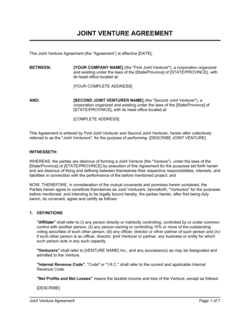
Forming a new joint venture between two companiesJoint Venture Agreement
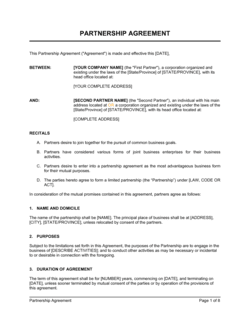
Formalizing a strategic partnership with commercial obligationsPartnership Agreement
Protecting confidential information shared during negotiationsNon-Disclosure Agreement
Committing to a specific contract after MOU terms are agreedHeads of Agreement
Documenting a supplier or vendor relationship before a full contractVendor Agreement
Recording grant or funding terms between two nonprofits or agenciesGrant Agreement

Common mistakes to avoid

❌ No clause explicitly designating what is and is not binding

Why it matters: Courts have found entire MOUs binding β€” or entirely unenforceable β€” when the document failed to distinguish between obligatory clauses and statements of intent. Either outcome can be damaging.

Fix: Include a dedicated binding-designations clause that lists each binding provision by section number, and add 'this clause is binding' at the end of each such provision as a belt-and-suspenders measure.

❌ Describing the arrangement in contract-level detail

Why it matters: Specifying price, payment milestones, delivery dates, or penalty provisions in an MOU that is labeled 'non-binding' creates an arguable contract β€” especially if one party has begun performing.

Fix: Keep the arrangement description at the term-sheet level: subject matter, general structure, and key conditions precedent. Reserve commercial specifics for the Definitive Agreement.

❌ No expiry date on the MOU

Why it matters: An open-ended MOU leaves confidentiality, exclusivity, and no-shop obligations running indefinitely, constraining a party's freedom to negotiate with third parties long after the deal has informally fallen apart.

Fix: Set a specific expiry date or a fixed period from signing β€” 60 to 120 days covers most transactions β€” with an explicit automatic termination trigger on execution of the Definitive Agreement.

❌ Omitting a 'no obligation to complete' clause

Why it matters: Without an express disclaimer, courts in the US and UK have occasionally found that an MOU creates an obligation to negotiate in good faith to completion, exposing a party that walks away to damages claims.

Fix: Include a clear clause stating that nothing in the MOU (other than the listed binding provisions) obliges either party to execute a Definitive Agreement or continue negotiations, and that withdrawal carries no liability.

❌ Signing with a trade name rather than the legal entity

Why it matters: If a trade name or division rather than the registered corporation signs, enforcing the binding clauses β€” particularly exclusivity β€” against the correct legal entity becomes procedurally complicated and sometimes impossible.

Fix: Verify each party's full registered legal name and entity type in the applicable corporate registry before completing the parties clause. Have the signatory confirm they are authorized to bind that entity.

❌ Assuming an existing NDA makes MOU confidentiality redundant

Why it matters: The standalone NDA may have a different scope, term, or permitted-use definition than what is needed for the specific transaction covered by the MOU. Gaps between the two documents can expose sensitive deal information.

Fix: Include a confidentiality clause in the MOU that is at least as protective as the existing NDA, and add a clause confirming both instruments operate together without contradiction.

The 9 key clauses, explained

Recitals and Purpose

In plain language: Sets out the background context β€” who the parties are, what each does, and the specific purpose this MOU is intended to accomplish.

Sample language
This Memorandum of Understanding is entered into as of [DATE] between [PARTY A LEGAL NAME], a [ENTITY TYPE] organized under the laws of [JURISDICTION] ('Party A'), and [PARTY B LEGAL NAME], a [ENTITY TYPE] organized under the laws of [JURISDICTION] ('Party B'). The parties intend to [DESCRIBE PURPOSE].

Common mistake: Naming a trade name or division rather than the registered legal entity. If the entity named cannot be found in a corporate registry, the MOU's enforceability for any binding clauses is immediately in question.

Description of the Proposed Arrangement

In plain language: Describes the transaction, collaboration, or project the parties are contemplating β€” in enough detail to distinguish it from other dealings, but not so specifically that it becomes a contract itself.

Sample language
The parties propose to [DESCRIPTION OF ARRANGEMENT], including [KEY ELEMENTS], subject to the negotiation and execution of a definitive [TYPE OF AGREEMENT] ('Definitive Agreement').

Common mistake: Writing this section so precisely β€” with prices, quantities, and delivery dates β€” that a court treats the MOU as a binding contract rather than a statement of intent.

Roles and Responsibilities

In plain language: Allocates which party is responsible for which activities, contributions, or deliverables during the MOU period β€” before the definitive contract takes over.

Sample language
During the MOU period, Party A shall [RESPONSIBILITY A] and Party B shall [RESPONSIBILITY B]. Each party shall bear its own costs unless otherwise agreed in writing.

Common mistake: Assigning specific monetary obligations or performance deadlines in this clause. Doing so converts a non-binding intention into a contractual commitment subject to damages if missed.

Exclusivity and No-Shop

In plain language: Prevents one or both parties from negotiating the same deal with third parties for a defined period, giving each side confidence that the other is committed to reaching a Definitive Agreement.

Sample language
For a period of [X] days from the date of this MOU ('Exclusivity Period'), [PARTY A / BOTH PARTIES] shall not, directly or indirectly, solicit, initiate, or participate in discussions with any third party regarding [SUBJECT MATTER]. This clause is binding.

Common mistake: Omitting an explicit statement that this clause is binding. Courts in several jurisdictions require clear language distinguishing binding obligations within a non-binding MOU β€” a blanket 'this MOU is non-binding' recital can accidentally void an exclusivity provision the parties intended to enforce.

Confidentiality

In plain language: Obligates each party to keep information shared during negotiations confidential, and limits use of that information to evaluating the proposed arrangement.

Sample language
Each party agrees to keep confidential all non-public information disclosed by the other party in connection with this MOU ('Confidential Information') and not to use it for any purpose other than evaluating the Proposed Arrangement. This clause is binding and survives termination of this MOU for [X] years.

Common mistake: Relying solely on a standalone NDA already signed between the parties without incorporating confidentiality into the MOU. If the NDA is later disputed or amended, gaps in the MOU's confidentiality coverage may expose shared deal information.

Binding and Non-Binding Designations

In plain language: Explicitly identifies which clauses in the MOU are legally enforceable and which are statements of intent only β€” eliminating ambiguity about what each party is legally committing to.

Sample language
The following provisions of this MOU are intended to be legally binding on the parties: [LIST BINDING CLAUSES]. All other provisions of this MOU are statements of intent only and do not create legally binding obligations. This MOU does not constitute a contract to complete the Proposed Arrangement.

Common mistake: Not including this clause at all. Without it, courts may find the entire MOU binding or entirely unenforceable β€” neither outcome reflects the parties' intent.

Term and Termination

In plain language: States how long the MOU remains in effect and how either party may end it early, with or without cause.

Sample language
This MOU shall remain in effect from the date of signing until the earlier of: (a) execution of the Definitive Agreement; (b) [X] months from the date hereof; or (c) written notice of termination by either party on [X] days' notice. Termination does not affect any binding obligations that arose before the termination date.

Common mistake: No expiry date, leaving the MOU open indefinitely. An undated MOU can create ambiguity about whether exclusivity or confidentiality obligations still apply months or years later.

No Obligation to Complete

In plain language: Explicitly states that neither party is legally required to finalize a Definitive Agreement β€” the MOU records intent, not a commitment to close.

Sample language
Nothing in this MOU (other than the binding provisions identified in Section [X]) shall obligate either party to complete the Proposed Arrangement, execute the Definitive Agreement, or continue negotiations. Either party may withdraw from negotiations at any time without liability.

Common mistake: Omitting this clause because the parties assume the MOU's non-binding nature is obvious. In disputes, courts look at the whole document β€” an absence of explicit disclaimer language has led courts in the US and UK to find implied contractual obligation.

Governing Law and Dispute Resolution

In plain language: Specifies which jurisdiction's law governs the MOU and how any disputes over the binding clauses will be resolved.

Sample language
This MOU is governed by the laws of [STATE / PROVINCE / COUNTRY], without regard to conflict-of-law principles. Any dispute arising from the binding provisions of this MOU shall be resolved by [binding arbitration / mediation / courts of [JURISDICTION]].

Common mistake: Choosing a governing law with no connection to either party's location or the subject matter of the deal. Some courts will disregard a governing law selection that appears designed only to defeat mandatory local protections.

How to fill it out

  1. 1

    Identify the parties using their registered legal names

    Enter each party's full legal entity name, jurisdiction of organization, and entity type (LLC, corporation, etc.) in the opening clause. Include a short defined term for each party β€” e.g., 'Company' and 'Partner' β€” to use throughout the document.

    πŸ’‘ Look up each party in the applicable corporate registry before signing. A misspelled or outdated entity name can complicate enforcement of any binding provisions.

  2. 2

    Describe the proposed arrangement at the right level of detail

    Write a clear but high-level description of the deal or collaboration β€” enough for a third party to understand the subject matter, but avoid including price, payment terms, or delivery dates that would convert this clause into a binding commitment.

    πŸ’‘ If you find yourself writing more than three paragraphs here, stop β€” you are drafting a contract, not an MOU.

  3. 3

    Decide which clauses will be binding

    Identify which provisions β€” typically confidentiality, exclusivity, governing law, and costs β€” will be legally enforceable. List them explicitly in the binding-designation clause. Mark all other sections as non-binding intent.

    πŸ’‘ Add the phrase 'this clause is binding' at the end of each provision you intend to enforce, in addition to the consolidated designation clause β€” courts have found belt-and-suspenders labeling more persuasive.

  4. 4

    Set the exclusivity period and scope

    If exclusivity applies, enter the duration (typically 30–90 days for most transactions), the specific subject matter covered, and whether it applies to one or both parties. Confirm this clause is explicitly flagged as binding.

    πŸ’‘ A 30-day exclusivity period with a mutual 30-day extension option on written agreement is a practical starting point for most transactions β€” long enough to demonstrate commitment, short enough to limit exposure if negotiations fail.

  5. 5

    Draft the confidentiality obligations

    Define what constitutes Confidential Information, state how it may be used (evaluation purposes only), list any permitted disclosures (e.g., to advisors under equivalent obligations), and set the survival period after the MOU expires.

    πŸ’‘ If a separate NDA is already in place, reference it and confirm this MOU's confidentiality clause supplements rather than replaces it β€” overlapping but non-contradictory is safer than a gap.

  6. 6

    Set the term and termination mechanism

    Enter a specific expiry date or a defined period from signing β€” 60 to 120 days is typical for M&A or partnership negotiations. Add an automatic expiry trigger when the Definitive Agreement is signed, and include a short notice period (5–15 days) for early termination.

    πŸ’‘ Build in a one-time written extension option at the same notice threshold β€” this avoids both parties needing to sign a full amendment if negotiations run slightly long.

  7. 7

    Confirm governing law and dispute resolution

    Select the governing jurisdiction based on where the key party is incorporated or where the transaction is being performed. For binding clause disputes, choose between litigation, arbitration, or mediation based on your preference for privacy and speed.

    πŸ’‘ Arbitration keeps disputes private and often resolves faster than litigation for commercial disputes β€” worth specifying even in an MOU if the binding provisions include material exclusivity obligations.

  8. 8

    Execute before disclosing any sensitive information

    Both authorized signatories must sign before any confidential information changes hands or any exclusivity obligations begin. Date the document accurately β€” post-dated MOUs have been found unenforceable in several jurisdictions.

    πŸ’‘ Use electronic signature with a timestamped audit trail. Courts in the US, Canada, UK, and EU all recognize e-signatures for commercial documents of this type.

Frequently asked questions

What is a Memorandum of Understanding?

A Memorandum of Understanding (MOU) is a written document that records the mutual intent of two or more parties to enter into a transaction or collaboration, without necessarily creating a fully binding contract. It sets out the broad terms of the proposed arrangement β€” purpose, roles, exclusivity, and confidentiality β€” and serves as the documented foundation from which a definitive contract is negotiated. An MOU can contain a mix of binding and non-binding provisions depending on how it is drafted.

Is a Memorandum of Understanding legally binding?

It depends entirely on the language used. An MOU can be fully non-binding, fully binding, or β€” most commonly β€” a hybrid where specific clauses such as confidentiality, exclusivity, and governing law are binding while the rest records intent only. Courts look at the document as a whole to determine enforceability; the safest approach is to explicitly label each binding provision and include a clear disclaimer that the remaining clauses are non-binding.

What is the difference between an MOU and a Letter of Intent?

An MOU and a Letter of Intent (LOI) are functionally similar β€” both record the terms parties have agreed in principle before a definitive contract is drafted. In practice, LOIs are more commonly used in M&A and real estate transactions, while MOUs appear more often in government, nonprofit, research, and strategic partnership contexts. The legal treatment is the same: the enforceability of either depends on the specific language, not the document title.

What is the difference between an MOU and a contract?

A contract creates definitive, enforceable obligations β€” agreed price, delivery terms, warranties, and remedies β€” and is typically executed when the parties are ready to commit fully. An MOU records intent and frames the negotiation of that contract. The key functional difference is that walking away from an MOU's non-binding provisions carries no legal consequence, whereas breaching a contract exposes the breaching party to damages. However, an MOU's binding clauses β€” confidentiality, exclusivity β€” are treated exactly like contract provisions if breached.

What clauses in an MOU are typically binding?

The provisions most commonly designated as binding in an MOU are: confidentiality, exclusivity and no-shop obligations, governing law and dispute resolution, and costs (each party bearing its own). The description of the proposed arrangement, roles, and responsibilities are almost always stated as non-binding intent. The parties may agree to make additional clauses binding β€” for example, a break fee β€” depending on the transaction.

How long should an MOU remain in effect?

Most commercial MOUs run for 60 to 120 days, which is typically sufficient to complete due diligence and negotiate a definitive contract. M&A transactions may require 90 to 180 days. Build in a written extension mechanism and an automatic expiry trigger on execution of the definitive agreement. An MOU with no expiry date creates indefinite confidentiality and exclusivity obligations β€” a significant constraint if the deal falls through.

Do I need a lawyer to draft an MOU?

For straightforward partnership or collaboration MOUs, a well-structured template is generally sufficient, provided you correctly designate binding and non-binding provisions. Consider engaging a lawyer when the transaction is material β€” M&A, major joint ventures, or research IP arrangements β€” when the parties operate in multiple jurisdictions, or when exclusivity provisions carry significant commercial value. A one-hour template review typically costs $200–$400 and is worthwhile when the deal is large enough that a walk-away would be costly.

Can an MOU be used as evidence in court?

Yes. Courts regularly admit MOUs as evidence of the parties' intent at a specific point in time, particularly in disputes about whether a definitive contract was ever formed or what the parties understood by a given term. Non-binding provisions are not enforceable as contracts, but they can be used to interpret ambiguous language in a later agreement. Binding provisions are enforceable in the same way as any other written contract.

What happens if a party walks away after signing an MOU?

Withdrawing from the non-binding portions of an MOU β€” declining to proceed with the Definitive Agreement β€” typically carries no legal liability, provided the MOU includes a clear 'no obligation to complete' clause. However, walking away while in breach of a binding clause β€” for example, by sharing confidential information or entering negotiations with a third party during the exclusivity period β€” exposes the withdrawing party to damages claims and, in some jurisdictions, injunctive relief. Courts in the US and UK have also occasionally found liability for bad-faith withdrawal where the conduct was particularly egregious.

How this compares to alternatives

vs Letter of Intent

An LOI and an MOU serve the same structural purpose β€” recording intent before a definitive contract β€” and are legally treated the same way. LOIs are more common in M&A and real estate; MOUs appear more often in government, nonprofit, and research contexts. Choose the format that matches your industry's convention; the substance of the binding-designation and exclusivity clauses matters more than the title.

vs Non-Disclosure Agreement

An NDA protects confidential information shared between parties but says nothing about the underlying transaction or collaboration. An MOU records the intent and terms of the deal itself, and typically includes its own confidentiality obligations. For significant negotiations, use both: an NDA at first contact and an MOU once the deal structure is agreed in principle.

vs Joint Venture Agreement

A Joint Venture Agreement is the definitive binding contract that establishes governance, capital contributions, profit sharing, and exit rights for the JV entity. An MOU precedes it β€” recording the parties' intent and principal terms while due diligence and negotiation proceed. Sign the MOU first; execute the JV Agreement when both parties are ready to commit fully.

vs Partnership Agreement

A Partnership Agreement creates legally binding obligations between business partners β€” profit allocation, decision-making authority, liability, and dissolution. An MOU records the intent to enter into that arrangement and frames the terms to be negotiated. Using an MOU as a substitute for a Partnership Agreement is a common and costly mistake; the MOU should always be followed by the definitive instrument.

Industry-specific considerations

Technology and SaaS

Technology MOUs commonly address API integration scope, data-sharing protocols, and mutual IP ownership of jointly developed features before a full partnership or licensing agreement is executed.

Government and Public Sector

Government agencies use MOUs to formalize inter-agency cooperation, resource sharing, and grant arrangements where procurement rules prevent full contracts β€” making the binding-designation clause especially important.

Healthcare and Life Sciences

Research collaborations, clinical trial partnerships, and hospital system arrangements routinely begin with an MOU that addresses data protection, regulatory compliance, and IP ownership before a consortium or licensing agreement is finalized.

Real Estate and Development

Developers use MOUs to secure exclusivity with landowners or equity partners while financing, environmental assessments, and planning approvals are obtained β€” making the exclusivity and term clauses the most heavily negotiated provisions.

Jurisdictional notes

United States

US courts apply state-specific contract law to determine MOU enforceability. Courts in states such as New York and Delaware look carefully at whether the parties intended to be bound and whether all material terms were agreed. A 'no obligation to complete' clause and explicit binding designations are critical. California courts have found implied obligations to negotiate in good faith in some MOU contexts, creating potential liability for bad-faith withdrawal even from a nominally non-binding document.

Canada

Canadian courts apply common-law contract principles and have in some cases found MOUs binding where the language suggested a firm commitment and performance had begun. Quebec applies civil law principles, which give more weight to the overall intent of the parties and less to technical labeling. Including a clear binding-designation clause and a 'no obligation to complete' provision is important in all provinces. Exclusivity clauses are generally enforceable in Canada if they are reasonable in duration and scope.

United Kingdom

UK courts are generally reluctant to impose contractual obligations on non-binding MOUs, but will enforce specific provisions β€” particularly confidentiality and exclusivity β€” if clearly expressed as binding. The concept of 'subject to contract' is well established and should be included in any clause the parties intend to be non-binding. Heads of Agreement is the more common UK equivalent of an MOU, and the two terms are used interchangeably by courts. Consideration of the document as a whole is the primary test for enforceability.

European Union

EU member states apply varying civil law principles to pre-contractual documents. France, Germany, and the Netherlands each have distinct doctrines on pre-contractual liability β€” French law recognizes culpa in contrahendo (liability for bad-faith withdrawal from negotiations) more readily than common-law jurisdictions. GDPR imposes obligations on any Confidential Information that includes personal data, even at the MOU stage, requiring a data-processing reference or separate GDPR addendum where personal data will be shared. Always specify member-state governing law rather than 'EU law' as EU commercial law is not a standalone governing law.

Template vs lawyer β€” what fits your deal?

PathBest forCostTime
Use the templateStrategic partnerships, inter-agency cooperation, research collaborations, and vendor pre-agreements where the deal value is modest and the parties are in the same jurisdictionFree30–60 minutes
Template + legal reviewMaterial transactions, cross-border arrangements, or deals where exclusivity has significant commercial value$200–$6001–3 days
Custom draftedM&A transactions, complex joint ventures, government procurement, or arrangements involving regulated industries or multiple jurisdictions$1,000–$4,000+1–2 weeks

Glossary

Memorandum of Understanding (MOU)
A written document recording the mutual intent of two or more parties, typically used as a precursor to a binding contract.
Binding Clause
A provision within an MOU that creates an enforceable legal obligation β€” such as confidentiality or exclusivity β€” even if the rest of the document is non-binding.
Non-Binding Clause
A provision that records intent or expectations without creating a legal obligation, allowing parties to withdraw without breach.
Exclusivity Period
A defined timeframe during which one or both parties agree not to negotiate the same transaction with third parties.
No-Shop Provision
A restriction preventing a party from soliciting or entertaining competing offers from third parties while the MOU is in effect.
Good Faith Negotiations
An obligation to negotiate honestly and sincerely toward a final agreement, without an obligation to reach one β€” courts in most jurisdictions do not enforce specific outcomes from good-faith clauses.
Letter of Intent (LOI)
A document similar to an MOU that records negotiating terms, most commonly used in M&A and real estate; the two terms are often used interchangeably, though an LOI typically implies a closer proximity to a binding deal.
Heads of Agreement
A document outlining the principal terms of a proposed contract, common in UK and Australian practice; functionally equivalent to an MOU but often more detailed.
Term
The duration for which the MOU remains in effect, after which it expires automatically unless extended in writing by both parties.
Governing Law
The jurisdiction whose laws apply to interpret and enforce the MOU, and before whose courts or arbitrators any disputes will be heard.
Counterparts Clause
A provision stating that the MOU may be signed in separate copies, each of which together constitute one binding instrument β€” enabling remote execution.

Part of your Business Operating System

This document is one of 3,000+ business & legal templates included in Business in a Box.

  • Fill-in-the-blanks β€” ready in minutes
  • 100% customizable Word document
  • Compatible with all office suites
  • Export to PDF and share electronically

Create your document in 3 simple steps.

From template to signed document β€” all inside one Business Operating System.
1
Download or open template

Access over 3,000+ business and legal templates for any business task, project or initiative.

2
Edit and fill in the blanks with AI

Customize your ready-made business document template and save it in the cloud.

3
Save, Share, Send, Sign

Share your files and folders with your team. Create a space of seamless collaboration.

Save time, save money, and create top-quality documents.

β˜…β˜…β˜…β˜…β˜…

"Fantastic value! I'm not sure how I'd do without it. It's worth its weight in gold and paid back for itself many times."

Managing Director Β· Mall Farm
Robert Whalley
Managing Director, Mall Farm Proprietary Limited
β˜…β˜…β˜…β˜…β˜…

"I have been using Business in a Box for years. It has been the most useful source of templates I have encountered. I recommend it to anyone."

Business Owner Β· 4+ years
Dr Michael John Freestone
Business Owner
β˜…β˜…β˜…β˜…β˜…

"It has been a life saver so many times I have lost count. Business in a Box has saved me so much time and as you know, time is money."

Owner Β· Upstate Web
David G. Moore Jr.
Owner, Upstate Web

Run your business with a system β€” not scattered tools

Stop downloading documents. Start operating with clarity. Business in a Box gives you the Business Operating System used by over 250,000 companies worldwide to structure, run, and grow their business.

Free Forever PlanΒ Β·Β No credit card required