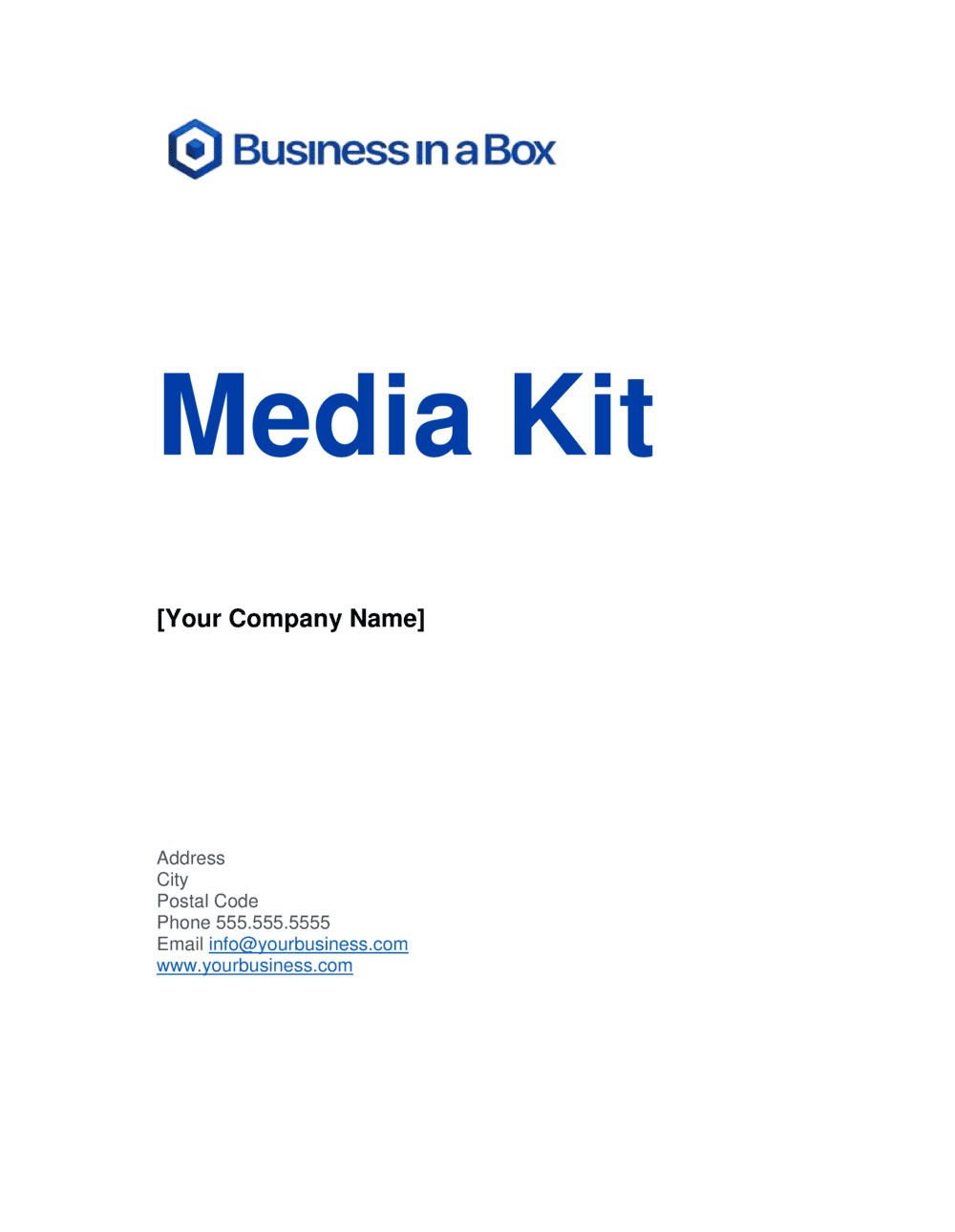
Media Kit Template

Free Word download β€’ Edit online β€’ Save & share with Drive β€’ Export to PDF

12 pagesβ€’25–35 min to fillβ€’Difficulty: Complexβ€’Signature requiredβ€’Legal review recommended
Learn more ↓
FreeMedia Kit Template

At a glance

What it is
A Media Kit is a formal document that consolidates a brand's or individual's key promotional and commercial information β€” audience demographics, reach statistics, advertising or sponsorship rates, editorial guidelines, and permitted usage terms β€” into a single reference package for media partners, sponsors, and advertisers. This free Word download gives you a structured, professionally formatted starting point you can edit online and export as PDF to share with prospective partners, press outlets, or sponsors.
When you need it
Use it when pitching sponsorship opportunities, responding to advertising inquiries, onboarding new media partners, or establishing binding usage and approval terms with anyone reproducing your brand assets or publishing on your behalf.
What's inside
Brand story and company overview, audience and reach statistics, advertising and sponsorship packages with rates, content and brand usage guidelines, approval and editorial control clauses, confidentiality terms, and contact and booking information.

What is a Media Kit?

A Media Kit is a formal document that packages a brand's or media property's commercial and editorial information β€” audience demographics, reach statistics, advertising placements, sponsorship tiers, pricing, and the legal terms governing any partnership β€” into a single reference document for prospective sponsors, advertisers, and press contacts. Beyond its role as a marketing tool, a properly structured and signed media kit functions as a binding agreement that defines deliverables, sets payment terms, establishes IP usage rights, and creates enforceable obligations on both the publisher and the partner. When drafted with clear legal clauses covering approval rights, confidentiality, and dispute resolution, it eliminates the ambiguity that most advertising and sponsorship disputes trace back to.

Why You Need This Document

Sending a media kit without binding terms is the equivalent of quoting a price with no contract β€” the sponsor knows what they want but has no obligation to pay, and you have no documented claim to the deliverables you promised. Without a written cancellation policy, a sponsor who pulls out after content has been created or inventory reserved leaves you with no recourse. Without an IP license expiration clause, former partners continue using your logo and imagery years after a campaign ends. Without an editorial independence clause, a sponsor can stall publication indefinitely by withholding approval. A media kit built on this template closes each of those gaps: it documents your audience data with a stated source, locks in deliverables with the specificity needed to hold both parties accountable, and provides the legal foundation β€” governing law, confidentiality, and dispute resolution β€” to enforce the agreement if a partnership breaks down.

Which variant fits your situation?

If your situation is…Use this template
Distributing brand background and assets to press and journalistsPress Kit
Pitching a social media channel sponsorship with follower and engagement dataInfluencer Media Kit
Presenting advertising inventory rates for a digital publicationDigital Advertising Rate Card
Attracting sponsors for a live or virtual eventEvent Sponsorship Proposal
Formalizing a brand partnership with content deliverables and exclusivityBrand Partnership Agreement
Licensing brand assets and logos to a third-party partnerBrand Licensing Agreement
Onboarding a podcast advertiser with defined ad-slot termsPodcast Advertising Agreement

Common mistakes to avoid

❌ Using unverified or inflated audience statistics

Why it matters: Sponsors who discover discrepancies between claimed and actual reach have grounds to dispute payment and, in some jurisdictions, to claim misrepresentation β€” creating both legal and reputational exposure.

Fix: Pull all statistics from a named analytics source (Google Analytics, Mailchimp, native platform insights) and include the pull date. Refresh the kit every 90 days.

❌ No cancellation or refund policy in the rate card

Why it matters: When a sponsor cancels after content has been produced or reserved ad inventory has been turned away, the absence of a written policy leaves the publisher with no enforceable claim to the contracted fee.

Fix: Include a tiered cancellation clause: for example, 25% of the contracted fee is non-refundable if cancelled more than 30 days out, and 100% if cancelled within 14 days of the campaign start date.

❌ Granting unlimited sponsor approval rights over editorial content

Why it matters: An uncapped approval right allows a sponsor to delay or block publication indefinitely, destroying the publisher's production schedule and causing downstream revenue loss.

Fix: Limit the sponsor review window to 3–5 business days and include a deemed-approved clause: content not rejected in writing within that window is approved for publication.

❌ No IP ownership or license expiration on brand assets

Why it matters: Without a defined license term, a former partner may continue using your logo, imagery, or co-branded materials long after the campaign ends β€” creating consumer confusion about an ongoing affiliation.

Fix: State explicitly that the brand asset license terminates on the campaign end date and that all licensed materials must be removed or archived within 10 business days of termination.

❌ Sending the media kit without a countersigned agreement

Why it matters: A media kit alone is a marketing document, not a contract. Without a countersigned agreement, rate card terms, deliverables, and confidentiality obligations are unenforceable.

Fix: Attach a one-page signature block or a separate partnership agreement referencing the media kit as an exhibit. Require countersignature before any campaign work begins.

❌ Omitting the governing law and dispute resolution clause

Why it matters: Without a governing law clause, parties in different jurisdictions may end up litigating in a court neither anticipated, adding significant cost and uncertainty to even minor disputes.

Fix: Always specify the governing jurisdiction and a preferred dispute resolution mechanism β€” arbitration is faster and less expensive than litigation for most advertising and sponsorship disputes.

The 10 key clauses, explained

Brand Overview and Company Profile

In plain language: Introduces the brand, its founding story, mission, key products or services, and the audience it serves β€” establishing credibility with potential partners.

Sample language
[BRAND NAME] was founded in [YEAR] and is a [DESCRIPTION OF BUSINESS] serving [TARGET AUDIENCE]. Our mission is to [MISSION STATEMENT]. Since launch, we have [KEY MILESTONE OR ACHIEVEMENT].

Common mistake: Writing a generic company bio copied from the 'About Us' page without tailoring it to a media or sponsorship audience. Partners want to know reach and relevance, not founding history alone.

Audience Demographics and Reach Statistics

In plain language: Provides verified data on audience size, demographics, geographic distribution, and engagement across all relevant channels β€” the section partners scrutinize most.

Sample language
Monthly unique visitors: [X]. Email subscribers: [X]. Social following: [PLATFORM] [X]. Audience breakdown: [X]% aged [RANGE], [X]% [GENDER], top geographies: [COUNTRY/REGION]. Average engagement rate: [X]%.

Common mistake: Presenting vanity metrics β€” total lifetime followers, for example β€” without engagement rate or active audience data. Advertisers verify numbers; inflated or outdated stats damage credibility and may constitute misrepresentation.

Advertising and Sponsorship Packages

In plain language: Defines each available placement or sponsorship tier β€” what is included, the duration, the deliverables, and the pricing β€” so partners can select and commit to a specific package.

Sample language
Gold Sponsor Package: [X] logo placements per month, [X] dedicated email mentions, [X] social posts. Duration: [TERM]. Rate: $[AMOUNT] per [PERIOD]. All packages subject to [APPROVAL PROCESS] and availability.

Common mistake: Listing packages without specifying deliverables with the precision needed to hold either party accountable. 'Social media coverage' is not a deliverable β€” '3 Instagram feed posts and 2 Stories per month' is.

Rate Card and Payment Terms

In plain language: States the published price for each placement, the payment schedule, accepted payment methods, and any deposit or cancellation fee structure.

Sample language
Standard rate card effective [DATE]. Payment due [NET 30 / UPON BOOKING]. Accepted methods: [WIRE / ACH / CREDIT CARD]. Cancellations within [X] days of campaign start: [X]% of contracted fee is non-refundable.

Common mistake: Omitting a cancellation and refund policy. When a sponsor pulls out after content has been created or reserved, the absence of a written cancellation clause leaves the publisher with no recourse.

Editorial Independence and Approval Rights

In plain language: Defines who controls content β€” whether the publisher retains editorial discretion, whether the sponsor has approval rights over sponsored content, and where the line between advertising and editorial sits.

Sample language
Sponsored content is clearly labeled as such per [APPLICABLE DISCLOSURE STANDARD, e.g., FTC guidelines]. [BRAND NAME] retains final editorial discretion over all non-sponsored content. Sponsor review period for sponsored content: [X] business days prior to publication.

Common mistake: Granting unlimited sponsor approval rights over all content without a time limit. Sponsors who hold indefinite veto rights can stall publication indefinitely β€” build in a deemed-approved clause after a defined review window.

Brand Asset Usage and Intellectual Property

In plain language: Specifies which brand assets β€” logos, trademarks, photography, taglines β€” each party may use, in what contexts, and for how long, and confirms IP ownership remains with the originating party.

Sample language
Partner is granted a non-exclusive, non-transferable license to use [BRAND NAME]'s logo and approved images solely for the purposes of this agreement during the term. No modifications to [BRAND NAME]'s logo or trademarks are permitted without written consent.

Common mistake: No expiration on the asset license. Partners who use your logo years after a campaign has ended create confusion about ongoing affiliation β€” include a clause that the license terminates automatically on campaign end.

Confidentiality and Non-Disclosure

In plain language: Requires both parties to keep pricing, audience data, campaign performance metrics, and proprietary business information confidential, specifying the duration and permissible disclosures.

Sample language
Each party agrees to hold the other's Confidential Information in strict confidence and not to disclose it to any third party for a period of [X] years following the termination of this agreement. Confidential Information includes, but is not limited to, rate cards, audience analytics, and campaign performance data.

Common mistake: No definition of what constitutes 'confidential information.' Without a clear definition, parties dispute whether specific items β€” like the fact that a partnership exists at all β€” are covered.

Representations and Warranties

In plain language: Each party confirms that the statistics, brand assets, and claims in the media kit are accurate, that they have the authority to enter the agreement, and that their content does not infringe third-party IP.

Sample language
[BRAND NAME] represents and warrants that all audience and reach statistics provided are accurate as of [DATE] and sourced from [ANALYTICS PLATFORM]. Each party warrants that it has full authority to enter into and perform this agreement without violating any third-party rights.

Common mistake: No accuracy warranty on audience data. If a publisher later inflates subscriber counts and a sponsor has paid on that basis, the absence of a warranty clause limits the sponsor's legal recourse.

Term, Termination, and Renewal

In plain language: States the agreement's start and end date, the conditions under which either party may terminate early, the notice required, and whether the agreement auto-renews.

Sample language
This agreement commences on [START DATE] and expires on [END DATE] unless earlier terminated. Either party may terminate with [X] days' written notice for material breach not cured within [X] days. This agreement does not auto-renew without written confirmation from both parties.

Common mistake: Auto-renewal clauses buried in fine print without a clear opt-out window. Partners who miss a renewal deadline and are billed for another term routinely dispute payment β€” make renewal explicit and opt-in.

Governing Law and Dispute Resolution

In plain language: Identifies the jurisdiction whose law governs the agreement and specifies whether disputes go to arbitration, mediation, or litigation, and where.

Sample language
This agreement is governed by the laws of [STATE / PROVINCE / COUNTRY], without regard to conflict-of-law principles. Any dispute arising under this agreement shall be resolved by [binding arbitration / mediation / courts] in [CITY / JURISDICTION].

Common mistake: Choosing a governing law jurisdiction that has no connection to either party's location. Courts in several jurisdictions may decline to enforce a governing-law clause that appears designed to deprive a party of local statutory protections.

How to fill it out

  1. 1

    Complete the brand overview section

    Enter your brand's legal name, founding year, mission statement, and a two-to-three sentence description of your core audience and value proposition. Keep this section to one page.

    πŸ’‘ Write the overview from a partner's perspective β€” answer 'why should I advertise here?' in the first paragraph.

  2. 2

    Pull verified audience and reach data

    Export the most recent 30-day or 90-day data from Google Analytics, your email platform, and each social channel. Enter the numbers with the data source and pull date noted.

    πŸ’‘ Partners will ask for screenshot verification or analytics access. Use a consistent 90-day window so numbers are comparable across channels.

  3. 3

    Define your sponsorship and advertising packages

    List each package tier with a name, specific deliverables, duration, and price. For each deliverable, write it at the level of specificity you'd put in a contract β€” placement, format, frequency.

    πŸ’‘ Three to four clearly differentiated tiers (e.g., Title, Gold, Silver) perform better than a long Γ  la carte menu when the goal is quick partner decisions.

  4. 4

    Set the rate card and payment terms

    State published rates effective from a specific date, the payment schedule (net 30 is standard for established brands; prepayment is common for new partners), and your cancellation policy with a specific percentage and time window.

    πŸ’‘ Include a 'rates subject to change with 30 days' notice' clause so you can update pricing without issuing a new media kit each time.

  5. 5

    Define editorial independence and approval rights

    Specify clearly which content requires sponsor review, how many business days the review window is, and what happens if the sponsor does not respond within that window (deemed approved).

    πŸ’‘ A 3–5 business day review window with a deemed-approved clause is the industry standard for sponsored content β€” it keeps production schedules on track.

  6. 6

    Document brand asset usage rules

    List which of your assets (logo versions, approved photography, brand colors) partners may use, any prohibited modifications, and the required credit line format.

    πŸ’‘ Link to or attach your full brand guidelines document as an appendix rather than summarizing them β€” this avoids conflicts between the kit and the guidelines.

  7. 7

    Add confidentiality and governing law clauses

    Specify the confidentiality duration (two to three years is typical post-termination), define what constitutes confidential information, and choose a governing jurisdiction aligned with your primary place of business.

    πŸ’‘ If you serve sponsors in multiple countries, choose the governing law most familiar to you and flag any jurisdiction-specific carve-outs for international partners.

  8. 8

    Have both parties sign before campaign delivery begins

    Circulate the signed media kit agreement to the partner before any content is created or ad placements are reserved. A countersigned copy confirms each party's commitments.

    πŸ’‘ Use an e-signature tool to timestamp execution and store the signed copy with the campaign brief β€” this is your primary record if a payment or content dispute arises.

Frequently asked questions

What is a media kit?

A media kit is a document β€” or document package β€” that presents a brand's or media property's key commercial and editorial information to potential sponsors, advertisers, and press contacts. It typically covers audience demographics, reach statistics, advertising options with pricing, brand usage guidelines, and the legal terms governing any partnership. For businesses, it functions as both a sales tool and a binding reference document once signed by a sponsor or advertising partner.

What is the difference between a media kit and a press kit?

A press kit is aimed at journalists and editors β€” it contains brand background, executive bios, product images, and recent press releases to facilitate media coverage. A media kit is aimed at advertisers and sponsors β€” it contains audience data, advertising placements, rate cards, and partnership terms. Many brands maintain both, with the media kit handling commercial relationships and the press kit handling editorial outreach.

Does a media kit need to be a legally binding document?

A media kit can be purely informational, but when it includes a rate card, deliverables, and usage terms it should be accompanied by β€” or structured as β€” a binding agreement. Without a signature block and enforceable terms, the rate card is an invitation to negotiate, not a contract. For any paid partnership, both parties should sign the media kit agreement or a separate sponsorship agreement that references the kit before work begins.

What should a media kit include?

A complete media kit includes a brand overview and mission statement, audience demographics and reach statistics with data sources, advertising and sponsorship packages with specific deliverables, a rate card with payment and cancellation terms, editorial independence and approval-rights clauses, brand asset usage guidelines, a confidentiality clause, and a governing law clause. Missing the legal clauses turns the kit into a brochure rather than an enforceable commercial document.

How often should a media kit be updated?

Audience statistics should be refreshed at least every 90 days β€” stale numbers erode credibility with sophisticated sponsors who can cross-check public data. Rate cards should be reviewed annually or when major audience growth occurs. The legal clauses and general structure typically remain stable, but should be reviewed when you expand to new channels, new geographies, or significantly new categories of sponsorship.

Can an influencer use this media kit template?

Yes. Individual content creators and influencers use media kits to pitch brand partnerships, setting out follower counts, engagement rates, audience demographics, content formats offered, and pricing per post or campaign. The same legal clauses β€” deliverables, approval rights, IP usage, payment terms, and confidentiality β€” apply to influencer partnerships as to publisher advertising relationships. Tailoring the audience statistics section to platform-native metrics (engagement rate, story views, link-click rate) is the main customization needed.

What are FTC disclosure requirements for sponsored content in the media kit?

In the United States, the FTC requires that sponsored or paid content be clearly and conspicuously disclosed to audiences β€” typically through labels like 'Sponsored', 'Ad', or 'Paid Partnership'. The media kit's editorial independence clause should explicitly state that all sponsored content will be labeled in compliance with applicable FTC guidelines and that the sponsor acknowledges and agrees to this disclosure as a condition of the partnership. Failure to disclose can expose both the publisher and the brand to FTC enforcement action.

Does a media kit need to be notarized?

No. A media kit agreement is generally enforceable with the signatures of both parties and does not require notarization in most jurisdictions. Notarization may be relevant if the agreement is being used in legal proceedings in a jurisdiction that requires it for certain document types, but for standard advertising and sponsorship partnerships it is not a standard requirement.

What happens if a sponsor doesn't pay after signing the media kit agreement?

A countersigned media kit agreement with clear payment terms and a rate card provides the basis for a formal demand letter and, if necessary, a small claims or civil court action. Including a provision for recovery of reasonable legal fees in the event of non-payment strengthens your position. For recurring partnerships, requiring prepayment or a deposit before content is produced eliminates most non-payment exposure before it arises.

How this compares to alternatives

vs Sponsorship Proposal

A sponsorship proposal is a one-directional document pitched to a specific prospective sponsor, tailored to their goals and outlining what they would receive. A media kit is a standardized package distributed to any potential partner or press contact. The media kit sets standing rates and terms; the sponsorship proposal customizes those terms for a specific deal. Most publishers use a media kit as the foundation and build custom proposals on top of it for high-value prospects.

vs Brand Partnership Agreement

A brand partnership agreement is a fully bilateral contract governing a collaborative commercial relationship β€” joint campaigns, co-branded products, or shared revenue arrangements. A media kit agreement governs a primarily transactional, advertiser-publisher relationship. Use the media kit for advertising and sponsored content; use a brand partnership agreement when two brands are jointly creating and distributing content or sharing audience access under a co-marketing arrangement.

vs Press Kit

A press kit targets journalists and editors seeking editorial coverage β€” it includes company background, executive bios, high-resolution images, and recent news. A media kit targets advertisers and sponsors and includes audience data, rate cards, and commercial terms. A press kit generates earned media; a media kit generates paid placements. Both are often distributed simultaneously but serve entirely different audiences and purposes.

vs Non-Disclosure Agreement

An NDA is a standalone confidentiality agreement executed before sensitive information is shared during negotiations. A media kit includes confidentiality provisions as one clause among many governing a full advertising or sponsorship relationship. When sharing highly sensitive audience analytics or undisclosed rate structures with a prospective partner during pre-agreement discussions, a standalone NDA should be signed first β€” before the full media kit agreement is negotiated.

Industry-specific considerations

Digital Media and Publishing

CPM-based display advertising, newsletter sponsorships, branded content series, and editorial calendar alignment with advertiser campaigns.

Marketing and Advertising Agencies

Agencies prepare media kits on behalf of clients, requiring clear IP ownership clauses and dual approval rights covering both the agency and the end brand.

Events and Entertainment

Attendance and demographic data drive sponsorship tier pricing, with on-site logo placement, speaking opportunities, and co-branded content forming the deliverable package.

Technology / SaaS

Product launches, developer community newsletters, and podcast channels require media kits with precise audience segmentation data and integration-partner co-marketing terms.

Jurisdictional notes

United States

FTC disclosure rules require clear labeling of all paid and sponsored content β€” 'Sponsored', 'Ad', or 'Paid Partnership' labels must be conspicuous and not buried in hashtags or collapsed text. State-level consumer protection laws (notably California's UCL) can create additional liability for misleading audience statistics or undisclosed material connections. Non-compete and exclusivity clauses must be reasonable in scope; California in particular may decline to enforce overbroad category exclusivity restrictions.

Canada

Canada's Anti-Spam Legislation (CASL) applies to any commercial electronic message, including sponsored email content β€” ensure the media kit agreement addresses CASL compliance for email-based ad placements. The Competition Act prohibits deceptive marketing practices, including false or misleading audience statistics. Quebec's Bill 96 may require French-language versions of agreements for Quebec-based partners, and PIPEDA (or provincial privacy laws in Alberta, BC, and Quebec) governs the sharing of audience data.

United Kingdom

The ASA (Advertising Standards Authority) and CAP Code require that paid partnerships and sponsored content are clearly identified as advertising before the audience engages with the content β€” not merely at the end. The Consumer Protection from Unfair Trading Regulations 2008 covers misleading audience claims. Post-Brexit, UK GDPR governs the handling and transfer of audience data shared with advertising partners, requiring a lawful basis for processing.

European Union

The EU Digital Services Act (DSA) and Unfair Commercial Practices Directive require transparent disclosure of commercial relationships and accurate audience representations. GDPR applies to any sharing of audience analytics data that includes personal data β€” ensure data processing agreements (DPAs) are in place before sharing granular audience data with sponsors. The Audiovisual Media Services Directive requires disclosure of commercial communications in video content across member states.

Template vs lawyer β€” what fits your deal?

PathBest forCostTime
Use the templateBloggers, content creators, small publishers, and brands establishing standard advertising or sponsorship rates for the first timeFree2–4 hours
Template + legal reviewGrowing media properties, brands with significant IP assets, or publishers entering exclusivity or multi-channel partnerships$300–$8002–5 days
Custom draftedEnterprise media companies, cross-border partnerships, or high-value exclusive sponsorships with complex IP and revenue-sharing arrangements$1,500–$5,000+1–3 weeks

Glossary

Media Kit
A document package that presents a brand's audience, reach, advertising options, rates, and usage terms to potential sponsors, advertisers, or media partners.
CPM (Cost Per Mille)
The cost an advertiser pays per 1,000 impressions of an ad β€” a standard pricing unit for display, video, and newsletter advertising.
Editorial Calendar
A forward-looking schedule of planned content themes and publication dates, shared with advertisers so they can align campaigns with relevant content.
Rate Card
A schedule listing the price for each available advertising placement or sponsorship package, typically included as an appendix to the media kit.
Brand Guidelines
Rules governing how a brand's name, logo, colors, and imagery may be used by third parties, including required credit lines and prohibited modifications.
Exclusivity Clause
A contractual term preventing the brand or the partner from working with direct competitors within a defined category and time period.
UVP (Unique Value Proposition)
A concise statement explaining what makes a media property or brand distinct from alternatives and why an advertiser or sponsor should choose it.
Engagement Rate
The percentage of an audience that actively interacts with content β€” through likes, comments, shares, or clicks β€” relative to total reach or followers.
Media Placement
A specific advertising or editorial slot within a publication, website, newsletter, podcast, or social channel made available to a sponsor or advertiser.
Earned Media
Publicity or coverage generated organically by press, word of mouth, or third-party mentions β€” as opposed to paid advertising or owned content.
Deliverables
The specific content outputs or placements a publisher or creator is contractually required to produce under a sponsorship or advertising agreement.
Impression
A single instance of an advertisement or piece of content being displayed to a viewer, used as a baseline unit for measuring advertising reach.

Part of your Business Operating System

This document is one of 3,000+ business & legal templates included in Business in a Box.

  • Fill-in-the-blanks β€” ready in minutes
  • 100% customizable Word document
  • Compatible with all office suites
  • Export to PDF and share electronically

Create your document in 3 simple steps.

From template to signed document β€” all inside one Business Operating System.
1
Download or open template

Access over 3,000+ business and legal templates for any business task, project or initiative.

2
Edit and fill in the blanks with AI

Customize your ready-made business document template and save it in the cloud.

3
Save, Share, Send, Sign

Share your files and folders with your team. Create a space of seamless collaboration.

Save time, save money, and create top-quality documents.

β˜…β˜…β˜…β˜…β˜…

"Fantastic value! I'm not sure how I'd do without it. It's worth its weight in gold and paid back for itself many times."

Managing Director Β· Mall Farm
Robert Whalley
Managing Director, Mall Farm Proprietary Limited
β˜…β˜…β˜…β˜…β˜…

"I have been using Business in a Box for years. It has been the most useful source of templates I have encountered. I recommend it to anyone."

Business Owner Β· 4+ years
Dr Michael John Freestone
Business Owner
β˜…β˜…β˜…β˜…β˜…

"It has been a life saver so many times I have lost count. Business in a Box has saved me so much time and as you know, time is money."

Owner Β· Upstate Web
David G. Moore Jr.
Owner, Upstate Web

Run your business with a system β€” not scattered tools

Stop downloading documents. Start operating with clarity. Business in a Box gives you the Business Operating System used by over 250,000 companies worldwide to structure, run, and grow their business.

Start freeΒ Β·Β No credit card required