How To Minimize Business Risk

Free to read β€’ Save or share with one click

FreeHow To Minimize Business Risk Template

At a glance

What it is
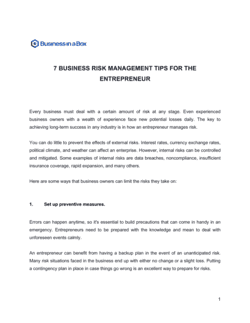
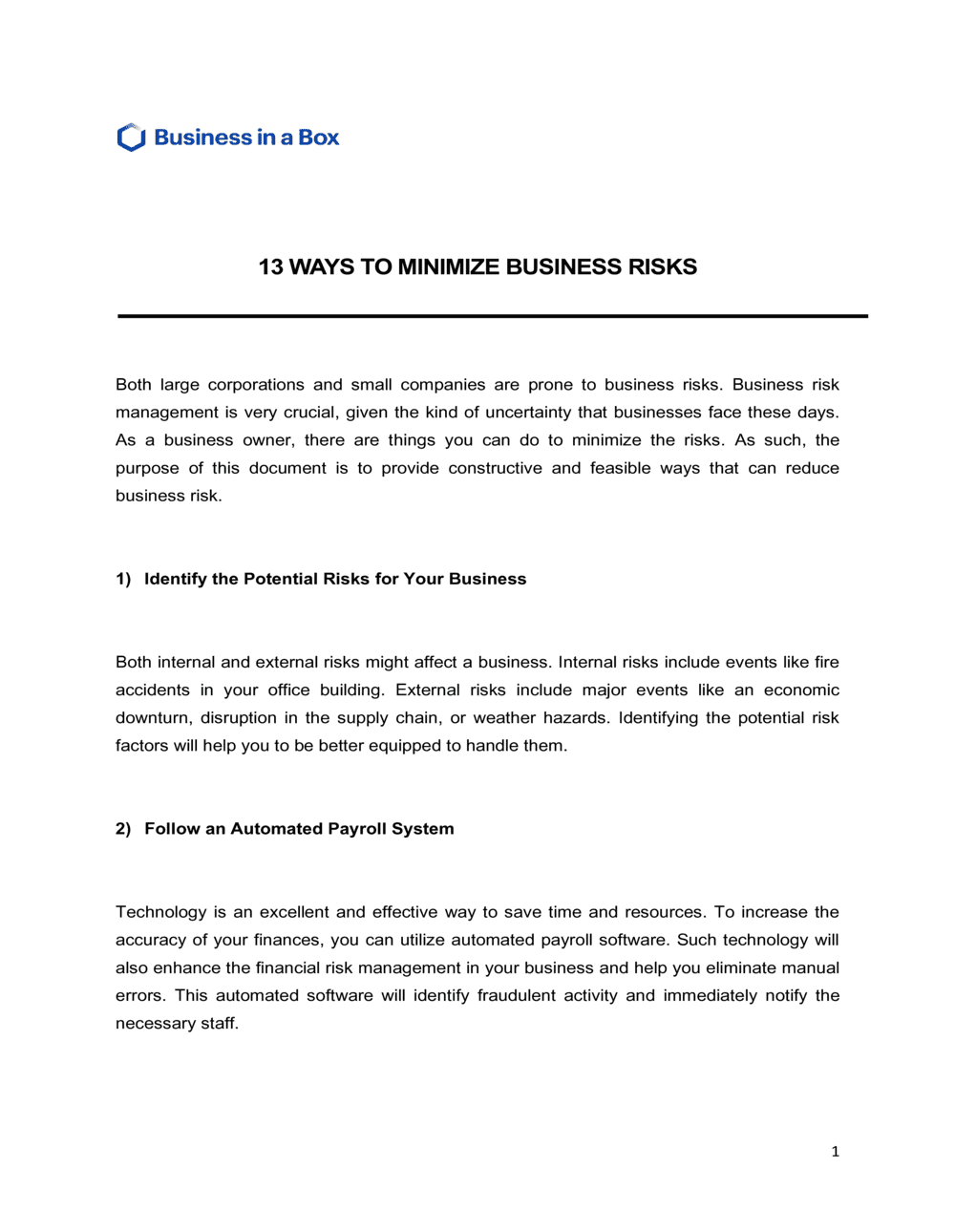
A How To Minimize Business Risk document is a structured operational guide that helps business owners and managers identify, assess, and reduce the threats that could disrupt operations, finances, or reputation. This free Word download gives you a step-by-step framework you can edit online and export as PDF to share with your leadership team, board, or advisors.
When you need it
Use it when launching a new venture, entering a new market, scaling operations, or responding to a disruptive event that has exposed gaps in your current risk controls. It is also valuable as an annual planning tool to keep your risk posture current as your business evolves.
What's inside
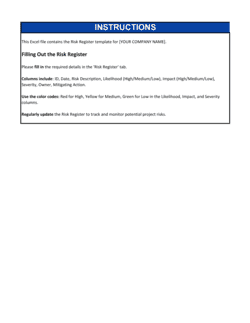
A risk identification inventory, probability and impact scoring matrix, prioritized mitigation strategies, contingency plans for high-severity risks, assigned ownership for each risk item, and a monitoring and review schedule to keep the document current over time.

What is a How To Minimize Business Risk Document?

A How To Minimize Business Risk document is a structured operational guide that walks business owners and managers through identifying, scoring, and reducing the threats most likely to disrupt their operations, finances, or reputation. It combines a risk identification inventory, a probability-impact scoring matrix, prioritized mitigation strategies, named risk ownership, measurable key risk indicators, and a scheduled review process into a single actionable plan. Unlike a general risk awareness checklist, this document produces a living register that connects each risk to a specific control, a responsible individual, and a measurable signal that triggers intervention before the risk event occurs.

Why You Need This Document

Without a structured risk minimization plan, threats accumulate undetected until they become crises β€” a customer representing 45% of revenue churns without a contingency plan in place, a key employee departs taking institutional knowledge with them, or a regulatory change creates compliance exposure that no one noticed building. The absence of documented risk ownership means that when something goes wrong, no one acts quickly enough because no one was designated to watch for it. Lenders, investors, and boards increasingly require evidence of formal risk management before extending capital or approving growth plans. This template gives you a reusable framework that turns informal risk awareness into an accountable, reviewable process β€” one that scales with your business and gives you the early warning signals to act on problems while they are still manageable.

Which variant fits your situation?

If your situation is…Use this template
Conducting an initial risk assessment for a new businessBusiness Risk Assessment
Managing risks across a specific project or initiativeProject Risk Management Plan
Documenting controls for regulatory compliance purposesCompliance Risk Management Plan
Planning for operational disruptions or disastersBusiness Continuity Plan
Recovering operations after a major disruption eventDisaster Recovery Plan
Assessing cybersecurity and data privacy risks specificallyIT Risk Assessment
Preparing a risk summary for investors or lendersRisk Management Report

Common mistakes to avoid

❌ Treating the document as a one-time exercise

Why it matters: A risk register completed once and filed becomes outdated within months as markets, regulations, and operations shift. Unreviewed plans give false confidence while real risk accumulates.

Fix: Embed a mandatory annual review and quarterly status check into the leadership calendar before finalizing the document.
❌ Assigning risk ownership to job titles instead of named individuals

Why it matters: Generic ownership means no single person is accountable when a KRI triggers β€” each person assumes someone else is watching, and the risk event occurs undetected.

Fix: Name a specific individual for every risk item and confirm acceptance of that responsibility in writing before the document is distributed.

❌ Scoring all risks as high without calibrating against dollar thresholds

Why it matters: When every risk is rated critical, the prioritization matrix collapses and teams spread mitigation resources uniformly β€” leaving the genuinely dangerous risks under-resourced.

Fix: Agree on a shared definition of each impact level β€” for example, a '5' means more than $500K in direct losses or operational shutdown exceeding 72 hours β€” before scoring begins.

❌ Writing contingency plans too vaguely to execute

Why it matters: A contingency plan that says 'respond appropriately and contact leadership' provides no real guidance under pressure, when the people executing it have limited time and information.

Fix: Write each contingency step as a specific numbered action with a named role, a time limit, and a defined output β€” a plan that a new hire could follow without context.

The 9 key sections, explained

Business Overview and Risk Context

Risk Identification Inventory

Probability and Impact Assessment

Risk Prioritization and Ranking

Mitigation Strategies

Risk Ownership and Accountability

Contingency Plans for Critical Risks

Key Risk Indicators and Monitoring Dashboard

Review and Update Schedule

How to fill it out

  1. 1

    Define the business context and scope

    Open the document by summarizing what your business does, its current strategic priorities, and what specific event or planning cycle is prompting this risk review.

    πŸ’‘ A one-paragraph context statement prevents scope creep β€” without it, teams often try to enumerate every conceivable risk rather than focusing on what is material to the business right now.

  2. 2

    Run a cross-functional risk identification session

    Gather input from at least three functional areas (finance, operations, and sales or marketing). Use the risk category list in the template as prompts and capture every risk without filtering.

    πŸ’‘ Set a 45-minute time limit for the brainstorm. Longer sessions tend to produce diminishing returns and circular repetition rather than genuinely new risk categories.

  3. 3

    Score each risk on probability and impact

    Rate each identified risk from 1 (very unlikely / minimal impact) to 5 (near-certain / catastrophic impact). Multiply the two scores to produce a composite risk score for ranking.

    πŸ’‘ Calibrate scores against concrete examples before scoring β€” agree as a group what a '5 impact' looks like in dollar or operational terms so scoring is consistent across raters.

  4. 4

    Prioritize using the probability-impact matrix

    Plot all risks on the matrix and group them into critical (15–25), significant (9–14), moderate (4–8), and low (1–3) tiers. Focus active mitigation on critical and significant tiers only.

    πŸ’‘ Resist the urge to mitigate every risk. Spending resources on low-scoring risks is itself an operational risk β€” it diverts attention and budget from what actually matters.

  5. 5

    Define mitigation strategies for each priority risk

    For each critical and significant risk, choose a strategy: avoid (eliminate the activity), reduce (control frequency or impact), transfer (insure or contract out), or accept (document the rationale and monitor). Write the specific action, responsible party, and deadline.

    πŸ’‘ Transfer strategies β€” insurance, indemnification clauses in contracts, outsourcing β€” are consistently underused by small businesses relative to their cost-effectiveness.

  6. 6

    Assign a named risk owner to every item

    Enter the name and title of the person accountable for monitoring and executing the mitigation plan for each risk. Avoid assigning the same person to more than five critical risks.

    πŸ’‘ Review ownership assignments with each risk owner in person β€” people who are assigned risk ownership without awareness become bottlenecks when a KRI fires.

  7. 7

    Set KRIs and thresholds for critical risks

    Identify one specific, measurable metric for each critical risk and set amber and red threshold values that give the team advance warning before the risk event materializes.

    πŸ’‘ KRI thresholds should be set at values that give at least 30 days of lead time β€” not at the point of no return.

  8. 8

    Schedule the first review and lock the cadence

    Enter the date of the next full review (no more than 12 months out), the quarterly status-check schedule, and at least four trigger events that would prompt an unscheduled review.

    πŸ’‘ Add the quarterly review dates to your leadership calendar before closing the document β€” a review that is not calendared does not happen.

Frequently asked questions

What does minimizing business risk mean?

Minimizing business risk means systematically identifying the threats that could disrupt your operations, finances, or reputation and then putting controls in place to reduce either the likelihood of those events occurring or the severity of their impact if they do. It does not mean eliminating all risk β€” some risk is inherent in every business activity. The goal is to ensure the risks you carry are conscious, proportionate, and matched by appropriate controls.

What are the main types of business risk?

Business risks fall into six broad categories: financial risks (cash flow shortfalls, customer concentration, currency exposure), operational risks (key-person dependency, supply chain disruption, process failures), strategic risks (market shift, competitive disruption, failed expansion), compliance and legal risks (regulatory change, contract disputes, data privacy breaches), reputational risks (public relations incidents, product failures, social media crises), and technology risks (cyberattacks, system downtime, data loss). A complete risk minimization plan addresses all six.

How do you identify business risks?

Start with a cross-functional brainstorm drawing on finance, operations, sales, and legal perspectives. Use structured prompts across the six risk categories to surface risks that any single function might miss. Supplement internal views with external sources β€” industry association reports, insurance broker risk surveys, and post-incident reviews from comparable businesses. Then score each risk by probability and impact to prioritize where to focus mitigation effort.

What is a risk register and do I need one?

A risk register is the master log that captures every identified risk, its probability and impact scores, assigned owner, mitigation strategy, KRI thresholds, and review status. Any business with more than a handful of employees and material operational or financial exposure benefits from maintaining one. It converts informal risk awareness into a structured, accountable process and provides the documentation trail that insurers, lenders, and boards increasingly expect to see.

What is the difference between risk mitigation and risk transfer?

Risk mitigation reduces the probability or impact of a risk through internal controls β€” diversifying your customer base, adding redundant systems, or hiring backup personnel. Risk transfer shifts the financial consequence of a risk to a third party β€” typically through insurance, contractual indemnification, or outsourcing. Both are valid strategies; small businesses often underuse transfer relative to its cost-effectiveness, particularly for low-probability but high-impact events like property damage or professional liability claims.

How often should a business risk plan be updated?

A full review of the risk register should happen at least annually, aligned to your fiscal year planning cycle. A lighter quarterly status check β€” confirming that KRIs are within thresholds and mitigation actions are on track β€” keeps the plan current between full reviews. An unscheduled review should be triggered by any major business change: an acquisition, a significant new customer, a regulatory update, a security incident, or a revenue decline of more than 15% in a single quarter.

What is a key risk indicator (KRI) and how is it different from a KPI?

A KPI (Key Performance Indicator) measures whether the business is achieving its goals. A KRI measures whether a specific risk is approaching its tolerance threshold β€” it is a leading indicator of a potential problem rather than a measure of current performance. For example, customer concentration above 30% of revenue is a KRI for the financial risk of client loss; it signals elevated exposure before any actual disruption occurs.

Do small businesses need a formal risk minimization plan?

Yes β€” and the argument is stronger for small businesses than large ones, because small businesses have less buffer to absorb an unexpected shock. A single uninsured event, a key-person departure, or a customer accounting for 40% of revenue churning can be existential for a small business but manageable for a large one. A structured plan does not need to be elaborate: a one-page risk register with scores, owners, and a review date provides most of the protection value at a fraction of the effort.

What is the difference between a risk minimization plan and a business continuity plan?

A risk minimization plan is proactive β€” it identifies and reduces risks before they occur. A business continuity plan is reactive β€” it defines how the business will keep operating during and after a major disruption event. They are complementary: a risk minimization plan reduces the probability that you will ever need to activate the continuity plan, but every business should have both, because no mitigation strategy eliminates all risk entirely.

How this compares to alternatives

vs Business Continuity Plan

A business continuity plan defines how operations will continue during and after a major disruption β€” it is activated after a risk event occurs. A risk minimization plan is proactive, designed to reduce the probability and impact of risks before they materialize. Both documents are complementary: the risk plan feeds the contingency sections of the continuity plan.

vs Disaster Recovery Plan

A disaster recovery plan focuses specifically on restoring IT systems, data, and infrastructure after a critical failure or cyberattack. A risk minimization plan covers the full spectrum of business risks β€” financial, operational, strategic, and reputational β€” not just technology. Use both if technology systems are core to your business model.

vs Business Risk Assessment

A risk assessment is a snapshot evaluation of risks at a point in time β€” it produces the scored risk inventory. A risk minimization plan goes further: it takes the assessment output and adds mitigation strategies, risk ownership, KRIs, contingency plans, and a structured review cadence. The assessment feeds the plan.

vs Strategic Plan

A strategic plan defines goals, initiatives, and resource allocation to drive growth. A risk minimization plan identifies what could prevent those goals from being achieved and puts controls in place to reduce that probability. For a strategic plan to be credible, its key assumptions should be stress-tested against the risks documented in the minimization plan.

Industry-specific considerations

Financial Services

Regulatory compliance risk and credit exposure require formal risk registers aligned to frameworks like COSO or ISO 31000, with board-level reporting on residual risk positions.

Healthcare

Patient safety, HIPAA data privacy, and licensing compliance risks are subject to regulatory audit, making documented mitigation strategies and assigned ownership mandatory rather than optional.

Manufacturing

Supply chain concentration, equipment failure, and workplace safety risks dominate the register, with KRIs tied to supplier lead times, maintenance schedules, and incident rates.

SaaS / Technology

Cybersecurity breaches, data loss, and key-person dependency on engineering talent are the highest-impact risks, with mitigation centered on redundancy, access controls, and retention programs.

Template vs pro β€” what fits your needs?

PathBest forCostTime
Use the templateSmall business owners and operators building a structured risk process for the first timeFree4–8 hours across one or two working sessions
Template + professional reviewGrowing businesses with board oversight, investor reporting requirements, or regulatory exposure$500–$2,000 for a risk consultant or CFO advisory review1–2 weeks
Custom draftedEnterprises in regulated industries, businesses seeking ISO 31000 alignment, or companies preparing for acquisition due diligence$5,000–$20,000+ for a formal enterprise risk management engagement4–12 weeks

Glossary

Risk Register
A master log listing every identified risk, its probability and impact scores, assigned owner, mitigation action, and current status.
Inherent Risk
The level of risk that exists before any controls or mitigation measures are applied.
Residual Risk
The level of risk that remains after controls and mitigation actions have been implemented.
Risk Appetite
The amount and type of risk an organization is willing to accept in pursuit of its objectives.
Risk Tolerance
The acceptable variation around a risk appetite threshold β€” how far above the set limit the organization can operate before action is required.
Probability-Impact Matrix
A scoring grid that plots each risk by likelihood of occurrence against the severity of its potential impact, used to prioritize mitigation effort.
Mitigation Strategy
A specific action or control designed to reduce the probability or impact of an identified risk.
Risk Owner
The individual accountable for monitoring a specific risk and executing its mitigation plan.
Key Risk Indicator (KRI)
A measurable metric that signals when a risk is approaching or exceeding its tolerance threshold, enabling early intervention.
Contingency Plan
A pre-defined response plan activated when a risk event occurs despite mitigation efforts, aimed at limiting damage and restoring normal operations.
Force Majeure
Unforeseeable external events β€” such as natural disasters, pandemics, or geopolitical disruptions β€” that fall outside normal operational risk planning.

Part of your Business Operating System

This document is one of 3,000+ business & legal templates included in Business in a Box.

  • Fill-in-the-blanks β€” ready in minutes
  • Compatible with all office suites
  • Export to PDF and share electronically

Create your document in 3 simple steps.

From template to signed document β€” all inside one Business Operating System.
1
Download or open template

Access over 3,000+ business and legal templates for any business task, project or initiative.

2
Edit and fill in the blanks with AI

Customize your ready-made business document template and save it in the cloud.

3
Save, Share, Send, Sign

Share your files and folders with your team. Create a space of seamless collaboration.

Save time, save money, and create top-quality documents.

β˜…β˜…β˜…β˜…β˜…

"Fantastic value! I'm not sure how I'd do without it. It's worth its weight in gold and paid back for itself many times."

Managing Director Β· Mall Farm
Robert Whalley
Managing Director, Mall Farm Proprietary Limited
β˜…β˜…β˜…β˜…β˜…

"I have been using Business in a Box for years. It has been the most useful source of templates I have encountered. I recommend it to anyone."

Business Owner Β· 4+ years
Dr Michael John Freestone
Business Owner
β˜…β˜…β˜…β˜…β˜…

"It has been a life saver so many times I have lost count. Business in a Box has saved me so much time and as you know, time is money."

Owner Β· Upstate Web
David G. Moore Jr.
Owner, Upstate Web

Run your business with a system β€” not scattered tools

Stop downloading documents. Start operating with clarity. Business in a Box gives you the Business Operating System used by over 250,000 companies worldwide to structure, run, and grow their business.

Start freeΒ Β·Β No credit card required