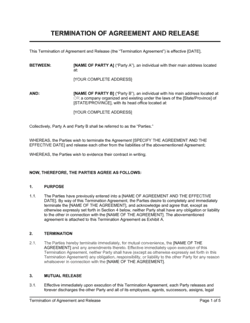
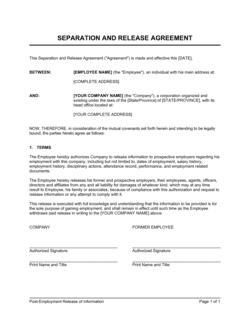
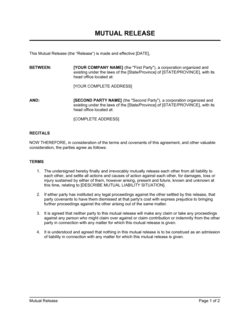
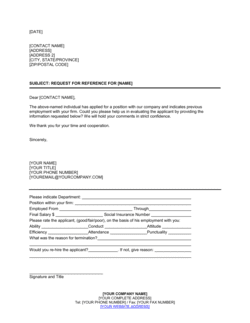
Employee Reference Release Agreement Template

Free Word download • Edit online • Save & share with Drive • Export to PDF

2 pages20–30 min to fillDifficulty: StandardSignature requiredLegal review recommended
Learn more ↓
FreeEmployee Reference Release Agreement Template

At a glance

What it is
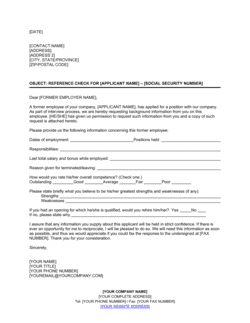
An Employee Reference Release Agreement is a legally binding document in which an employee or job applicant authorizes a current or former employer to disclose employment information to a prospective employer and releases both parties from liability for good-faith statements made during the reference process. This free Word download gives HR teams and hiring managers a structured, editable template they can adapt to their reference policies and export as PDF for countersignature.
When you need it
Use it whenever a departing employee requests a reference letter, when a prospective employer conducts a background or reference check, or when an HR policy requires written authorization before employment records are shared with any third party. It is also appropriate when an employer wants a documented liability shield before responding to reference inquiries.
What's inside
The agreement covers the identity of all parties, the scope of information authorized for disclosure, a liability release for good-faith statements, confidentiality obligations, the duration of the authorization, and governing law. It includes signature blocks for both the employee and an authorized employer representative.

What is an Employee Reference Release Agreement?

An Employee Reference Release Agreement is a legally binding document in which an employee authorizes a current or former employer to disclose specific employment information to a prospective employer or recruiter, and releases both parties from liability for truthful, good-faith statements made during that reference process. It defines exactly which categories of information may be shared — such as dates of employment, job title, compensation, reason for separation, and performance assessment — while simultaneously creating a documented consent record that satisfies privacy law requirements and reduces the employer's exposure to defamation claims. The agreement is typically executed at or after separation, or at the point a job applicant formally requests that a reference check be conducted.

Why You Need This Document

Without a signed reference release, employers face a difficult choice every time a reference request arrives: decline entirely and risk damaging a former employee's prospects, or respond and risk a defamation claim if any detail is perceived as negative. A properly drafted release eliminates that dilemma by documenting exactly what was authorized, by whom, and for which recipient. From the employee's perspective, the release gives them control — they decide what is shared, with whom, and for how long — rather than leaving the scope of disclosure to the employer's discretion. For HR teams, the agreement standardizes the reference process across the organization, ensures that only a designated spokesperson responds to inquiries, and creates the audit trail that privacy regulators in Canada, the EU, and the UK require before personal employment data may be disclosed. Using this template means you start with language calibrated to all four major jurisdictions rather than discovering the gaps after a claim has been filed.

Which variant fits your situation?

If your situation is…Use this template
Authorizing a former employer to provide a verbal or written reference to one specific companyEmployee Reference Release Agreement (Single Recipient)
Granting open authorization to share references with multiple prospective employers over timeGeneral Employment Reference Authorization Form
Requesting a formal reference letter rather than authorizing a reference checkReference Letter Template
Checking a candidate's background beyond employment history (criminal, credit, education)Background Check Authorization Form
Documenting a mutual agreement on what the employer will say about the departing employeeSeparation Agreement with Reference Clause
Restricting what a former employer may disclose during the reference processMutual Non-Disparagement Agreement
Onboarding a new hire who requires reference verification before start datePre-Employment Reference Check Form

Common mistakes to avoid

❌ Using a catch-all disclosure scope

Why it matters: Authorizing 'any employment-related information' without specifying categories can inadvertently permit disclosure of medical leave records, HR investigation outcomes, or accommodation requests — creating HIPAA, ADA, and privacy law exposure.

Fix: List only the specific categories of information to be disclosed and confirm each is documented in the employee's personnel file before signing.

❌ Omitting a duration or expiration date

Why it matters: An open-ended release can be invoked years after signing to justify disclosures the employee would never have authorized for a later audience — and may violate GDPR's purpose-limitation and storage-limitation principles.

Fix: Always specify a duration — 90 days for an active search, up to 12 months for a general authorization — and include a clear revocation procedure.

❌ Presenting the release the same day as termination

Why it matters: Courts in several US states and most Canadian provinces have scrutinized or voided releases obtained under duress during a stressful termination meeting, particularly when the employee had no opportunity to consult counsel.

Fix: Send the release in advance of any required signing and document that the employee had time to review it. A 48-to-72-hour review window is a defensible minimum.

❌ Failing to designate a single authorized spokesperson

Why it matters: Without a designated reference contact, managers across the organization may respond to inquiries independently — providing inconsistent or unauthorized information that falls outside the release's liability protection.

Fix: Name a single HR point of contact in the agreement and brief all managers to redirect reference inquiries to that person without providing any independent comment.

❌ Drafting a blanket liability release with no good-faith limitation

Why it matters: A release covering false or malicious statements is void as against public policy in most jurisdictions and signals to courts that the release itself was designed to shield misconduct rather than facilitate honest communication.

Fix: Limit the release explicitly to 'good-faith, truthful statements' and ensure the language aligns with the qualified-privilege standard applicable in your jurisdiction.

❌ Ignoring privacy law requirements for the governing jurisdiction

Why it matters: GDPR in the EU and PIPEDA in Canada require that any consent to disclose personal data be freely given, specific, informed, and time-limited. A generic US-style release that lacks these features may be unenforceable in non-US jurisdictions.

Fix: Add jurisdiction-specific privacy language — or a separate privacy consent addendum — for employees based in the EU, UK, or Canada to ensure the release satisfies local data protection standards.

The 9 key clauses, explained

Parties and recitals

In plain language: Identifies the employee granting the release, the current or former employer being authorized to disclose, and the prospective employer or recipient authorized to receive the information.

Sample language
This Employee Reference Release Agreement ('Agreement') is entered into as of [DATE] by and between [EMPLOYEE FULL NAME] ('Employee') and [EMPLOYER LEGAL NAME], a [STATE/PROVINCE] [ENTITY TYPE] ('Employer'), with respect to employment reference disclosures to [RECIPIENT NAME OR 'any prospective employer identified by Employee'].

Common mistake: Naming only the HR contact instead of the legal entity as the disclosing party. If a defamation claim is filed, the claim must run against the correct legal entity — a contact name creates an unresolvable gap.

Scope of authorized disclosure

In plain language: Lists the specific categories of employment information the employer may share — typically dates of employment, job title, department, salary, reason for leaving, and a general performance assessment.

Sample language
Employee authorizes Employer to disclose the following categories of information: (a) dates of employment ([START DATE] to [END DATE]); (b) positions held; (c) final compensation ([$X] per [year/hour]); (d) reason for separation; (e) general performance and conduct assessment; (f) eligibility for rehire.

Common mistake: Using a catch-all like 'any employment-related information' without specifying categories. Overly broad authorization may still expose the employer to claims if sensitive HR investigation records or medical leave details are inadvertently shared.

Liability release

In plain language: The employee releases both the disclosing employer and the recipient from liability for any claims arising from good-faith, truthful statements made during the reference process.

Sample language
Employee hereby releases and forever discharges Employer, its officers, directors, employees, and agents from any and all claims, demands, or causes of action arising out of or relating to any good-faith statement made by Employer in connection with an employment reference, including but not limited to claims of defamation, libel, slander, or invasion of privacy.

Common mistake: Omitting 'good-faith' from the release language. A blanket release for any statement — including knowingly false ones — is void as against public policy in most jurisdictions and will not protect the employer if malice is later proven.

Confidentiality of disclosed information

In plain language: Restricts the authorized recipient from further distributing or publishing the reference information beyond internal hiring decision-makers.

Sample language
Employee acknowledges that information disclosed pursuant to this Agreement is confidential and intended solely for the use of [RECIPIENT NAME] in evaluating Employee's candidacy for employment. Recipient shall not disclose such information to any third party without Employee's prior written consent.

Common mistake: Skipping this clause entirely. Without it, a reference shared with a prospective employer can be forwarded to competitors, posted online, or used in unrelated proceedings — creating exposure for both the employer and the employee.

Duration and revocation

In plain language: States how long the authorization remains valid and whether the employee may revoke it before expiration.

Sample language
This authorization shall remain in effect for [90 days / one year] from the date of signing, unless revoked earlier by Employee in writing. Revocation does not affect disclosures already made in reliance on this Agreement prior to receipt of written notice of revocation.

Common mistake: Omitting a duration entirely, creating an open-ended release. A reference release with no expiration can be used years later to justify disclosures the employee would no longer authorize — raising both privacy and fairness concerns.

Authorized representative and title

In plain language: Designates the specific individual within the employer organization who is authorized to respond to reference inquiries, preventing unauthorized disclosures by managers or colleagues.

Sample language
All reference inquiries directed to Employer pursuant to this Agreement shall be handled exclusively by [NAME / TITLE / DEPARTMENT], reachable at [CONTACT INFORMATION]. Unauthorized disclosures by other Employer personnel are not covered by this Agreement.

Common mistake: Failing to designate a single authorized spokesperson. When multiple managers respond to reference calls independently, the employer loses control of the narrative, increases defamation risk, and may violate its own reference policy.

Entire agreement and amendment

In plain language: Confirms this document is the complete agreement between the parties on the subject of reference disclosures, superseding any prior verbal agreements or promises.

Sample language
This Agreement constitutes the entire agreement of the parties with respect to employment reference disclosures and supersedes all prior or contemporaneous oral or written representations on the subject. This Agreement may be amended only by a written instrument signed by both parties.

Common mistake: Not including this clause when a prior separation agreement or employment contract contains a non-disparagement provision. Without integration language, courts may find the two documents conflict — creating ambiguity about which controls.

Governing law and dispute resolution

In plain language: Specifies which jurisdiction's law governs the agreement and the method for resolving disputes — arbitration, mediation, or litigation.

Sample language
This Agreement shall be governed by the laws of [STATE / PROVINCE / COUNTRY], without regard to conflict-of-laws principles. Any dispute arising under this Agreement shall be resolved by [binding arbitration / mediation / litigation in the courts of [JURISDICTION]].

Common mistake: Choosing a governing law state that has no connection to where the employee worked. Several states — California in particular — apply local employment law regardless of contractual choice-of-law provisions.

Employee acknowledgment and voluntary execution

In plain language: Confirms the employee had the opportunity to review the agreement, was not coerced into signing, and understands the rights being released.

Sample language
Employee acknowledges that Employee has read this Agreement, had the opportunity to consult with legal counsel prior to signing, and executes this Agreement freely and voluntarily without duress or undue influence.

Common mistake: Presenting the form for signature during the final hour of the last workday with no time allowed for review. Courts in several jurisdictions have voided releases obtained under time pressure, particularly where the employee was not advised of their right to consult counsel.

How to fill it out

  1. 1

    Identify all parties by full legal name

    Enter the employee's full legal name, the employer's registered corporate name (not a brand name or department), and the full name of the prospective employer or recruiter authorized to receive the reference.

    💡 If the authorization is open — covering any future prospective employer — state that clearly rather than leaving the recipient field blank, which may create ambiguity about whether a specific inquiry was authorized.

  2. 2

    Define the scope of authorized disclosure

    Check each category of information the employee is authorizing the employer to share. Limit the list to information genuinely relevant to the hiring decision — dates, titles, salary, reason for leaving, performance, and rehire eligibility cover the vast majority of reference requests.

    💡 Exclude categories the employer cannot substantiate with documentation. If no formal performance review was conducted, do not authorize 'performance assessment' — a verbal characterization unsupported by records is a defamation risk.

  3. 3

    Draft the liability release in good-faith terms

    Ensure the release covers defamation, libel, slander, and invasion of privacy claims, but limits the protection to good-faith, truthful statements. Review the language against your jurisdiction's qualified-privilege statute or case law.

    💡 In Canada and the UK, qualified privilege already provides statutory or common-law protection for honest references — the release clause reinforces that protection but should not overstate it.

  4. 4

    Set a specific duration for the authorization

    Enter a fixed expiration date or a duration from signing — 90 days is common for active job searches; 12 months works for ongoing reference availability. Include revocation language stating that prior disclosures remain valid even after revocation.

    💡 For GDPR and PIPEDA compliance, avoid open-ended authorizations. Privacy regulators expect a defined purpose and time limit for any consent to disclose personal data.

  5. 5

    Designate a single authorized spokesperson

    Name the HR manager, HR business partner, or designated representative who will handle all reference inquiries. Include their direct contact information so prospective employers do not call random managers.

    💡 Brief the spokesperson on the scope of the release before any calls are made. A spokesperson who shares unauthorized information — even inadvertently — can void the liability protection.

  6. 6

    Add governing law and dispute resolution

    Select the state, province, or country whose laws govern the agreement based on where the employee performed their work — not where the employer is incorporated. Choose an appropriate dispute resolution mechanism for the risk level.

    💡 For senior employees with complex separation terms, arbitration is generally preferable to litigation for cost and confidentiality reasons.

  7. 7

    Obtain signatures before any reference is given

    Both the employee and an authorized employer representative must sign and date the agreement before any reference disclosure is made. Use BIB eSign or a PDF with wet-ink signatures and retain a copy in the employee's personnel file.

    💡 Send the agreement to the employee at least 48 hours before requesting a signature. Same-day signing under deadline pressure is the single most common reason courts scrutinize reference releases.

Frequently asked questions

What is an employee reference release agreement?

An employee reference release agreement is a signed document in which an employee authorizes a current or former employer to disclose specific employment information to a prospective employer or recruiter, and releases both parties from liability for good-faith, truthful statements made during that process. It creates a documented consent trail that protects the disclosing employer from defamation claims and gives the employee control over what information is shared and with whom.

Is a reference release agreement legally required?

No federal or state law in the US specifically mandates a written reference release before an employer may respond to a reference inquiry. However, many privacy laws — including GDPR in the EU, PIPEDA in Canada, and various US state statutes — treat employment information as personal data and require consent or a legitimate basis for its disclosure. Using a signed release is considered best practice in all jurisdictions and is often required by internal HR policy.

Does a reference release protect an employer from defamation claims?

A properly drafted release — limited to good-faith, truthful statements — significantly reduces defamation exposure. In most common-law jurisdictions, employers also benefit from a qualified privilege that protects honest references absent malice. The release reinforces that protection by documenting the employee's consent. It does not, however, protect an employer who knowingly makes false or malicious statements — no release can waive liability for bad-faith conduct.

Can an employee revoke a reference release after signing?

Yes, in most jurisdictions an employee can revoke a prospective release before disclosures are made. The agreement should specify the revocation procedure — typically written notice to the designated HR contact — and make clear that revocation does not affect disclosures already made in good faith before the employer received notice. Once a reference has been provided, it cannot be un-given; the release covers that disclosure regardless of subsequent revocation.

What employment information can an employer legally disclose in a reference?

Dates of employment, positions held, final compensation, reason for separation, and general performance assessment are the most commonly disclosed categories and carry the lowest risk when accurate and documented. Medical information, disability accommodations, workers' compensation claims, pregnancy, and union activity should not be disclosed. Some US states limit references to title and dates of employment only; the release should be tailored to what the employer's policy actually permits.

What is the difference between a reference release and a reference letter?

A reference release is an authorization document — it gives the employer permission to speak to a third party and releases liability for doing so. A reference letter is the substantive document the employer produces, describing the employee's performance, character, and accomplishments. The release enables and protects the letter or verbal reference; the two serve different functions and should be used together.

Should a reference release name a specific prospective employer or be open?

Naming a specific authorized recipient is more defensible from a privacy standpoint — especially under GDPR and PIPEDA — because the consent is specific and purposeful. An open authorization covering any future employer is convenient for candidates in active job searches but may be challenged as insufficiently specific under privacy law. A practical compromise is a 90-day open authorization that expires and requires renewal, rather than a perpetual open-ended release.

Do reference releases need to be notarized?

Notarization is not required for a reference release agreement to be valid in any common jurisdiction. A signed and dated document with identified parties is typically sufficient. However, retaining a timestamped electronic signature record — for example, via a compliant eSign platform — provides a stronger audit trail than a scanned paper signature in the event of a later dispute.

Can a reference release be part of a separation agreement?

Yes, and this is a common approach. Including reference terms — scope of disclosure, authorized spokesperson, agreed language — within a separation agreement ties the reference protocol to the broader settlement. If you take this approach, ensure the separation agreement includes a specific reference clause rather than relying on a general non-disparagement provision, which may not address scope of disclosure or authorization in enough detail.

How this compares to alternatives

vs Reference Letter

A reference letter is a written endorsement the employer produces describing the employee's qualifications and performance. A reference release agreement is the authorization document that permits the employer to produce that letter or respond to verbal inquiries. The release protects the employer legally; the letter communicates the substance. Both are needed for a defensible reference process.

vs Employee Separation Agreement

A separation agreement governs the full terms of an employment ending — severance, benefits, non-disparagement, and claims release. A reference release agreement is a narrower, standalone authorization covering only what employment information may be disclosed and to whom. Separation agreements often include a reference clause, but a standalone release provides more granular scope control and can be used without a formal separation.

vs Non-Disclosure Agreement

An NDA restricts what an employee may disclose about the employer's business, clients, and confidential information. A reference release agreement operates in the opposite direction — it authorizes what the employer may disclose about the employee. The two documents address different disclosure flows and are not substitutes for each other; many offboarding packages include both.

vs Background Check Authorization Form

A background check authorization form gives a third-party screening company permission to verify criminal records, credit history, education, and prior employment across multiple sources. A reference release agreement authorizes a specific former employer to speak to a specific prospective employer about defined employment topics. Background check authorizations are broader in source scope; reference releases are more targeted and typically cover professional judgment and performance information that a background check vendor cannot obtain.

Industry-specific considerations

Financial Services

Regulatory licensing bodies such as FINRA and the FCA may independently request employment history verification, making a documented release essential for both the employer and the departing registered representative.

Healthcare

Credentialing bodies and hospital systems require detailed employment verifications including separation reasons and clinical performance assessments, which require explicit written authorization under HIPAA and state licensing rules.

Technology / SaaS

High employee mobility and reference requests involving access to proprietary systems or IP make a scoped disclosure clause — explicitly excluding NDA-protected project details — particularly important.

Professional Services

Law firms, accounting practices, and consulting firms routinely conduct reference checks that include client relationship history and billing performance — categories that require explicit authorization to avoid confidentiality breaches.

Jurisdictional notes

United States

Most US states extend qualified privilege to good-faith employment references, significantly reducing defamation exposure. However, some states — including California, Colorado, and New York — have enacted statutes further limiting or structuring what employers may disclose. Several states prohibit blacklisting (discouraging future employment) by statute. The release should be calibrated to the law of the state where the employee worked, not where the employer is headquartered.

Canada

PIPEDA and provincial privacy legislation — including Quebec's Law 25 (Bill 64) — treat employment information as personal data, requiring a documented consent basis for any disclosure. Quebec's French-language requirements apply to employment documents for provincially regulated employers. Qualified privilege protects honest references under common law, but the written release strengthens that protection and satisfies the documented-consent standard privacy regulators expect.

United Kingdom

UK employers have no legal obligation to provide a reference but do have a duty of care to ensure any reference given is accurate and not misleading. UK GDPR and the Data Protection Act 2018 require a lawful basis for disclosing personal data, with consent being one of the most straightforward bases. The release should state that the employee consents to processing under UK GDPR Article 6(1)(a) and, where special-category data might be involved, Article 9(2)(a).

European Union

GDPR requires that consent to disclose personal data be freely given, specific, informed, and unambiguous — a generic or pre-ticked release will not satisfy these requirements. The authorization must state the specific categories of data, the named recipient, and the retention period. Employees retain the right to withdraw consent at any time under Article 7(3), and the release language must acknowledge this. Member states including Germany, France, and the Netherlands have additional employment data protection rules layered on top of GDPR.

Template vs lawyer — what fits your deal?

PathBest forCostTime
Use the templateHR teams standardizing a reference disclosure process for routine separations of non-executive employeesFree15–20 minutes per agreement
Template + legal reviewEmployers with employees in multiple US states, Canadian provinces, or EU member states, or any release signed in connection with a contested termination$200–$500 for a 1-hour employment attorney review1–3 business days
Custom draftedExecutive separations with equity, regulated industries (financial services, healthcare), or cross-border employment with GDPR or PIPEDA compliance requirements$800–$2,500+3–7 business days

Glossary

Reference Release
Written permission from an employee authorizing a named employer to disclose employment information to a specified third party.
Liability Waiver
A clause in which the signing party gives up the right to pursue legal claims arising from a defined act — here, good-faith statements made during a reference check.
Authorized Recipient
The prospective employer, recruiter, or other party to whom the releasing employer is permitted to disclose employment information.
Scope of Disclosure
The specific categories of information the employer is authorized to share — such as dates of employment, job title, salary, reason for separation, and performance assessment.
Good-Faith Statement
A truthful, non-malicious statement made without intent to harm — the standard typically required for a liability release in an employment reference context to be enforceable.
Qualified Privilege
A legal doctrine in most common-law jurisdictions that protects employers from defamation claims when providing honest employment references, provided there is no malice.
Defamation
A false statement of fact communicated to a third party that damages a person's reputation — the primary legal risk employers face when providing negative employment references.
Non-Disparagement Clause
A contractual provision preventing one or both parties from making negative public or private statements about the other.
At-Will Employment
An employment relationship in most US states where either party may end employment at any time without cause — relevant to reference agreements because the reason for separation may be sensitive.
Privacy Legislation
Federal and provincial or state laws governing the collection, use, and disclosure of personal information — such as GDPR in the EU, PIPEDA in Canada, and various US state privacy statutes.
Governing Law Clause
A provision specifying which jurisdiction's laws will be used to interpret and enforce the agreement in the event of a dispute.

Part of your Business Operating System

This document is one of 3,000+ business & legal templates included in Business in a Box.

  • Fill-in-the-blanks — ready in minutes
  • 100% customizable Word document
  • Compatible with all office suites
  • Export to PDF and share electronically

Create your document in 3 simple steps.

From template to signed document — all inside one Business Operating System.
1
Download or open template

Access over 3,000+ business and legal templates for any business task, project or initiative.

2
Edit and fill in the blanks with AI

Customize your ready-made business document template and save it in the cloud.

3
Save, Share, Send, Sign

Share your files and folders with your team. Create a space of seamless collaboration.

Save time, save money, and create top-quality documents.

★★★★★

"Fantastic value! I'm not sure how I'd do without it. It's worth its weight in gold and paid back for itself many times."

Managing Director · Mall Farm
Robert Whalley
Managing Director, Mall Farm Proprietary Limited
★★★★★

"I have been using Business in a Box for years. It has been the most useful source of templates I have encountered. I recommend it to anyone."

Business Owner · 4+ years
Dr Michael John Freestone
Business Owner
★★★★★

"It has been a life saver so many times I have lost count. Business in a Box has saved me so much time and as you know, time is money."

Owner · Upstate Web
David G. Moore Jr.
Owner, Upstate Web

Run your business with a system — not scattered tools

Stop downloading documents. Start operating with clarity. Business in a Box gives you the Business Operating System used by over 250,000 companies worldwide to structure, run, and grow their business.

Free Forever Plan · No credit card required