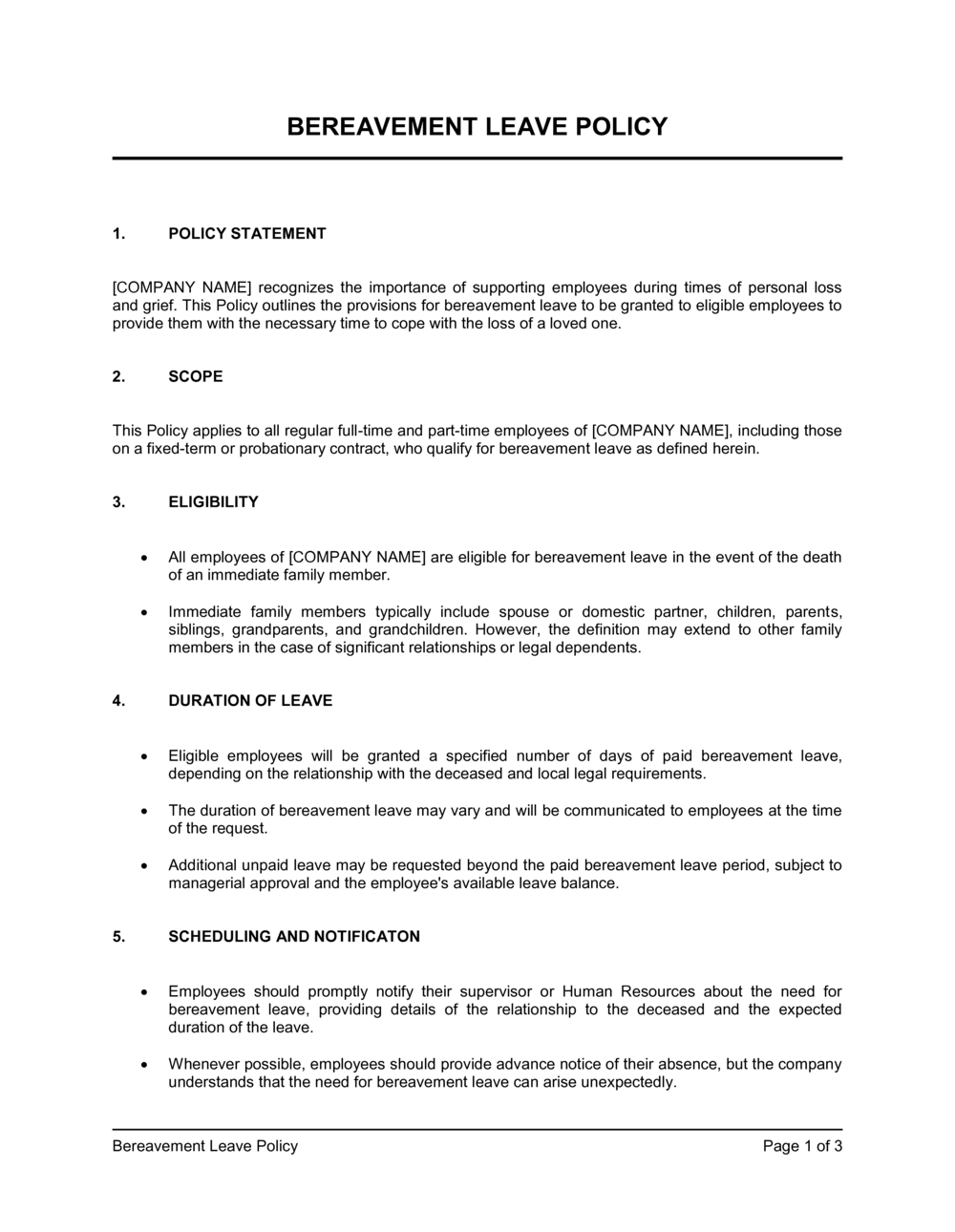
Bereavement Leave Policy Template

Free Word download β€’ Edit online β€’ Save & share with Drive β€’ Export to PDF

3 pagesβ€’20–25 min to fillβ€’Difficulty: Standard
Learn more ↓
FreeBereavement Leave Policy Template

At a glance

What it is
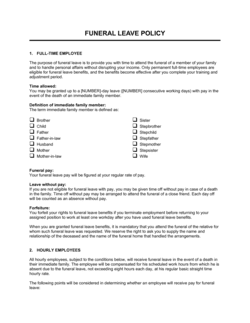
A Bereavement Leave Policy is an internal HR document that defines how much paid or unpaid time off employees receive following the death of a family member or close relation, which relationships qualify, and how employees request and document the leave. This free Word download gives you a structured, ready-to-edit template you can tailor to your organization's size and values, then publish directly in your employee handbook or HR portal.
When you need it
Use it when onboarding your first employees, updating an existing employee handbook, or responding to a bereavement situation where your organization has no written policy in place. Any employer with more than one staff member benefits from having a clear, written policy before a loss occurs.
What's inside
Purpose and scope, definitions of covered relationships, paid and unpaid leave entitlements by relationship tier, request and notification procedures, documentation requirements, provisions for travel or extended circumstances, and return-to-work support guidance.

What is a Bereavement Leave Policy?

A Bereavement Leave Policy is a formal HR document that defines an organization's rules for granting employees paid or unpaid time off following the death of a qualifying family member or close relation. It specifies which relationships are covered, how many days each tier receives, how employees notify their manager and HR, what documentation may be requested, and how the leave interacts with other benefits such as PTO or state-mandated leave. By setting these parameters in writing before a loss occurs, the policy enables managers to respond consistently and compassionately without making case-by-case judgment calls under pressure.

Why You Need This Document

Without a written bereavement leave policy, every manager handles a death differently β€” one approves five days, another approves one, and a third tells the employee to use sick time. The inconsistency erodes trust, generates legal exposure, and puts grieving employees in the position of negotiating at the worst possible moment. Several states, including California, Illinois, and Oregon, now mandate minimum bereavement leave entitlements; a company with no written policy has no way to demonstrate compliance. Beyond legal risk, the absence of a policy sends a clear cultural signal: the organization has not thought about how it treats people during one of the hardest experiences of their lives. This template gives you a complete, customizable policy you can finalize in under two hours and distribute immediately β€” so when the next employee experiences a loss, your response is consistent, documented, and humane.

Which variant fits your situation?

If your situation is…Use this template
Setting a standalone policy distributed outside the employee handbookBereavement Leave Policy
Incorporating bereavement leave into a full employee handbookEmployee Handbook
Documenting a broader paid time off program that includes bereavementPaid Time Off (PTO) Policy
Covering extended absences for serious illness of a family memberFamily and Medical Leave Policy
Outlining leave entitlements specific to a unionized workforceCollective Bargaining Agreement Addendum
Providing a formal written response to an employee bereavement requestBereavement Leave Request Letter
Documenting flexible work arrangements during an employee's grief periodRemote Work Agreement

Common mistakes to avoid

❌ Excluding domestic partners and chosen family

Why it matters: Employees in non-traditional family structures receive no bereavement benefit, creating an inequitable two-tier system that damages morale and can generate discrimination complaints.

Fix: Explicitly list domestic partners, step-relatives, and add a manager-discretion clause for close relationships that don't fit a predefined category.

❌ Requiring documentation before leave begins

Why it matters: Forcing a grieving employee to produce a death certificate or obituary immediately after a loss creates unnecessary hardship and signals distrust β€” and the fraud risk bereavement policies face is extremely low.

Fix: Allow documentation to be submitted within three to five business days after the employee returns to work, not as a condition of approval.

❌ Using calendar days without stating it

Why it matters: An employee who learns of a parent's death on Friday may exhaust a three-day entitlement over the weekend before the funeral even occurs, leaving them no paid leave to attend.

Fix: Define the day type explicitly as business days in the policy, and count from the first day the employee is unable to work β€” not the date of death.

❌ Giving managers unlimited discretion with no approval guidelines

Why it matters: Without guardrails, managers in similar situations make different decisions β€” one approves an extension, another denies it β€” creating favoritism claims and inconsistent employee experiences across teams.

Fix: Define the maximum number of discretionary extension days, require HR sign-off for any extension beyond the standard entitlement, and document all decisions in the employee's HR file.

❌ Ignoring state and local bereavement leave mandates

Why it matters: States including California, Illinois, Oregon, and Maryland require minimum bereavement leave entitlements by statute; a policy that falls below the legal floor is unenforceable and exposes the employer to complaints and fines.

Fix: Before finalizing the policy, verify current statutes in every jurisdiction where you employ staff and confirm your entitlements meet or exceed each applicable minimum.

❌ No return-to-work acknowledgment or support

Why it matters: Employees who return to work with no acknowledgment from their manager report significantly lower engagement and higher short-term attrition β€” the cost of ignoring the transition far exceeds the cost of a five-minute check-in.

Fix: Build a manager check-in and EAP referral into the policy as a standard step, not an optional gesture, so it happens consistently.

The 9 key sections, explained

Purpose and scope

Covered relationships and leave tiers

Leave duration and pay continuation

Request and notification procedure

Documentation requirements

Travel and extended circumstance provisions

Interaction with other leave types

Manager responsibilities

Return-to-work support

How to fill it out

  1. 1

    Define your covered employee population

    Specify which employee classifications the policy covers β€” full-time, part-time above a weekly hours threshold, temporary, and contract staff. If contractors are excluded, state that explicitly to avoid ambiguity.

    πŸ’‘ Erring toward broader coverage is easier to defend than narrowing it later after an employee challenges an exclusion.

  2. 2

    Build your relationship tiers and day entitlements

    List every qualifying relationship category and assign a specific number of paid days to each tier. Common practice: three to five days for immediate family, one to three days for extended family, and one discretionary day for close friends.

    πŸ’‘ Include domestic partners and chosen family explicitly β€” omitting them is the single most common source of employee relations disputes under bereavement policies.

  3. 3

    Clarify calendar days versus business days

    Decide whether your entitlement counts calendar days or business days and state this clearly. Business days are almost always more employee-friendly and reduce calculation disputes.

    πŸ’‘ Business days also align with how employees think about their work schedule, making the policy easier to administer.

  4. 4

    Set the notification and documentation process

    Name the specific HR system or email address employees use to notify leave, list what information they must provide, and set a realistic documentation submission window β€” no earlier than the employee's first day back.

    πŸ’‘ A simple one-line notification to a manager followed by an HR email is sufficient for most organizations β€” complex forms add friction during an already difficult time.

  5. 5

    Add travel and extension provisions

    Include a clause for employees who need additional time due to long-distance or international travel. State the maximum extension, whether it is paid or unpaid, and the approval process.

    πŸ’‘ Cap the discretionary extension at a specific number of days β€” open-ended extensions create inconsistency and make payroll planning difficult.

  6. 6

    Cross-reference applicable state and local laws

    Check whether your jurisdiction has a bereavement leave statute that sets a minimum entitlement. If it does, confirm your policy meets or exceeds that floor, and cite the relevant law in the interaction-with-other-leave section.

    πŸ’‘ As of 2025, California requires up to five days for employees at companies with five or more staff β€” verify current statutes before finalizing.

  7. 7

    Publish the policy and communicate it to managers

    Add the policy to your employee handbook, post it on your HR portal, and brief all managers on the notification and approval process. Managers should receive a one-page quick-reference summary.

    πŸ’‘ A policy that exists but is unknown to managers is effectively no policy at all β€” document the communication step so you have a record.

  8. 8

    Schedule an annual review

    Set a calendar reminder to review the policy every 12 months against current state and local bereavement leave laws, your organization's attrition data, and peer benchmarks.

    πŸ’‘ Bereavement leave statutes are among the fastest-changing areas of employment law right now β€” an annual review takes 30 minutes and prevents a compliance gap.

Frequently asked questions

What is a bereavement leave policy?

A bereavement leave policy is a written HR document that defines how much paid or unpaid time off employees receive when a qualifying family member or close relation dies. It specifies which relationships are covered, how many days each relationship tier receives, how employees request the leave, what documentation may be required, and how the leave interacts with other time-off benefits. A written policy ensures consistent, equitable treatment across the entire organization.

Is bereavement leave required by law in the United States?

There is no federal law in the United States requiring employers to provide bereavement leave. However, several states and localities have enacted their own mandates β€” California, Illinois, Oregon, and Maryland among them β€” with specific minimum day requirements and covered relationships. Employers with staff in those jurisdictions must comply with state law regardless of what their internal policy says. All employers should verify current requirements in every state where they have employees before finalizing a policy.

How many days of bereavement leave should I offer?

Common practice among US employers is three to five business days for immediate family members (spouse, parent, child, sibling) and one to three days for extended family (grandparent, in-law, grandchild). Some employers offer additional discretionary days for travel or exceptional circumstances. Benchmarking against your industry and company size is useful β€” technology companies and large employers have trended toward more generous entitlements in recent years.

Can an employer require documentation to verify a bereavement absence?

Yes, employers may request documentation such as an obituary, funeral program, or copy of a death certificate to verify the qualifying event. Best practice is to allow employees to submit documentation after they return to work β€” requiring it as a condition of approval before leave begins creates unnecessary hardship. Given the low incidence of bereavement leave fraud, most HR professionals recommend requesting documentation only when there is a specific reason to do so.

Should bereavement leave apply to part-time employees?

Extending bereavement leave to part-time employees above a reasonable hours threshold β€” commonly 20 hours per week β€” is considered best practice. Excluding part-time staff entirely creates a two-tier system that can damage morale and, in some jurisdictions, raise questions about disparate impact. The policy should state the hours threshold explicitly so eligibility is clear to both employees and managers.

What family relationships should a bereavement leave policy cover?

At minimum, a policy should cover spouses, domestic partners, parents, children, and siblings as immediate family. Extended family coverage typically includes grandparents, grandchildren, in-laws, and step-relatives. Adding a manager-discretion clause for close friendships or non-traditional family structures β€” chosen family β€” reflects the diversity of modern households and reduces inequitable outcomes for employees whose closest relationships fall outside standard categories.

What is the difference between bereavement leave and compassionate leave?

Bereavement leave applies specifically after a death has occurred. Compassionate leave is a broader term used in some countries and organizations to cover both bereavement situations and leave taken to care for a critically ill family member before death. In US HR practice, the two terms are often used interchangeably, but a policy should define which situations it covers to avoid ambiguity when an employee requests leave for a dying β€” but not yet deceased β€” family member.

Can employees use PTO to extend bereavement leave?

Yes, and most well-drafted bereavement policies explicitly permit employees to supplement their bereavement entitlement with accrued PTO once the standard leave days are exhausted. The policy should state this option clearly, along with any approval requirements for an extended absence. Some employers also offer unpaid leave as an option for employees who have no accrued PTO remaining.

How often should a bereavement leave policy be reviewed?

An annual review is standard practice. Bereavement leave statutes at the state and local level have been among the fastest-changing areas of employment law in recent years, and what was compliant 18 months ago may no longer meet current minimums. An annual review β€” aligned to the start of each fiscal or plan year β€” takes under an hour and ensures the policy keeps pace with legal changes and evolving workforce expectations.

How this compares to alternatives

vs PTO Policy

A PTO policy governs how employees accrue and use general paid time off for vacation, personal days, and sometimes sick leave. A bereavement leave policy is a separate, dedicated entitlement triggered specifically by a death β€” employees should not be required to consume accrued PTO for bereavement before the dedicated policy applies. Both documents belong in every employee handbook.

vs Family and Medical Leave Policy

A family and medical leave policy covers extended absences β€” typically unpaid, job-protected leave β€” for the employee's own serious health condition or to care for an ill family member. Bereavement leave is a shorter, paid entitlement for grief and funeral attendance following a death. The two policies interact: an employee may transition from bereavement leave to FMLA if they need extended time beyond the standard entitlement.

vs Employee Handbook

An employee handbook is the comprehensive document housing all HR policies β€” including bereavement leave. A standalone bereavement leave policy is appropriate for organizations that need to publish or update a single policy without revising the entire handbook. Once finalized, the standalone policy is typically incorporated into the handbook at the next scheduled update.

vs Sick Leave Policy

Sick leave covers absences due to the employee's own illness or medical appointments. Bereavement leave is a distinct benefit for grief following a death β€” the two should not be conflated. Requiring employees to use sick leave for bereavement, where a dedicated policy exists, is considered poor practice and may conflict with state laws that distinguish the two entitlements.

Industry-specific considerations

Technology / SaaS

Remote and distributed teams require clear guidance on time-zone-agnostic notification procedures and extended leave for international travel to attend services abroad.

Healthcare

Shift-based scheduling requires the policy to address coverage handoff procedures and clarify whether bereavement leave applies to partial shifts or only full-day absences.

Retail / Hospitality

High part-time and seasonal workforce proportions make clear eligibility thresholds β€” hours per week, length of service β€” essential to prevent case-by-case disputes.

Professional Services

Client-facing billable roles need explicit guidance on client communication during the absence and workload redistribution so employees do not feel pressured to work during leave.

Template vs pro β€” what fits your needs?

PathBest forCostTime
Use the templateSmall and mid-size businesses establishing or updating a bereavement leave policy without in-house HR counselFree1–2 hours
Template + professional reviewEmployers with staff in multiple states, jurisdictions with bereavement leave statutes, or companies undergoing rapid headcount growth$150–$400 for an HR consultant or employment attorney review2–5 business days
Custom draftedLarge employers, unionized workforces, or organizations requiring full compliance mapping across multiple states and countries$500–$2,000+1–3 weeks

Glossary

Bereavement Leave
Paid or unpaid time off granted to an employee following the death of a qualifying family member or close relation.
Immediate Family
The closest tier of family relationships covered by the policy β€” typically a spouse or domestic partner, parent, child, or sibling.
Extended Family
A secondary tier of qualifying relationships β€” often grandparents, in-laws, aunts, uncles, or step-relatives β€” that may receive fewer paid leave days than immediate family.
Domestic Partner
A person in a committed, cohabiting relationship with the employee who is recognized as equivalent to a spouse for benefits purposes.
Compassionate Leave
An alternative term for bereavement leave, sometimes applied more broadly to include leave taken to care for a critically ill family member before death.
Paid Continuation
The employer's commitment to maintain an employee's regular base pay during an approved bereavement leave period.
Documentation Requirement
Evidence an employer may request to verify a qualifying death, such as an obituary, funeral program, or death certificate copy.
Return-to-Work Plan
A structured set of accommodations β€” phased return, reduced hours, or temporary workload adjustment β€” offered to an employee coming back after bereavement leave.
Leave Extension
Additional time off beyond the standard bereavement entitlement, granted at manager or HR discretion and typically unpaid or charged against accrued PTO.
Policy Scope
The defined population to whom the policy applies β€” e.g., full-time employees, part-time employees above a threshold hours level, or all staff including contractors.

Part of your Business Operating System

This document is one of 3,000+ business & legal templates included in Business in a Box.

  • Fill-in-the-blanks β€” ready in minutes
  • 100% customizable Word document
  • Compatible with all office suites
  • Export to PDF and share electronically

Create your document in 3 simple steps.

From template to signed document β€” all inside one Business Operating System.
1
Download or open template

Access over 3,000+ business and legal templates for any business task, project or initiative.

2
Edit and fill in the blanks with AI

Customize your ready-made business document template and save it in the cloud.

3
Save, Share, Send, Sign

Share your files and folders with your team. Create a space of seamless collaboration.

Save time, save money, and create top-quality documents.

β˜…β˜…β˜…β˜…β˜…

"Fantastic value! I'm not sure how I'd do without it. It's worth its weight in gold and paid back for itself many times."

Managing Director Β· Mall Farm
Robert Whalley
Managing Director, Mall Farm Proprietary Limited
β˜…β˜…β˜…β˜…β˜…

"I have been using Business in a Box for years. It has been the most useful source of templates I have encountered. I recommend it to anyone."

Business Owner Β· 4+ years
Dr Michael John Freestone
Business Owner
β˜…β˜…β˜…β˜…β˜…

"It has been a life saver so many times I have lost count. Business in a Box has saved me so much time and as you know, time is money."

Owner Β· Upstate Web
David G. Moore Jr.
Owner, Upstate Web

Run your business with a system β€” not scattered tools

Stop downloading documents. Start operating with clarity. Business in a Box gives you the Business Operating System used by over 250,000 companies worldwide to structure, run, and grow their business.

Start freeΒ Β·Β No credit card required