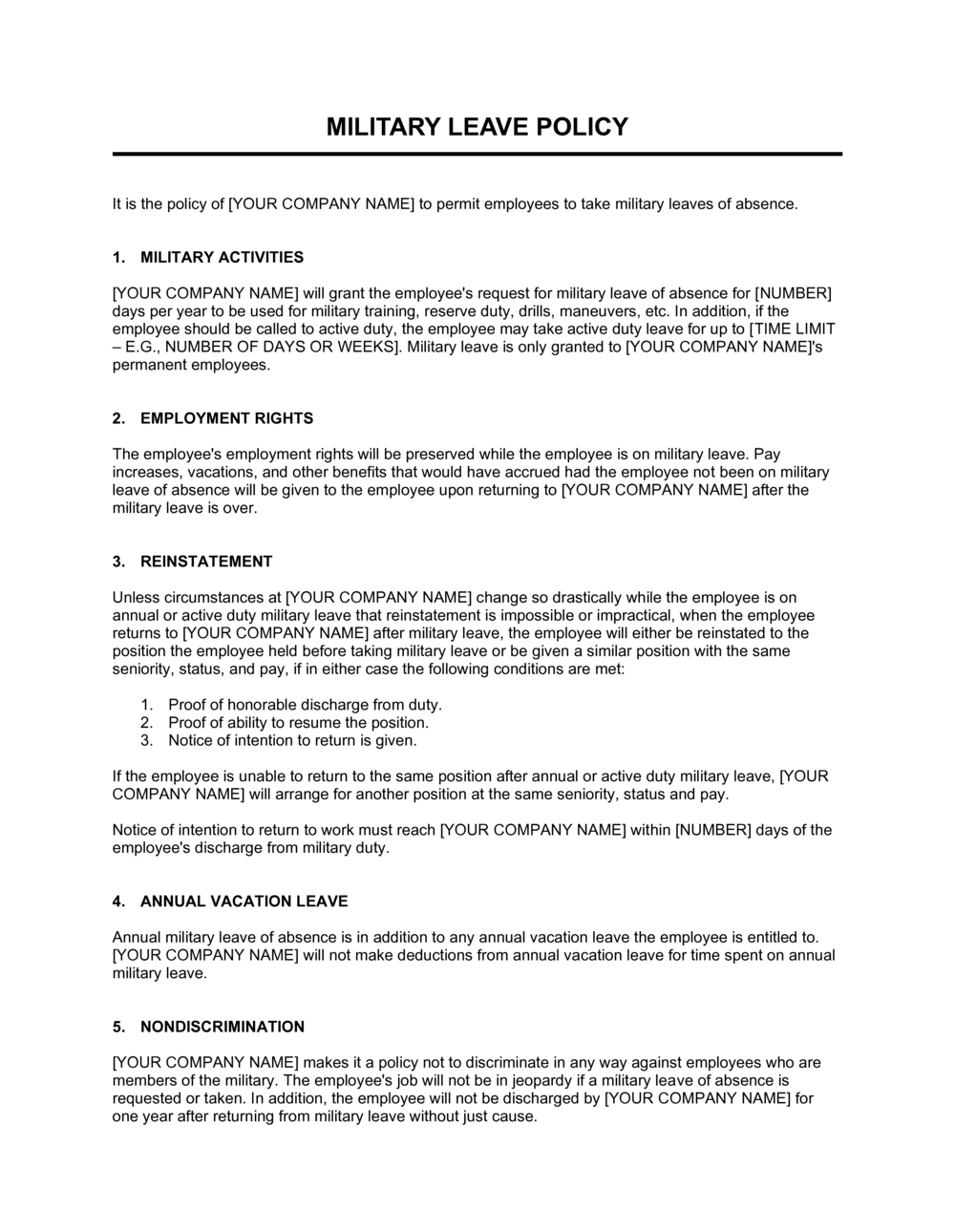
Military Leave Policy Template

Free Word download β€’ Edit online β€’ Save & share with Drive β€’ Export to PDF

1 pageβ€’20–25 min to fillβ€’Difficulty: Standard
Learn more ↓
FreeMilitary Leave Policy Template

At a glance

What it is
A Military Leave Policy is a written HR policy that defines an employer's procedures and obligations when an employee is called to active duty, training, or any other uniformed service. This free Word download gives you a structured, compliant-ready starting point you can edit online and export as PDF to include in your employee handbook or HR manual.
When you need it
Use it when an employee receives military orders, when you are building or updating your employee handbook, or when you need a documented procedure to guide HR and managers through military leave requests consistently.
What's inside
The policy covers employee notification requirements, pay continuation rules, benefits continuation during leave, return-to-work and reinstatement rights, job protection language, and anti-discrimination provisions β€” organized to reflect USERRA obligations and common employer best practices.

What is a Military Leave Policy?

A Military Leave Policy is a written HR document that defines an employer's obligations and internal procedures when an employee is called to active duty, reserve training, or any other qualifying uniformed service. It establishes how employees notify the company, how pay and benefits are handled during the absence, and precisely what rights the employee has when they return β€” including the escalator-principle reinstatement protections mandated by the Uniformed Services Employment and Reemployment Rights Act (USERRA). The policy applies to all branches of the US Armed Forces, the National Guard, and Reserve components, covering everything from a weekend drill to a multi-year deployment.

Why You Need This Document

Without a documented military leave policy, managers handle absences inconsistently β€” some permanently fill the departing employee's role, others stop benefits incorrectly, and payroll applies PTO without the employee's consent, all of which are USERRA violations that can trigger federal complaints, back-pay awards, and reinstatement orders. USERRA applies to every US employer regardless of size, and the penalties for non-compliance β€” including attorney fee awards to prevailing employees β€” apply equally to a five-person shop and a large corporation. A written policy eliminates guesswork for managers, protects the company from avoidable liability, and signals to service members on your team that their sacrifice is handled with respect and procedural fairness. This template gives you a compliant, structured starting point you can adapt and distribute in under two hours.

Which variant fits your situation?

If your situation is…Use this template
Policy focused specifically on weekend and annual training absencesMilitary Training Leave Policy
Full employee handbook including military leave and all other leave typesEmployee Handbook
Standalone request form for employees to submit military leaveMilitary Leave Request Form
General leave of absence covering medical, personal, and military leaveLeave of Absence Policy
Policy for a public-sector or government employerGovernment Employee Military Leave Policy
Documentation confirming an employee's return from military serviceReturn to Work Letter
Policy addressing extended active duty deployments of 90+ daysExtended Military Deployment Policy

Common mistakes to avoid

❌ Requiring mandatory PTO substitution during military leave

Why it matters: USERRA prohibits employers from requiring employees to use accrued PTO or vacation to cover military leave. Doing so is a federal violation that can result in VETS complaints and back-pay liability.

Fix: State explicitly that PTO use during military leave is at the employee's election, not the employer's. Provide a written option form for employees who want to elect PTO use.

❌ Stopping vesting credit on retirement plans during the leave period

Why it matters: USERRA requires that returning employees receive retirement plan credit β€” including employer matching β€” as if they had been continuously employed. Withholding this triggers back-contribution liability plus potential DOL penalties.

Fix: Coordinate with your 401(k) plan administrator before publishing the policy to confirm your plan document reflects USERRA make-up contribution obligations.

❌ Permanently filling the employee's position during long-term deployment

Why it matters: Filling a role permanently while an employee is on military leave and then failing to reinstate them is one of the most frequently litigated USERRA violations β€” courts have awarded reinstatement plus back pay plus attorney fees.

Fix: Use temporary or contract workers to cover the role. Document the coverage arrangement as temporary from the outset and maintain a reinstatement plan in the employee's file.

❌ Omitting the anti-discrimination provision for pre-employment applicants

Why it matters: USERRA protects individuals who have been offered employment but not yet started β€” rescinding an offer because of upcoming military service is unlawful. Policies that only reference current employees miss this group entirely.

Fix: Add a sentence explicitly extending anti-discrimination protections to job applicants and individuals offered employment, not just current employees.

The 10 key sections, explained

Policy purpose and scope

Employee notification procedures

Pay continuation and differential pay

Benefits continuation

Pension and retirement plan rights

Reinstatement and reemployment rights

Job protection and anti-discrimination

Manager responsibilities

Return-to-work procedures

Complaint and dispute resolution

How to fill it out

  1. 1

    Identify covered employee groups

    Define which employees the policy applies to β€” full-time, part-time, temporary, and probationary employees all qualify for USERRA protections. Confirm coverage extends to all uniformed service types including National Guard and Reserve.

    πŸ’‘ Do not limit coverage to full-time employees β€” USERRA applies to any employee regardless of tenure or hours worked.

  2. 2

    Set your pay continuation approach

    Decide whether you will offer differential pay, full pay continuation, or unpaid leave beyond PTO for a defined period. Document the calculation method and the number of days per calendar year the company will supplement military pay.

    πŸ’‘ Industry benchmarks: many mid-size employers pay differential for 30 days per year; government contractors often extend to 180 days. State your figure explicitly β€” ambiguity creates payroll inconsistency.

  3. 3

    Define the notification and documentation process

    Write out the exact steps an employee must follow β€” who to notify, what documents to submit, and within what timeframe β€” while preserving flexibility for short-notice orders.

    πŸ’‘ Include a fallback for employees who cannot provide advance notice due to classified or urgent orders. USERRA requires only 'advance notice as soon as practicable.'

  4. 4

    Specify benefits continuation terms

    Document the health and dental continuation rules for leaves under 31 days (employer-sponsored rates) and over 31 days (up to 102% of full cost for 24 months). Coordinate this section with your benefits administrator.

    πŸ’‘ Ask your benefits carrier to confirm plan terms before finalizing this section β€” some plans have specific military leave riders that supersede the default.

  5. 5

    Confirm reinstatement timelines

    Insert the three USERRA reinstatement deadlines: 1 day for service under 30 days, 14 days for 31–180 days, and 90 days for service over 180 days. Confirm HR and the returning employee both receive written confirmation of the return date.

    πŸ’‘ Build a checklist into your HR intake process so reinstatement steps are not missed during busy periods β€” a forgotten step is the most common reemployment complaint.

  6. 6

    Add manager guidance and prohibited actions

    Write a dedicated section telling managers precisely what they must do and must not do when a team member requests military leave. Include examples of prohibited conduct such as reassigning the role permanently or cutting the employee's hours on return.

    πŸ’‘ Brief managers verbally when the policy is adopted and keep a signed acknowledgment on file β€” most USERRA complaints trace back to manager missteps, not HR errors.

  7. 7

    Integrate into the employee handbook and communicate

    Add the finalized policy to your employee handbook, post it in your HR system, and issue a written notice to all employees confirming the policy is in effect and where to find it.

    πŸ’‘ If your workforce includes current or former service members, consider a brief all-hands overview when the policy is first published β€” they are most likely to have questions.

Frequently asked questions

What is a military leave policy?

A military leave policy is a written HR document that defines an employer's procedures and obligations when an employee is called to active duty, reserve training, or any other uniformed service. It typically covers notification requirements, pay and benefits continuation, reinstatement rights, and anti-discrimination protections. Having a written policy ensures consistent treatment across managers and departments and demonstrates compliance with USERRA obligations.

Is a military leave policy required by law?

No federal law mandates that employers publish a written military leave policy, but USERRA imposes substantive obligations that apply regardless of whether a policy exists. A written policy is the practical way to ensure those obligations are met consistently. Several states β€” including California, Texas, and New York β€” have additional military leave statutes that may require documented procedures for state employees or employers above certain size thresholds.

Does USERRA apply to small businesses?

Yes. USERRA applies to all US employers regardless of size β€” there is no minimum employee threshold. A sole proprietor with one employee is subject to the same USERRA reinstatement and anti-discrimination obligations as a Fortune 500 company. Small businesses are sometimes unaware of this because USERRA lacks the headcount thresholds common in other employment laws like the FMLA.

How much time off is an employee entitled to for military leave?

USERRA does not cap the duration of military leave, but it limits the cumulative period of protected absence with a single employer to five years, with several exceptions for extended active duty. Within that five-year window, an employee who serves and returns within the applicable timeframes is entitled to full reinstatement regardless of how long the service lasted. The employer is not required to pay for the entire absence β€” pay continuation is a policy choice, not a legal floor.

Can an employer require an employee to use PTO during military leave?

No. USERRA explicitly prohibits employers from requiring employees to substitute accrued vacation or PTO for military leave. Employers may allow employees to voluntarily elect to use PTO, but the choice must be the employee's. Policies that automatically apply PTO balances to military absences are non-compliant and should be revised immediately.

What benefits must be continued during military leave?

For leave of fewer than 31 days, the employer must continue health benefits at the normal employee contribution rate as if the employee had not left. For leave of 31 days or more, the employee has the right to elect continued coverage for up to 24 months at up to 102% of the full plan cost. Upon reemployment, health coverage must be reinstated immediately without any waiting period or exclusion for pre-existing conditions that arose during the service period.

What are reinstatement rights under USERRA?

USERRA's escalator principle entitles returning employees to the position β€” and seniority, pay, and benefits β€” they would have attained had they never left. For service under 90 days, this typically means the same or equivalent position. For service of 91 days or more, the employer has limited discretion to place the employee in a comparable role if the original position no longer exists. Reinstatement must occur promptly within the applicable USERRA timeframes after the employee applies for reemployment.

What happens if an employee is injured or disabled during military service?

USERRA requires employers to make reasonable efforts to accommodate returning employees who have a service-connected disability. If the employee cannot perform the duties of their original position because of the disability, the employer must attempt to place them in a position they can perform that is comparable in seniority, status, and pay. The Americans with Disabilities Act may impose additional accommodation obligations on top of USERRA requirements.

Should a military leave policy be included in the employee handbook?

Yes. Including the policy in the employee handbook ensures every employee has access to it, creates a clear record that the policy was communicated, and integrates military leave with adjacent policies like general leave of absence and pay continuation. Standalone policy documents are also acceptable but should be referenced in the handbook and distributed through the same acknowledgment process.

How this compares to alternatives

vs Leave of Absence Policy

A general leave of absence policy covers medical, personal, and family leave under a single framework. A military leave policy is specific to uniformed service and must satisfy USERRA's distinct rules β€” which differ materially from FMLA and other leave frameworks. Most employers need both documents, with the military policy either standalone or incorporated by reference into the broader leave policy.

vs Employee Handbook

An employee handbook is the complete reference document for all HR policies, including military leave. A standalone military leave policy provides greater depth and is easier to update when USERRA guidance changes without revising the full handbook. Best practice is to maintain a standalone policy and reference it within the handbook's leave section.

vs FMLA Policy

FMLA covers up to 12 weeks of unpaid, job-protected leave for qualifying family and medical reasons. USERRA governs military leave with different eligibility rules, duration limits, and reinstatement rights. The two laws can run concurrently for qualifying exigency leave related to a family member's deployment, but they are administered separately and should not be merged into a single policy document.

vs Attendance and Absence Policy

An attendance policy sets expectations for punctuality, unplanned absences, and disciplinary steps for excessive absenteeism. Military leave absences are expressly protected under USERRA and must be carved out of any attendance tracking or disciplinary framework. A military leave policy provides that carve-out language and ensures USERRA-protected absences are never counted against attendance records.

Industry-specific considerations

Manufacturing

High concentration of National Guard and Reserve members in production roles makes formal coverage-planning guidance critical to maintaining shift schedules during extended absences.

Retail and Hospitality

High turnover makes it tempting to treat military absences as voluntary separations; a written policy prevents the permanent backfill mistake that triggers the most common USERRA reemployment claims.

Technology and SaaS

Fast-growing teams that restructure frequently need explicit escalator-principle language to ensure returning employees are benchmarked to promoted peers, not their pre-departure job description.

Professional Services

Client-facing roles require coverage planning language that protects client relationships during deployment without penalizing the returning employee through account reassignment.

Template vs pro β€” what fits your needs?

PathBest forCostTime
Use the templateHR managers and small business owners documenting military leave procedures for a domestic US workforceFree1–2 hours
Template + professional reviewEmployers in states with additional military leave statutes or those with large numbers of Guard and Reserve employees$200–$500 for an HR consultant or employment attorney review2–5 business days
Custom draftedFederal contractors with VETS-4212 reporting obligations, multi-state employers, or organizations seeking to add differential pay provisions beyond the template defaults$800–$2,500 for a custom employment attorney drafting engagement1–2 weeks

Glossary

USERRA
The Uniformed Services Employment and Reemployment Rights Act β€” a US federal law that protects the job and benefits rights of employees who leave for military service.
Uniformed Service
Active duty, active duty for training, initial active duty for training, inactive duty training, full-time National Guard duty, and certain examination periods covered by USERRA.
Reemployment Rights
The legal entitlement of a returning service member to be restored to the same or an equivalent position upon returning from qualifying military service.
Escalator Principle
The USERRA requirement that returning employees be reinstated with the seniority, pay, and benefits they would have attained had they never left β€” not just the status they held at departure.
Pay Continuation
An employer's voluntary or policy-mandated practice of supplementing or fully paying an employee's regular salary during military leave, above and beyond any military pay received.
Benefits Continuation
The ongoing provision of health, dental, and other insurance benefits during military leave β€” USERRA requires employers to offer continuation for up to 24 months at the employee's own cost.
Differential Pay
The amount an employer pays to bridge the gap between an employee's regular civilian salary and their lower military pay during active duty leave.
Notice Requirement
The obligation under USERRA for employees to provide advance written or oral notice of military service to their employer, except when precluded by military necessity.
COBRA
A federal law allowing employees to continue employer-sponsored health coverage after a qualifying event such as military leave, typically at their own expense.
Anti-Discrimination Provision
USERRA's prohibition on denying employment, promotion, reemployment, or any benefit based on an employee's past, present, or future military service obligations.

Part of your Business Operating System

This document is one of 3,000+ business & legal templates included in Business in a Box.

  • Fill-in-the-blanks β€” ready in minutes
  • 100% customizable Word document
  • Compatible with all office suites
  • Export to PDF and share electronically

Create your document in 3 simple steps.

From template to signed document β€” all inside one Business Operating System.
1
Download or open template

Access over 3,000+ business and legal templates for any business task, project or initiative.

2
Edit and fill in the blanks with AI

Customize your ready-made business document template and save it in the cloud.

3
Save, Share, Send, Sign

Share your files and folders with your team. Create a space of seamless collaboration.

Save time, save money, and create top-quality documents.

β˜…β˜…β˜…β˜…β˜…

"Fantastic value! I'm not sure how I'd do without it. It's worth its weight in gold and paid back for itself many times."

Managing Director Β· Mall Farm
Robert Whalley
Managing Director, Mall Farm Proprietary Limited
β˜…β˜…β˜…β˜…β˜…

"I have been using Business in a Box for years. It has been the most useful source of templates I have encountered. I recommend it to anyone."

Business Owner Β· 4+ years
Dr Michael John Freestone
Business Owner
β˜…β˜…β˜…β˜…β˜…

"It has been a life saver so many times I have lost count. Business in a Box has saved me so much time and as you know, time is money."

Owner Β· Upstate Web
David G. Moore Jr.
Owner, Upstate Web

Run your business with a system β€” not scattered tools

Stop downloading documents. Start operating with clarity. Business in a Box gives you the Business Operating System used by over 250,000 companies worldwide to structure, run, and grow their business.

Start freeΒ Β·Β No credit card required