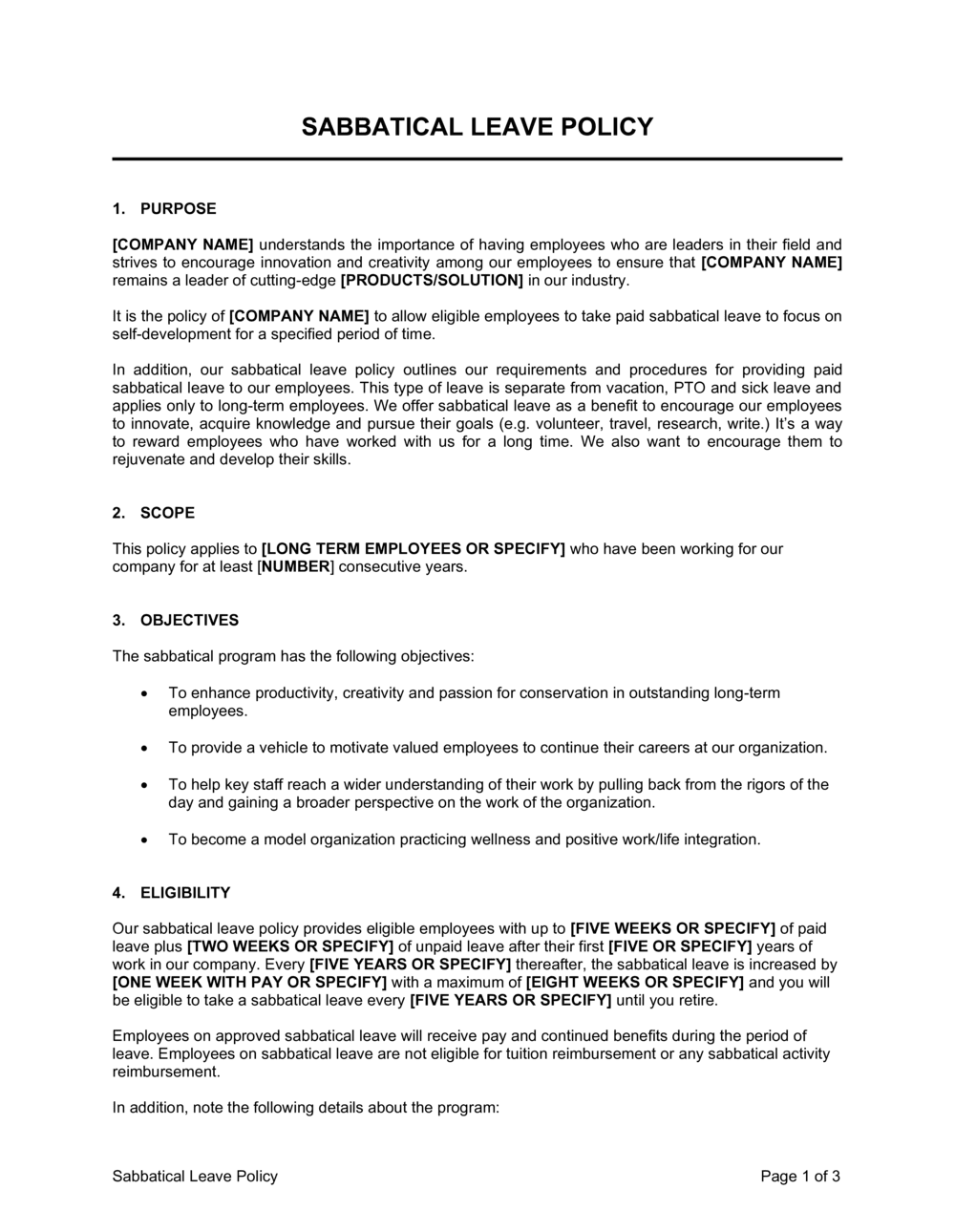
Sabbatical Leave Policy Template

Free Word download β€’ Edit online β€’ Save & share with Drive β€’ Export to PDF

3 pagesβ€’20–30 min to fillβ€’Difficulty: Standard
Learn more ↓
FreeSabbatical Leave Policy Template

At a glance

What it is
A Sabbatical Leave Policy is an internal HR document that defines the rules governing extended leaves of absence granted to eligible employees for purposes such as professional development, research, personal renewal, or community service. This free Word download gives HR teams and business owners a structured, editable starting point they can tailor to their organization and export as PDF for inclusion in an employee handbook.
When you need it
Use it when formalizing a sabbatical benefit for the first time, when employee requests for extended leave are being handled inconsistently, or when updating an existing policy to reflect changes in eligibility thresholds, pay levels, or return obligations.
What's inside
Purpose and scope, eligibility criteria, approved leave purposes, duration and frequency limits, compensation and benefits during leave, the application and approval process, employee obligations on return, and policy administration details including amendment and termination provisions.

What is a Sabbatical Leave Policy?

A Sabbatical Leave Policy is an internal HR document that establishes the rules, eligibility requirements, and obligations governing extended leaves of absence granted to tenured employees for purposes such as professional development, academic research, community service, or personal renewal. Unlike standard vacation or personal leave, a sabbatical is a planned, discretionary benefit tied to a minimum service threshold β€” typically 5 to 7 years β€” and is subject to a formal application and approval process. The policy defines how long the leave may last, whether it is paid or unpaid, how employee benefits are handled during the absence, and what the employee owes the organization on return.

Why You Need This Document

Without a written sabbatical leave policy, every request is handled differently β€” one manager approves a 3-month paid leave while another in the same organization denies an identical request, creating real exposure to favoritism or discrimination claims. Employees who take ad hoc sabbaticals without a return obligation or repayment clause leave the company financially exposed when they resign shortly after returning from a fully compensated leave. Operational gaps appear when there is no handover requirement, leaving projects and client relationships unmanaged for months. A clearly written policy closes all of these gaps: it sets consistent eligibility rules, documents the approval process, protects the company through repayment provisions, and signals to long-tenured employees that their contributions are genuinely valued. This template gives HR teams and business owners a ready-to-edit starting point that covers every material element of a defensible sabbatical program.

Which variant fits your situation?

If your situation is…Use this template
Offering paid sabbatical to employees who reach a tenure milestonePaid Sabbatical Leave Policy
Granting unpaid extended leave for personal or educational purposesUnpaid Leave of Absence Policy
Documenting a specific employee's approved sabbatical termsSabbatical Leave Agreement
Covering short-term personal leave needs outside sabbatical scopePersonal Leave Policy
Setting rules for all types of employee leave in one documentEmployee Leave of Absence Policy
Formalizing remote or flexible work arrangements during a leaveRemote Work Policy
Bundling all HR policies into a single reference documentEmployee Handbook

Common mistakes to avoid

❌ No repayment clause for paid sabbaticals

Why it matters: Without a repayment obligation, an employee can take a fully paid sabbatical and resign immediately after returning, leaving the company with no recourse to recover the compensation paid.

Fix: Include a pro-rated repayment clause that decreases monthly over the return obligation period. Have employees sign an acknowledgment of this term before the leave begins.

❌ Leaving approved purposes undefined

Why it matters: Open-ended eligibility creates inconsistent approvals across managers β€” one team's employee gets approved for travel while another's is denied for the same reason, exposing the company to discrimination or favoritism claims.

Fix: List at least three to four approved purpose categories and require the employee's proposal to map their planned activities to one of them.

❌ Omitting a coverage and handover requirement

Why it matters: An employee who departs without transferring their responsibilities creates project delays, damages client relationships, and forces colleagues to absorb unplanned workloads without preparation.

Fix: Require a written handover document and a completed coverage plan as conditions for leave approval β€” not afterthoughts once the start date is confirmed.

❌ No re-eligibility rule after a first sabbatical

Why it matters: Without a waiting period between sabbaticals, an employee who returns and immediately re-qualifies creates scheduling and budget unpredictability for the business.

Fix: State explicitly that the eligibility clock resets on the date the employee returns from sabbatical, with the next sabbatical available after completing another full eligibility period.

❌ Vague compensation language for variable-pay employees

Why it matters: Describing sabbatical pay as 'regular compensation' creates disputes when commissions, bonuses, or equity vesting continue or stop without explicit policy language to back the decision.

Fix: Specify that sabbatical pay is calculated on base salary only, and list each variable-pay component separately with a clear treatment β€” paused, continued, or pro-rated.

❌ Applying the policy inconsistently across departments

Why it matters: When one department routinely approves sabbaticals and another routinely denies them using the same policy, the company faces morale damage and potential legal exposure for disparate treatment.

Fix: Require HR sign-off on every approval β€” not just manager approval β€” and track approval rates by department quarterly to identify inconsistencies before they become grievances.

The 10 key sections, explained

Purpose and scope

Eligibility criteria

Approved purposes

Duration and frequency

Compensation and benefits during leave

Application and approval process

Coverage and transition planning

Return obligations and repayment

Post-sabbatical reporting

Policy administration and amendments

How to fill it out

  1. 1

    Define eligibility and set the tenure threshold

    Enter the minimum years of continuous full-time service required before an employee may apply. Most organizations set this between 5 and 7 years. Specify whether part-time staff qualify on a prorated basis or are excluded.

    πŸ’‘ Check your employee handbook for any existing tenure milestones β€” align sabbatical eligibility with recognition or vesting events to reinforce the retention signal.

  2. 2

    List approved sabbatical purposes

    Choose which activity categories qualify β€” academic study, professional development, community service, personal renewal, or a combination. Be specific enough to guide approvals consistently but not so narrow that legitimate requests are automatically excluded.

    πŸ’‘ Adding 'personal renewal with manager and HR approval' as a catch-all category lets you accommodate unusual cases without opening the door to unlimited discretion.

  3. 3

    Set duration limits and frequency rules

    Enter the minimum and maximum leave lengths and the interval before an employee may take a second sabbatical. Tie the minimum length to your PTO policy β€” anything shorter should route through standard leave channels.

    πŸ’‘ A 5-year re-eligibility window is most common. Shorter windows increase administrative load; longer windows reduce the perceived value of the benefit.

  4. 4

    Decide on pay and benefits during leave

    Choose full pay, partial pay (e.g., 50–75% of base), or unpaid leave. For each option, confirm whether health benefits continue at the standard employee rate and whether retirement contributions pause or continue.

    πŸ’‘ If budget limits a fully paid sabbatical, a partial-pay model (e.g., 75% for up to 3 months) is more attractive to employees than unpaid leave and still signals meaningful investment in the benefit.

  5. 5

    Draft the application and approval workflow

    Specify the required lead time (90 days is standard), what the written proposal must contain, and which approvers must sign off. Document the expected response timeline so employees are not left waiting.

    πŸ’‘ Requiring a draft coverage plan as part of the application forces employees to think about operational impact before submitting β€” reducing last-minute scrambles and manager resistance.

  6. 6

    Write the return obligation and repayment clause

    Set the minimum post-return service period and the repayment formula for employees who resign within that window. Express the repayment as a declining pro-rated amount β€” the longer the employee stays after returning, the lower the obligation.

    πŸ’‘ A 12-month return obligation for a 3-month paid sabbatical is a commonly accepted ratio. Obligations exceeding 24 months risk deterring employees from applying at all.

  7. 7

    Specify the post-sabbatical report requirement

    State the deadline (30 days after return is standard), the required format or length, and where it is submitted. For development-focused leaves, consider requiring a brief knowledge-sharing session with the team.

    πŸ’‘ Framing the report as a 'what I learned and how I'll apply it' document β€” rather than a formal audit β€” increases compliance and makes the output genuinely useful to the organization.

  8. 8

    Add the amendment and exception clauses, then assign ownership

    Name the HR role or department that administers the policy, set the review cadence (annual is standard), and include language reserving the company's right to amend with notice. Document the process for handling exceptions.

    πŸ’‘ Publishing the policy owner's name and a contact email reduces informal exception requests routed through managers β€” keeping approvals consistent and auditable.

Frequently asked questions

What is a sabbatical leave policy?

A sabbatical leave policy is an internal HR document that defines the rules under which a company grants extended leaves of absence to eligible employees. It specifies who qualifies, how long they may be away, whether the leave is paid, what activities are approved, and what obligations the employee carries on return. A written policy replaces ad hoc arrangements and ensures the benefit is applied consistently across the organization.

How long is a typical sabbatical?

Most employer sabbatical policies allow leaves of between 4 weeks and 12 months. The most common duration for corporate programs is 4–12 weeks. Academic and research institutions tend to grant longer sabbaticals of 6–12 months. The right duration depends on your organization's operational capacity, the nature of approved activities, and the level of pay offered during the leave.

Should sabbatical leave be paid or unpaid?

Both models are used in practice. Paid sabbaticals β€” at full or partial salary β€” are more common at technology companies and professional services firms using the benefit as a retention tool for tenured employees. Unpaid sabbaticals are more common in industries with tighter margins. A hybrid model β€” full pay for the first 4–6 weeks, then unpaid β€” balances employee value with cost control and is increasingly common at mid-sized companies.

What happens to benefits during a sabbatical?

Benefits treatment during a sabbatical varies by policy design. Health and dental coverage typically continues, with the employee paying their standard contribution. Retirement contributions may pause or continue depending on plan rules and the pay status of the leave. Paid time off and vacation accrual usually pauses during unpaid sabbaticals and continues during paid ones. Your policy should address each benefit category explicitly to avoid disputes.

What should a sabbatical leave proposal include?

A sabbatical proposal should describe the purpose of the leave, the specific activities the employee plans to undertake, the requested start and end dates, how the employee's responsibilities will be covered during their absence, and what professional benefit the employee expects to bring back to the organization. Many policies also require a draft post-sabbatical report outline at the proposal stage so the employee's goals are defined before the leave begins.

Can an employer deny a sabbatical request?

Yes. A sabbatical is a discretionary benefit, not an entitlement, in most jurisdictions. Employers may deny requests that do not meet eligibility criteria, fall outside approved purposes, create unacceptable operational coverage gaps, or are submitted without sufficient advance notice. The policy should document the denial process and timelines so employees understand the decision-making framework.

What is a return obligation and why does it matter?

A return obligation requires the employee to remain employed for a set period after a paid sabbatical β€” commonly equal to the leave duration. It matters because it gives the company time to recoup the value of the investment. Most policies pair the obligation with a repayment clause: if the employee resigns within the return period, they reimburse a pro-rated share of the sabbatical compensation received. Without this clause, a paid sabbatical carries financial risk for the employer.

How does a sabbatical leave policy differ from a leave of absence policy?

A leave of absence policy covers a broad range of extended absences β€” medical, family, personal, and bereavement β€” typically triggered by specific life events. A sabbatical leave policy is narrower and more proactive: it is a planned, discretionary benefit tied to tenure, granted for development or renewal purposes rather than in response to a personal emergency. The two policies can coexist in a handbook, with clear guidance on which applies to a given situation.

How this compares to alternatives

vs Leave of absence policy

A leave of absence policy covers all types of extended absence β€” medical, family, personal, and bereavement β€” typically triggered by a specific need or life event. A sabbatical leave policy is a proactive, tenure-based benefit granted for professional development or renewal, not an emergency accommodation. Organizations typically need both documents; the sabbatical policy addresses what the leave of absence policy does not.

vs Vacation policy

A vacation policy governs short, recurring paid time off that accrues annually for all employees. A sabbatical is a distinct, extended benefit granted only to employees who meet a tenure threshold, for approved purposes beyond rest and leisure. Approvals, durations, pay treatments, and return obligations differ substantially between the two.

vs Employee handbook

An employee handbook is a comprehensive reference document covering all workplace policies in a single document. A sabbatical leave policy is a standalone policy that can be incorporated by reference into the handbook or distributed separately. Using a standalone policy makes it easier to update the sabbatical terms without reissuing the entire handbook.

vs Remote work policy

A remote work policy governs where and how employees perform their regular duties on an ongoing basis. A sabbatical policy governs a complete break from regular duties for an approved period. The two may interact β€” for example, when an employee requests a sabbatical to complete a remote academic program β€” but they address fundamentally different aspects of the employment relationship.

Industry-specific considerations

Technology / SaaS

Used as a retention benefit for senior engineers and product managers who have reached 5–7 year tenure milestones in a high-attrition industry.

Professional Services

Law firms, consulting firms, and accounting practices use sabbaticals to fund advanced certifications, academic research, and pro bono work that enhances the firm's reputation.

Higher Education and Research

Faculty sabbaticals are often governed by collective agreements or institutional policy, with formal research output requirements and publication deliverables attached.

Nonprofit and Social Services

Sabbaticals are used to prevent burnout in mission-driven roles, often approved for community service projects or leadership development programs directly aligned with organizational values.

Template vs pro β€” what fits your needs?

PathBest forCostTime
Use the templateHR managers and business owners formalizing sabbatical benefits for the first time or updating an existing informal policyFree1–2 hours
Template + professional reviewCompanies with variable-pay structures, unionized workforces, or multi-jurisdiction operations where benefits and repayment terms require alignment with local law$200–$600 for an HR consultant or employment lawyer review2–5 days
Custom draftedLarge enterprises, academic institutions, or organizations where sabbatical entitlements are governed by collective agreements or regulatory frameworks$1,000–$3,000+1–3 weeks

Glossary

Sabbatical Leave
An extended, employer-approved absence from work β€” typically 4 weeks to 12 months β€” granted to eligible employees for professional development, research, or personal renewal.
Eligibility Period
The minimum continuous years of service an employee must complete before becoming eligible to apply for sabbatical leave, commonly 5 or 7 years.
Paid Sabbatical
A sabbatical during which the employer continues paying the employee's full or partial salary and maintains their benefits.
Unpaid Sabbatical
A sabbatical during which the employee takes a leave of absence without salary, though benefits continuation may be negotiated.
Return Obligation
A requirement that the employee return to active employment for a defined period after the sabbatical β€” typically equal to the leave duration β€” or repay pro-rated sabbatical compensation.
Sabbatical Proposal
A written submission from the employee describing the purpose, planned activities, duration, and expected professional benefit of the requested sabbatical.
Benefits Continuation
The maintenance of health, dental, retirement, and other employee benefits during a leave period, either by the employer or through employee self-payment.
Accrual Reset
A policy provision specifying whether paid time off, vacation, or sick leave accruals pause, continue, or reset to zero during a sabbatical period.
Coverage Plan
An operational document prepared before the sabbatical begins that assigns the departing employee's responsibilities to colleagues or a temporary hire.
Post-Sabbatical Report
A deliverable required from the employee upon return, summarizing activities completed, skills gained, or research produced during the sabbatical.

Part of your Business Operating System

This document is one of 3,000+ business & legal templates included in Business in a Box.

  • Fill-in-the-blanks β€” ready in minutes
  • 100% customizable Word document
  • Compatible with all office suites
  • Export to PDF and share electronically

Create your document in 3 simple steps.

From template to signed document β€” all inside one Business Operating System.
1
Download or open template

Access over 3,000+ business and legal templates for any business task, project or initiative.

2
Edit and fill in the blanks with AI

Customize your ready-made business document template and save it in the cloud.

3
Save, Share, Send, Sign

Share your files and folders with your team. Create a space of seamless collaboration.

Save time, save money, and create top-quality documents.

β˜…β˜…β˜…β˜…β˜…

"Fantastic value! I'm not sure how I'd do without it. It's worth its weight in gold and paid back for itself many times."

Managing Director Β· Mall Farm
Robert Whalley
Managing Director, Mall Farm Proprietary Limited
β˜…β˜…β˜…β˜…β˜…

"I have been using Business in a Box for years. It has been the most useful source of templates I have encountered. I recommend it to anyone."

Business Owner Β· 4+ years
Dr Michael John Freestone
Business Owner
β˜…β˜…β˜…β˜…β˜…

"It has been a life saver so many times I have lost count. Business in a Box has saved me so much time and as you know, time is money."

Owner Β· Upstate Web
David G. Moore Jr.
Owner, Upstate Web

Run your business with a system β€” not scattered tools

Stop downloading documents. Start operating with clarity. Business in a Box gives you the Business Operating System used by over 250,000 companies worldwide to structure, run, and grow their business.

Free Forever PlanΒ Β·Β No credit card required