1
Identify the signing leader and organizational scope
Enter the leader's full legal name, title, and the organization's registered name in the parties block. Confirm the signatory holds authority to formally adopt the document on behalf of the organization.
💡 For governance-sensitive organizations (nonprofits, publicly traded companies), confirm with your board secretary or legal counsel that the signatory has delegated authority before the document is circulated.
2
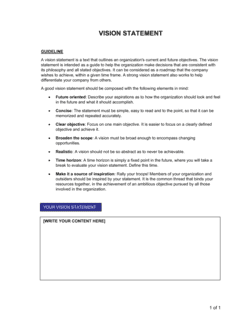
Draft the vision articulation statement
Write a single, concrete statement that names the future state, the time horizon, the intended beneficiary, and at least one measurable indicator. Avoid superlatives — describe outcomes, not adjectives.
💡 Read your draft to someone unfamiliar with your industry. If they cannot explain it back in their own words, it is not yet specific enough.
3
Identify and define two to five core values
List values that already guide behavior in your best decisions — not values you aspire to have. Write a one-sentence behavioral definition for each that describes what the value looks like in practice.
💡 Test each value against a recent difficult decision: if the value did not actually influence that decision, remove it from the list.
4
Declare strategic priorities with rationale
Name two to five focus areas for the coming planning period and write one sentence explaining why each is a priority now. Tie priorities explicitly to the vision statement — if a priority does not advance the vision, question whether it belongs.
💡 If you cannot reduce your list to five or fewer, apply an effort-impact filter: keep only the priorities with the highest potential impact relative to organizational capacity.
5
Define stakeholder communication commitments
Name each stakeholder group (employees, board, customers, partners), the channel you will use, and the minimum frequency. Write these as specific commitments, not intentions.
💡 Calendar the first communication before you sign the document — putting it in your schedule before adoption removes the friction of scheduling it later.
6
Set accountability checkpoints and name reviewers
Enter specific review dates (not just 'quarterly') and name the individual or committee responsible for facilitating each review. Attach the first review date to an existing recurring meeting where possible.
💡 Pairing the review with an existing leadership rhythm (quarterly business review, board meeting) eliminates scheduling resistance and keeps vision review from feeling like an extra meeting.
7
Complete the leadership commitment statement
Write the personal commitment in first person, using your own name. Be specific about the behaviors you commit to — not just the outcomes you want. Avoid passive constructions.
💡 Share a draft of your commitment statement with a trusted colleague or coach before signing and ask: 'Does this match how you actually see me lead?' The gap between self-perception and observed behavior is the most important insight this exercise generates.
8
Collect signatures and distribute the endorsed document
Obtain all required signatures — yours and any co-endorsers' — before distributing. Store the signed PDF in a shared location accessible to all stakeholders named in the document, and confirm receipt.
💡 Use an eSign tool to timestamp execution and create an audit trail. A timestamped signature is materially stronger than a scanned handwritten one if the document is later referenced in a governance or coaching context.