Key Holder Job Description Template

Free Word download β€’ Edit online β€’ Save & share with Drive β€’ Export to PDF

2 pagesβ€’20–30 min to fillβ€’Difficulty: Standardβ€’Signature requiredβ€’Legal review recommended
Learn more ↓
FreeKey Holder Job Description Template

At a glance

What it is
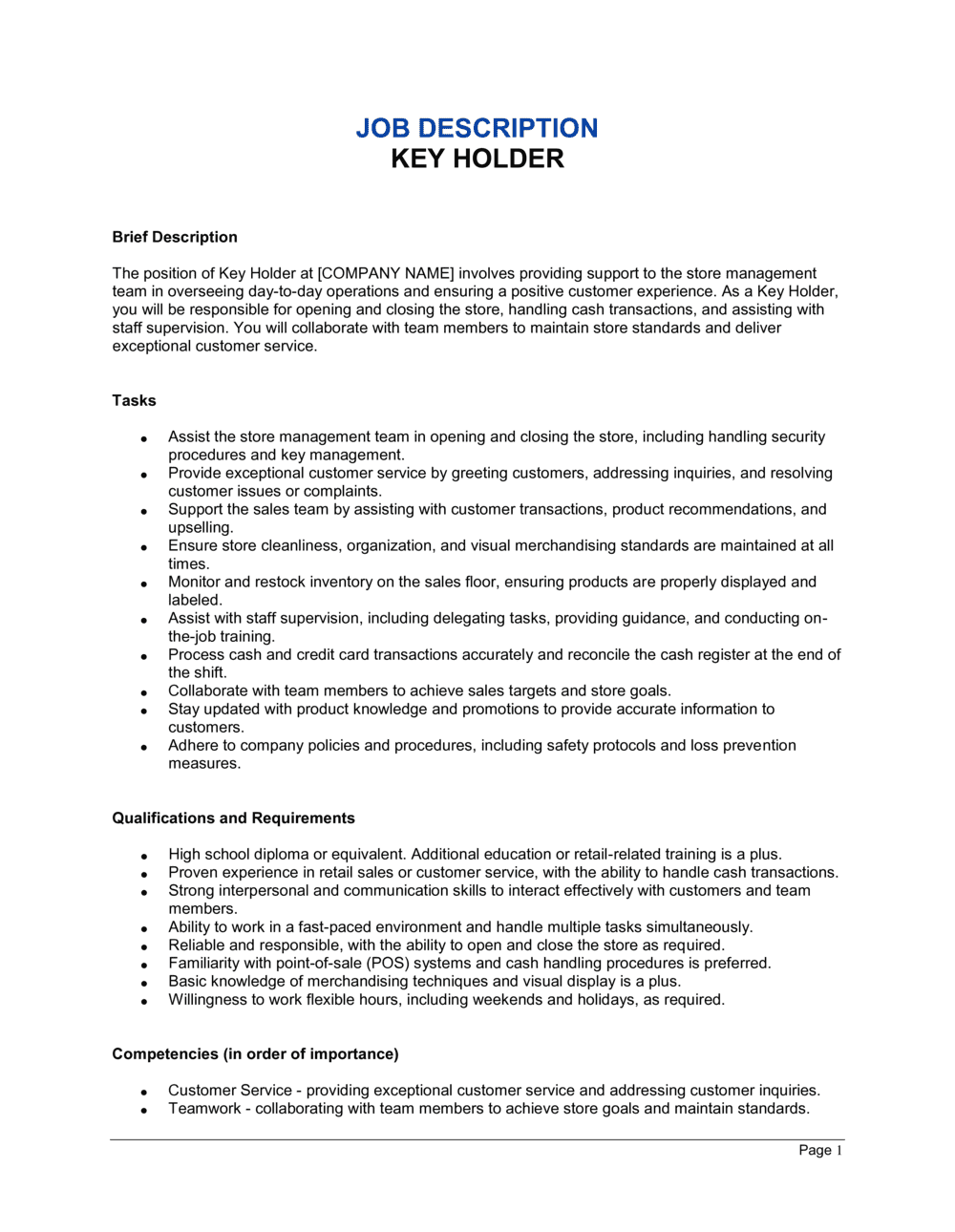
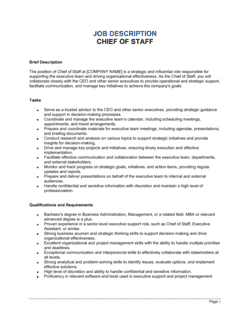
A Key Holder Job Description is a binding employment document that formally defines the duties, responsibilities, authority, and accountability standards for an employee entrusted with keys, alarm codes, and after-hours access to a business premises. This free Word download gives you a structured, signable template you can edit online and export as PDF β€” covering opening and closing procedures, security obligations, cash handling, and escalation protocols.
When you need it
Use it when promoting or hiring an employee into a key holder role, granting access to premises outside regular supervision, or formalizing security and cash-handling responsibilities for the first time. It should be signed before the employee receives physical keys or alarm credentials.
What's inside
Role definition and reporting structure, opening and closing duties, alarm and access code responsibilities, cash handling and safe procedures, security incident escalation protocol, confidentiality of access credentials, consequences for breach, and acknowledgment signature block.

What is a Key Holder Job Description?

A Key Holder Job Description is a formal employment document that defines the specific duties, authority, and accountability obligations of an employee entrusted with physical keys, alarm codes, and independent access to a business premises outside of normal management hours. Unlike a general job description, it establishes legally enforceable responsibilities β€” including opening and closing procedures, cash handling protocols, security incident escalation, and confidentiality of access credentials β€” and requires a countersignature from both the employer and the employee before keys or credentials are transferred. It functions as both a role-definition document and a written acknowledgment of trusted obligations that can support disciplinary action or cost recovery if those obligations are breached.

Why You Need This Document

Operating without a signed key holder job description creates four concrete risks. First, if a cash discrepancy or security breach occurs during an unsupervised shift, there is no documented standard against which the employee's conduct can be measured β€” making disciplinary action or termination for cause difficult to defend. Second, without a written confidentiality obligation, a former employee who shares alarm codes or access schedules with a third party may have no contractual duty to stay silent. Third, if an employee fails to return keys after separation and no written return obligation exists, the employer has limited recourse beyond changing the locks at full cost. Fourth, without a documented escalation protocol, a key holder responding to a 2 a.m. alarm activation has no instruction β€” and the decisions they make independently become the employer's liability. This template closes all four gaps in under 30 minutes, giving you a signed, enforceable record before the first set of keys leaves your hands.

Which variant fits your situation?

If your situation is…Use this template
Retail environment where the key holder manages opening, closing, and daily cash reconciliationRetail Key Holder Job Description
Restaurant or cafΓ© needing to assign opening prep and end-of-night closing dutiesRestaurant Key Holder Job Description
Formalizing a broader assistant manager role that includes key holder dutiesAssistant Manager Job Description
Documenting the full scope of a store manager who also holds keysStore Manager Job Description
Creating a written agreement for physical key and access credential controlKey Holder Agreement
Outlining security and alarm responsibilities in a standalone policy documentSecurity Policy and Procedures Document
Onboarding a new part-time key holder with a condensed role summaryPart-Time Employee Job Description

Common mistakes to avoid

❌ Issuing keys before the document is signed

Why it matters: If an incident occurs before signing, the employer has no written record of the employee's agreed obligations β€” making disciplinary action or cost recovery legally difficult.

Fix: Treat signing as the formal handover event. Transfer physical keys and credentials at the moment of signature, never before.

❌ Using a shared alarm code for all key holders

Why it matters: Shared credentials eliminate individual accountability. When a security breach or cash discrepancy occurs, it is impossible to determine which key holder was responsible.

Fix: Assign each key holder a unique alarm code and document the assignment in writing. Change all codes when any key holder's employment ends.

❌ No post-employment confidentiality clause

Why it matters: Without explicit language, a former employee who discloses alarm codes or security schedules to a third party may have no contractual obligation to maintain secrecy β€” leaving the business exposed.

Fix: Include a confidentiality clause that explicitly survives the termination of employment, and change all credentials immediately upon any separation.

❌ Vague consequence language for breach

Why it matters: Phrases like 'may be subject to review' do not put the employee on clear notice that breach constitutes grounds for termination β€” weakening the employer's position in a subsequent dismissal dispute.

Fix: State explicitly that specific breaches β€” failure to secure premises, unauthorized disclosure of credentials, unexplained cash variances β€” may result in termination for cause.

❌ No secondary escalation contact

Why it matters: If the primary manager is unreachable during an after-hours incident, the key holder has no instruction β€” and any independent decision they make can expose both parties to liability.

Fix: Name a secondary escalation contact with a direct phone number. Test both contacts before the employee's first solo shift.

❌ Failing to update the document when the reporting manager changes

Why it matters: An outdated escalation contact means the key holder calls a person who no longer has authority β€” delaying response and creating a documented gap in the employer's security procedures.

Fix: Treat any change in the reporting manager as a trigger to issue an updated, re-signed key holder job description within five business days.

The 9 key clauses, explained

Role identification and reporting structure

In plain language: Names the position formally, states that it is a key holder role with elevated access authority, and identifies the direct supervisor or manager the employee reports to.

Sample language
[EMPLOYEE NAME] is designated as Key Holder for [LOCATION NAME] located at [ADDRESS]. In this capacity, Employee reports directly to [MANAGER TITLE / NAME] and assumes primary responsibility for premises access and security outside of regular management hours.

Common mistake: Listing the role title without defining what 'key holder' means in the specific context of the business β€” leaving the employee uncertain about the scope of their authority and liability.

Opening and closing duties

In plain language: Defines every task the key holder must complete when opening or closing the premises, referenced to a written checklist attached as a schedule.

Sample language
Key Holder shall perform all opening duties as set out in Schedule A (Opening Checklist) and all closing duties as set out in Schedule B (Closing Checklist), including but not limited to disarming/arming the alarm system, completing a premises safety walkthrough, and confirming all entry points are secured.

Common mistake: Describing duties in vague terms like 'open and close the store' without attaching a written checklist. Without a checklist, there is no enforceable standard against which performance or a breach can be measured.

Alarm and access credential responsibilities

In plain language: Establishes that the employee is personally responsible for their assigned alarm code and keys, prohibits sharing credentials with unauthorized persons, and requires immediate reporting if credentials are lost or compromised.

Sample language
Key Holder shall be issued one (1) set of premises keys and a personal alarm code (Code No. [ASSIGNED CODE ID]). Key Holder shall not share, disclose, or transfer access credentials to any other person without prior written authorization from [MANAGER TITLE]. Loss or suspected compromise of any credential must be reported to [CONTACT] within [X] hours.

Common mistake: Issuing a shared alarm code to multiple employees under a single key holder. When a breach or discrepancy occurs, shared credentials make it impossible to establish individual accountability.

Cash handling and safe procedures

In plain language: Sets out the key holder's obligations when handling cash drawers, processing end-of-day reconciliation, and operating the safe β€” including required documentation for any discrepancy.

Sample language
Key Holder shall count and verify the cash drawer at the start and end of each shift using the Cash Reconciliation Form (Schedule C). Any variance greater than $[THRESHOLD] must be documented, reported to [MANAGER TITLE] immediately, and preserved for review. Key Holder shall not authorize discounts, voids, or refunds exceeding $[AMOUNT] without manager approval.

Common mistake: Setting no discrepancy threshold for escalation. Without a defined dollar amount that triggers a required report, small but recurring losses go undetected and undocumented.

Security incident escalation protocol

In plain language: Defines the exact steps the key holder must take if an alarm is triggered, a break-in is discovered, a suspicious person is on the premises, or another security event occurs outside regular management hours.

Sample language
In the event of an alarm activation, suspected intrusion, or other security incident, Key Holder shall: (1) not enter the premises until confirmed safe; (2) contact emergency services at [911 / LOCAL NUMBER] if required; (3) notify [PRIMARY CONTACT] at [PHONE] and [SECONDARY CONTACT] at [PHONE]; (4) complete the Incident Report Form (Schedule D) within [24] hours.

Common mistake: Omitting a secondary escalation contact. If the primary manager is unreachable at 2 a.m., the key holder has no instruction and is exposed to personal liability for any decision they make independently.

Confidentiality of premises and security information

In plain language: Prohibits the key holder from disclosing alarm codes, safe combinations, access schedules, or any other security information to unauthorized persons β€” including during and after employment.

Sample language
Key Holder acknowledges that all access credentials, alarm codes, safe combinations, security schedules, and related information are confidential property of [EMPLOYER NAME] and shall not be disclosed to any person without express written authorization. This obligation survives the termination of employment.

Common mistake: Failing to specify that confidentiality obligations survive the end of employment. Without explicit post-employment language, a former key holder who discloses access information may have no contractual obligation to maintain secrecy.

Return of keys and credentials upon separation

In plain language: Requires the employee to return all keys, fobs, access cards, and written credentials on or before their last day of employment, and authorizes the employer to deduct reasonable replacement costs from final pay if items are not returned.

Sample language
Upon separation from employment for any reason, Key Holder shall return all keys, fobs, access cards, and any documents containing access credentials to [MANAGER TITLE] on or before the final day of work. Failure to return items within [48] hours of separation authorizes [EMPLOYER NAME] to charge Key Holder for replacement costs not to exceed $[AMOUNT], to the extent permitted by applicable law.

Common mistake: Not specifying a return deadline or cost consequence. Without a deadline, employers have no leverage to recover keys promptly β€” creating an ongoing security risk after an employee leaves.

Consequences for breach

In plain language: States explicitly that failure to comply with key holder responsibilities β€” including unauthorized disclosure of credentials, failure to secure the premises, or cash handling violations β€” may result in disciplinary action up to and including termination.

Sample language
Failure to comply with any obligation under this Job Description, including but not limited to unauthorized disclosure of access credentials, failure to complete opening or closing procedures, or unexplained cash discrepancies, may result in disciplinary action up to and including immediate termination for cause, and may expose Key Holder to liability for resulting losses.

Common mistake: Using language like 'may be subject to review' instead of clearly stating that breach can constitute cause for termination. Vague consequence language weakens the employer's position in a wrongful dismissal dispute.

Acknowledgment and signature block

In plain language: Confirms that the employee has read, understood, and agreed to the responsibilities in this document, and that their signature constitutes acceptance of the key holder role and its obligations.

Sample language
I, [EMPLOYEE FULL NAME], acknowledge that I have read, understood, and agree to comply with the responsibilities and obligations set out in this Key Holder Job Description. I understand that this document forms part of my employment record. Signed: _________________________ Date: ____________

Common mistake: Obtaining only a manager's signature without requiring the employee's countersignature. An unsigned acknowledgment provides no evidence that the employee was aware of or agreed to the specific obligations.

How to fill it out

  1. 1

    Identify the employee and location

    Enter the employee's full legal name, job title, and the specific location address where they will hold keys. If the employee covers multiple sites, list each address and specify whether one set of credentials covers all locations.

    πŸ’‘ Use the same name that appears on the employee's HR file β€” discrepancies between legal name in contracts and payroll records can complicate disciplinary proceedings.

  2. 2

    Define the reporting structure

    Name the direct supervisor or manager the key holder reports to and include a backup contact in case the primary manager is unreachable. Both contacts should be named individuals, not just job titles.

    πŸ’‘ Update this section whenever the reporting manager changes β€” an outdated escalation contact is the most common gap discovered after a security incident.

  3. 3

    Attach opening and closing checklists as schedules

    Create a detailed Schedule A (Opening Checklist) and Schedule B (Closing Checklist) listing every task in sequence. Reference them explicitly in the duties clause so the schedules become part of the binding document.

    πŸ’‘ Walk through the opening and closing process in real time to build the checklists β€” paper descriptions often miss steps that are obvious on-site but not obvious on paper.

  4. 4

    Assign and document credentials

    Record the assigned alarm code ID (not the code itself), key set number, and any fob or card identifiers in the credentials clause. Keep a separate secure log of the actual credentials stored off-document.

    πŸ’‘ Never print alarm codes or safe combinations in the body of this document β€” use an assigned code ID that maps to a separate secure credential log held by management.

  5. 5

    Set cash handling thresholds and escalation triggers

    Enter the specific dollar threshold above which a cash discrepancy requires immediate escalation, the name and phone number of the escalation contact, and the maximum transaction value the key holder can authorize independently.

    πŸ’‘ Set the discrepancy threshold lower than you think necessary β€” a $10 threshold catches patterns that a $50 threshold masks.

  6. 6

    Complete the security incident escalation protocol

    Fill in the primary and secondary emergency contacts with names and direct phone numbers, the local emergency services number if outside North America, and the maximum time allowed before an incident report must be submitted.

    πŸ’‘ Test the escalation chain before the employee's first solo shift β€” call the primary contact to confirm the number is active and the person knows they are listed.

  7. 7

    State return obligations and deduction authorization

    Enter the deadline for returning keys and credentials after separation, the maximum replacement cost that can be deducted from final pay, and confirm this language complies with your jurisdiction's wage deduction laws.

    πŸ’‘ In several US states and Canadian provinces, deducting from final pay requires prior written authorization β€” this clause provides that authorization, but confirm it meets local statutory requirements.

  8. 8

    Execute before handing over keys

    Have both the employee and the authorized manager sign and date the document before physical keys or alarm credentials are transferred. File a copy in the employee's HR record and provide one to the employee.

    πŸ’‘ Conduct the signing in person rather than by email β€” it creates a natural moment to walk through the responsibilities verbally and ensures the employee cannot later claim they did not receive the document.

Frequently asked questions

What is a key holder job description?

A key holder job description is a formal employment document that defines the duties, authority, and accountability obligations of an employee entrusted with physical keys, alarm codes, and independent access to business premises. It covers opening and closing procedures, cash handling, security incident protocols, and the consequences of failing to meet those responsibilities. When signed by both parties, it forms part of the employee's employment record and provides a written basis for disciplinary action if obligations are breached.

What does a key holder do?

A key holder is typically responsible for opening or closing the business premises independently, disarming and arming the security system, completing a safety walkthrough, setting up or reconciling the cash drawer, and responding to after-hours alarm activations. In retail and hospitality settings, the role often includes supervising other staff during opening or closing periods and serving as the first point of contact in a security incident before management arrives.

Is a key holder job description legally binding?

When signed by both the employer and the employee, a key holder job description is generally enforceable as part of the employment relationship. It establishes agreed obligations that can support disciplinary action, termination for cause, and cost recovery in the event of a breach. However, enforceability depends on the jurisdiction and whether the document conflicts with any applicable employment standards legislation β€” consider having it reviewed by an employment lawyer for senior or high-trust roles.

What is the difference between a key holder and a manager?

A key holder has authority over access and security of the premises but does not necessarily have full managerial authority over staffing, scheduling, or business operations. A manager typically holds all key holder responsibilities plus broader supervisory, HR, and operational decision-making authority. Key holders are often senior frontline employees β€” shift leads, senior associates β€” rather than management-tier personnel, though the exact distinction depends on the employer's structure.

When should a key holder agreement be signed?

The document should be signed before physical keys or alarm credentials are transferred to the employee β€” ideally on the day the role is formally assigned and during an in-person meeting where the responsibilities can be explained verbally. Post-start-date signing without additional consideration may create an enforceability issue in common-law jurisdictions, so timing the signature to coincide with a formal role change or promotion is best practice.

What happens if a key holder loses their keys or alarm code?

The key holder is typically required to report the loss to their manager within a specified time window β€” commonly within the same business day or within 24 hours. The employer should immediately change alarm codes, rekey locks if necessary, and document the incident. The key holder job description should specify this reporting obligation and may authorize the employer to recover reasonable replacement costs from the employee's pay, subject to jurisdictional wage deduction rules.

Can a key holder be held liable for a security breach?

An employee who fails to follow documented security procedures β€” such as leaving doors unsecured, sharing alarm codes, or failing to report a discrepancy β€” may face disciplinary action up to and including termination for cause. Personal financial liability for losses depends on the employment contract and jurisdiction. In most cases, employers pursue disciplinary rather than civil remedies, but a well-documented key holder job description strengthens the employer's position in either scenario.

How often should a key holder job description be updated?

Review and reissue the document whenever the employee's reporting manager changes, the security system or alarm codes are updated, the premises change, or the employee's scope of key holder duties materially expands or contracts. As a general rule, any change that affects the employee's obligations or escalation contacts should trigger a new signed document β€” an outdated job description creates gaps that are difficult to close after an incident.

Do I need a lawyer to create a key holder job description?

For most small businesses and standard retail or hospitality key holder roles, a well-structured template is sufficient. Legal review is worth the cost when the role involves high-value premises or inventory, when the employer operates in a jurisdiction with strict wage deduction or employment documentation rules, or when the key holder responsibilities include managing other staff during unsupervised hours. A brief 1-hour employment lawyer review typically costs $150–$350 and is advisable for any multi-location or franchise operation.

How this compares to alternatives

vs Store Manager Job Description

A store manager job description defines full operational and supervisory authority over a retail location β€” including staffing, scheduling, vendor management, and P&L accountability. A key holder job description is narrower, focusing specifically on access authority, security obligations, and cash handling during unsupervised hours. Key holder roles are typically filled by senior frontline staff, not management-tier employees.

vs Assistant Manager Job Description

An assistant manager job description covers broad supervisory duties β€” team oversight, scheduling, performance management, and operational decision-making β€” in addition to access and security responsibilities. A key holder job description isolates the access and security obligations specifically, making it appropriate for a shift lead or senior associate who holds keys but does not have full assistant-manager authority.

vs Employee Non-Disclosure Agreement

A non-disclosure agreement covers confidentiality of business information broadly β€” trade secrets, client data, financials, and proprietary processes. A key holder job description includes a narrower confidentiality clause specific to access credentials and security information. For high-trust or senior key holder roles, both documents should be used together rather than relying on either alone.

vs Employment Contract

An employment contract governs the full employment relationship β€” compensation, benefits, IP, non-compete, and termination. A key holder job description is a role-specific document that defines a particular set of trusted duties and their consequences for breach. In most cases, the key holder job description is issued alongside or as an addendum to the underlying employment contract, not as a replacement for it.

Industry-specific considerations

Retail

Key holders in retail typically manage daily cash reconciliation, point-of-sale close-out, and alarm response β€” making precise cash handling thresholds and documented closing checklists essential to the role.

Food & Beverage / Restaurant

Restaurant key holders handle end-of-night cash drops, walk-in cooler and prep area security, and vendor access coordination β€” requiring detailed opening prep and equipment check-in procedures.

Healthcare

In healthcare settings, key holder responsibilities may extend to medication storage areas and controlled substance cabinets, creating regulatory documentation requirements that go beyond a standard access protocol.

Property & Facilities Management

Facilities key holders often manage access across multiple building zones or tenant spaces, requiring role-specific credential assignments and a formal key issuance log to maintain audit trails for each access point.

Jurisdictional notes

United States

At-will employment is the default in most US states, so a key holder job description generally does not create a separate employment contract β€” but it does document agreed obligations that support termination for cause. Wage deduction authorizations for unreturned keys must comply with state wage payment laws; several states (including California and New York) prohibit deductions from final pay without specific statutory conditions. Non-exempt key holders must still receive FLSA overtime for hours over 40 per week regardless of the added responsibilities.

Canada

Canadian employment standards legislation in all provinces sets minimum notice and termination pay requirements that apply regardless of the key holder document's language. Authorization to deduct replacement costs from final pay must comply with applicable Employment Standards Act provisions β€” Ontario, for example, prohibits most unauthorized deductions from wages. In Quebec, the document should be available in French for provincially regulated employers. Ensure that the consequences clause does not inadvertently characterize the role as an independent contractor.

United Kingdom

Under the Employment Rights Act 1996, employers must provide a written statement of employment particulars on or before the first day of work. A key holder job description that is signed as part of onboarding can form part of that written statement. Deductions from wages for unreturned keys or lost credentials require prior written consent under the Wages Act 1986 β€” a signed acknowledgment in the job description provides that consent. Post-employment confidentiality obligations are generally enforceable in the UK if reasonable in scope.

European Union

The EU Transparent and Predictable Working Conditions Directive requires employers to provide written information on role duties and responsibilities within seven days of the start of employment β€” a signed key holder job description satisfies this requirement for the specific role. GDPR considerations apply if the document includes personal access credential records; credential logs should be stored securely and limited to authorized HR and management personnel. Post-employment confidentiality clauses are generally enforceable across member states if proportionate in duration and scope, though specific enforceability conditions vary by country.

Template vs lawyer β€” what fits your deal?

PathBest forCostTime
Use the templateStandard retail, restaurant, or small business key holder roles with straightforward access and cash handling dutiesFree20–30 minutes
Template + legal reviewMulti-location operations, franchise environments, or roles involving high-value inventory or controlled access areas$150–$350 for a 1-hour employment lawyer review1–3 business days
Custom draftedHealthcare or regulated-industry key holder roles, roles with liability exposure beyond standard employment, or operations in jurisdictions with strict wage deduction or access documentation requirements$500–$1,5001–2 weeks

Glossary

Key Holder
An employee authorized by an employer to hold physical keys and/or alarm codes granting independent access to business premises outside of normal staffing hours.
Opening Procedures
A documented checklist of tasks an employee must complete when unlocking and preparing the premises for business β€” including alarm disarming, safety checks, and cash drawer setup.
Closing Procedures
A documented checklist of tasks performed at the end of the business day β€” including cash reconciliation, securing the premises, setting the alarm, and locking all access points.
Alarm Code
A numeric or alphanumeric credential used to arm or disarm a security system; treated as confidential and assigned to specific authorized individuals only.
Cash Reconciliation
The process of counting and verifying cash drawer or safe contents against recorded transactions at the start or end of a shift to identify discrepancies.
Safe Combination
The access credential for a physical safe on the premises; typically restricted to key holders, managers, and designated authorized personnel.
Escalation Protocol
A predefined sequence of contacts and actions an employee must follow when a security incident, alarm trigger, or discrepancy occurs outside normal management hours.
Duty of Care
The legal obligation an employee in a position of trust has to take reasonable steps to protect the employer's property, assets, and other personnel.
Access Credential
Any form of authentication β€” physical key, key fob, PIN, or digital code β€” that grants entry to a secured space or system.
Breach of Trust
Conduct by an employee in a fiduciary or trusted position that violates the confidence placed in them β€” such as sharing alarm codes or failing to secure premises β€” which may constitute grounds for termination.

Part of your Business Operating System

This document is one of 3,000+ business & legal templates included in Business in a Box.

  • Fill-in-the-blanks β€” ready in minutes
  • 100% customizable Word document
  • Compatible with all office suites
  • Export to PDF and share electronically

Create your document in 3 simple steps.

From template to signed document β€” all inside one Business Operating System.
1
Download or open template

Access over 3,000+ business and legal templates for any business task, project or initiative.

2
Edit and fill in the blanks with AI

Customize your ready-made business document template and save it in the cloud.

3
Save, Share, Send, Sign

Share your files and folders with your team. Create a space of seamless collaboration.

Save time, save money, and create top-quality documents.

β˜…β˜…β˜…β˜…β˜…

"Fantastic value! I'm not sure how I'd do without it. It's worth its weight in gold and paid back for itself many times."

Managing Director Β· Mall Farm
Robert Whalley
Managing Director, Mall Farm Proprietary Limited
β˜…β˜…β˜…β˜…β˜…

"I have been using Business in a Box for years. It has been the most useful source of templates I have encountered. I recommend it to anyone."

Business Owner Β· 4+ years
Dr Michael John Freestone
Business Owner
β˜…β˜…β˜…β˜…β˜…

"It has been a life saver so many times I have lost count. Business in a Box has saved me so much time and as you know, time is money."

Owner Β· Upstate Web
David G. Moore Jr.
Owner, Upstate Web

Run your business with a system β€” not scattered tools

Stop downloading documents. Start operating with clarity. Business in a Box gives you the Business Operating System used by over 250,000 companies worldwide to structure, run, and grow their business.

Free Forever PlanΒ Β·Β No credit card required