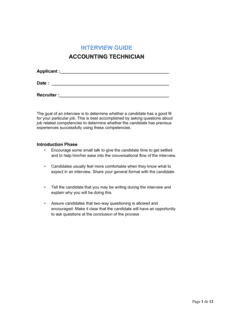
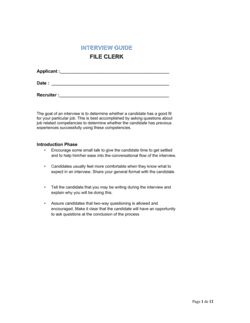
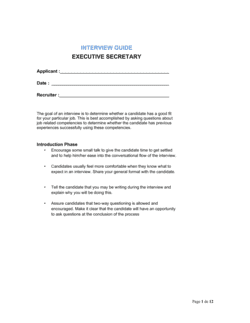
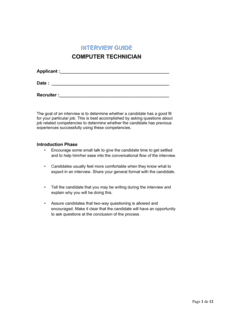
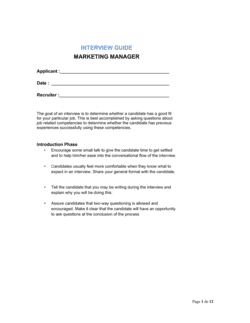
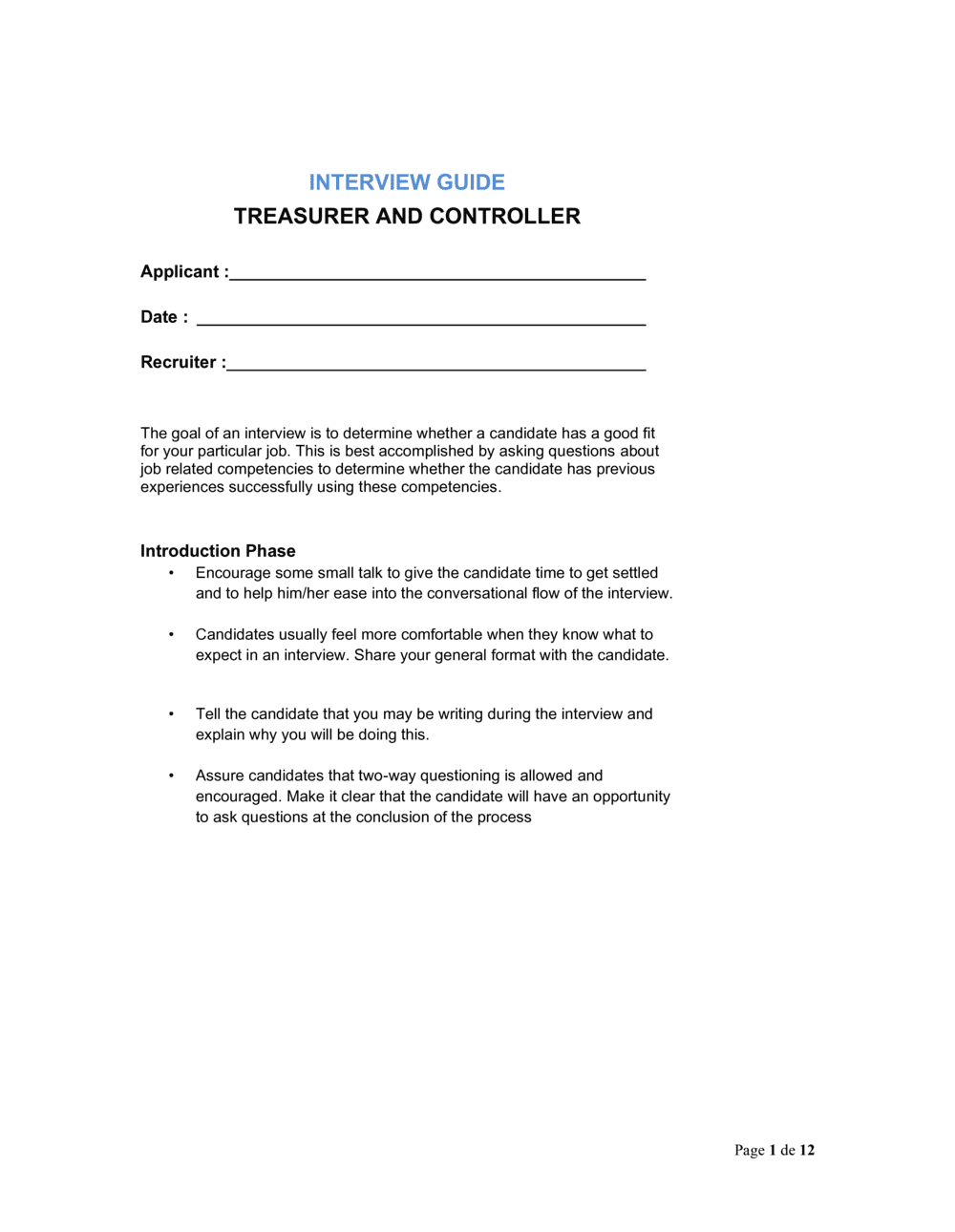
Interview Guide Treasurer and Controller

Free to read β€’ Save or share with one click

FreeInterview Guide Treasurer and Controller Template

At a glance

What it is
An Interview Guide for Treasurer and Controller is a structured document that gives hiring managers and search committees a consistent, repeatable framework for evaluating candidates for senior finance roles. This free Word download includes role-specific technical questions, behavioral scenarios, scoring rubrics, and evaluation criteria you can edit online and adapt to your organization's size and finance structure.
When you need it
Use it when filling a Treasurer, Controller, or combined finance leadership role β€” whether you are a founder hiring your first dedicated finance head, an HR team standardizing a formal search process, or a CFO replacing a key direct report. It ensures every candidate is evaluated against the same criteria rather than the interviewer's gut instinct.
What's inside
Role overview and required competencies, structured technical questions covering financial reporting, treasury management, controls, and compliance, behavioral and situational questions with scoring rubrics, a candidate comparison scorecard, and an interviewer debrief section for recording final hire or no-hire decisions with supporting notes.

What is an Interview Guide for Treasurer and Controller?

An Interview Guide for Treasurer and Controller is a structured evaluation document that gives hiring managers and interview panels a consistent, evidence-based framework for assessing candidates for senior finance leadership roles. It combines a competency framework, role-specific technical questions across financial reporting and treasury management, behavioral and situational scenarios, and a scoring rubric β€” so every candidate is measured against the same standard rather than each interviewer's personal impression. The guide covers both the Controller's domain (financial reporting, internal controls, month-end close) and the Treasurer's domain (cash forecasting, banking relationships, debt compliance), making it suitable for organizations filling either role independently or as a combined position.

Why You Need This Document

Hiring a Controller or Treasurer without a structured guide is one of the most expensive process shortcuts a finance function can take. A mis-hire at this level typically costs six to twelve months of total compensation in lost productivity, re-recruitment fees, and the downstream cost of correcting the controls gaps or reporting errors that accumulate during the gap. Without a written guide, interviewers default to conversational comfort over competency evidence, treasury-specific questions get skipped for candidates who excel in the Controller portion, and scoring happens informally after a group debrief where the loudest voice drives the outcome. This template gives your panel the specific questions, scoring anchors, and debrief structure to make a defensible, evidence-based hiring decision β€” the first time.

Which variant fits your situation?

If your situation is…Use this template
Hiring a Controller only, focused on financial reporting and close cyclesInterview Guide Controller
Hiring a CFO with both strategic and operational finance responsibilitiesInterview Guide CFO
Hiring a staff accountant or senior accountant below Controller levelInterview Guide Accountant
Filling a VP Finance role at a growth-stage companyInterview Guide VP Finance
Evaluating a candidate for a payroll or accounts payable manager roleInterview Guide Payroll Manager
Conducting a broad finance department restructure with multiple open rolesOrganizational Chart Finance Department

Common mistakes to avoid

❌ Using the same guide for Controller and CFO candidates

Why it matters: A CFO role requires strategic planning, investor relations, and capital structure judgment that a Controller guide does not assess. Evaluating CFO candidates with Controller questions systematically undervalues strategic capability.

Fix: Maintain separate interview guides for each level of finance leadership and select the appropriate one based on the approved job description before the search begins.

❌ Skipping the scoring rubric and relying on interviewer gut feel

Why it matters: Without anchored scoring criteria, hiring decisions default to likability and cultural familiarity rather than demonstrated competence β€” increasing the risk of a costly mis-hire.

Fix: Complete the scoring rubric section before the first interview and require every panel member to submit numerical scores before the debrief discussion begins.

❌ Omitting treasury-specific questions for a combined role

Why it matters: Candidates strong in financial reporting often have limited hands-on treasury experience. The gap only surfaces after hire when cash forecasting or banking relationships fall short.

Fix: Include at least three treasury-specific questions even when the Controller component is primary β€” use them to identify candidates who need a development plan in that area from day one.

❌ Completing scorecards after the group debrief

Why it matters: Post-debrief scoring is heavily influenced by the most vocal or senior person in the room, eliminating the independent perspective each interviewer was supposed to provide.

Fix: Set a firm policy: scorecards are submitted to the hiring manager before the debrief starts. Use a shared document with editing locked until the debrief begins.

❌ Asking only hypothetical questions with no behavioral follow-through

Why it matters: Situational questions reveal how candidates think, but they don't reveal what they have actually done. Finance leadership roles require proven execution, not just sound reasoning.

Fix: Pair every situational question with a behavioral follow-up: 'Can you give me a real example from your current role where you faced something similar?'

❌ Failing to tailor questions to the company's actual finance challenges

Why it matters: Generic questions produce generic answers. A candidate who sounds impressive discussing abstract controls may have no experience with your specific ERP, reporting structure, or industry compliance requirements.

Fix: Before each interview round, add one or two questions tied directly to your organization's current finance challenges β€” a recent audit finding, a system migration, or a cash flow constraint.

The 10 key sections, explained

Role Overview and Hiring Objectives

Required Competencies and Evaluation Criteria

Introductory and Role-Fit Questions

Technical Finance Questions β€” Reporting and Controls

Technical Finance Questions β€” Treasury and Cash Management

Leadership and Team Management Questions

Situational and Judgment Questions

Systems and Technology Questions

Scoring Rubric and Candidate Scorecard

Interviewer Debrief and Hire Decision

How to fill it out

  1. 1

    Define the role scope before customizing questions

    Decide whether you are hiring a standalone Controller, a standalone Treasurer, or a combined role. The scope determines which technical question sections are weighted most heavily and which competencies are non-negotiable.

    πŸ’‘ For a combined role at a sub-$50M revenue company, weight Controller technical questions at 60% and treasury at 40% β€” most combined roles are Controller-heavy in practice.

  2. 2

    Identify the three to five must-have competencies

    From the full competency list, select the three to five that are genuinely required on day one versus nice-to-have. These become your knock-out criteria and carry the highest weight in the scoring rubric.

    πŸ’‘ Separate 'required at hire' from 'can be developed in the role' β€” this distinction prevents you from rejecting strong candidates over learnable gaps.

  3. 3

    Customize technical questions to your environment

    Replace generic placeholders with your actual ERP system, reporting cadence, and specific challenges β€” for example, a recent audit finding, a cash flow constraint, or a system migration in progress.

    πŸ’‘ Candidates who research your company will recognize specific context in your questions and give more precise answers β€” it also signals to strong candidates that the role is substantive.

  4. 4

    Assign questions to specific interviewers

    Distribute sections across your interview panel β€” the CFO covers leadership and strategic judgment, a senior finance team member covers technical controls and systems, and an HR partner covers behavioral and culture-fit questions.

    πŸ’‘ No single interviewer should ask more than two sections β€” cognitive load and time constraints reduce question quality when one person carries the whole guide.

  5. 5

    Brief all interviewers on the scoring rubric before the first interview

    Walk each interviewer through the scoring anchors so a '3' means the same thing to every panel member. Calibration before the first interview is far more effective than trying to reconcile inconsistent scores afterward.

    πŸ’‘ Run a 15-minute calibration session using a hypothetical candidate response β€” it surfaces scoring disagreements before they affect a real evaluation.

  6. 6

    Complete individual scorecards immediately after each interview

    Each interviewer should complete their scorecard within 30 minutes of the interview ending, before comparing notes with other panel members. Record direct quotes from the candidate to anchor scores to evidence.

    πŸ’‘ Write down the candidate's exact words for the top two or three responses β€” paraphrasing erodes accuracy faster than you expect.

  7. 7

    Run a structured debrief within 24 hours

    Have each interviewer share their scores and key observations in turn before opening discussion. The hiring manager should speak last to avoid anchoring the group on their preferred outcome.

    πŸ’‘ If scores diverge by more than two points on any competency, spend five minutes understanding the source of disagreement before averaging β€” divergence usually signals different evidence, not different standards.

  8. 8

    Document the hire or no-hire decision with supporting rationale

    Record the final decision, the total weighted score, the two or three strongest evidence points, and any outstanding concerns. This documentation protects the organization in the event of a hiring dispute and supports onboarding planning.

    πŸ’‘ File the completed guide alongside the offer letter β€” if the new hire struggles in month six, the scorecard tells you exactly which gaps you knew about at hire.

Frequently asked questions

What is an interview guide for a Treasurer and Controller?

An interview guide for a Treasurer and Controller is a structured document that provides hiring managers and search panels with a consistent set of technical, behavioral, and situational questions β€” plus scoring rubrics β€” for evaluating candidates for senior finance roles. It ensures every candidate is assessed against the same criteria, reduces interviewer bias, and creates a documented basis for the hire or no-hire decision.

What is the difference between a Treasurer and a Controller?

A Controller is primarily responsible for financial reporting accuracy, month-end close, general ledger management, internal controls, and audit readiness. A Treasurer manages the organization's cash position, banking relationships, debt facilities, and investment of surplus funds. In many small and mid-size businesses, both responsibilities are held by a single senior finance leader, making it important that the interview guide covers both technical domains.

What questions should I ask a Controller candidate?

Focus on month-end and year-end close processes, internal control design and remediation, financial statement preparation under GAAP or IFRS, audit management, ERP systems experience, and team leadership. Behavioral questions should probe how the candidate has handled reconciling items under deadline pressure, disagreements with auditors, and performance management of finance staff.

What questions should I ask a Treasurer candidate?

Ask about cash flow forecasting methodology, banking relationship management, debt covenant compliance, liquidity risk management, and investment policy for surplus funds. Behavioral questions should cover situations where the candidate managed a covenant breach risk, negotiated a credit facility, or improved cash forecasting accuracy.

How many interviewers should be on the panel for a Treasurer or Controller hire?

Three to four interviewers is the standard for a senior finance leadership role β€” typically the direct supervisor (CFO or CEO), a peer or senior finance team member, and an HR partner. Adding a fourth interviewer from operations or the board audit committee is appropriate when the role has cross-functional authority or external reporting obligations. More than five interviewers adds coordination cost without materially improving decision quality.

Should I use a structured or unstructured interview for a finance leadership role?

Structured interviews β€” where every candidate is asked the same questions in the same order and scored on the same rubric β€” consistently outperform unstructured conversations for predicting job performance. For a senior finance role where a mis-hire can cost six to twelve months of salary plus operational disruption, the additional 30 minutes of preparation to structure the process is a sound investment.

What certifications should a Controller or Treasurer candidate have?

A CPA designation is the most common credential for a Controller, providing assurance of technical accounting competence and audit readiness. A CTP (Certified Treasury Professional) is the standard credential for Treasurer roles. For a combined role, a CPA with treasury management experience is typically preferred over a CTP without accounting depth. MBA credentials are valued at larger organizations but are rarely a standalone substitute for a technical finance designation.

How do I compare candidates across multiple interview rounds?

Use the scorecard section of the guide to record numerical scores per competency after every round. At the end of the process, compare total weighted scores across candidates for the same role β€” not absolute scores from different rounds, since question difficulty may vary. Document the two or three strongest evidence points and the top concern for each finalist before the final debrief to ensure the decision is grounded in evidence rather than recency bias.

How this compares to alternatives

vs Interview Guide CFO

A CFO interview guide emphasizes strategic planning, investor relations, capital structure decisions, and board communication β€” competencies beyond the scope of a Controller or Treasurer role. Use the CFO guide when the position has P&L ownership and external investor accountability; use this guide for operational finance leadership focused on reporting accuracy, controls, and cash management.

vs Interview Guide Accountant

An accountant interview guide focuses on transactional execution β€” journal entries, reconciliations, and individual reporting tasks. This Treasurer and Controller guide assesses leadership of the finance function, system ownership, and strategic cash management β€” appropriate for roles managing a team and reporting to senior leadership.

vs Job Description Treasurer and Controller

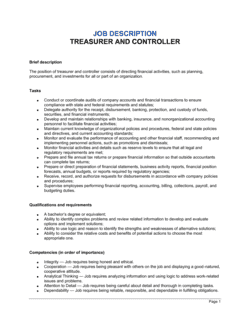
A job description defines the role requirements for posting and candidate attraction. This interview guide is the evaluation tool used once candidates are in the process. The two documents should be built from the same competency framework β€” the job description sets expectations, and the interview guide tests whether candidates meet them.

vs Performance Review Template

A performance review evaluates an employee already in the role against established goals and competencies. This interview guide assesses candidates before hire using the same competency framework. Aligning both documents ensures the criteria used to select the Controller or Treasurer match the criteria used to manage their performance once onboarded.

Industry-specific considerations

Financial Services

Candidates must demonstrate familiarity with regulatory capital reporting, liquidity coverage ratios, and compliance with FINRA or bank-specific reporting requirements alongside standard GAAP controls.

Manufacturing

Inventory accounting, cost of goods sold analysis, and standard costing systems are critical technical areas; treasury questions should emphasize foreign exchange exposure management for multi-site operations.

Healthcare

Revenue cycle management, accounts receivable from government payers, and compliance with CMS reporting requirements are key Controller competencies; treasury questions should address operating reserve management.

SaaS / Technology

ASC 606 revenue recognition, deferred revenue management, and stock-based compensation accounting are technical must-haves; cash runway management and milestone-based covenant compliance are the primary treasury focus areas.

Template vs pro β€” what fits your needs?

PathBest forCostTime
Use the templateHR managers, CFOs, and founders running a structured internal search for a Controller or TreasurerFree1–2 hours to customize and brief the panel
Template + professional reviewOrganizations using an executive search firm that requires a calibrated, competency-aligned evaluation tool$200–$500 for an HR consultant to tailor the rubric1–2 days
Custom draftedLarge organizations with formal talent acquisition frameworks, DEI-compliant structured interview requirements, or regulated industries with documentation obligations$1,000–$3,000 for a talent acquisition specialist or IO psychologist1–2 weeks

Glossary

Structured Interview
An interview format where every candidate is asked the same predetermined questions in the same order, allowing direct, fair comparison of responses.
Behavioral Question
A question that asks a candidate to describe a past situation β€” 'Tell me about a time when...' β€” on the premise that past behavior predicts future performance.
Situational Question
A hypothetical scenario question asking how a candidate would handle a specific challenge, used to assess judgment and decision-making process.
Scoring Rubric
A predefined rating scale β€” typically 1–5 β€” with specific behavioral anchors describing what a strong, acceptable, or weak response looks like for each question.
Competency Framework
A defined set of skills, knowledge areas, and behavioral traits required for success in a specific role, used to anchor interview questions and evaluation criteria.
Treasury Management
The oversight of an organization's cash position, liquidity, banking relationships, debt facilities, and investment of surplus funds.
Internal Controls
Policies, procedures, and checks designed to prevent financial errors, detect fraud, and ensure the accuracy and reliability of financial reporting.
Month-End Close
The monthly process of reconciling accounts, recording accruals, and preparing financial statements β€” a core operational responsibility of a Controller.
GAAP / IFRS
Generally Accepted Accounting Principles (US) and International Financial Reporting Standards β€” the two dominant accounting frameworks a Controller must apply to financial statement preparation.
Debrief Session
A structured meeting held immediately after all interview rounds where interviewers share ratings and observations to reach a collective hire or no-hire decision.

Part of your Business Operating System

This document is one of 3,000+ business & legal templates included in Business in a Box.

  • Fill-in-the-blanks β€” ready in minutes
  • Compatible with all office suites
  • Export to PDF and share electronically

Create your document in 3 simple steps.

From template to signed document β€” all inside one Business Operating System.
1
Download or open template

Access over 3,000+ business and legal templates for any business task, project or initiative.

2
Edit and fill in the blanks with AI

Customize your ready-made business document template and save it in the cloud.

3
Save, Share, Send, Sign

Share your files and folders with your team. Create a space of seamless collaboration.

Save time, save money, and create top-quality documents.

β˜…β˜…β˜…β˜…β˜…

"Fantastic value! I'm not sure how I'd do without it. It's worth its weight in gold and paid back for itself many times."

Managing Director Β· Mall Farm
Robert Whalley
Managing Director, Mall Farm Proprietary Limited
β˜…β˜…β˜…β˜…β˜…

"I have been using Business in a Box for years. It has been the most useful source of templates I have encountered. I recommend it to anyone."

Business Owner Β· 4+ years
Dr Michael John Freestone
Business Owner
β˜…β˜…β˜…β˜…β˜…

"It has been a life saver so many times I have lost count. Business in a Box has saved me so much time and as you know, time is money."

Owner Β· Upstate Web
David G. Moore Jr.
Owner, Upstate Web

Run your business with a system β€” not scattered tools

Stop downloading documents. Start operating with clarity. Business in a Box gives you the Business Operating System used by over 250,000 companies worldwide to structure, run, and grow their business.

Free Forever PlanΒ Β·Β No credit card required