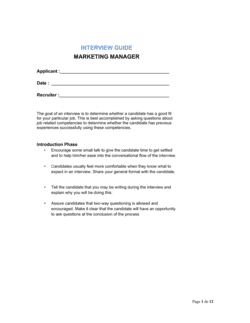
Interview Guide Marketing Assistant

Free to read β€’ Save or share with one click

FreeInterview Guide Marketing Assistant Template

At a glance

What it is
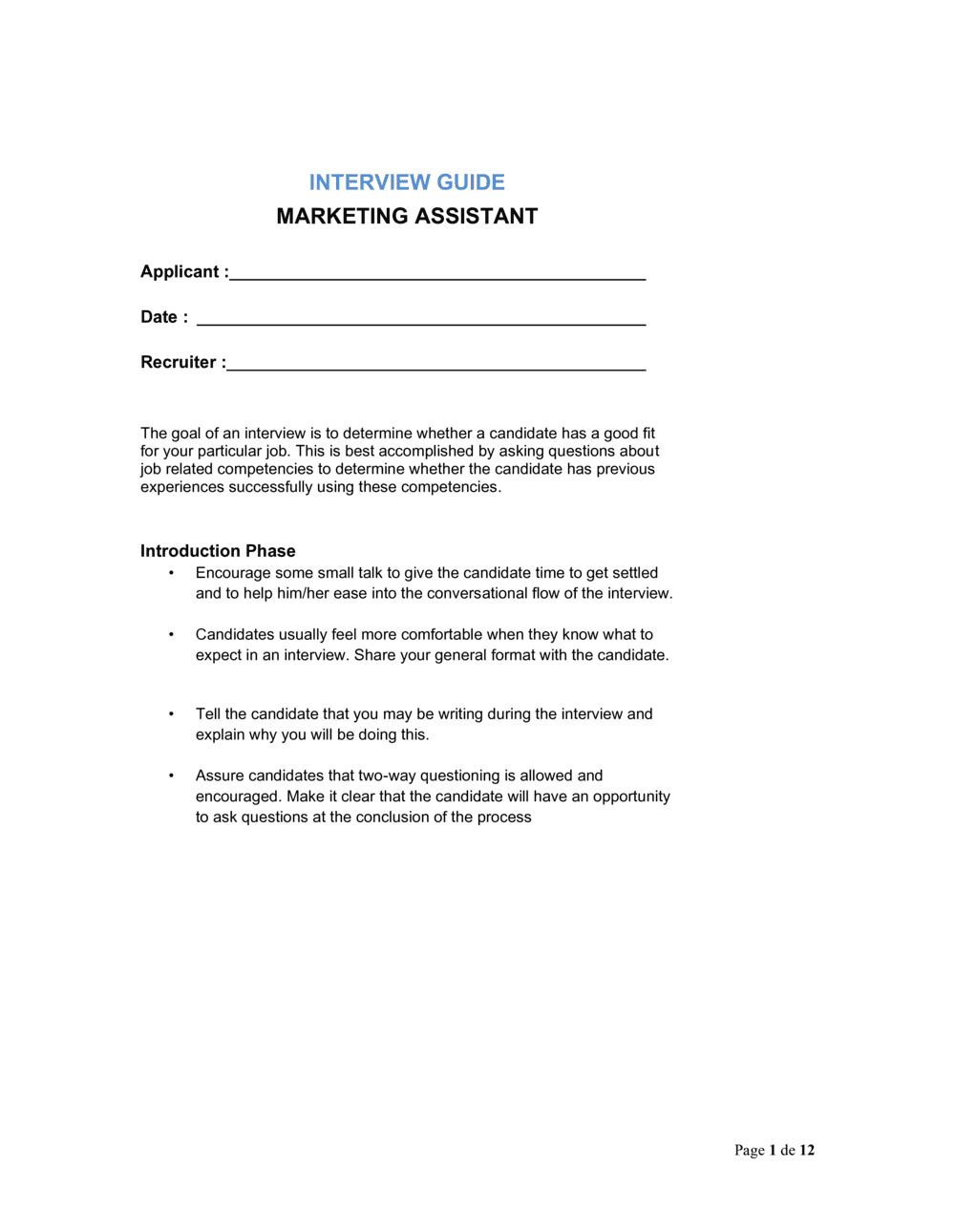
An Interview Guide for a Marketing Assistant is a structured hiring document that equips interviewers with role-specific questions, evaluation criteria, and a scoring rubric to assess candidates consistently. This free Word download includes competency-mapped questions, behavioral prompts, and a scoring section you can edit online and share with your hiring panel before each interview.
When you need it
Use it when you are actively interviewing candidates for a marketing assistant or marketing coordinator role and need a repeatable, bias-reducing process across multiple interviewers. It is also useful when onboarding a new hiring manager to your marketing team's evaluation standards.
What's inside
Role overview and competency framework, structured behavioral and situational questions organized by skill area, a numerical scoring rubric, interviewer notes sections, a candidate comparison summary, and a hiring recommendation block.

What is an Interview Guide for a Marketing Assistant?

An Interview Guide for a Marketing Assistant is a structured hiring document that gives interviewers a consistent set of role-specific questions, a competency framework, and a numerical scoring rubric to evaluate every candidate against the same criteria. It maps behavioral and situational questions to the specific skills a marketing assistant needs β€” content scheduling, digital tool proficiency, attention to detail, and cross-functional communication β€” and produces documented, comparable scores across your entire candidate pool. Unlike an informal conversation, a structured guide reduces the influence of first-impression bias and gives your hiring panel shared evidence to work from when making a final decision.

Why You Need This Document

Without a structured interview guide, two interviewers conducting back-to-back sessions will ask different questions, weight different qualities, and arrive at recommendations that reflect personal chemistry as much as actual job readiness. The cost of that inconsistency is concrete: a weak hire in a marketing assistant role delays campaign execution, generates rework, and typically triggers another full hiring cycle within six months. A documented scoring process also protects your organization if a rejected candidate questions the selection decision β€” scorecards with behavioral evidence are your primary record of a non-discriminatory process. This template gives you a ready-to-customize starting point that installs a repeatable, defensible hiring process in under an hour, whether you are filling your first marketing role or standardizing across a growing team.

Which variant fits your situation?

If your situation is…Use this template
Hiring an entry-level marketing assistant with under two years of experienceInterview Guide Marketing Assistant
Evaluating a mid-level marketing coordinator with campaign ownershipInterview Guide Marketing Coordinator
Hiring a content writer or copywriter for the marketing teamInterview Guide Content Writer
Assessing a digital marketing specialist with paid media experienceInterview Guide Digital Marketing Specialist
Conducting a structured phone or video screen before a full interviewPhone Screen Interview Guide
Comparing multiple final-round candidates with a scored panel formatCandidate Evaluation Form
Onboarding a new marketing hire after the offer is acceptedEmployee Onboarding Checklist

Common mistakes to avoid

❌ Using the same generic questions for every marketing role

Why it matters: Questions built for a content strategist do not assess the scheduling, coordination, and tool-execution skills that define a marketing assistant role. Candidates who would thrive get screened out; candidates who interview well get hired for the wrong reasons.

Fix: Map every question to a specific competency on the job's success profile. Delete any question that does not connect to a competency you are actually scoring.

❌ Completing scorecards after the panel debrief

Why it matters: Scores completed after group discussion reflect the group's consensus rather than each interviewer's independent evidence-based assessment β€” which is the entire point of using a panel.

Fix: Require all panelists to submit individual scorecards before the debrief meeting begins. Make this a non-negotiable step in your hiring process.

❌ Skipping follow-up probes when a candidate gives a strong opening answer

Why it matters: Rehearsed opening answers are easy to prepare; detailed follow-up questions reveal whether the candidate has genuine depth or a polished story with nothing behind it.

Fix: Use the follow-up probes printed in the guide for every behavioral question, regardless of how complete the initial answer sounds.

❌ Failing to tell all candidates the same next steps and timeline

Why it matters: Inconsistent closing statements generate candidate follow-up emails, create perceived favoritism, and produce negative employer brand reviews on platforms like Glassdoor.

Fix: Read the scripted closing statement in the guide verbatim for every candidate β€” it takes 30 seconds and eliminates all inconsistency.

The 10 key sections, explained

Role Overview and Success Profile

Competency Framework

Opening and Rapport-Building Questions

Behavioral Questions by Competency

Situational and Skills-Based Questions

Digital Tools and Technical Proficiency

Culture and Collaboration Questions

Candidate Questions and Closing

Scoring Rubric and Interviewer Notes

Hiring Recommendation and Debrief Summary

How to fill it out

  1. 1

    Confirm the competencies you are hiring for

    Before editing any questions, align with the hiring manager on four to six competencies that matter most for this specific role. Remove any pre-filled competencies that do not match your team's actual needs.

    πŸ’‘ Limit yourself to six competencies maximum for an assistant-level role β€” more than that produces shallow assessment of everything.

  2. 2

    Customize the role overview and success profile

    Replace the placeholder job title, reporting line, and responsibilities with the exact details from your job posting. Add two to three sentences describing what your best current marketing assistant does that average performers do not.

    πŸ’‘ Pull language directly from your highest-performing team member's last performance review to make the success profile concrete rather than aspirational.

  3. 3

    Review and adapt the behavioral questions

    Read each behavioral question and confirm it maps to a competency you are actually scoring. Remove questions that duplicate a competency already covered, and add one question per competency area you added in Step 1.

    πŸ’‘ Aim for one primary behavioral question per competency plus two follow-up probes β€” that structure reliably fills a 45-minute interview.

  4. 4

    Update the digital tools section for your stack

    Replace the placeholder platform names with the specific tools your team uses daily β€” your CMS, email platform, social scheduler, and analytics dashboard. This ensures you assess actual on-the-job readiness, not generic tool awareness.

    πŸ’‘ If a tool is trainable in under a week, consider making it a nice-to-have rather than a scored competency β€” otherwise you filter out strong candidates with transferable skills.

  5. 5

    Set up the scoring rubric anchors

    For each competency, write a one-sentence description of what a 1, 3, and 5 response looks like for your team context. Behavioral anchors are what make the rubric useful β€” without them, two interviewers will score the same answer differently.

    πŸ’‘ Run a calibration session with your panel using a sample response before the first interview. Fifteen minutes of calibration eliminates most inter-rater disagreement.

  6. 6

    Brief every interviewer before the first session

    Share the completed guide with all panel members at least 24 hours before interviews begin. Confirm each person knows which competency sections they are responsible for probing if interviews are divided by topic.

    πŸ’‘ Assign one interviewer as the note-taker and one as the primary questioner per session β€” split roles reduce the chance that note-taking and active listening compete with each other.

  7. 7

    Complete the scorecard immediately after each interview

    Fill in all numerical scores and free-text notes within 15 minutes of the interview ending. Do not discuss the candidate with other panelists before submitting your individual scores.

    πŸ’‘ Score each competency before you write your overall recommendation β€” this prevents your gut feeling about the candidate from anchoring your individual competency scores.

  8. 8

    Run a structured debrief with the full panel

    Collect all individual scorecards before the debrief meeting. Have each panelist share their overall recommendation independently before discussion begins, then review competency scores that diverge by two or more points.

    πŸ’‘ The panelist who interviewed most recently should share last in the debrief β€” recency bias is the strongest of the common hiring biases and the easiest to counteract with process.

Frequently asked questions

What is an interview guide for a marketing assistant?

An interview guide for a marketing assistant is a structured document that gives interviewers a consistent set of role-specific questions, a competency framework, and a scoring rubric to evaluate every candidate against the same criteria. It reduces the variability that comes from unstructured interviews, produces comparable data across candidates, and helps hiring teams make defensible decisions. It is distinct from a job description β€” the job description defines what the role does; the interview guide defines how to assess whether a candidate can do it.

What questions should I ask a marketing assistant candidate?

Effective marketing assistant interview questions fall into four categories: behavioral questions that surface past experience managing deadlines and content workflows, situational questions that test judgment on common scenarios like scheduling errors or unclear briefs, technical questions assessing hands-on proficiency with your specific tools, and collaboration questions that reveal how the candidate communicates and takes feedback. Generic questions like 'Where do you see yourself in five years?' produce rehearsed answers with no predictive value for this role.

How is a structured interview guide different from an unstructured interview?

In an unstructured interview, each interviewer chooses their own questions in the moment β€” producing incomparable answers and scores that reflect personal rapport as much as actual competency. A structured interview guide gives every candidate the same questions in the same order, scores them against defined behavioral anchors, and enables true apples-to-apples comparison. Research consistently shows structured interviews predict job performance roughly twice as accurately as unstructured conversations.

How many questions should a marketing assistant interview guide include?

For a 45-minute interview, plan for eight to twelve questions β€” one to two opening questions, four to six behavioral questions (one per competency), two situational or technical questions, and one to two culture or collaboration questions. Each behavioral question should include two to three follow-up probes. More than twelve primary questions will either rush the session or require the interview to run long.

Who should be on the interview panel for a marketing assistant role?

A typical panel for an assistant-level marketing hire includes the direct hiring manager, one peer-level team member who will work closely with the new hire, and optionally an HR representative or a cross-functional stakeholder from a team the marketing assistant will support. More than three panelists for an entry-level role adds scheduling overhead without meaningfully improving decision quality.

How should interviewers score candidates using this guide?

Each panelist scores independently on a 1–5 scale per competency immediately after the interview, using the behavioral anchors in the scoring rubric as their reference β€” not their overall impression of the candidate. Scores are submitted before the panel debrief. During the debrief, the panel reviews any competency scores that diverge by two or more points and discusses the specific evidence behind each score before reaching a recommendation.

Can I use this interview guide for remote or video interviews?

Yes β€” the guide works for in-person, phone, and video interviews without modification. For video interviews, add a brief technology check to the opening section and build in an extra two minutes per 45-minute session to account for connectivity delays. The structured question sequence is particularly valuable for remote panels, where interviewers cannot read nonverbal cues and rely more heavily on documented evidence.

How do I adapt this guide for a marketing coordinator role versus a marketing assistant?

A marketing coordinator role typically involves more independent project ownership, stakeholder management, and campaign reporting than an assistant role. Adapt the guide by replacing execution-focused behavioral questions with questions that assess initiative, cross-functional coordination, and data interpretation. Raise the proficiency expectations in the digital tools section and add a question on prioritization when managing competing projects without day-to-day direction.

What should I do with completed interview scorecards?

Store completed scorecards with the candidate's application file for a minimum of one year β€” and up to four years in jurisdictions with longer employment record retention requirements. Documented scores and notes are your primary evidence of a non-discriminatory hiring process if a rejected candidate files a complaint. Never discard scorecards before the retained employee has completed their probationary period.

How this compares to alternatives

vs Job Description β€” Marketing Assistant

A job description communicates the role's duties, qualifications, and reporting structure to candidates before they apply. An interview guide is an internal tool used after applications are received, designed to help interviewers evaluate candidates consistently. You need both β€” the job description attracts the applicant pool; the interview guide filters it.

vs Candidate Evaluation Form

A candidate evaluation form captures an interviewer's overall impression and a summary recommendation after a conversation. An interview guide prescribes what questions to ask, how to probe answers, and how to score each competency β€” it structures the interview itself, not just the post-interview documentation. The evaluation form is often used alongside or as a simplified substitute for a full guide.

vs Employee Onboarding Checklist

An onboarding checklist is used after a hiring decision is made to set up the new employee for success in their first 30, 60, and 90 days. An interview guide is used before the hire to make the hiring decision. They address sequential stages of the same process and should both exist in a complete hiring workflow.

vs Phone Screen Interview Guide

A phone screen guide is a short 15–20 minute script used to verify basic qualifications and culture alignment before committing to a full interview. This marketing assistant interview guide is designed for a 45-minute structured in-person or video interview covering full competency assessment. Use the phone screen to narrow the pool; use this guide to make the final selection.

Industry-specific considerations

Marketing and Advertising Agencies

Agency interviews emphasize client-facing communication, multi-account task switching, and proficiency with project management and asset delivery tools like Asana, Sprout Social, and Canva.

E-commerce and Retail

E-commerce teams prioritize hands-on experience with promotional calendar management, email deployment cadences, and product content updates in a CMS under tight launch deadlines.

SaaS and Technology

SaaS marketing assistants are frequently assessed on familiarity with marketing automation platforms like HubSpot or Marketo, basic understanding of the sales funnel, and ability to support content and demand generation programs.

Healthcare and Professional Services

Regulated industries place additional weight on accuracy, compliance awareness, and the ability to follow brand and legal review processes before publishing any external-facing content.

Template vs pro β€” what fits your needs?

PathBest forCostTime
Use the templateMarketing managers and HR coordinators hiring one to three marketing assistants per year with a small panelFree30–60 minutes to customize per hiring cycle
Template + professional reviewTeams conducting high-volume hiring or building a standardized interview process across a marketing department$200–$800 for an HR consultant or I-O psychologist review2–5 days
Custom draftedEnterprise HR teams building a validated, competency-mapped assessment framework across multiple marketing role levels$2,000–$8,000 for a custom competency model and interview toolkit3–6 weeks

Glossary

Structured Interview
An interview format in which all candidates are asked the same predetermined questions in the same order, enabling fair, side-by-side comparison.
Behavioral Question
A question that asks a candidate to describe a specific past experience to predict future performance β€” typically framed as 'Tell me about a time when...'
Situational Question
A hypothetical question that asks how a candidate would handle a specific scenario, used to assess judgment and problem-solving approach.
Competency Framework
A defined set of skills, behaviors, and knowledge areas required for successful performance in a role, used to align interview questions to actual job requirements.
Scoring Rubric
A numerical or descriptive scale used to rate candidate responses consistently across interviewers β€” typically 1–5 per competency.
STAR Method
A response framework standing for Situation, Task, Action, and Result β€” commonly used to structure answers to behavioral interview questions.
Hiring Panel
A group of two or more interviewers who each evaluate a candidate independently before comparing scores and making a collective hiring recommendation.
Candidate Scorecard
A summary sheet that aggregates individual competency ratings into an overall score for a candidate, enabling objective comparison across the applicant pool.
Adverse Impact
A pattern of interview or selection outcomes that disproportionately screens out candidates from a protected group, which can expose employers to discrimination claims.
Structured Debrief
A post-interview meeting in which all panel members share independent scores before discussion begins, reducing groupthink and anchoring bias.

Part of your Business Operating System

This document is one of 3,000+ business & legal templates included in Business in a Box.

  • Fill-in-the-blanks β€” ready in minutes
  • Compatible with all office suites
  • Export to PDF and share electronically

Create your document in 3 simple steps.

From template to signed document β€” all inside one Business Operating System.
1
Download or open template

Access over 3,000+ business and legal templates for any business task, project or initiative.

2
Edit and fill in the blanks with AI

Customize your ready-made business document template and save it in the cloud.

3
Save, Share, Send, Sign

Share your files and folders with your team. Create a space of seamless collaboration.

Save time, save money, and create top-quality documents.

β˜…β˜…β˜…β˜…β˜…

"Fantastic value! I'm not sure how I'd do without it. It's worth its weight in gold and paid back for itself many times."

Managing Director Β· Mall Farm
Robert Whalley
Managing Director, Mall Farm Proprietary Limited
β˜…β˜…β˜…β˜…β˜…

"I have been using Business in a Box for years. It has been the most useful source of templates I have encountered. I recommend it to anyone."

Business Owner Β· 4+ years
Dr Michael John Freestone
Business Owner
β˜…β˜…β˜…β˜…β˜…

"It has been a life saver so many times I have lost count. Business in a Box has saved me so much time and as you know, time is money."

Owner Β· Upstate Web
David G. Moore Jr.
Owner, Upstate Web

Run your business with a system β€” not scattered tools

Stop downloading documents. Start operating with clarity. Business in a Box gives you the Business Operating System used by over 250,000 companies worldwide to structure, run, and grow their business.

Start freeΒ Β·Β No credit card required