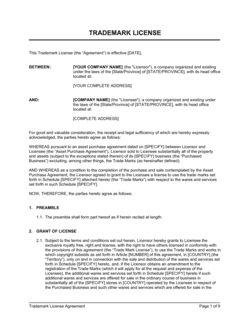
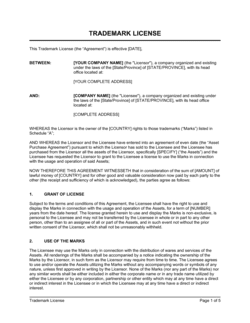
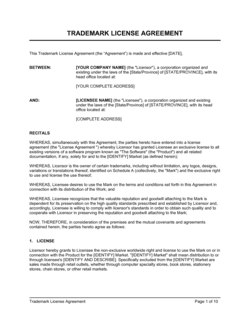
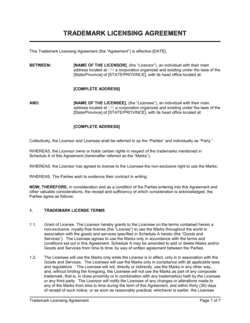
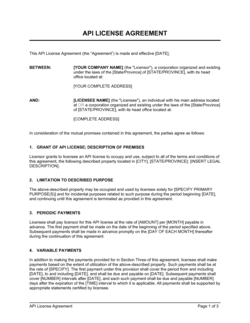
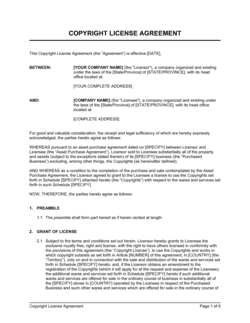
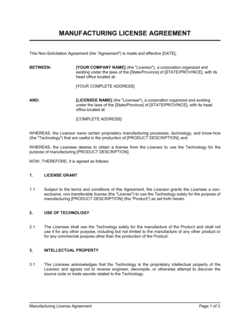
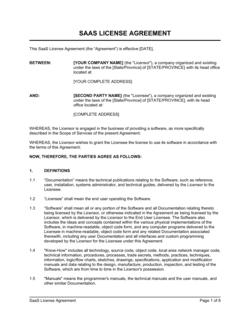
Trademark License and Royalty Agreement Template

Free Word download • Edit online • Save & share with Drive • Export to PDF

12 pages35–45 min to fillDifficulty: ComplexSignature requiredLegal review recommended
Learn more ↓
FreeTrademark License and Royalty Agreement Template

At a glance

What it is
A Trademark License and Royalty Agreement is a legally binding contract in which a trademark owner (the licensor) grants another party (the licensee) the right to use a registered or common-law trademark in exchange for ongoing royalty payments. This free Word download covers scope of use, territory, royalty rate and calculation method, quality control obligations, audit rights, and termination — and can be exported as PDF and executed before any licensee begins using your brand.
When you need it
Use it when you own a trademark and want to authorize a manufacturer, retailer, franchisee, or distribution partner to use your brand on products or services in exchange for a percentage of sales or a flat fee. It is also required when your company is the licensee and needs documented authority to use a third-party mark.
What's inside
Grant of license and scope of permitted use, licensed trademark identification, royalty rate and payment schedule, quality control and approval process, audit rights, term and renewal, indemnification, and termination conditions.

What is a Trademark License and Royalty Agreement?

A Trademark License and Royalty Agreement is a legally binding contract in which a trademark owner — the licensor — grants another party — the licensee — the right to use a specific trademark on defined products or services, within a defined territory, in exchange for ongoing royalty payments. The agreement governs everything material to the licensing relationship: the exact marks covered, the scope of permitted use, the royalty rate and how it is calculated, quality control obligations the licensor must enforce to preserve the registration, audit rights, and the conditions under which the license ends. Unlike an assignment, a trademark license retains ownership with the licensor — rights revert when the agreement terminates, and royalties continue for as long as the licensee operates under the mark.

Why You Need This Document

Operating a trademark licensing relationship without a written agreement exposes both parties to serious legal and financial risk. For the licensor, the most dangerous consequence is losing the trademark registration itself: US and Canadian trademark law requires licensors to actively supervise the quality of goods sold under a licensed mark — a licensor who allows use without documented quality control creates a "naked license," which courts have used to cancel trademark registrations entirely. Without a signed agreement specifying royalty rates, Net Sales definitions, and payment schedules, royalty disputes become credibility contests rather than contract interpretation exercises, and recovering underpaid royalties requires costly litigation with uncertain outcomes. For the licensee, operating without a signed license means using a trademark without documented authorization — leaving the business exposed to infringement claims the moment the relationship sours. This template gives both parties a clear, enforceable record of every agreed term before the first licensed product reaches market, protecting the brand, the royalty stream, and the working relationship.

Which variant fits your situation?

If your situation is…Use this template
Granting exclusive rights in a defined territory to a single licenseeExclusive Trademark License Agreement
Authorizing multiple licensees to use the same mark simultaneouslyNon-Exclusive Trademark License Agreement
Licensing both a trademark and underlying technology togetherTechnology and Trademark License Agreement
Licensing a trademark as part of a franchise relationshipFranchise Agreement
Assigning (permanently transferring) the trademark rather than licensing itTrademark Assignment Agreement
Licensing copyrighted artwork, characters, or brand imageryCopyright License Agreement
Granting a short-term trial license with no ongoing royaltyTrademark Consent Agreement

Common mistakes to avoid

❌ Creating a naked license by not enforcing quality control

Why it matters: US and Canadian trademark law requires licensors to actually supervise and control quality of licensed goods. A licensor who signs quality control language but never reviews samples can lose the trademark registration entirely — courts have cancelled marks on this basis.

Fix: Build a real approval workflow: require sample submissions before first use, review and approve in writing within the contract's deadline, and document every approval decision in a dated log.

❌ Leaving 'Net Sales' undefined or loosely defined

Why it matters: Without a precise definition, licensees deduct shipping, warehousing, co-op advertising, and overhead from gross sales, shrinking the royalty base to a fraction of real revenue — disputes over the definition are one of the most common sources of licensing litigation.

Fix: List each permitted deduction by name (e.g., 'cash discounts actually taken, not to exceed 2%; returns of defective product') and state that all other deductions are disallowed.

❌ Granting exclusive rights with no minimum royalty or performance benchmark

Why it matters: An exclusive licensee with no floor payment can tie up valuable trademark rights indefinitely while generating little or no royalty income — and the licensor cannot license the mark to anyone else in the territory.

Fix: Set a minimum annual royalty and include a clause converting exclusivity to non-exclusive (or allowing termination) if the licensee fails to meet defined sales benchmarks in Year 1 or Year 2.

❌ Omitting the goodwill inurement clause

Why it matters: Without explicit language confirming that goodwill accrues to the licensor, a long-term licensee may argue they have acquired proprietary rights in the brand they helped build — a claim that becomes expensive to litigate even when ultimately unsuccessful.

Fix: Include a clear inurement clause stating that all goodwill from the licensee's use belongs exclusively to the licensor, and have the licensee acknowledge licensor's sole ownership at signing.

❌ No post-termination sell-off period with clear limits

Why it matters: Without a defined sell-off window, the licensee either demands an indefinite right to liquidate inventory bearing the licensed mark — continuing brand exposure the licensor cannot control — or faces financial harm from an immediate stop-sell obligation.

Fix: Include a 60–90 day post-termination sell-off right limited to existing inventory on hand as of the termination date, with a final royalty statement and payment due at the end of the sell-off period.

❌ Permitting sublicensing without prior written consent

Why it matters: If the licensee can sublicense freely, the licensor's brand may end up on products made or sold by a party the licensor has never vetted — creating quality control gaps, legal exposure, and potential trademark genericness.

Fix: Include a clause expressly prohibiting sublicensing without the licensor's prior written consent, and state that any attempted sublicense without consent is void and constitutes a material breach.

The 10 key clauses, explained

Grant of license and scope

In plain language: Specifies exactly which trademark(s) are licensed, whether the grant is exclusive or non-exclusive, the permitted field of use, and the licensed territory.

Sample language
Licensor hereby grants to Licensee a [exclusive / non-exclusive], non-transferable license to use the Licensed Mark ([MARK DESCRIPTION], Registration No. [NUMBER]) solely in connection with [FIELD OF USE] within [TERRITORY].

Common mistake: Describing the field of use too broadly — authorizing the licensee to use the mark in any category rather than a defined product or service class, which makes quality control unmanageable and dilutes the brand.

Licensed trademark identification

In plain language: Lists every trademark, logo, trade name, and registration number covered by the agreement and attaches specimens as exhibits.

Sample language
The Licensed Mark means the trademark(s) identified in Exhibit A, including the word mark '[MARK]', design mark '[DESCRIPTION]' (USPTO Reg. No. [NUMBER]), and any derivatives approved in writing by Licensor.

Common mistake: Referencing only the word mark while omitting logo versions or stylized forms — allowing the licensee to use design elements the licensor did not intend to license.

Royalty rate, calculation, and payment schedule

In plain language: States the royalty percentage or per-unit fee, defines the royalty base (net sales), and sets payment frequency and the method of remittance.

Sample language
Licensee shall pay Licensor a royalty of [X]% of Net Sales of Licensed Products in each calendar quarter, due within [30] days after quarter-end, accompanied by a royalty statement in the form of Exhibit B.

Common mistake: Failing to define 'Net Sales' — leaving room for the licensee to deduct shipping, co-op advertising, and overhead costs that inflate deductions and reduce the royalty base.

Minimum royalty guarantee

In plain language: Requires the licensee to pay a floor amount each period regardless of actual sales, giving the licensor a predictable income stream and an incentive for the licensee to actively promote the brand.

Sample language
Regardless of actual Net Sales, Licensee shall pay Licensor a minimum annual royalty of $[AMOUNT] ('Minimum Royalty'), payable in equal quarterly installments of $[AMOUNT].

Common mistake: Setting no minimum royalty at all, allowing a licensee to sit on exclusive rights without actively using the mark — blocking the licensor from licensing to better-performing partners.

Quality control and approval process

In plain language: Obligates the licensee to submit product samples, packaging, and marketing materials for licensor approval before use, and sets ongoing quality standards the licensee must maintain.

Sample language
Licensee shall submit to Licensor, for written approval prior to first use, representative samples of all Licensed Products, packaging, and promotional materials bearing the Licensed Mark. Licensor shall have [15] business days to approve or reject each submission.

Common mistake: Including quality control language without actually exercising it — courts have held that a licensor who never reviews samples or enforces standards has created a naked license, risking cancellation of the trademark registration.

Audit rights and record-keeping

In plain language: Gives the licensor the right to inspect the licensee's books and sales records to verify royalty accuracy, and requires the licensee to retain records for a defined period.

Sample language
Licensee shall maintain accurate books and records of all sales of Licensed Products for a minimum of [3] years. Licensor may, upon [15] days' written notice, audit such records no more than once per calendar year. If an audit reveals an underpayment exceeding [5]%, Licensee shall bear the cost of the audit.

Common mistake: Omitting an audit-cost-shifting provision — without it, a licensor bears audit costs even when the licensee has significantly under-reported royalties.

Intellectual property ownership and inurement

In plain language: Confirms that the licensor retains all ownership of the trademark and that any goodwill generated by the licensee's use accrues to the licensor, not the licensee.

Sample language
Licensee acknowledges that Licensor is and shall remain the sole owner of the Licensed Mark and all goodwill associated with it. Any goodwill arising from Licensee's use of the Licensed Mark inures exclusively to the benefit of Licensor.

Common mistake: Omitting the inurement clause, which can allow a licensee to claim a proprietary interest in goodwill they helped build — creating a basis for a trademark ownership dispute at the end of the relationship.

Term, renewal, and termination

In plain language: Sets the initial license period, renewal conditions, and the grounds on which either party may terminate early — including material breach, insolvency, or failure to meet minimum royalties.

Sample language
This Agreement shall have an initial term of [X] years commencing on [DATE]. Either party may terminate upon [30] days' written notice of a material breach that remains uncured. Licensor may terminate immediately if Licensee becomes insolvent or fails to pay the Minimum Royalty.

Common mistake: No cure period before termination for breach — triggering immediate termination for minor, fixable violations creates unnecessary litigation risk and may be unenforceable in some jurisdictions.

Indemnification and insurance

In plain language: Requires the licensee to indemnify the licensor against third-party claims arising from the licensee's use of the mark and to maintain adequate product liability insurance.

Sample language
Licensee shall indemnify, defend, and hold harmless Licensor from any third-party claims arising out of Licensee's use of the Licensed Mark or sale of Licensed Products. Licensee shall maintain product liability insurance of not less than $[AMOUNT] per occurrence, naming Licensor as an additional insured.

Common mistake: Setting an insurance floor without specifying that the licensor must be named as an additional insured — in a product liability claim, the licensor may otherwise receive no direct coverage.

Governing law and dispute resolution

In plain language: Specifies which jurisdiction's law governs the agreement and the mechanism for resolving disputes — arbitration, mediation, or litigation — and the venue.

Sample language
This Agreement is governed by the laws of [STATE / PROVINCE / COUNTRY]. Any dispute arising under this Agreement shall be resolved by binding arbitration administered by [AAA / JAMS] in [CITY], except that either party may seek injunctive relief in any court of competent jurisdiction.

Common mistake: Choosing a governing law with no connection to where either party operates — courts may refuse to enforce the choice if it has no reasonable relationship to the transaction.

How to fill it out

  1. 1

    Identify the parties and licensed marks

    Enter the licensor's full legal entity name and the licensee's legal name. Complete Exhibit A by listing every trademark, registration number, and specimen image that is covered by the agreement.

    💡 Pull the exact registered form of the mark from the USPTO, CIPO, or EUIPO database to ensure the description in Exhibit A matches the official registration exactly.

  2. 2

    Define the field of use and territory

    Specify the exact product categories or service classes in which the licensee may use the mark, and list the countries, states, or regions that constitute the licensed territory. Narrow definitions protect the licensor's ability to license other categories or regions independently.

    💡 If you intend to grant rights in the US only, list the US by name — do not use 'worldwide' unless you have verified the licensee has the operational capacity and intent to use the mark globally.

  3. 3

    Set the royalty rate and define the royalty base

    Enter the royalty percentage and write out the full definition of Net Sales, listing every permitted deduction by name. Set the payment frequency (monthly or quarterly) and the number of days after period-end by which payment and statements are due.

    💡 Industry royalty rates for consumer goods typically range from 3–8% of net sales; character and entertainment brands command 8–15%. Research comparable deals in your category before finalizing.

  4. 4

    Set the minimum royalty and performance benchmarks

    Enter the annual minimum royalty and allocate it across quarterly installments. Optionally add a sales volume benchmark that, if not met in Year 1 or Year 2, converts an exclusive license to non-exclusive.

    💡 Tying an exclusivity downgrade to a missed sales threshold — rather than allowing termination — keeps the license active while removing the exclusivity penalty, a structure many licensees find more acceptable.

  5. 5

    Complete the quality control section

    Describe the approval process in detail: what must be submitted (product samples, packaging, advertising), in what form (physical or digital), and the timeline for licensor approval or rejection. Attach brand guidelines as Exhibit C.

    💡 Schedule an approval review into your calendar each quarter so you actually exercise quality control — failure to review submitted samples creates a naked-license risk regardless of what the contract says.

  6. 6

    Set audit rights and record-retention terms

    Confirm the record-retention period (3 years is standard), the audit notice period (10–15 business days is typical), frequency (once per calendar year), and the underpayment threshold above which the licensee bears audit costs.

    💡 Set the cost-shifting trigger at 3–5% underpayment — too low and you create audit friction for minor errors; too high and you reward systematic under-reporting.

  7. 7

    Define the term, renewal, and termination triggers

    Enter the initial term length, renewal conditions (automatic vs. negotiated), notice period for non-renewal, cure periods for breach (typically 30 days), and the specific grounds for immediate termination — insolvency, IP abandonment, regulatory violations.

    💡 Build in a 30-day cure period for payment defaults but allow immediate termination for trademark abandonment or unauthorized sublicensing — the harm from those events is not curable by writing a check.

  8. 8

    Sign before the licensee begins using the mark

    Both parties must execute the agreement before any licensed trademark use begins. Post-use signatures create a gap period during which the licensor's quality control obligations were not in place, weakening the registration against a naked-license challenge.

    💡 Use a countersigned effective-date clause ('This Agreement is effective as of [DATE], the date of last signature') rather than a backdated agreement — backdating creates enforceability and fraud risks.

Frequently asked questions

What is a trademark license and royalty agreement?

A trademark license and royalty agreement is a binding contract in which a trademark owner (the licensor) authorizes another party (the licensee) to use a specific trademark on defined products or services, within a defined territory, in exchange for ongoing royalty payments. It sets out the scope of permitted use, the royalty rate and payment schedule, quality control obligations, audit rights, and what happens when the agreement ends.

What is the difference between a trademark license and a trademark assignment?

A license grants permission to use the trademark while the licensor retains ownership — the rights revert to the licensor when the agreement ends. An assignment permanently transfers ownership of the trademark from the assignor to the assignee, like a sale of the mark itself. If you want ongoing royalty income while keeping the brand, you need a license, not an assignment.

What is a 'naked license' and why does it matter?

A naked license is a trademark license that lacks adequate quality control — the licensor grants permission to use the mark but exercises no real oversight over how the mark is used or the quality of goods bearing it. US and Canadian courts treat a naked license as grounds to cancel the trademark registration entirely, on the theory that the mark no longer reliably indicates a single source of quality goods. Including and actually enforcing quality control provisions prevents this outcome.

How is the royalty rate calculated in a trademark license?

Royalties are most commonly calculated as a percentage of the licensee's net sales of licensed products, with typical rates ranging from 3–8% for consumer goods and 8–15% for entertainment characters or premium brands. Some agreements use a flat per-unit fee instead of a percentage. The agreement should also specify a minimum annual royalty — a floor payment the licensee owes regardless of actual sales — to protect the licensor from a low-performing licensee holding exclusive rights.

Does a trademark license need to be registered?

In the US, trademark license agreements do not need to be recorded with the USPTO to be enforceable between the parties. However, recording a license with the relevant trademark office in some jurisdictions (notably China and several EU member states) may be required to enforce it against third parties or to maintain the registration. Always check the rules in each country within the licensed territory.

Can a trademark license be exclusive?

Yes. An exclusive license grants the licensee the sole right to use the mark within the defined field of use and territory — even excluding the licensor itself. A non-exclusive license permits the licensor to grant the same rights to multiple licensees simultaneously. Exclusivity typically commands a higher royalty rate or a higher minimum royalty, and should always be paired with performance benchmarks that allow the licensor to convert to non-exclusive or terminate if the licensee underperforms.

What quality control provisions should the agreement include?

At minimum: a requirement that the licensee submit product samples, packaging, and marketing materials for licensor approval before first use; a defined approval timeline (typically 10–15 business days); the right for the licensor to inspect facilities on reasonable notice; standards for trademark display (size, color, placement); and the licensor's right to require the licensee to correct non-conforming uses within a set period. The licensor must actually exercise these rights — contractual language alone does not satisfy the quality control requirement.

What happens to the license when the agreement is terminated?

Upon termination, all rights to use the licensed trademark revert to the licensor immediately, subject to any negotiated sell-off period (typically 60–90 days) for existing inventory. The licensee must destroy or return all materials bearing the mark, provide a final royalty statement, and pay any outstanding royalties. The licensor should confirm in writing that the license has ended and monitor the market to ensure the former licensee has ceased use.

Do I need a lawyer to draft a trademark license and royalty agreement?

For a straightforward domestic non-exclusive license with a single licensee, a high-quality template reviewed by the parties is often sufficient. Engage a trademark attorney when the license is exclusive, covers multiple jurisdictions, involves a high-value brand, or includes complex royalty structures such as sublicenses or milestone-based rates. The cost of a 2–3 hour attorney review ($600–$1,500) is typically far less than the cost of a royalty dispute or trademark cancellation proceeding triggered by a poorly drafted agreement.

How this compares to alternatives

vs Non-Disclosure Agreement

An NDA protects confidential information shared during negotiations but grants no rights to use any trademark or IP. A trademark license agreement grants actual usage rights and establishes the royalty relationship. You may need both — an NDA during the negotiation phase and a trademark license once terms are agreed.

vs Copyright License Agreement

A copyright license covers original creative works — text, imagery, music, software code — while a trademark license covers brand identifiers such as names, logos, and trade dress. A branded product often requires both: a trademark license for the brand name and a copyright license for the associated artwork. The two agreements have different ownership rules, registration requirements, and enforcement mechanisms.

vs Franchise Agreement

A franchise agreement bundles a trademark license with a full system license — including operating standards, training, territory rights, and supply chain obligations — and is regulated by franchise disclosure laws in the US, Canada, and the EU. A standalone trademark license is simpler and less regulated, but it does not convey a business system. If your arrangement looks like a franchise (trademark + system + fees), franchise law may apply regardless of what you call the document.

vs Intellectual Property Assignment Agreement

An IP assignment permanently transfers ownership of the trademark to the buyer — the seller retains no ongoing rights or royalty stream. A trademark license retains ownership with the licensor and generates ongoing royalties. Choose an assignment when you want a clean sale of the brand; choose a license when you want to monetize it while keeping ownership and the ability to license to others or reclaim the mark.

Industry-specific considerations

Consumer Goods and Retail

Licensing brand names and logos to manufacturers for apparel, accessories, or home goods — where per-SKU royalty rates, territory exclusivity, and quality sampling are the critical deal terms.

Entertainment and Media

Character and franchise licensing for merchandise, where royalty rates commonly reach 10–15% of net sales and style guides are incorporated as binding quality control exhibits.

Food and Beverage

Co-branding and ingredient trademark licensing (e.g., 'Made with [BRAND]') where product formula approval, labeling compliance, and FDA/Health Canada requirements are integrated into the quality control clause.

Technology and SaaS

Licensing technology brand names or certification marks to channel partners and OEMs, where field-of-use restrictions align with software licensing tiers and sublicensing to end users requires explicit authorization.

Franchising

Trademark licensing forms the core of every franchise relationship — the franchise agreement incorporates a trademark license with strict brand standards, training requirements, and termination rights tied to operational compliance.

Manufacturing

Original equipment manufacturers licensing a brand mark for co-branded products, where tooling approval, production facility audits, and per-unit royalty caps based on production volume are standard negotiating points.

Jurisdictional notes

United States

US trademark law (Lanham Act) requires licensors to exercise genuine quality control or risk losing the trademark registration through a 'naked license' finding. Trademark licenses do not need to be recorded with the USPTO, but recording is advisable for exclusive licenses. Non-compete provisions included in licensing agreements are subject to state law, with California and several other states imposing significant restrictions.

Canada

The Canadian Trademarks Act requires that a licensed trademark be used by a licensee 'under the control of' the owner — the quality control obligation is statutory, not merely contractual. Recording trademark licenses with the Canadian Intellectual Property Office (CIPO) is not mandatory but is recommended to put third parties on notice. Quebec civil law may affect interpretation of license terms for licensees operating in Quebec.

United Kingdom

UK trademark licenses should be recorded with the Intellectual Property Office (IPO) to allow the licensee to take action against infringers and to protect the licensee against subsequent transfers of the mark. The Trade Marks Act 1994 distinguishes between exclusive and non-exclusive licensees with respect to standing to sue for infringement. Post-Brexit, separate UK and EU trademark registrations are required for pan-European licensing programs.

European Union

EU trademark licenses can be recorded with the EUIPO and should be to allow the licensee to join infringement actions. The EU Trademark Regulation requires that a licensee comply with quality control obligations as a condition of the licensor's ability to maintain the registration. GDPR considerations apply where the agreement involves processing of customer or sales data by the licensee as part of royalty reporting obligations.

Template vs lawyer — what fits your deal?

PathBest forCostTime
Use the templateSingle-territory, non-exclusive licenses with a known partner and straightforward royalty structuresFree30–60 minutes
Template + legal reviewExclusive licenses, multi-territory deals, or agreements involving a high-value brand or significant minimum royalties$600–$1,5003–7 days
Custom draftedComplex multi-party licensing programs, cross-border portfolios, or franchise-adjacent arrangements subject to disclosure regulations$2,500–$8,000+2–6 weeks

Glossary

Licensor
The trademark owner who grants another party the right to use the mark under the terms of the agreement.
Licensee
The party who receives permission to use the licensed trademark, subject to the conditions and royalty obligations in the agreement.
Royalty Rate
The percentage of net sales — or flat fee per unit or per period — that the licensee pays to the licensor in exchange for use of the trademark.
Net Sales
Gross sales revenue minus returns, allowances, and applicable taxes — the base amount on which percentage royalties are typically calculated.
Quality Control Clause
A contract provision requiring the licensor to set and enforce standards for how the trademark is used, ensuring the mark does not become generic or deceptive.
Naked License
A trademark license that lacks adequate quality control provisions — a legal defect that can result in the licensor losing trademark rights entirely.
Minimum Royalty
A guaranteed payment floor the licensee must pay each period regardless of actual sales, ensuring the licensor receives baseline compensation.
Licensed Territory
The specific geographic area — country, region, or list of states — within which the licensee is authorized to use the trademark.
Sublicense
The licensee's act of granting a third party permission to use the licensed mark — typically prohibited without the licensor's prior written consent.
Audit Rights
The licensor's contractual right to inspect the licensee's sales records and royalty calculations, typically on reasonable notice and at the licensor's cost absent a discrepancy.
Goodwill
The commercial reputation and consumer recognition associated with a trademark — in licensing, goodwill generated by the licensee's use typically inures to the benefit of the licensor.
Inurement Clause
A clause stating that any goodwill arising from the licensee's use of the mark accrues to the licensor, protecting the licensor's ownership of the brand.

Part of your Business Operating System

This document is one of 3,000+ business & legal templates included in Business in a Box.

  • Fill-in-the-blanks — ready in minutes
  • 100% customizable Word document
  • Compatible with all office suites
  • Export to PDF and share electronically

Create your document in 3 simple steps.

From template to signed document — all inside one Business Operating System.
1
Download or open template

Access over 3,000+ business and legal templates for any business task, project or initiative.

2
Edit and fill in the blanks with AI

Customize your ready-made business document template and save it in the cloud.

3
Save, Share, Send, Sign

Share your files and folders with your team. Create a space of seamless collaboration.

Save time, save money, and create top-quality documents.

★★★★★

"Fantastic value! I'm not sure how I'd do without it. It's worth its weight in gold and paid back for itself many times."

Managing Director · Mall Farm
Robert Whalley
Managing Director, Mall Farm Proprietary Limited
★★★★★

"I have been using Business in a Box for years. It has been the most useful source of templates I have encountered. I recommend it to anyone."

Business Owner · 4+ years
Dr Michael John Freestone
Business Owner
★★★★★

"It has been a life saver so many times I have lost count. Business in a Box has saved me so much time and as you know, time is money."

Owner · Upstate Web
David G. Moore Jr.
Owner, Upstate Web

Run your business with a system — not scattered tools

Stop downloading documents. Start operating with clarity. Business in a Box gives you the Business Operating System used by over 250,000 companies worldwide to structure, run, and grow their business.

Free Forever Plan · No credit card required