How To Become A Visionary Person

Free to read β€’ Save or share with one click

FreeHow To Become A Visionary Person Template

At a glance

What it is
How To Become A Visionary Person is a structured personal and professional development guide that walks leaders, entrepreneurs, and high-performers through the mindset shifts, habits, and strategic practices that distinguish visionary thinkers from reactive ones. This free Word download gives you a ready-to-edit framework covering self-assessment, vision articulation, long-range thinking, and execution planning β€” exportable as PDF for coaching sessions, team workshops, or individual use.
When you need it
Use it when you are stepping into a leadership role, launching a new venture, feeling stuck in short-term thinking, or building a development program for managers and executives who need to operate at a higher strategic altitude.
What's inside
Self-assessment of current thinking patterns, a structured vision-articulation exercise, long-range goal mapping, habit and mindset development practices, communication and influence strategies, and a 90-day action plan with accountability checkpoints.

What is a How To Become A Visionary Person guide?

A How To Become A Visionary Person guide is a structured personal and professional development document that breaks down the specific thinking patterns, habits, and practices that define visionary leaders β€” and provides a step-by-step path for building them deliberately. It moves beyond motivational advice to give individuals a concrete framework: a self-assessment to establish a baseline, a method for articulating a compelling long-range vision, a trend-scanning practice, a goal hierarchy that connects daily decisions to a 10-year direction, and a 90-day action plan to begin the work immediately. This free Word download is designed for independent use, team workshops, and leadership development programs alike.

Why You Need This Document

Without a structured approach, most professionals default to short-term, reactive thinking β€” not because they lack ambition, but because urgency always crowds out importance in the absence of a deliberate system. The cost is concrete: leaders without a clear personal vision make inconsistent strategic decisions, struggle to inspire their teams, and find themselves advancing other people's agendas rather than their own. Organizations whose leaders lack visionary capacity lag in identifying market shifts until competitors have already acted. This template gives you the framework to close that gap β€” turning the abstract idea of "thinking bigger" into a repeatable, measurable practice with a 90-day horizon to show real results.

Which variant fits your situation?

If your situation is…Use this template
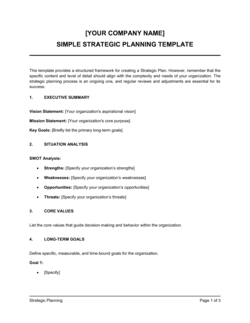
Building a company-wide long-term strategic directionStrategic Planning Template
Defining a personal career growth path over 3–5 yearsPersonal Development Plan
Setting and tracking individual leadership goalsLeadership Development Plan
Communicating a company vision to employees and stakeholdersVision and Mission Statement Template
Aligning a leadership team around shared strategic prioritiesStrategic Planning Meeting Agenda
Coaching a team member through a leadership transitionCoaching Plan Template
Turning vision into a structured 90-day execution roadmap90-Day Action Plan

Common mistakes to avoid

❌ Writing activity-based vision statements

Why it matters: Vague statements like 'I will focus on growth and innovation' provide no direction for decisions and no criteria for measuring progress β€” making the entire document decorative.

Fix: Rewrite the vision as a specific, observable future state with a time horizon: 'By [YEAR], I will have [MEASURABLE OUTCOME] that [IMPACT].'

❌ Adopting more than two new habits at once

Why it matters: Behavioral research consistently shows that stacking multiple new habits simultaneously causes all of them to collapse within weeks as willpower resources are depleted.

Fix: Select the two habits that address the most critical gaps from your self-assessment, sustain them for 30 days, then add the next pair.

❌ Skipping the stakeholder alignment section

Why it matters: A vision that exists only in the leader's head cannot be executed β€” key stakeholders who are not actively aligned will allocate resources and make decisions that contradict the direction.

Fix: Map at least five stakeholders β€” including two skeptics β€” and define a specific influence action for each before the 90-day plan begins.

❌ Treating the 90-day plan as a to-do list with no single priority

Why it matters: Plans that list eight to ten parallel actions spread effort across too many fronts and consistently underdeliver on every item, creating a pattern of missed commitments that erodes self-trust.

Fix: Identify the single outcome that, if achieved in 90 days, would create the most momentum toward the vision, and make every weekly action subordinate to that one outcome.

The 9 key sections, explained

Self-Assessment: Current Thinking Patterns

Defining Your Personal Vision

Strategic Foresight and Trend Scanning

Long-Range Goal Mapping

Mindset and Habit Development

Communicating Vision to Others

Influence and Alignment Strategy

Overcoming Resistance and Short-Term Bias

90-Day Visionary Action Plan

How to fill it out

  1. 1

    Complete the self-assessment before reading ahead

    Fill in the thinking-pattern self-assessment in Section 1 before reviewing the rest of the document. Your uninfluenced baseline score is more useful than a score shaped by knowing what the 'right' answers look like.

    πŸ’‘ Ask a trusted colleague or direct report to rate you on the same dimensions independently β€” the gap between self-perception and external perception is often the most revealing data point.

  2. 2

    Write your vision statement in a single sitting

    Set aside 30 uninterrupted minutes and draft your vision statement in Section 2 without editing. Write quickly to bypass the inner critic; refinement comes after the first draft is complete.

    πŸ’‘ A useful prompt: 'If I read a profile about myself in a respected publication 10 years from now, the headline would say…'

  3. 3

    Identify three to five trends relevant to your domain

    In Section 3, list the specific trends, technology shifts, or behavioral changes you believe will most significantly affect your industry or career field in the next 5–10 years. Add a source and a brief note on the implication.

    πŸ’‘ Use at least one source outside your immediate industry β€” cross-sector signals often arrive earlier than sector-specific ones.

  4. 4

    Build the 10/3/1 goal hierarchy

    In Section 4, work backward from the 10-year vision to define what needs to be true at Year 3 and Year 1 for the long-range outcome to remain achievable. Write each goal as a specific, measurable outcome, not a direction.

    πŸ’‘ If the Year 1 goal feels easy given your current trajectory, it is probably not ambitious enough to close the gap to the 10-year vision.

  5. 5

    Select exactly two new habits and schedule them

    From Section 5, choose two habits that address the weakest dimension from your self-assessment score. Block time for both in your calendar for the next 30 days before moving on.

    πŸ’‘ Attach each new habit to an existing anchor routine β€” for example, reading directly after your morning coffee β€” to reduce the activation energy required to sustain it.

  6. 6

    Draft your vision narrative for your primary audience

    In Section 6, write a 3–5 sentence version of your vision story tailored to the single most important audience you need to influence in the next 90 days β€” whether that is your team, a board, investors, or a potential partner.

    πŸ’‘ Read the narrative aloud. If you stumble or feel the need to explain it further, the language is not yet clear enough to inspire action.

  7. 7

    Complete the 90-day action plan with a named accountability partner

    In Section 9, define one primary outcome for the next 90 days, break it into weekly actions, and enter the name of a specific person who will hold you accountable. A nameless 'accountability partner' is not accountability.

    πŸ’‘ Schedule the first check-in with your accountability partner before you finish filling in this section β€” booking it in advance increases follow-through by a significant margin.

Frequently asked questions

What is a visionary person in a business context?

A visionary person in a business context is someone who consistently identifies long-range opportunities, articulates a compelling future state, and aligns people and resources toward that direction before others recognize the need. Visionary thinking is not a personality trait reserved for a few gifted individuals β€” it is a set of learnable practices including strategic foresight, long-range goal mapping, and disciplined habit development that anyone can build deliberately.

Who should use a 'How To Become A Visionary Person' guide?

This guide is designed for founders and executives who need to operate at a higher strategic altitude, HR and learning professionals building leadership development curricula, individual contributors preparing for senior roles, and coaches working with clients on leadership presence. It is equally useful for someone early in their career who wants to establish visionary habits before operational pressures crowd them out.

How is this different from a personal development plan?

A personal development plan typically focuses on skills, competencies, and career milestones within an existing role or trajectory. This guide specifically addresses the cognitive habits, strategic practices, and influence skills that characterize visionary leadership β€” including trend scanning, long-range goal hierarchies, and stakeholder alignment. It goes beyond skill-building to reshape how someone thinks about time horizons and possibility.

How long does it take to complete this template?

The self-assessment and vision articulation sections take 30–60 minutes in a focused sitting. The full document β€” including long-range goal mapping, habit selection, stakeholder alignment, and the 90-day action plan β€” typically takes 3–4 hours spread across two to three sessions. Rushing the vision-articulation and self-assessment sections undermines the quality of everything that follows.

Can this template be used in a team workshop setting?

Yes. The self-assessment, vision statement, and stakeholder alignment sections work well as facilitated exercises in leadership workshops of 6–20 participants. For team use, the trend-scanning section is particularly effective as a group activity β€” different team members scanning different industry sectors produces a richer picture than any individual working alone.

How do I know if my vision statement is strong enough?

A strong vision statement passes three tests: it describes a specific future state rather than an ongoing activity, it has a defined time horizon, and a stranger could read it and know exactly what success looks like without asking a follow-up question. If your vision requires explanation to be understood, it is not yet clear enough to guide decisions or inspire others.

What is the difference between a vision and a goal?

A vision describes the future state you are building toward β€” the qualitative picture of what success looks like at a 5–10 year horizon. A goal is a specific, measurable output that moves you toward that vision on a shorter timeline (1–3 years). Vision answers 'what are we becoming?'; goals answer 'what will we have accomplished by this date?' Both are required β€” vision without goals produces inspiration with no traction; goals without vision produce activity with no meaning.

How often should I revisit this document?

Review the vision statement and long-range goal hierarchy once per quarter to test whether new information β€” market shifts, personal circumstances, organizational changes β€” should refine your direction. The 90-day action plan should be updated at the end of every 90-day cycle. A full reset of the self-assessment is worthwhile annually or after a significant role change.

Is visionary thinking relevant to middle managers, or only to senior leaders?

Visionary thinking is relevant at every level of an organization, but the scope changes. A middle manager applying visionary practices thinks 3–5 years ahead about their function, team capability, and career direction β€” not necessarily the whole company. The habits and frameworks in this guide scale to any scope: the individual contributor who thinks ahead about their field and builds accordingly consistently outperforms peers who react to whatever is in front of them.

How this compares to alternatives

vs Strategic Planning Template

A strategic planning template is an organizational tool focused on company-wide direction, resource allocation, and competitive positioning. This guide is a personal and leadership development document focused on the individual habits and thinking practices that make someone capable of leading that organizational strategy. Use both in sequence β€” individual visionary capacity first, then organizational strategic planning.

vs Personal Development Plan

A personal development plan tracks skill gaps, training goals, and career milestones within a defined role. This guide operates at a higher level β€” it addresses how someone thinks about time, possibility, and influence, not just what skills to acquire. A personal development plan is a component of the broader visionary development framework this guide provides.

vs Leadership Development Plan

A leadership development plan maps competencies, behaviors, and experiences needed to advance through leadership levels. This guide specifically targets the foresight, vision-articulation, and long-range thinking practices that distinguish visionary leaders from effective managers. The two documents complement each other and can be used in parallel.

vs 90-Day Action Plan

A 90-day action plan is an execution tool for a defined near-term sprint. This guide produces the vision and strategic clarity that gives a 90-day plan its direction β€” without the upstream visionary work, a 90-day plan is tactical activity in search of a purpose. This template includes a 90-day planning section as its final output.

Industry-specific considerations

Technology / SaaS

Founders and product leaders use the trend-scanning and long-range goal sections to position their roadmap ahead of platform shifts and competitive disruption.

Professional Services

Partners and principals apply the stakeholder alignment and influence framework to build client relationships that go beyond transactional delivery into strategic advisory.

Education and Training

L&D teams embed the self-assessment and 90-day action plan as the backbone of high-potential leadership programs, giving participants a repeatable personal development structure.

Healthcare

Clinical leaders and healthcare administrators use the long-range goal mapping and resistance-management sections to navigate multi-year organizational transformation initiatives.

Template vs pro β€” what fits your needs?

PathBest forCostTime
Use the templateIndividuals, managers, and founders working through vision development independently or in a team workshopFree3–4 hours across 2–3 sessions
Template + professional reviewExecutives embedding this into a formal leadership program with facilitation and group debrief$500–$2,000 for a leadership coach or facilitator session1–2 days (workshop design and delivery)
Custom draftedOrganizations building a proprietary visionary leadership curriculum with branded assessments and executive coaching integration$5,000–$25,000 for a custom L&D program design4–12 weeks

Glossary

Visionary Thinking
The ability to identify long-range possibilities and trends, then translate them into actionable direction before others recognize the opportunity.
Vision Statement
A concise, aspirational declaration of what a person or organization intends to achieve or become over a defined time horizon.
Strategic Foresight
The structured practice of scanning for emerging trends, weak signals, and future scenarios to inform present-day decisions.
Growth Mindset
The belief that abilities and intelligence can be developed through effort, learning, and persistence β€” as opposed to being fixed at birth.
Long-Range Thinking
The habit of making decisions with explicit consideration of their impact 3, 5, or 10 years into the future, not just the next quarter.
Execution Gap
The distance between a clearly articulated vision and the actual progress made toward it β€” typically caused by unclear priorities or absent accountability structures.
Influence Without Authority
The ability to shape others' beliefs, decisions, and actions through credibility, communication, and shared vision rather than positional power.
Self-Awareness
An accurate understanding of one's own strengths, blind spots, values, and behavioral patterns β€” the foundation of intentional personal development.
Accountability Checkpoint
A scheduled review point at which progress toward a defined goal is measured against a concrete benchmark and course corrections are made.
Systems Thinking
A way of analyzing situations by focusing on how components interact within a whole, rather than examining each part in isolation.

Part of your Business Operating System

This document is one of 3,000+ business & legal templates included in Business in a Box.

  • Fill-in-the-blanks β€” ready in minutes
  • Compatible with all office suites
  • Export to PDF and share electronically

Create your document in 3 simple steps.

From template to signed document β€” all inside one Business Operating System.
1
Download or open template

Access over 3,000+ business and legal templates for any business task, project or initiative.

2
Edit and fill in the blanks with AI

Customize your ready-made business document template and save it in the cloud.

3
Save, Share, Send, Sign

Share your files and folders with your team. Create a space of seamless collaboration.

Save time, save money, and create top-quality documents.

β˜…β˜…β˜…β˜…β˜…

"Fantastic value! I'm not sure how I'd do without it. It's worth its weight in gold and paid back for itself many times."

Managing Director Β· Mall Farm
Robert Whalley
Managing Director, Mall Farm Proprietary Limited
β˜…β˜…β˜…β˜…β˜…

"I have been using Business in a Box for years. It has been the most useful source of templates I have encountered. I recommend it to anyone."

Business Owner Β· 4+ years
Dr Michael John Freestone
Business Owner
β˜…β˜…β˜…β˜…β˜…

"It has been a life saver so many times I have lost count. Business in a Box has saved me so much time and as you know, time is money."

Owner Β· Upstate Web
David G. Moore Jr.
Owner, Upstate Web

Run your business with a system β€” not scattered tools

Stop downloading documents. Start operating with clarity. Business in a Box gives you the Business Operating System used by over 250,000 companies worldwide to structure, run, and grow their business.

Free Forever PlanΒ Β·Β No credit card required