Encryption Policy Template

Free Word download β€’ Edit online β€’ Save & share with Drive β€’ Export to PDF

3 pagesβ€’20–30 min to fillβ€’Difficulty: Standard
Learn more ↓
FreeEncryption Policy Template

At a glance

What it is
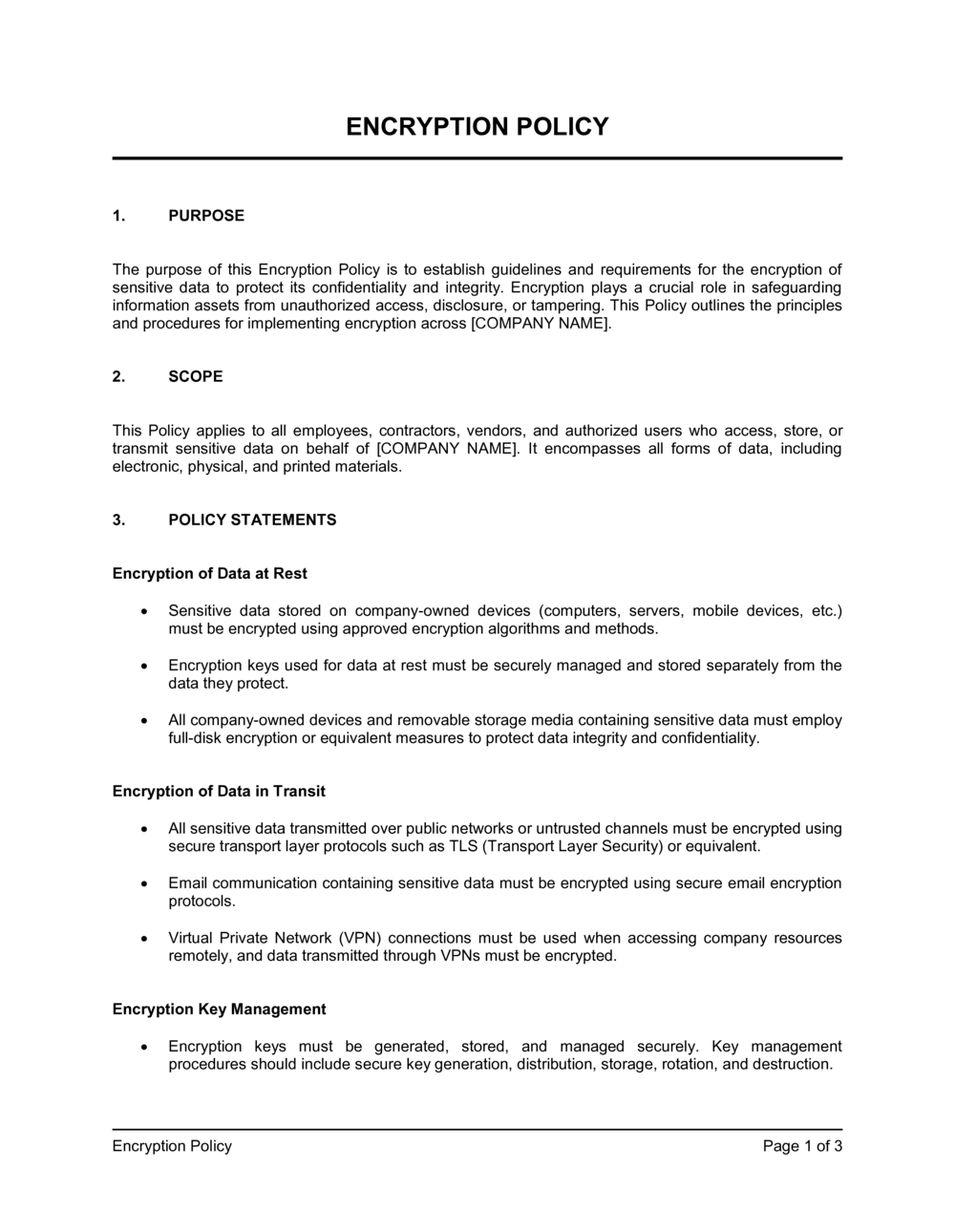
An Encryption Policy is a formal operational document that defines how an organization protects sensitive data at rest and in transit using approved cryptographic methods. This free Word download gives you a ready-to-edit framework covering data classification, encryption standards, key management, device requirements, and compliance obligations β€” exportable as PDF and ready to share with your IT team, auditors, or regulators.
When you need it
Use it when your organization handles personally identifiable information, financial records, health data, or intellectual property β€” or when a compliance framework such as HIPAA, PCI-DSS, SOC 2, or ISO 27001 requires documented encryption controls. It is also the right time when onboarding a new MSSP or preparing for a security audit.
What's inside
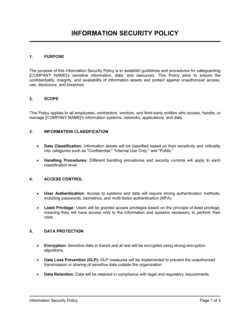
The policy covers the scope and purpose of encryption controls, data classification tiers, approved algorithms and key lengths, key management procedures, device and transmission requirements, exceptions handling, and roles and responsibilities. It also includes enforcement, review cadence, and a glossary of technical terms.

What is an Encryption Policy?

An Encryption Policy is a formal operational document that defines how an organization applies cryptographic controls to protect sensitive data β€” specifying which data must be encrypted, which algorithms and key lengths are approved, how encryption keys are generated and managed, and which roles are responsible for enforcement. It transforms a general security commitment into concrete, auditable technical standards that apply consistently across on-premises systems, cloud environments, endpoints, and data transmissions. Unlike a broad information security policy, an encryption policy focuses exclusively on cryptographic controls and gives IT teams the unambiguous technical baseline they need to implement and maintain data protection at every layer.

Why You Need This Document

Without a documented encryption policy, your organization operates without a defined standard for cryptographic controls β€” meaning different teams apply different algorithms, keys are rotated inconsistently or not at all, and deprecated protocols like TLS 1.0 or MD5 remain in use because no one ever formally prohibited them. The consequences are concrete: a single unencrypted database or misconfigured storage bucket is all it takes to trigger a reportable breach under HIPAA, GDPR, or PCI-DSS, with fines that routinely reach six or seven figures. Enterprise customers and security auditors conducting vendor assessments expect a written encryption policy before they will sign a contract or issue a clean audit opinion β€” making this document as much a commercial asset as a security control. This template gives you a ready-to-complete framework that covers every critical control area, so you can establish a defensible encryption baseline without starting from a blank page.

Which variant fits your situation?

If your situation is…Use this template
Healthcare organization subject to HIPAA Security Rule requirementsHIPAA Security Policy
Company processing payment card data under PCI-DSS scopePCI-DSS Information Security Policy
Organization seeking ISO 27001 certificationInformation Security Policy (ISO 27001)
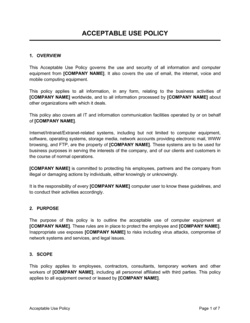
Policy covering all employee devices including BYODAcceptable Use Policy
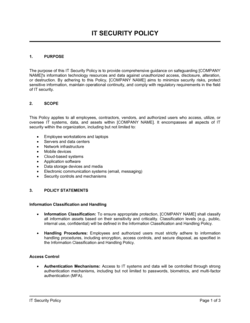
Organization managing a broad set of IT security controlsIT Security Policy
Policy focused specifically on cloud storage and SaaS applicationsCloud Security Policy
Vendor or third-party data-sharing arrangement requiring security termsData Processing Agreement

Common mistakes to avoid

❌ No prohibited algorithms list

Why it matters: Listing approved algorithms without banning deprecated ones (DES, MD5, RC4, TLS 1.0) leaves the door open for legacy systems to keep using broken cryptography undetected.

Fix: Add an explicit prohibited list to the algorithms section and require written exception approval for any deviation. Run a periodic scan of TLS configurations to verify compliance.

❌ Omitting key retirement procedures

Why it matters: Keys for decommissioned systems or departed employees that are never formally retired remain valid indefinitely, creating a persistent decryption risk and a finding in virtually every security audit.

Fix: Add a key lifecycle section covering generation, rotation, and destruction. Define a maximum key age and a documented destruction procedure tied to asset or employee offboarding.

❌ Scoping out cloud and SaaS environments

Why it matters: Policies that only address on-premises infrastructure miss the environments where most modern organizations store their most sensitive data β€” cloud storage buckets, SaaS databases, and email platforms.

Fix: Inventory all cloud services and SaaS applications that handle Confidential or Restricted data and include them explicitly in the scope section.

❌ No exception process defined

Why it matters: Without a formal waiver process, teams facing technical constraints quietly deviate from the policy without any compensating controls, risk documentation, or management awareness.

Fix: Define a written exception request form, an approval authority, a maximum validity period, and a requirement for compensating controls during the exception window.

❌ Requiring encryption without verifying it

Why it matters: A policy mandate is only as effective as its enforcement mechanism. Requiring full-disk encryption without auditing it through MDM or endpoint tooling means non-compliant devices remain in use undetected.

Fix: Pair each encryption requirement with a specific monitoring or verification control β€” MDM enrollment, configuration management scans, or quarterly compliance reports.

❌ Setting a review cadence with no out-of-cycle triggers

Why it matters: Annual reviews are insufficient when a major vulnerability (like a deprecated cipher) or a new regulation emerges mid-year. Stale policies create compliance gaps that outlast the annual cycle.

Fix: Add a list of specific triggers for out-of-cycle reviews β€” a material data breach, a NIST algorithm deprecation notice, a new regulatory requirement, or a significant infrastructure change.

The 10 key sections, explained

Purpose and scope

Data classification tiers

Approved algorithms and minimum standards

Key management procedures

Encryption requirements for devices and endpoints

Data transmission requirements

Roles and responsibilities

Exceptions and waivers

Compliance, enforcement, and consequences

Policy review and update cadence

How to fill it out

  1. 1

    Define your organization's data classification tiers

    Before filling in any encryption requirements, confirm the data classification levels your organization uses. If a classification policy already exists, import the tier names and definitions verbatim to ensure consistency.

    πŸ’‘ Four tiers (Public, Internal, Confidential, Restricted) cover most organizations. Adding more tiers creates mapping confusion without meaningfully improving security.

  2. 2

    Identify all systems and environments in scope

    List every environment where sensitive data lives β€” on-premises servers, cloud storage buckets, SaaS applications, laptops, mobile devices, and backup media. Use this inventory to make scope language in Section 1 concrete rather than generic.

    πŸ’‘ Shadow IT is the most common scope gap. Ask department heads to list the SaaS tools they use before finalizing the scope section.

  3. 3

    Select approved algorithms and set minimum version standards

    Complete the approved algorithms section by specifying exact algorithms, key lengths, and protocol versions. Then explicitly list prohibited algorithms and protocols β€” this is the section most likely to stop outdated cryptography in use.

    πŸ’‘ Cross-reference NIST SP 800-131A Rev. 2 for current algorithm guidance. NIST's recommendations are the de-facto baseline accepted by most auditors.

  4. 4

    Document your key management procedures

    Describe how keys are generated, where they are stored, who has access, the rotation schedule, and how retired keys are destroyed. If you use a cloud KMS (AWS KMS, Azure Key Vault, Google Cloud KMS), name it explicitly.

    πŸ’‘ Specify a key rotation period in months β€” 'periodically' and 'regularly' are not auditable. Annual rotation is the most common standard for symmetric keys.

  5. 5

    Assign roles and owners for each control area

    Fill in the specific job titles responsible for policy enforcement, key management, device compliance monitoring, exception approval, and employee training. Avoid assigning everything to 'IT' β€” name the specific team or role.

    πŸ’‘ If your organization is small, it is acceptable for one person to hold multiple roles β€” just name that person's title explicitly so accountability is clear.

  6. 6

    Write the exceptions and waivers process

    Define the form or channel for requesting an exception, the approval authority, the maximum waiver duration, and the compensating controls that must be in place during any approved exception period.

    πŸ’‘ Cap exception validity at 12 months maximum. Open-ended exceptions routinely become permanent workarounds.

  7. 7

    Map policy controls to applicable compliance frameworks

    If your organization is subject to HIPAA, PCI-DSS, SOC 2, GDPR, or ISO 27001, add a mapping table as an appendix linking each policy section to the relevant framework clause or control. This is not required for an internal policy but is expected in any third-party audit.

    πŸ’‘ Many auditors accept a simple two-column table β€” policy section on the left, framework control reference on the right. It does not need to be elaborate.

  8. 8

    Set the review cadence and get sign-off

    Enter the annual review date, name the role responsible for triggering reviews, and list the out-of-cycle triggers. Route the finished policy for approval by your CISO or equivalent and document the approval date and approver name on the cover page.

    πŸ’‘ Version-number the policy from the start (v1.0, v1.1) and store all prior versions. Auditors routinely ask to see the version history.

Frequently asked questions

What is an encryption policy?

An encryption policy is a formal organizational document that defines which data must be encrypted, which cryptographic algorithms and key lengths are approved, how encryption keys are managed, and who is responsible for enforcing these controls. It translates a general commitment to data security into specific, auditable requirements for systems, devices, and data transmission.

Who needs an encryption policy?

Any organization that stores or transmits sensitive data β€” including customer PII, payment card numbers, health records, or proprietary business data β€” benefits from a documented encryption policy. It is required or strongly recommended by HIPAA, PCI-DSS, SOC 2 Type II, ISO 27001, and GDPR. Organizations preparing for enterprise sales or third-party security assessments will almost always be asked to produce one.

What encryption standard should the policy require?

For data at rest, AES-256 is the current industry standard and is accepted by all major compliance frameworks. For data in transit, TLS 1.2 is the minimum acceptable version, with TLS 1.3 recommended for new implementations. For asymmetric encryption, RSA-2048 or higher is the baseline, with RSA-4096 or elliptic curve cryptography (ECC P-256 or higher) preferred for high-sensitivity use cases. Algorithms like DES, 3DES, RC4, and MD5 should be explicitly prohibited.

What is the difference between encryption at rest and encryption in transit?

Encryption at rest protects data stored on disk, in databases, or on backup media β€” it prevents someone who gains physical or logical access to the storage medium from reading the data. Encryption in transit protects data moving across a network between two systems, preventing interception. Both are required for comprehensive data protection; many breaches exploit gaps in one while the other is addressed.

How often should an encryption policy be reviewed?

Annual review is the standard cadence recommended by most compliance frameworks. However, the policy should also be reviewed out-of-cycle whenever NIST or an equivalent body deprecates an algorithm, a significant vulnerability is discovered in a deployed protocol, a major infrastructure change is made (such as migrating to a new cloud provider), or a new regulatory requirement affecting encryption takes effect.

Does GDPR require encryption?

The GDPR does not mandate encryption as an absolute requirement, but Article 32 requires organizations to implement "appropriate technical measures" β€” and the regulation explicitly cites encryption as an example. Supervisory authorities across the EU have consistently treated the absence of encryption as a failure to meet Article 32 obligations, particularly following a data breach. In practice, encrypting personal data at rest and in transit is the expected baseline for GDPR compliance.

What should a key management section of the policy cover?

Key management procedures should cover at least six areas: how keys are generated (algorithm, key length, source of randomness), where they are stored (software KMS, HSM, cloud key vault), who is authorized to access them, how often they are rotated, how compromised keys are revoked and replaced, and how retired keys are destroyed. Missing any of these creates a gap that auditors will flag during a SOC 2 or ISO 27001 assessment.

How is an encryption policy different from an information security policy?

An information security policy is a broad governance document covering the full range of security controls β€” access management, incident response, physical security, acceptable use, and more. An encryption policy is a focused sub-policy that addresses cryptographic controls specifically. Most organizations maintain an overarching information security policy and reference more detailed sub-policies like this one for specific control domains.

Can a small business use this template without a dedicated security team?

Yes. A small business can complete this template by focusing on the core sections β€” data classification, approved algorithms, device encryption, and key management β€” and leaving advanced sections like HSM requirements and mTLS as aspirational or marked not-applicable. The most important outcome for a small organization is a documented, consistent baseline that can be shown to customers, auditors, or insurance carriers. A 10-person company does not need the same depth as a 500-person enterprise, but having something written and approved is far better than nothing.

How this compares to alternatives

vs Information Security Policy

An information security policy is a high-level governance document covering the full spectrum of security controls β€” access management, incident response, physical security, and more. An encryption policy is a focused sub-policy dedicated exclusively to cryptographic controls. Most organizations need both: the information security policy sets overall direction, and the encryption policy provides the specific technical standards that teams implement.

vs IT Security Policy

An IT security policy addresses the broader set of IT controls β€” network security, patch management, access control, and vulnerability management β€” across the organization's technology environment. An encryption policy is narrower, covering only how cryptographic techniques are applied to data at rest and in transit. The two documents complement each other but serve different control objectives.

vs Acceptable Use Policy

An acceptable use policy governs how employees are permitted to use organizational systems, devices, and data β€” including personal use rules, prohibited activities, and monitoring disclosures. An encryption policy specifies the technical security controls applied to data, not user behavior. Employees may be referenced in both, but the documents address entirely different layers of the security program.

vs Data Retention Policy

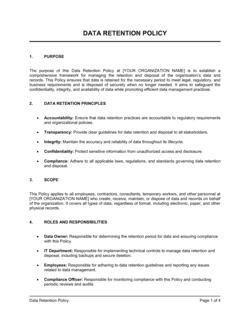
A data retention policy governs how long different categories of data are kept and how they are securely disposed of at end-of-life. An encryption policy governs how data is protected while it is stored or transmitted. The two policies intersect at secure disposal β€” encrypted data must be properly destroyed or cryptographically erased at end of retention β€” but each addresses a distinct phase of the data lifecycle.

Industry-specific considerations

Healthcare

HIPAA Security Rule Β§ 164.312(a)(2)(iv) and Β§ 164.312(e)(2)(ii) address encryption as an addressable specification, making a documented encryption policy essential for covered entities and business associates.

Financial Services

PCI-DSS Requirement 3 (protect stored cardholder data) and Requirement 4 (encrypt transmission over open networks) require documented encryption controls with specific algorithm and key management standards.

SaaS / Technology

Enterprise customers routinely require a documented encryption policy as part of vendor security questionnaires (SIG, CAIQ) before signing contracts, making this a revenue-enabling document as much as a security one.

Professional Services

Law firms, accounting firms, and consultancies handling client confidential data face increasing client-audit requirements and bar association data security guidelines that expect documented encryption practices.

Template vs pro β€” what fits your needs?

PathBest forCostTime
Use the templateSMBs, startups, and IT teams establishing a baseline encryption policy for internal use or a first auditFree2–4 hours
Template + professional reviewOrganizations preparing for a SOC 2, ISO 27001, or HIPAA audit where the policy must map to specific framework controls$500–$2,000 for a security consultant review1–3 days
Custom draftedEnterprises in regulated industries with complex multi-cloud environments, HSM infrastructure, or cross-border data transfer requirements$3,000–$8,000 for a security consulting engagement2–4 weeks

Glossary

Encryption at Rest
The process of encoding stored data β€” on hard drives, databases, or backup media β€” so it is unreadable without the correct decryption key.
Encryption in Transit
The protection of data moving across a network using cryptographic protocols such as TLS, preventing interception by unauthorized parties.
AES-256
Advanced Encryption Standard with a 256-bit key β€” the current industry-recommended algorithm for symmetric encryption of sensitive data at rest.
TLS (Transport Layer Security)
A cryptographic protocol that secures communications over a network, replacing the older SSL standard; TLS 1.2 or higher is the current minimum acceptable version.
Key Management
The policies and procedures governing the generation, storage, rotation, distribution, and retirement of cryptographic keys used to encrypt and decrypt data.
Public Key Infrastructure (PKI)
A framework of hardware, software, policies, and procedures used to create, manage, and revoke digital certificates and public-private key pairs.
Data Classification
The process of categorizing data by sensitivity level β€” typically Public, Internal, Confidential, and Restricted β€” to determine which encryption controls apply.
Key Rotation
The practice of replacing cryptographic keys on a defined schedule (e.g., annually) to limit the exposure window if a key is ever compromised.
HSM (Hardware Security Module)
A physical device that generates, stores, and manages cryptographic keys in tamper-resistant hardware, used when key security requirements are highest.
Hashing
A one-way cryptographic function that converts data into a fixed-length digest, used to verify integrity rather than to encrypt and recover data.
End-to-End Encryption (E2EE)
An approach where data is encrypted on the sender's device and can only be decrypted by the intended recipient, with no readable copy in transit.

Part of your Business Operating System

This document is one of 3,000+ business & legal templates included in Business in a Box.

  • Fill-in-the-blanks β€” ready in minutes
  • 100% customizable Word document
  • Compatible with all office suites
  • Export to PDF and share electronically

Create your document in 3 simple steps.

From template to signed document β€” all inside one Business Operating System.
1
Download or open template

Access over 3,000+ business and legal templates for any business task, project or initiative.

2
Edit and fill in the blanks with AI

Customize your ready-made business document template and save it in the cloud.

3
Save, Share, Send, Sign

Share your files and folders with your team. Create a space of seamless collaboration.

Save time, save money, and create top-quality documents.

β˜…β˜…β˜…β˜…β˜…

"Fantastic value! I'm not sure how I'd do without it. It's worth its weight in gold and paid back for itself many times."

Managing Director Β· Mall Farm
Robert Whalley
Managing Director, Mall Farm Proprietary Limited
β˜…β˜…β˜…β˜…β˜…

"I have been using Business in a Box for years. It has been the most useful source of templates I have encountered. I recommend it to anyone."

Business Owner Β· 4+ years
Dr Michael John Freestone
Business Owner
β˜…β˜…β˜…β˜…β˜…

"It has been a life saver so many times I have lost count. Business in a Box has saved me so much time and as you know, time is money."

Owner Β· Upstate Web
David G. Moore Jr.
Owner, Upstate Web

Run your business with a system β€” not scattered tools

Stop downloading documents. Start operating with clarity. Business in a Box gives you the Business Operating System used by over 250,000 companies worldwide to structure, run, and grow their business.

Start freeΒ Β·Β No credit card required