Employment Relations Policy Template

Free Word download β€’ Edit online β€’ Save & share with Drive β€’ Export to PDF

4 pagesβ€’20–30 min to fillβ€’Difficulty: Standard
Learn more ↓
FreeEmployment Relations Policy Template

At a glance

What it is
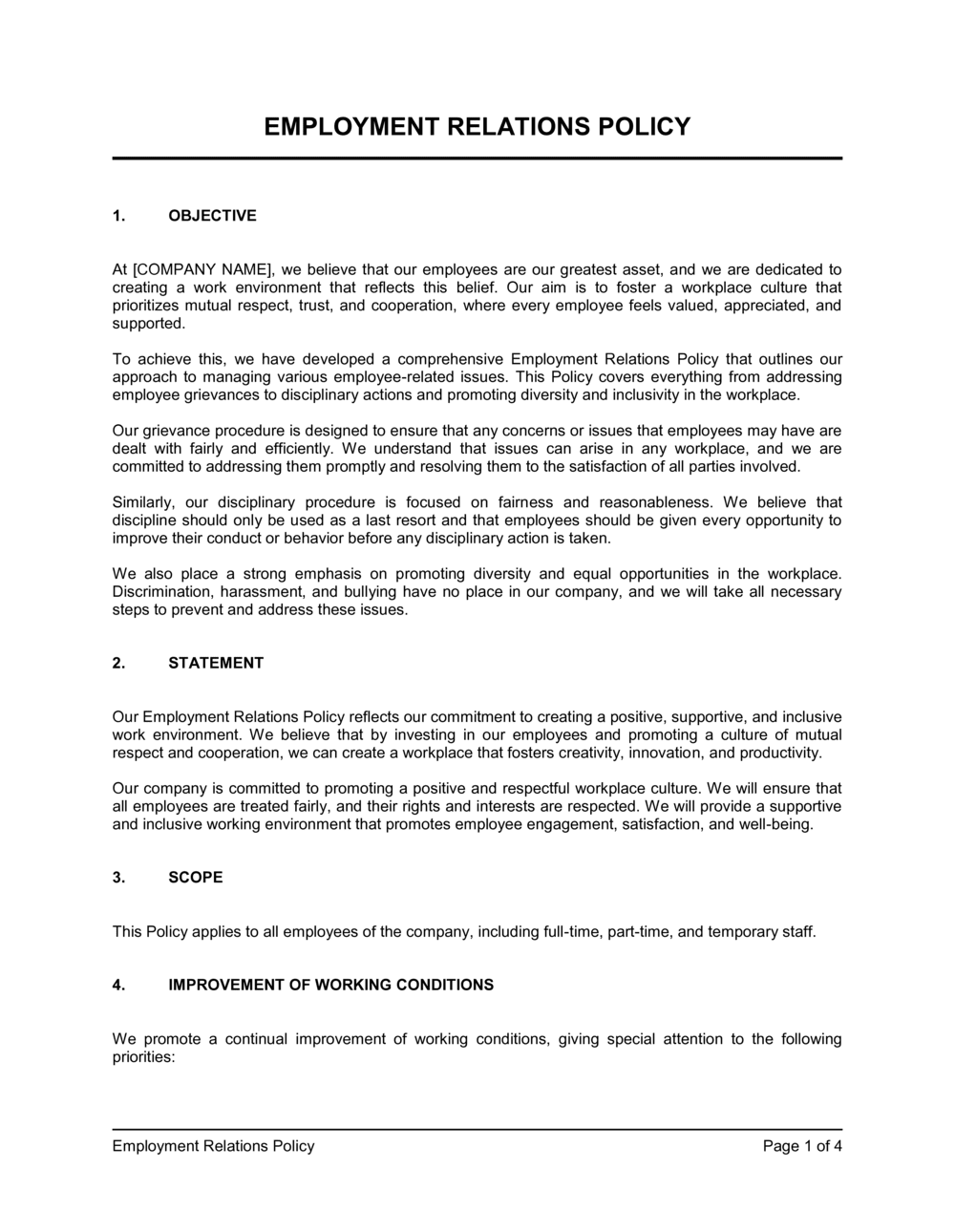
An Employment Relations Policy is a formal internal document that defines how an organization manages the relationship between the employer and its employees β€” covering workplace conduct expectations, communication channels, grievance and disciplinary procedures, and the principles that guide fair treatment. This free Word download gives you a structured, editable starting point you can tailor to your organization's size and culture, then export as PDF for distribution to staff.
When you need it
Use it when onboarding your first HR function, updating an outdated employee handbook, preparing for a workforce audit, or formalizing informal practices that have grown inconsistently across departments. It is also essential when a grievance or disciplinary incident has exposed a gap in written policy.
What's inside
Policy scope and objectives, guiding principles, communication and consultation framework, grievance procedure, disciplinary procedure, performance management approach, anti-discrimination and equal opportunity statements, and roles and responsibilities for managers and HR.

What is an Employment Relations Policy?

An Employment Relations Policy is a formal internal document that defines the principles, procedures, and responsibilities that govern the relationship between an organization and its employees. It establishes how the business communicates with staff, how employee concerns are raised and addressed through a grievance procedure, how misconduct and performance issues are handled through a disciplinary and capability framework, and what standards of conduct and equal treatment apply to everyone in the organization. Unlike an employment contract β€” which sets individual binding terms β€” this policy applies organization-wide and provides the procedural infrastructure that managers rely on to handle people issues consistently and fairly.

Why You Need This Document

Operating without a written employment relations policy means every grievance, disciplinary matter, and performance concern is handled by individual manager judgment β€” and judgment varies. Inconsistent treatment across teams is one of the most common triggers for discrimination claims, because a protected-characteristic employee who is treated differently from a comparable colleague has a factual basis for a claim even if the underlying decision was correct. Beyond discrimination risk, employment tribunals in most jurisdictions apply a two-stage test to dismissal cases: was the decision substantively fair, and was the procedure followed correctly? Skipping documented steps β€” a hearing, a warning, an appeal β€” typically fails the second test regardless of how justified the dismissal was. A well-structured employment relations policy closes both gaps, gives managers a clear process to follow under pressure, and demonstrates to regulators, auditors, and prospective investors that your people practices meet a professional standard.

Which variant fits your situation?

If your situation is…Use this template
Documenting the full suite of HR policies in one employee-facing manualEmployee Handbook
Setting out the step-by-step grievance process as a standalone documentGrievance Policy
Defining the disciplinary process separately for manager referenceDisciplinary Policy and Procedure
Covering remote or hybrid working arrangements and expectationsRemote Work Policy
Addressing workplace harassment and bullying specificallyAnti-Harassment Policy
Setting performance review criteria and rating frameworksPerformance Review Policy
Outlining attendance, leave, and absence management rulesAttendance and Leave Policy

Common mistakes to avoid

❌ Using the disciplinary procedure for performance issues

Why it matters: Underperformance and misconduct require different procedural approaches. Applying a misconduct process to a performance issue frequently results in a finding of procedural unfairness at tribunal, even when the dismissal was substantively justified.

Fix: Maintain a distinct performance management section with its own PIP process. Train managers to identify whether an issue is conduct-based or capability-based before deciding which procedure to invoke.

❌ Skipping procedural steps for 'obvious' cases

Why it matters: Employment tribunals apply a procedural fairness test independently of whether the outcome was correct. Skipping a warning stage or failing to hold a hearing because the outcome seems inevitable is one of the most common causes of unfair dismissal findings.

Fix: Build a checklist into each stage of the disciplinary procedure so managers can confirm every required step was completed before moving to the next stage.

❌ No version control or review date on the policy

Why it matters: A policy with no version number or review date cannot be proven current. In a tribunal or audit, the employer cannot demonstrate the policy reflected applicable law at the time of the incident.

Fix: Add a cover-page version table (version number, effective date, approved by, next review date) and update it each time the document changes.

❌ Omitting the right to accompaniment from formal meeting stages

Why it matters: In many jurisdictions, employees have a statutory or common-law right to be accompanied by a colleague or union representative at formal disciplinary or grievance meetings. Failing to offer this right can invalidate the entire procedure.

Fix: Add a standard paragraph to each formal meeting stage confirming the employee's right to be accompanied and the process for requesting accompaniment in advance.

❌ Conflating informing employees with consulting them

Why it matters: Announcing a decision and calling it consultation is a procedural error that can give rise to constructive dismissal claims, particularly for changes to working hours, location, or pay.

Fix: Define consultation explicitly in the policy: employees must be given sufficient information, adequate time to respond, and genuine consideration must be given to their input before a final decision is made.

❌ No appeal stage in the grievance procedure

Why it matters: Without a defined right of appeal, an employee who is dissatisfied with a grievance outcome has no internal recourse β€” making external escalation to a regulator or tribunal more likely.

Fix: Add a formal appeal stage to both the grievance and disciplinary procedures, assigned to a manager senior to the original decision-maker who was not involved in the initial process.

The 9 key sections, explained

Policy scope and objectives

Guiding principles

Roles and responsibilities

Communication and consultation framework

Grievance procedure

Disciplinary procedure

Performance management approach

Equal opportunity and anti-discrimination statement

Policy review and version control

How to fill it out

  1. 1

    Define scope and insert company details

    Replace all [PLACEHOLDERS] with your organization's legal name, locations, and the employee categories covered. Confirm whether the policy applies to contractors, agency workers, and remote staff as well as permanent employees.

    πŸ’‘ If you operate in more than one country, create a separate version for each jurisdiction rather than cramming all variations into one document β€” multi-jurisdiction policies become unreadable and are rarely applied correctly.

  2. 2

    Assign roles and accountability

    Name the specific roles β€” not individuals β€” responsible for maintaining the policy, handling grievances, and conducting disciplinary hearings. Ensure the investigating manager and the appeal manager are different people.

    πŸ’‘ List a backup role for each responsibility so the process does not stall when the primary person is on leave or has a conflict of interest.

  3. 3

    Set timelines for each procedural step

    Fill in the working-day deadlines for grievance meetings, investigation outcomes, and appeal responses. Timelines should be realistic for your organization's size β€” a 5-person team cannot realistically commit to 2-day response windows.

    πŸ’‘ Express deadlines in 'working days' rather than calendar days to account for weekends, public holidays, and leave.

  4. 4

    Tailor the disciplinary stages to your organization

    Decide whether your disciplinary process will have three stages (informal, written warning, dismissal) or five stages (informal, verbal, first written, final written, dismissal). Larger organizations typically need more stages; small teams can operate with fewer.

    πŸ’‘ Define 'gross misconduct' examples explicitly in the policy β€” theft, fraud, physical violence, serious data breach. Courts give employers less benefit of the doubt on summary dismissal when the policy does not define what it covers.

  5. 5

    Write the grievance and disciplinary forms into appendices

    Add template grievance submission forms and disciplinary meeting records as appendices to the policy. Consistent record-keeping forms reinforce that the procedure was followed correctly.

    πŸ’‘ A signed acknowledgment form β€” where the employee confirms they received and read the policy β€” is your first line of defense in an unfair dismissal claim.

  6. 6

    Add the equal opportunity statement and protected characteristics list

    Insert the protected characteristics applicable to each jurisdiction where you employ people. Cross-reference your anti-harassment policy if you have one.

    πŸ’‘ Reference any associated policies (anti-harassment, reasonable adjustments, parental leave) by name in this section so employees know where to go for further detail.

  7. 7

    Set the review date and version number

    Enter the effective date, version number, and next scheduled review date on the cover page. Commit to an annual review cycle in the policy text itself.

    πŸ’‘ Calendar a recurring reminder 8 weeks before the review date so the update does not slip β€” a lapsed review date signals to tribunals that the policy is not actively maintained.

  8. 8

    Distribute and obtain acknowledgment

    Share the final policy with all employees via your preferred channel (intranet, email, or onboarding pack) and collect signed acknowledgments. Brief line managers separately on their specific responsibilities.

    πŸ’‘ A 15-minute manager briefing on the grievance and disciplinary procedure is more effective than distributing the document alone β€” managers who understand the process apply it correctly under pressure.

Frequently asked questions

What is an employment relations policy?

An employment relations policy is a formal internal document that defines how an organization manages its relationship with employees β€” covering workplace conduct expectations, communication and consultation processes, grievance and disciplinary procedures, and the principles of fair treatment. It serves as the authoritative reference for managers and employees when workplace issues arise, and provides a documented framework that demonstrates procedural fairness to regulators and employment tribunals.

Who should have an employment relations policy?

Any organization with employees benefits from a written employment relations policy. It becomes essential once headcount reaches around 10, when informal management practices become inconsistent across teams. Businesses operating in regulated industries, those with union recognition, and any employer that has faced a grievance or disciplinary incident without a written process in place should prioritize drafting one immediately.

What is the difference between an employment relations policy and an employee handbook?

An employment relations policy focuses specifically on the procedures and principles governing the employer-employee relationship β€” grievances, discipline, performance, and consultation. An employee handbook is a broader document that incorporates the employment relations policy alongside other topics such as leave entitlements, IT acceptable use, expenses, and benefits. The policy can exist as a standalone document or as a chapter within the handbook.

Does an employment relations policy need to be signed by employees?

The policy itself does not need to be signed, but obtaining a signed acknowledgment confirming that the employee received and read it is strongly recommended. A signed acknowledgment is your primary evidence in a disciplinary or grievance dispute that the employee was aware of the procedure. Include an acknowledgment form as an appendix and collect signed copies during onboarding.

How often should an employment relations policy be reviewed?

Review the policy annually as a minimum, and immediately following any significant change in applicable employment legislation, a restructuring or acquisition, a material grievance or tribunal case, or a change in the organization's size or structure. Policies that have not been reviewed in more than two years are unlikely to reflect current legal requirements and should be updated before any formal procedure is invoked.

What is the difference between a grievance procedure and a disciplinary procedure?

A grievance procedure is initiated by an employee who wishes to raise a complaint about their working conditions, treatment, or a management decision. A disciplinary procedure is initiated by the employer in response to an employee's alleged misconduct or performance issue. The two procedures are distinct and should not be merged β€” though a grievance can sometimes be raised by an employee in response to disciplinary action, in which case both procedures may run concurrently.

Can I use the same employment relations policy for employees in different countries?

A single policy can set overarching principles that apply globally, but the procedural sections β€” particularly grievance, disciplinary, and termination procedures β€” must reflect the specific legal requirements of each jurisdiction where you employ people. Using a UK-format disciplinary procedure for employees in the US, Canada, or Australia creates procedural gaps. The recommended approach is a global policy framework with jurisdiction-specific procedural annexes.

What happens if a manager does not follow the employment relations policy?

Failure to follow the policy creates two risks. First, an employee who is dismissed or sanctioned through a non-compliant process can claim procedural unfairness at tribunal, regardless of whether the substantive decision was correct. Second, inconsistent application of the policy across teams can support a discrimination claim if the employee belongs to a protected group. Regular manager training and a procedural checklist for each stage reduce both risks significantly.

Should the employment relations policy reference other HR policies?

Yes. The employment relations policy should cross-reference any related standalone policies β€” anti-harassment, reasonable adjustments, parental leave, remote work β€” by name, so employees and managers know where to go for further detail. This keeps the employment relations policy focused and prevents duplication of content that then falls out of sync when individual policies are updated.

How this compares to alternatives

vs Employee Handbook

An employee handbook is a comprehensive reference document covering all HR policies β€” leave, expenses, IT, conduct, benefits, and more. An employment relations policy is a focused document covering specifically the principles and procedures governing the employer-employee relationship. The employment relations policy is typically one chapter within a handbook, or it can stand alone for organizations that do not yet have a full handbook.

vs Employment Contract

An employment contract is a legally binding bilateral agreement setting the terms of an individual's employment β€” salary, title, notice, IP, and restrictive covenants. An employment relations policy is an internal governance document that applies to all staff and can be updated without individual consent. The contract creates enforceable obligations on both parties; the policy sets procedural expectations and is typically incorporated by reference rather than embedded in the contract.

vs Code of Conduct

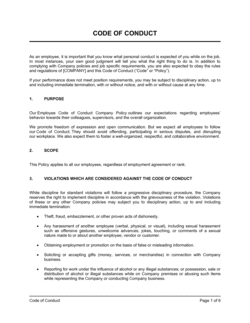
A code of conduct focuses on behavioral standards and ethical expectations β€” how employees represent the organization, treat colleagues and customers, and handle conflicts of interest. An employment relations policy focuses on the procedures for managing the employment relationship, including what happens when conduct falls short. The two documents complement each other: the code defines the standard; the employment relations policy defines the process for enforcing it.

vs Performance Review Template

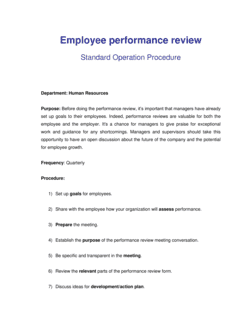
A performance review template structures the annual or quarterly evaluation of an individual employee's performance against agreed objectives. An employment relations policy sets the broader framework within which performance management β€” including performance improvement plans and capability-related dismissal β€” operates. The review template is a tool used within the policy's performance management section.

Industry-specific considerations

Professional Services

High billing-rate environments require clear performance management frameworks and non-solicitation expectations embedded alongside conduct standards.

Retail and Hospitality

High staff turnover and shift-based scheduling make consistent application of the disciplinary and grievance procedure especially critical to avoid claims of selective enforcement.

Healthcare

Regulatory fitness-to-practice requirements and mandatory reporting obligations must be referenced in the disciplinary procedure alongside standard conduct expectations.

Technology / SaaS

Distributed and remote teams require explicit consultation frameworks and communication channels, and the policy must address cross-border employment arrangements.

Manufacturing

Safety-related conduct rules and union recognition or works council consultation obligations are frequently integrated into the employment relations framework.

Financial Services

Regulatory conduct standards (FCA, SEC, FINRA) and whistleblowing obligations must be explicitly incorporated and referenced within the grievance and disciplinary sections.

Template vs pro β€” what fits your needs?

PathBest forCostTime
Use the templateSmall and medium businesses formalizing HR practices for the first time or updating an outdated policyFree2–4 hours to customize and distribute
Template + professional reviewOrganizations operating in multiple jurisdictions, unionized workforces, or businesses that have recently faced a grievance or tribunal claim$300–$800 for an employment lawyer or HR consultant review3–5 business days
Custom draftedLarge employers, regulated industries (financial services, healthcare), or organizations undergoing significant restructuring$1,500–$5,000+ for a bespoke employment law firm engagement2–4 weeks

Glossary

Employment Relations
The management of the formal and informal interactions between an employer and its employees, including conduct, communication, and dispute resolution.
Grievance Procedure
A defined, step-by-step process through which an employee formally raises a workplace complaint and the employer investigates and responds.
Disciplinary Procedure
A structured process for addressing employee conduct or performance issues, typically progressing from informal discussion to verbal warning, written warning, and dismissal.
Natural Justice
The principle that an employee accused of misconduct must be informed of the allegation, given a fair opportunity to respond, and have their case decided impartially.
Constructive Dismissal
When an employer's conduct β€” such as unilaterally changing terms or creating an intolerable work environment β€” forces an employee to resign, which courts may treat as dismissal.
Reasonable Adjustment
A modification to a role, process, or workplace environment made to accommodate an employee with a disability or protected characteristic.
Progressive Discipline
A disciplinary approach that escalates consequences incrementally β€” from informal coaching through to termination β€” giving the employee opportunity to correct behavior at each stage.
Consultation
A formal process of seeking employee input before implementing significant workplace changes, distinct from simply informing employees after a decision is made.
Right to Accompaniment
An employee's entitlement to bring a colleague or trade union representative to a formal disciplinary or grievance meeting.
Performance Improvement Plan (PIP)
A documented plan that sets specific, measurable performance targets for an underperforming employee within a defined timeframe, with regular review points.

Part of your Business Operating System

This document is one of 3,000+ business & legal templates included in Business in a Box.

  • Fill-in-the-blanks β€” ready in minutes
  • 100% customizable Word document
  • Compatible with all office suites
  • Export to PDF and share electronically

Create your document in 3 simple steps.

From template to signed document β€” all inside one Business Operating System.
1
Download or open template

Access over 3,000+ business and legal templates for any business task, project or initiative.

2
Edit and fill in the blanks with AI

Customize your ready-made business document template and save it in the cloud.

3
Save, Share, Send, Sign

Share your files and folders with your team. Create a space of seamless collaboration.

Save time, save money, and create top-quality documents.

β˜…β˜…β˜…β˜…β˜…

"Fantastic value! I'm not sure how I'd do without it. It's worth its weight in gold and paid back for itself many times."

Managing Director Β· Mall Farm
Robert Whalley
Managing Director, Mall Farm Proprietary Limited
β˜…β˜…β˜…β˜…β˜…

"I have been using Business in a Box for years. It has been the most useful source of templates I have encountered. I recommend it to anyone."

Business Owner Β· 4+ years
Dr Michael John Freestone
Business Owner
β˜…β˜…β˜…β˜…β˜…

"It has been a life saver so many times I have lost count. Business in a Box has saved me so much time and as you know, time is money."

Owner Β· Upstate Web
David G. Moore Jr.
Owner, Upstate Web

Run your business with a system β€” not scattered tools

Stop downloading documents. Start operating with clarity. Business in a Box gives you the Business Operating System used by over 250,000 companies worldwide to structure, run, and grow their business.

Start freeΒ Β·Β No credit card required