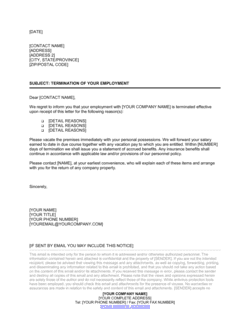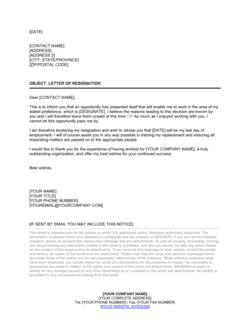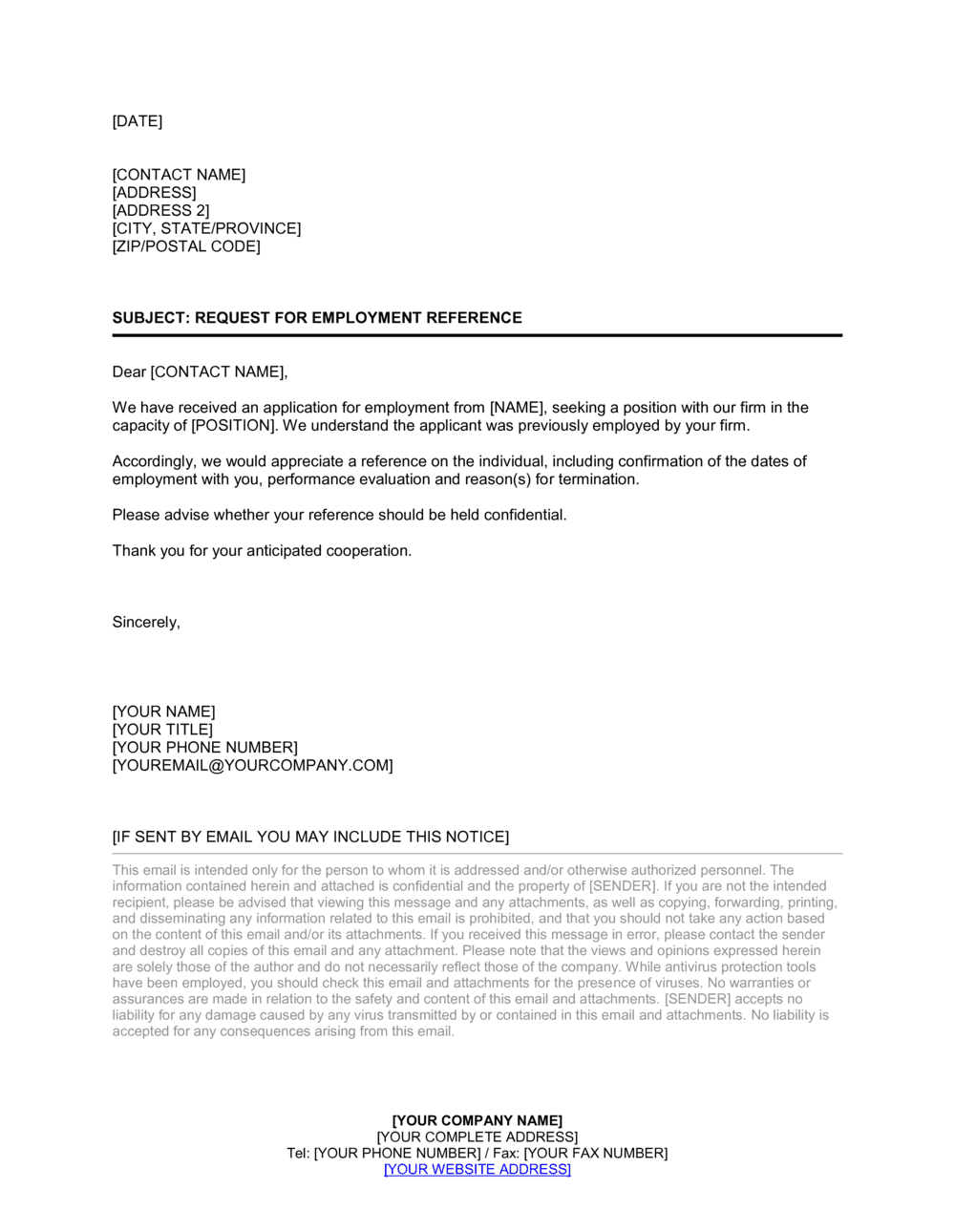
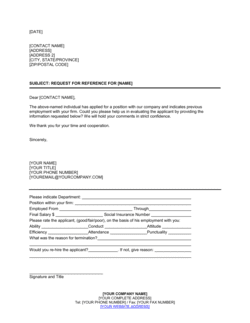
Request for Employment Reference Template

Free Word download β€’ Edit online β€’ Save & share with Drive β€’ Export to PDF

1 pageβ€’20–25 min to fillβ€’Difficulty: Standard
Learn more ↓
FreeRequest for Employment Reference Template

At a glance

What it is
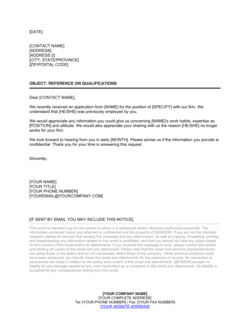
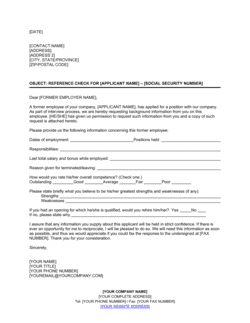
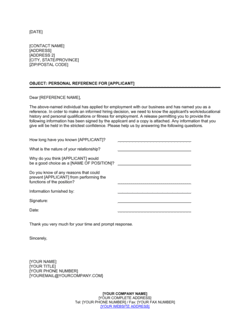
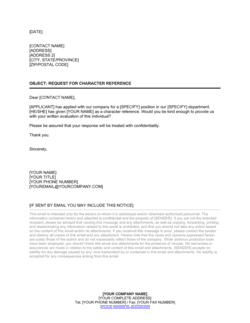
A Request for Employment Reference is a formal letter sent by a job seeker to a former manager, supervisor, or colleague asking them to provide a professional reference to a prospective employer. This free Word download gives you a ready-to-personalize template you can edit online and send by email or post in under ten minutes.
When you need it
Use it when a prospective employer requests professional references as part of the hiring process, or proactively when you want to confirm a reference is willing and prepared before you list their name on an application.
What's inside
A polite opening that reminds the recipient of your working relationship, a clear statement of the role you are applying for, relevant context about your accomplishments to help the reference speak specifically, and a courteous close with your contact details and a deadline for response.

What is a Request for Employment Reference?

A Request for Employment Reference is a formal letter sent by a job seeker to a former manager, supervisor, or colleague asking them to confirm their willingness to serve as a professional reference during a hiring process. It introduces the target role, refreshes the referee's memory of your shared work history, and provides specific accomplishments they can speak to when contacted by the prospective employer. Unlike an informal text or verbal ask, a written request gives the referee everything they need in one place and signals the professionalism that reflects well on you throughout the hiring process.

Why You Need This Document

Listing a reference without sending this letter is one of the most avoidable mistakes in any job search. An unprepared referee contacted out of the blue may hesitate, give a vague response, or β€” if the relationship has faded β€” struggle to recall the details that matter to a hiring team. Employers consistently report that hesitant or generic references raise concerns about a candidate, even when the underlying relationship was strong. A clear, well-timed reference request ensures your referees are willing, prepared, and focused on the skills most relevant to the role β€” turning a potential weak point in your application into a competitive advantage. This template gives you a polished, professional starting point that takes under fifteen minutes to personalize and send.

Which variant fits your situation?

If your situation is…Use this template
Requesting a reference from a direct former managerRequest for Employment Reference (Manager)
Asking a peer or colleague rather than a supervisorRequest for Professional Reference (Colleague)
Asking a professor or academic advisorRequest for Academic Reference Letter
Following up after no response to the initial requestReference Request Follow-Up Letter
Thanking a reference after the hiring process concludesThank-You Letter to Reference
Providing a reference rather than requesting oneEmployment Reference Letter
Requesting a written reference to attach to an applicationLetter of Recommendation Request

Common mistakes to avoid

❌ Asking with no advance notice

Why it matters: A referee caught off guard by a prospective employer's call cannot give a thoughtful, specific answer β€” and a hesitant or vague reference can cost you an offer.

Fix: Send this letter at least one week before you expect the employer to begin reference checks, and confirm the referee has agreed before you provide their name.
❌ Providing no context about the target role

Why it matters: A reference given without knowledge of the role is generic at best β€” the referee will default to broad praise that carries little weight with a hiring team.

Fix: Include the job title, company name, and a two-sentence role summary so the referee can connect your past performance to the specific skills the employer is evaluating.

❌ Omitting talking points or accomplishments

Why it matters: Referees who are left to recall your work from memory alone often undersell or misremember your contributions, especially if several years have passed.

Fix: Provide two or three specific, quantified accomplishments from your shared work history that map directly to the requirements of the target role.

❌ Listing a reference without asking first

Why it matters: An unprepared referee may confirm factual details only, decline to comment further, or β€” in the worst case β€” give a negative or ambivalent response because they were not expecting the call.

Fix: Always send this letter and receive explicit confirmation before providing any person's name as a reference on an application or resume.

The 9 key clauses, explained

Date and recipient address block

In plain language: Opens the letter with today's date, the recipient's full name, title, company, and mailing or email address β€” standard formal letter formatting.

Sample language
[DATE] [REFEREE FULL NAME] [REFEREE TITLE] [COMPANY NAME] [ADDRESS / EMAIL]

Common mistake: Omitting the recipient's current title and employer. Using an outdated title signals you haven't kept the relationship current and makes the letter feel impersonal.

Salutation

In plain language: A direct, professional greeting addressed to the referee by name β€” never a generic opener.

Sample language
Dear [REFEREE FIRST NAME],

Common mistake: Using 'To Whom It May Concern' when you know the recipient personally. It reads as indifferent and reduces the likelihood of a warm, enthusiastic response.

Opening β€” relationship reminder

In plain language: A brief sentence or two reminding the referee how you know each other, including the role you held and the dates of your working relationship.

Sample language
I hope this message finds you well. As you may recall, I had the pleasure of working with you as [YOUR TITLE] at [COMPANY NAME] from [START DATE] to [END DATE].

Common mistake: Assuming the referee remembers the details of your shared history. Even a trusted former manager may have overseen dozens of reports β€” a specific reminder prevents vague responses.

The request β€” clear and direct

In plain language: States plainly that you are asking them to serve as a professional reference, so there is no ambiguity about what you need.

Sample language
I am currently exploring a new opportunity and would be grateful if you would be willing to serve as a professional reference on my behalf.

Common mistake: Burying the actual request in the middle of a long paragraph. If the referee has to search for what you are asking, the response rate drops.

Role and employer context

In plain language: Describes the specific position you are applying for β€” job title, company name, and a one-sentence summary of the role β€” so the referee can tailor their response.

Sample language
The position is [JOB TITLE] at [PROSPECTIVE EMPLOYER], a [BRIEF COMPANY DESCRIPTION]. The role focuses on [KEY RESPONSIBILITIES].

Common mistake: Leaving out the role details entirely. A referee who doesn't know the target role cannot frame their comments around the skills that matter most to this particular employer.

Relevant accomplishments and talking points

In plain language: Offers two or three specific achievements or skills from your shared work history that are particularly relevant to the new role, making it easy for the referee to speak concretely.

Sample language
In particular, if it is helpful, you might speak to our work on [PROJECT / INITIATIVE], where I [SPECIFIC ACCOMPLISHMENT], and to my ability to [SKILL RELEVANT TO TARGET ROLE].

Common mistake: Omitting talking points entirely and leaving the referee to guess what to say. Specific prompts produce specific, credible references β€” vague requests produce vague responses.

Logistics β€” deadline and contact method

In plain language: States when the reference is needed and how the prospective employer will reach out β€” phone, email, or a written letter β€” so the referee can prepare and plan accordingly.

Sample language
The hiring team at [PROSPECTIVE EMPLOYER] may contact you by [PHONE / EMAIL] at [REFEREE CONTACT ON FILE]. They are aiming to complete references by [DATE].

Common mistake: Not mentioning a deadline. Without one, even willing referees deprioritize the task, and the candidate risks losing the offer due to an incomplete reference check.

Offer to provide additional information

In plain language: Invites the referee to reach out with any questions and offers to supply an updated resume or background context to help them prepare.

Sample language
I am happy to send you an updated copy of my resume or any additional background that would be useful. Please don't hesitate to reach out at [YOUR PHONE] or [YOUR EMAIL].

Common mistake: Failing to offer supporting materials. A referee working from a years-old memory of your role will give a weaker reference than one who has just reviewed your current resume.

Gracious close and sign-off

In plain language: Closes with a sincere expression of gratitude and leaves the door open for the referee to decline without awkwardness.

Sample language
I truly appreciate your time and support. I completely understand if your schedule does not permit it. I look forward to staying in touch regardless. Warm regards, [YOUR FULL NAME] [YOUR PHONE] [YOUR EMAIL]

Common mistake: Ending with pressure instead of gratitude β€” phrases like 'I'm counting on you' put the referee in an uncomfortable position and can result in a lukewarm reference even when they agree.

How to fill it out

  1. 1

    Enter the date and the referee's current contact details

    Fill in today's date and the referee's full name, current job title, company, and preferred contact address. Verify these details before sending β€” people change roles frequently.

    πŸ’‘ A quick LinkedIn check before sending confirms their current title and employer, which signals that you have stayed professionally aware of their career.

  2. 2

    Personalize the salutation and relationship reminder

    Address the referee by first name and add a sentence reminding them of the specific role you held and the dates of your time working together.

    πŸ’‘ Mention a shared project or team by name β€” one concrete detail makes the letter feel personal rather than templated.

  3. 3

    State the request directly in the opening paragraph

    Make your ask clear in the first body paragraph. Do not delay it until the second or third paragraph.

    πŸ’‘ Keep the request sentence short and specific: 'Would you be willing to serve as a professional reference for me?' β€” one sentence, no hedging.

  4. 4

    Add the role description and target employer details

    Insert the job title, the prospective employer's name, and a one-to-two sentence description of what the role involves, so the referee understands the context of their reference.

    πŸ’‘ Copy the first two sentences of the job posting's summary β€” it is accurate, concise, and saves you time.

  5. 5

    Supply two or three specific talking points

    Identify the accomplishments or skills most relevant to the new role and briefly mention them so the referee can reference them specifically when contacted.

    πŸ’‘ Frame talking points as questions the referee might be asked β€” 'You might mention my ability to manage cross-functional teams of up to 12 people' β€” rather than instructions.

  6. 6

    State the deadline and the contact method

    Tell the referee when the reference is needed and whether the employer will call, email, or request a written letter. Include the employer's contact name if you have it.

    πŸ’‘ Give the referee at least five business days' notice whenever possible β€” last-minute reference requests produce rushed responses.

  7. 7

    Close with your contact information and a genuine thank-you

    End with your current phone number and email address, a sincere thank-you, and a gracious out if they are unable to help.

    πŸ’‘ Follow up with a handwritten note or a personal email after the process concludes β€” referees who feel appreciated are more willing to help again in the future.

Frequently asked questions

What is a request for employment reference?

A request for employment reference is a formal letter sent to a former manager, supervisor, or colleague asking them to vouch for your professional performance with a prospective employer. It confirms the referee's willingness, provides context about the role you are pursuing, and gives them the talking points they need to give a specific, credible response when contacted.

When should I send a reference request letter?

Send it as soon as you decide to list someone as a reference β€” ideally before you submit the job application. Most hiring teams begin reference checks after an interview or offer stage, giving you a narrow window. Aim to have confirmed referees in place at least one week before you expect contact to begin.

How many references should I ask for?

Most employers request two to three professional references. It is good practice to maintain a confirmed list of three to four referees so you have flexibility if one becomes unavailable or the employer requests a specific type of reference β€” such as a direct supervisor rather than a peer.

Can I use a colleague instead of a manager as a reference?

Yes, peer references are widely accepted, particularly when a direct manager is unavailable, the relationship ended poorly, or you are making a confidential job search while still employed. Frame a peer reference around collaboration, specific projects, and observable skills rather than managerial oversight.

Should I send this letter by email or post?

Email is standard for most professional reference requests β€” it is faster, easier to respond to, and allows you to attach your updated resume in the same message. Use physical post only in industries where formal correspondence is still the norm, such as law, government, or academia.

What if the referee declines?

Thank them graciously and move on to another contact. A declined request is far better than an unenthusiastic or hesitant reference delivered unprepared. Keeping the interaction positive preserves the professional relationship for the future.

Is it appropriate to remind a referee of specific accomplishments?

Yes β€” it is expected and helpful. Supplying two or three specific talking points from your shared work history does not coach the referee dishonestly; it helps them recall concrete details they might otherwise forget. Hiring managers consistently report that specific, evidence-based references are far more persuasive than general character endorsements.

What is the difference between a reference request and a letter of recommendation?

A reference request asks someone to be available for a verbal or written check initiated by the prospective employer. A letter of recommendation is a written document the referee prepares independently and that you submit directly with your application. Many roles require one or the other, and some β€” particularly in academia or senior executive searches β€” require both.

How this compares to alternatives

vs Employment Reference Letter

A Request for Employment Reference is sent by the job seeker to ask a referee for their support. An Employment Reference Letter is the document the referee writes and provides in response. They are two sides of the same process β€” this template initiates the request; the reference letter fulfills it.

vs Letter of Recommendation

A letter of recommendation is a written document submitted directly with an application, authored entirely by the referee. A reference request letter asks the referee to be available for a check initiated by the employer β€” verbal or written. The key difference is who submits the document and when.

vs Reference List

A reference list is a formatted document you provide to the employer, listing your referees' names, titles, and contact details. A reference request letter is the private communication you send to each referee before providing their name. You need both: send this letter first, then include confirmed referees on the list.

vs Job Application Cover Letter

A cover letter is addressed to the prospective employer and argues why you are the right candidate. A reference request letter is addressed to your referee and prepares them to support your application. Both serve the same goal β€” securing the role β€” but they operate at different stages and with different audiences.

Industry-specific considerations

Financial Services

Regulatory roles often require verified employment history; reference requests in this sector typically need to cover specific compliance competencies and professional conduct.

Healthcare

Clinical and administrative roles frequently require references that can speak to patient care standards, licensing, and professional conduct under regulated conditions.

Technology / SaaS

Fast-moving hiring cycles mean reference checks often happen within 48 hours of an offer β€” confirming referee availability and preparing talking points in advance is critical.

Professional Services

Law firms, consulting practices, and accounting firms place heavy weight on professional reputation; a well-prepared reference from a named senior partner carries significant hiring influence.

Template vs pro β€” what fits your needs?

PathBest forCostTime
Use the templateAny job seeker asking a former colleague or manager for a standard professional referenceFree10–15 minutes per letter
Template + professional reviewSenior executives conducting confidential searches or requesting references in regulated industries$50–$150 (career coach or professional writer review)1–2 hours
Custom draftedC-suite candidates with complex employment histories or requiring bespoke reference management support$200–$500 (executive career consultant)1–2 days

Glossary

Professional Reference
A person who can speak to your work performance, skills, and character based on direct professional experience with you.
Reference Check
A verification step in the hiring process where a prospective employer contacts listed references to ask structured questions about a candidate.
Character Reference
A reference who speaks to personal qualities and integrity rather than direct work performance β€” typically used when professional references are limited.
Referee
The individual being asked to serve as a reference β€” the person who will receive this letter and respond to the prospective employer.
Reference Waiver
A candidate's agreement, often signed during an application, to waive the right to see the contents of reference responses submitted on their behalf.
Blind Reference
A reference check conducted by the prospective employer without advance notice to the candidate β€” typically used to cross-verify candidate-supplied references.
Letter of Recommendation
A written reference submitted directly with a job or academic application, as opposed to a verbal reference provided by phone or email.
Reference List
A separate document listing the names, titles, contact details, and relationship of each person willing to serve as a reference for a candidate.

Part of your Business Operating System

This document is one of 3,000+ business & legal templates included in Business in a Box.

  • Fill-in-the-blanks β€” ready in minutes
  • 100% customizable Word document
  • Compatible with all office suites
  • Export to PDF and share electronically

Create your document in 3 simple steps.

From template to signed document β€” all inside one Business Operating System.
1
Download or open template

Access over 3,000+ business and legal templates for any business task, project or initiative.

2
Edit and fill in the blanks with AI

Customize your ready-made business document template and save it in the cloud.

3
Save, Share, Send, Sign

Share your files and folders with your team. Create a space of seamless collaboration.

Save time, save money, and create top-quality documents.

β˜…β˜…β˜…β˜…β˜…

"Fantastic value! I'm not sure how I'd do without it. It's worth its weight in gold and paid back for itself many times."

Managing Director Β· Mall Farm
Robert Whalley
Managing Director, Mall Farm Proprietary Limited
β˜…β˜…β˜…β˜…β˜…

"I have been using Business in a Box for years. It has been the most useful source of templates I have encountered. I recommend it to anyone."

Business Owner Β· 4+ years
Dr Michael John Freestone
Business Owner
β˜…β˜…β˜…β˜…β˜…

"It has been a life saver so many times I have lost count. Business in a Box has saved me so much time and as you know, time is money."

Owner Β· Upstate Web
David G. Moore Jr.
Owner, Upstate Web

Run your business with a system β€” not scattered tools

Stop downloading documents. Start operating with clarity. Business in a Box gives you the Business Operating System used by over 250,000 companies worldwide to structure, run, and grow their business.

Free Forever PlanΒ Β·Β No credit card required