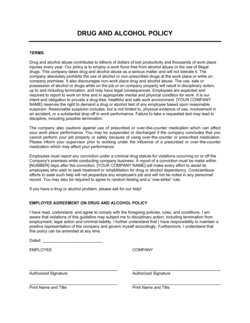
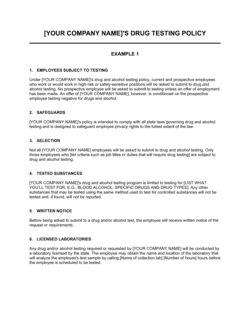
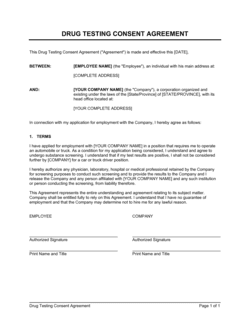
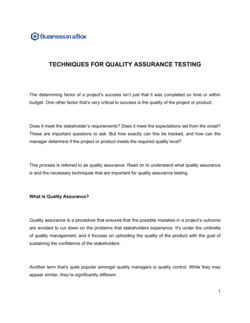
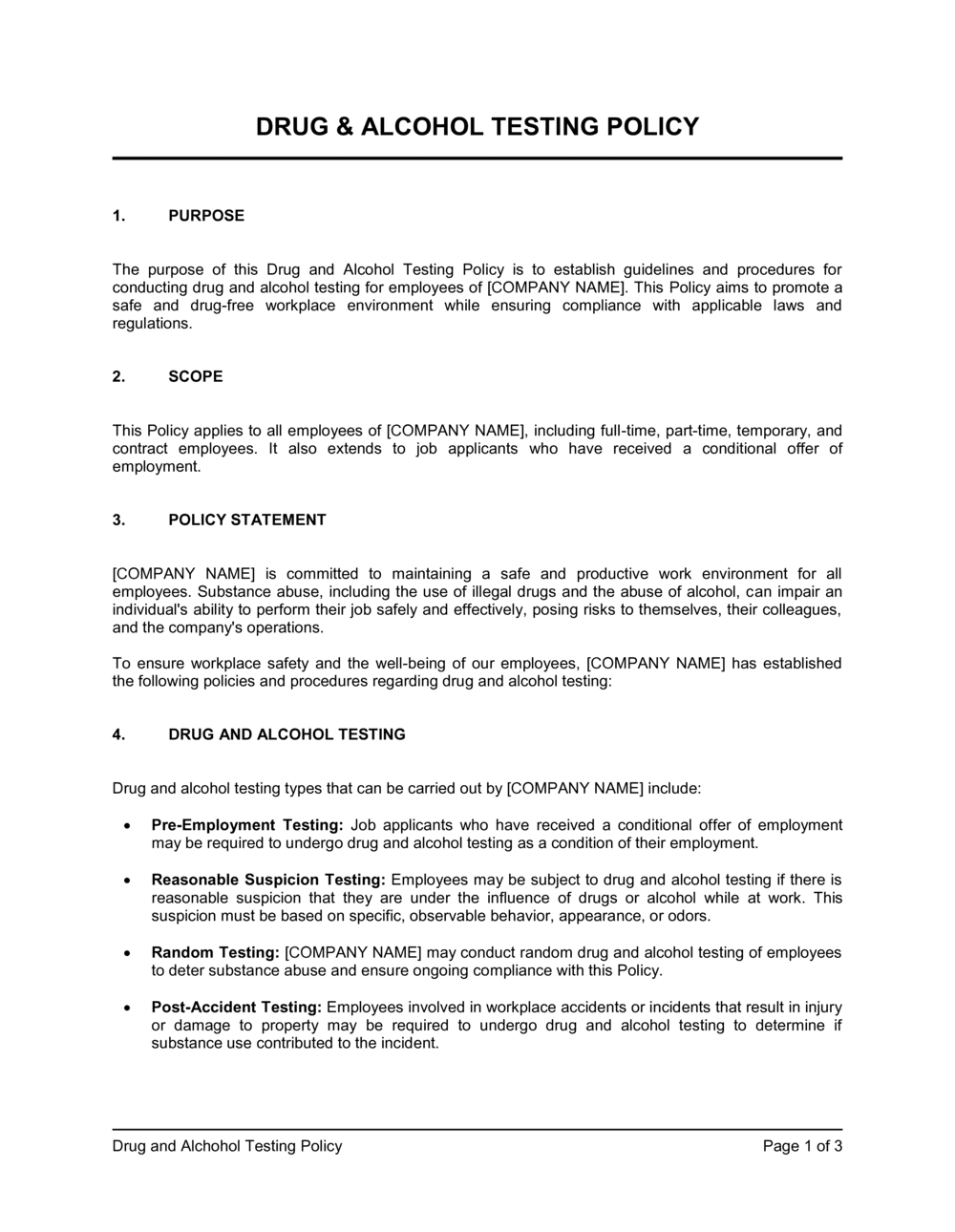
Drug and Alcohol Testing Policy Template

Free Word download β€’ Edit online β€’ Save & share with Drive β€’ Export to PDF

3 pagesβ€’20–25 min to fillβ€’Difficulty: Standard
Learn more ↓
FreeDrug and Alcohol Testing Policy Template

At a glance

What it is
A Drug and Alcohol Testing Policy is a formal workplace document that defines when and how an employer tests employees or job applicants for prohibited substances, what substances are covered, how results are handled, and what consequences follow a positive test or policy violation. This free Word download gives you a structured, editable template you can adapt to your organization's size, industry, and applicable regulations, then export as PDF for distribution to staff.
When you need it
Use it when onboarding new hires who must be tested before starting work, when a safety incident triggers a post-accident test, when you are required to maintain a drug-free workplace program by a federal contract or DOT regulation, or when you want to establish clear, consistent standards before a problem arises.
What's inside
Policy purpose and scope, definitions of prohibited conduct, covered testing situations (pre-employment, random, post-accident, reasonable suspicion, return-to-duty), testing procedures and chain of custody, employee rights and confidentiality protections, consequences for violations, and accommodation and assistance provisions.

What is a Drug and Alcohol Testing Policy?

A Drug and Alcohol Testing Policy is a formal workplace document that establishes an organization's rules around substance use on the job, defines exactly when and how employees and applicants are tested, describes the chain-of-custody and review procedures that protect the integrity of results, and specifies the consequences for violations and the accommodations available to employees seeking help. Unlike a brief handbook section, a standalone testing policy provides the procedural detail β€” testing triggers, specimen collection methods, Medical Review Officer involvement, employee rights, and a graduated consequences matrix β€” that makes the program legally defensible and consistently enforceable. This free Word download gives employers a structured, editable framework they can adapt to their workforce size, industry requirements, and applicable state and federal regulations, then distribute and collect employee acknowledgments in one streamlined process.

Why You Need This Document

Without a written drug and alcohol testing policy, employers face four compounding risks: inconsistent enforcement that exposes them to discrimination claims, post-accident impairment evidence that cannot be used because no authorized testing program existed, federal contract or DOT compliance violations that can result in fines or disqualification, and wrongful termination suits from employees who claim they were never informed of the rules. Courts and regulatory agencies consistently require employers to demonstrate that a published, acknowledged policy was in place before any test was conducted or disciplinary action taken. A policy distributed at onboarding and re-acknowledged at each material revision closes the documentation gap that underpins most successful employee challenges. This template provides the complete structure you need β€” from prohibited conduct and testing circumstances through chain-of-custody requirements and consequences β€” so you can build a compliant, consistently applied program without starting from a blank page.

Which variant fits your situation?

If your situation is…Use this template
Safety-sensitive roles regulated by the DOT (drivers, pilots, railroad workers)DOT Drug and Alcohol Testing Policy
Federal contractor required to comply with the Drug-Free Workplace ActDrug-Free Workplace Program Policy
General office or professional workforce with no safety-sensitive rolesDrug And Alcohol Testing Policy
Post-incident testing procedure documentation onlyWorkplace Incident Report
Supporting EAP referral for employees who test positiveEmployee Assistance Program (EAP) Policy
Return-to-work agreement after a positive test or treatmentReturn-to-Duty Agreement
Broader substance abuse awareness and education programSubstance Abuse Prevention Program

Common mistakes to avoid

❌ Silence on legal cannabis use

Why it matters: In states where cannabis is legal, a policy that simply lists marijuana as a prohibited substance without addressing off-duty use creates confusion and may expose the employer to disability or lawful-activity discrimination claims.

Fix: Add a dedicated subsection that specifies whether off-duty cannabis use is permissible for non-safety-sensitive roles, referencing the applicable state statute and noting that impairment on the job remains prohibited regardless of off-duty legality.

❌ Vague disciplinary language

Why it matters: Phrases like 'up to and including termination' or 'appropriate disciplinary action' result in inconsistent enforcement across managers and departments, creating discrimination and wrongful termination exposure.

Fix: Replace vague language with a specific consequences matrix that maps each violation type and each role category to a defined outcome β€” suspension duration, EAP requirement, or immediate termination.

❌ No supervisor training requirement or tracking

Why it matters: A supervisor who initiates a reasonable-suspicion test without documented training gives the affected employee strong grounds to challenge the test and any resulting disciplinary action.

Fix: Specify the minimum training hours required (at least 2 hours is standard), name the approved training program, and maintain a completion log in HR records.

❌ Failing to collect signed employee acknowledgments

Why it matters: Without a signed acknowledgment, employees can claim they were never informed of the policy β€” undermining your ability to take disciplinary action based on it.

Fix: Require a signed acknowledgment from every current employee when the policy is first issued and from every new hire at onboarding, and store copies in individual personnel files.

❌ Merging DOT and non-DOT testing requirements in a single document

Why it matters: DOT regulations (49 CFR Part 40) are prescriptive and cannot be modified. Mixing them with general workplace provisions creates conflicting requirements and can void your DOT compliance.

Fix: Maintain a separate, standalone DOT testing policy for regulated roles and use this general policy template exclusively for non-regulated employees.

❌ Not naming a backup collection site

Why it matters: Post-accident testing has a 2-hour window for alcohol and 8-hour window for drugs. If the primary collection site is closed or unavailable, the window closes and the test cannot be conducted β€” eliminating key evidence for incident investigation.

Fix: Name at least one backup collection site in the policy or in a referenced operational appendix, and confirm that site's hours cover all shifts on which employees work.

The 9 key sections, explained

Purpose and scope

Prohibited conduct

Substances covered

Testing situations

Testing procedures

Employee rights and confidentiality

Consequences for violations

Accommodation and assistance

Supervisor training and responsibilities

How to fill it out

  1. 1

    Confirm which regulatory framework applies

    Determine whether your employees are subject to DOT regulations (FMCSA, FAA, FTA, FRA, PHMSA), the Drug-Free Workplace Act (federal contractors), or only state and general employment law. DOT-regulated employers must follow 49 CFR Part 40 exactly β€” this template provides the civilian framework.

    πŸ’‘ If even one role is DOT-regulated, maintain a separate DOT-compliant policy alongside this general policy rather than merging them.

  2. 2

    Define the scope and covered roles

    List every category of worker the policy covers β€” full-time, part-time, temporary, and contract workers β€” and specify which roles are designated safety-sensitive, as they trigger additional testing obligations and stricter BAC thresholds.

    πŸ’‘ Use job titles rather than department names in the scope section so coverage is unambiguous when roles are renamed or reorganized.

  3. 3

    Select the substances and cut-off levels

    Choose the standard testing panel (five-panel or ten-panel) for your industry and confirm the BAC cut-off thresholds for alcohol. For safety-sensitive roles, 0.02 BAC is typically the action level and 0.04 BAC is the removal level.

    πŸ’‘ For states where cannabis is legal, add explicit language on whether off-duty cannabis use is permitted for non-safety-sensitive roles and cite the applicable state statute.

  4. 4

    Identify your testing circumstances and frequency

    Document every trigger situation: pre-employment, random (including the annual percentage), post-accident, reasonable suspicion, return-to-duty, and follow-up. Set the random testing percentage β€” typically 25–50% of the covered pool per year.

    πŸ’‘ Tie post-accident testing time windows to specific thresholds (e.g., any OSHA recordable injury, any accident causing vehicle damage above $[X]) to give supervisors a clear decision rule.

  5. 5

    Select and document your collection and laboratory vendor

    Name the certified collection site, backup site, and SAMHSA-certified laboratory in the policy or in a referenced appendix. Include the name and contact for your Medical Review Officer.

    πŸ’‘ Confirm the collection site's hours before publishing the policy β€” a site that closes at 5 p.m. cannot support post-accident testing on evening shifts.

  6. 6

    Draft the consequences matrix by role type

    Map specific consequences β€” EAP referral, suspension, termination β€” to each violation type and each role category (safety-sensitive vs. general). Ensure consequences are graduated and consistently applied.

    πŸ’‘ Have HR review the consequences matrix against your existing progressive discipline policy to eliminate contradictions before publishing.

  7. 7

    Add the self-disclosure and EAP referral language

    State clearly when voluntary self-disclosure triggers protection, when it does not, and how EAP referrals work. Reference your EAP provider by name and include contact information.

    πŸ’‘ Confirm with your EAP provider what services are covered before citing them in the policy β€” referencing a benefit the EAP no longer offers creates both confusion and legal exposure.

  8. 8

    Distribute, acknowledge, and document

    Distribute the final policy to all covered workers and collect a signed acknowledgment from each employee confirming they received and understood the policy. Retain acknowledgments in personnel files.

    πŸ’‘ Build acknowledgment collection into your onboarding checklist for new hires so it is never skipped, and re-collect signatures whenever the policy is materially revised.

Frequently asked questions

What is a drug and alcohol testing policy?

A drug and alcohol testing policy is a written workplace document that defines the employer's rules around substance use, specifies when and how employees are tested, describes what happens after a positive result, and outlines employees' rights throughout the process. It gives all parties β€” managers, HR, and employees β€” a consistent, documented framework so testing is conducted fairly and defensibly.

Who is required to have a drug and alcohol testing policy?

Federal contractors receiving grants or contracts of $100,000 or more are required to maintain a drug-free workplace program under the Drug-Free Workplace Act. Employers regulated by the DOT β€” including trucking, aviation, rail, transit, and pipeline companies β€” must maintain DOT-compliant testing programs under 49 CFR Part 40. Even employers without a legal mandate benefit from a written policy because it establishes defensible, consistent standards and reduces liability exposure from incidents involving impaired workers.

What types of drug tests are covered by a workplace policy?

Workplace policies typically address five testing situations: pre-employment (before a candidate's first day), random (unannounced testing of a percentage of the covered pool throughout the year), post-accident (following a recordable workplace injury or incident), reasonable suspicion (triggered by a supervisor's documented observation of impairment signs), and return-to-duty or follow-up testing after a confirmed violation. The policy should define each trigger and the time window within which a test must be completed.

Can an employer test for cannabis in states where it is legal?

Generally yes, for safety-sensitive roles β€” most courts have upheld employer rights to maintain cannabis-free safety policies regardless of state legalization. However, several states, including California, New York, and New Jersey, have enacted laws restricting employer discipline for lawful off-duty cannabis use by non-safety-sensitive employees. Employers operating in those states should add explicit language distinguishing safety-sensitive from non-safety-sensitive roles and review applicable state statutes before publishing the policy.

What should happen after an employee tests positive?

The standard sequence is: the Medical Review Officer contacts the employee to rule out legitimate medical explanations, then reports a confirmed positive to the employer's designated HR contact. The employer notifies the employee, initiates the consequences defined in the policy (EAP referral, suspension, or termination depending on role and violation number), and issues a return-to-duty test if the employee will be retained. All steps should be documented in writing and stored in a confidential file separate from the general personnel record.

Does a drug and alcohol policy need to be reviewed by a lawyer?

For most general-workforce employers, a well-drafted template is sufficient as a starting point. Legal review becomes advisable when your workforce includes DOT-regulated employees (who require strict compliance with 49 CFR Part 40), when your operations span multiple states with conflicting cannabis laws, or when you are a federal contractor subject to the Drug-Free Workplace Act. A 1-hour employment lawyer review ($200–$400) is typically sufficient to flag jurisdiction- specific issues before you publish.

How should supervisors document reasonable-suspicion observations?

Supervisors should write a contemporaneous, factual description of specific observable signs β€” slurred speech, unsteady gait, bloodshot eyes, smell of alcohol, erratic behavior β€” noting the date, time, location, and names of any witnesses. They should avoid conclusions like 'employee appeared drunk' in favor of specific observations like 'employee's speech was slurred and he stumbled twice while walking to his workstation at 10:15 a.m.' The documentation should be completed and signed before initiating the test.

How often should a drug and alcohol testing policy be updated?

Review the policy at least annually, and immediately following any change in applicable law β€” particularly state cannabis statutes, which have been evolving rapidly since 2020. Re-distribute and re-collect acknowledgments whenever a material change is made. If a test or disciplinary action is successfully challenged, treat that as a signal to review the relevant section rather than waiting for the annual cycle.

What is the difference between a BAC action level and a removal level?

In DOT-regulated testing, a BAC of 0.02–0.039 is the action level β€” the employee is removed from safety-sensitive duty for 24 hours but does not trigger the full violation consequences. A BAC of 0.04 or above is the removal level β€” it constitutes a DOT violation requiring MRO evaluation, SAP referral, and a return-to-duty test before the employee can return to safety-sensitive functions. Non-DOT employers may set different thresholds but should define both levels explicitly in their policy to avoid ambiguity.

How this compares to alternatives

vs Employee Handbook

An employee handbook is a broad document covering all workplace policies β€” conduct, leave, benefits, and more. A drug and alcohol testing policy is a standalone, detailed document that goes far deeper on testing procedures, chain of custody, MRO review, and consequences than a handbook section can. For regulated industries or any employer where testing is a meaningful compliance obligation, a standalone policy is more defensible than a handbook summary.

vs Substance Abuse Policy

A substance abuse policy focuses on defining prohibited conduct and the employer's position on substance use, including education and EAP access. A drug and alcohol testing policy is narrower and more procedural β€” it details testing types, collection procedures, chain of custody, and MRO review. For comprehensive coverage, many employers maintain both documents: the substance abuse policy sets the standards; the testing policy defines the enforcement mechanism.

vs Return-to-Duty Agreement

A return-to-duty agreement is a document signed by an individual employee after a confirmed violation, outlining the specific conditions β€” negative test, SAP evaluation, follow-up testing schedule β€” they must meet to return to work. A drug and alcohol testing policy is the organization-wide framework that authorizes and governs that agreement. The testing policy should be in place before any individual return-to-duty situation arises.

vs Workplace Health and Safety Policy

A workplace health and safety policy addresses the full spectrum of hazard identification, risk assessment, incident reporting, and safety obligations. A drug and alcohol testing policy is a specific subset that addresses one category of safety risk β€” impairment. Both documents are typically maintained separately so each can be updated, distributed, and acknowledged independently as requirements change.

Industry-specific considerations

Transportation and logistics

DOT-regulated employers must follow 49 CFR Part 40 exactly, with mandatory random testing rates of 50% for drugs and 10% for alcohol annually for covered drivers.

Construction

Site-safety requirements, insurance conditions, and general contractor mandates often require written policies and pre-employment testing for all workers before site access is granted.

Healthcare

Licensing boards, accreditation bodies such as The Joint Commission, and state health department regulations typically require substance abuse policies for clinical staff with patient-care responsibilities.

Manufacturing

Heavy machinery operation, confined-space work, and OSHA process safety management regulations make post-accident and random testing standard practice for production and maintenance roles.

Professional services

Policies for office-based workforces typically limit testing to pre-employment and post-accident situations, with reasonable-suspicion testing reserved for performance or safety incidents.

Government and public sector

Federal employees in sensitive positions and all federal contractor workforces are subject to Drug-Free Workplace Act requirements, mandating a written policy, employee education, and EAP access.

Template vs pro β€” what fits your needs?

PathBest forCostTime
Use the templateGeneral-workforce employers in a single state with no DOT-regulated roles or federal contract obligationsFree1–2 hours to complete and customize
Template + professional reviewEmployers operating in multiple states, employers with safety-sensitive roles, or companies with federal contracts$200–$500 for a 1-hour employment lawyer review2–5 days
Custom draftedDOT-regulated employers, federal agencies, or companies in heavily regulated industries such as healthcare or nuclear energy$1,000–$3,000 for a custom policy drafted by an employment or regulatory attorney1–3 weeks

Glossary

Chain of Custody
The documented process that tracks a biological specimen from collection to laboratory analysis, ensuring the sample has not been tampered with or misidentified.
Medical Review Officer (MRO)
A licensed physician who reviews laboratory drug test results and contacts employees to rule out legitimate medical explanations before a positive result is reported to the employer.
Reasonable Suspicion Testing
Drug or alcohol testing initiated when a trained supervisor observes specific, documented behavioral or physical signs suggesting an employee may be impaired.
Post-Accident Testing
Testing conducted after a workplace accident or safety incident to determine whether substance impairment was a contributing factor.
Return-to-Duty Test
A required drug or alcohol test an employee must pass before returning to work following a confirmed policy violation or after completing a substance abuse program.
Safety-Sensitive Position
A role in which impairment from drugs or alcohol could directly cause or contribute to a serious injury, accident, or fatality β€” including drivers, operators of heavy machinery, and certain healthcare workers.
EAP (Employee Assistance Program)
An employer-sponsored benefit that provides confidential counseling and referral services to employees dealing with substance use, mental health, or personal issues.
Adulteration
The deliberate addition of a substance to a urine or other biological specimen to interfere with or invalidate a drug test result.
Cut-off Level
The minimum concentration of a substance β€” expressed in nanograms per milliliter β€” that a laboratory uses to classify a specimen as positive for that substance.
Follow-Up Testing
Unannounced drug or alcohol tests conducted on an employee returning to duty after a violation, typically for a period of 1–5 years as directed by a Substance Abuse Professional.

Part of your Business Operating System

This document is one of 3,000+ business & legal templates included in Business in a Box.

  • Fill-in-the-blanks β€” ready in minutes
  • 100% customizable Word document
  • Compatible with all office suites
  • Export to PDF and share electronically

Create your document in 3 simple steps.

From template to signed document β€” all inside one Business Operating System.
1
Download or open template

Access over 3,000+ business and legal templates for any business task, project or initiative.

2
Edit and fill in the blanks with AI

Customize your ready-made business document template and save it in the cloud.

3
Save, Share, Send, Sign

Share your files and folders with your team. Create a space of seamless collaboration.

Save time, save money, and create top-quality documents.

β˜…β˜…β˜…β˜…β˜…

"Fantastic value! I'm not sure how I'd do without it. It's worth its weight in gold and paid back for itself many times."

Managing Director Β· Mall Farm
Robert Whalley
Managing Director, Mall Farm Proprietary Limited
β˜…β˜…β˜…β˜…β˜…

"I have been using Business in a Box for years. It has been the most useful source of templates I have encountered. I recommend it to anyone."

Business Owner Β· 4+ years
Dr Michael John Freestone
Business Owner
β˜…β˜…β˜…β˜…β˜…

"It has been a life saver so many times I have lost count. Business in a Box has saved me so much time and as you know, time is money."

Owner Β· Upstate Web
David G. Moore Jr.
Owner, Upstate Web

Run your business with a system β€” not scattered tools

Stop downloading documents. Start operating with clarity. Business in a Box gives you the Business Operating System used by over 250,000 companies worldwide to structure, run, and grow their business.

Start freeΒ Β·Β No credit card required