- Assignor
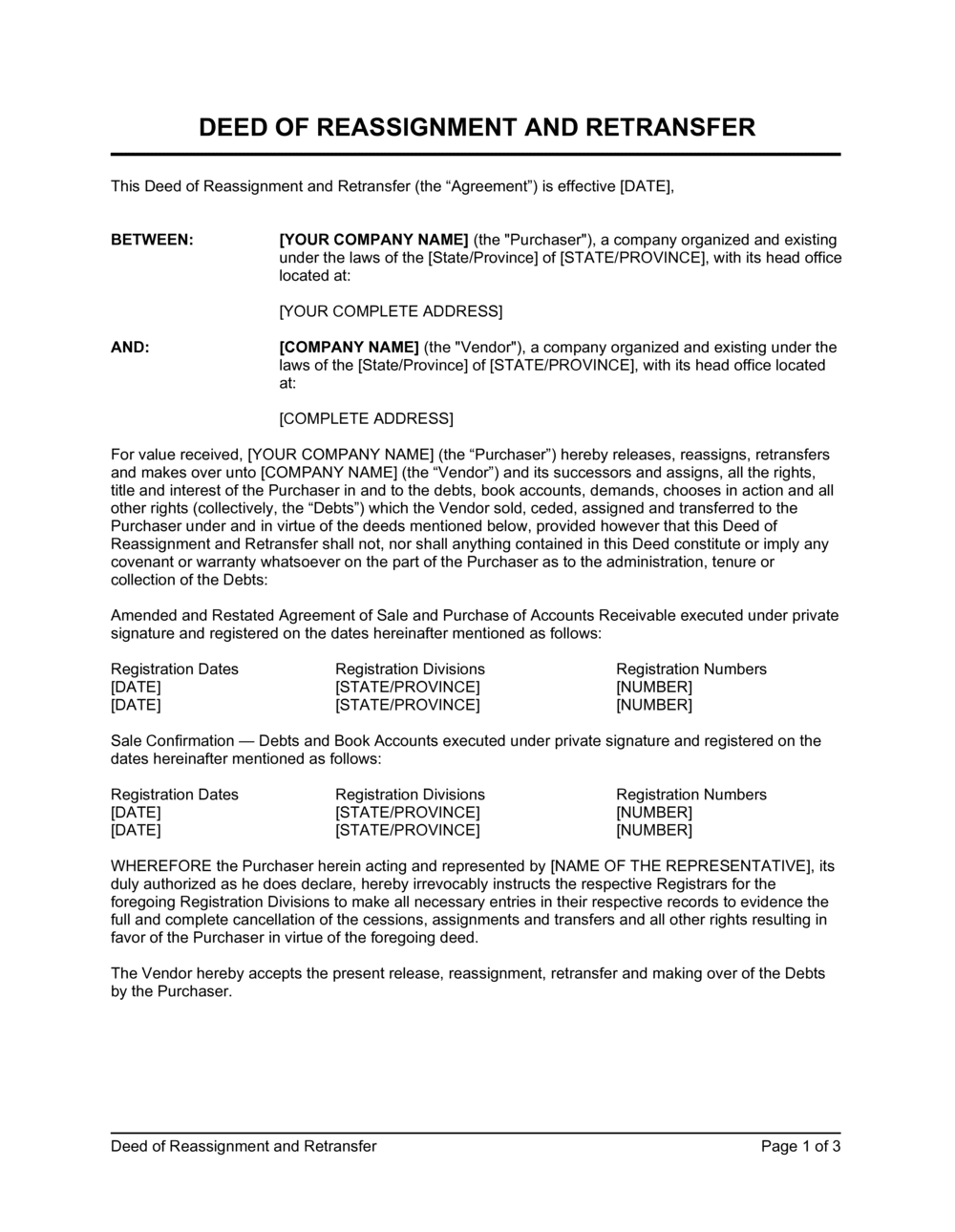
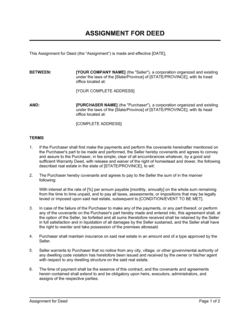
- The party who originally transferred rights or ownership to another party and who typically receives those rights back under a deed of reassignment.
- Assignee
- The party who received the rights under the original assignment and who, under a reassignment deed, transfers those rights back to the assignor.
- Operative Clause
- The core sentence in a deed that performs the actual transfer of rights — the words of grant that effect the reassignment as a matter of law.
- Consideration
- Something of value exchanged to support the deed — may be a nominal amount such as $1, a release of obligations, or a substantive payment depending on the circumstances.
- Deed
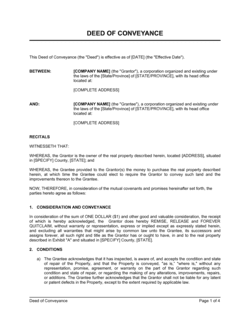
- A formal written instrument signed, witnessed, and sometimes sealed that transfers rights or property with greater legal weight than a simple contract, often without requiring proof of consideration in common-law jurisdictions.
- Chain of Title
- The documented history of ownership transfers for an asset, from the original owner through all subsequent assignees — a complete chain is required for enforceable ownership.
- Warranty of Title
- A guarantee by the reassigning party that they have valid, unencumbered ownership of the rights being retransferred and the authority to reassign them.
- Encumbrance
- Any lien, charge, security interest, or third-party claim attached to an asset that could limit or defeat the retransfer of clean title.
- Execution Block
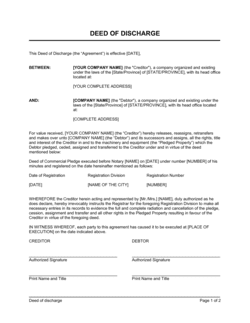
- The signature section of a deed identifying the parties, their authorized signatories, witness details, and the date of signing — essential for the deed to take legal effect.
- Registration
- The formal recording of an IP reassignment or property retransfer with the relevant government authority (e.g., USPTO, EUIPO, UKIPO, land registry) to provide public notice and enforce priority.
- Novation
- A related instrument that substitutes a new party into a contract entirely, extinguishing the original obligation — distinct from reassignment, which transfers rights without necessarily releasing the original obligor.