Confirmation Requested_Bank Has no Interest Template

Free Word download • Edit online • Save & share with Drive • Export to PDF

1 page20–30 min to fillDifficulty: StandardSignature requiredLegal review recommended
Learn more ↓
FreeConfirmation Requested_Bank Has no Interest Template

At a glance

What it is
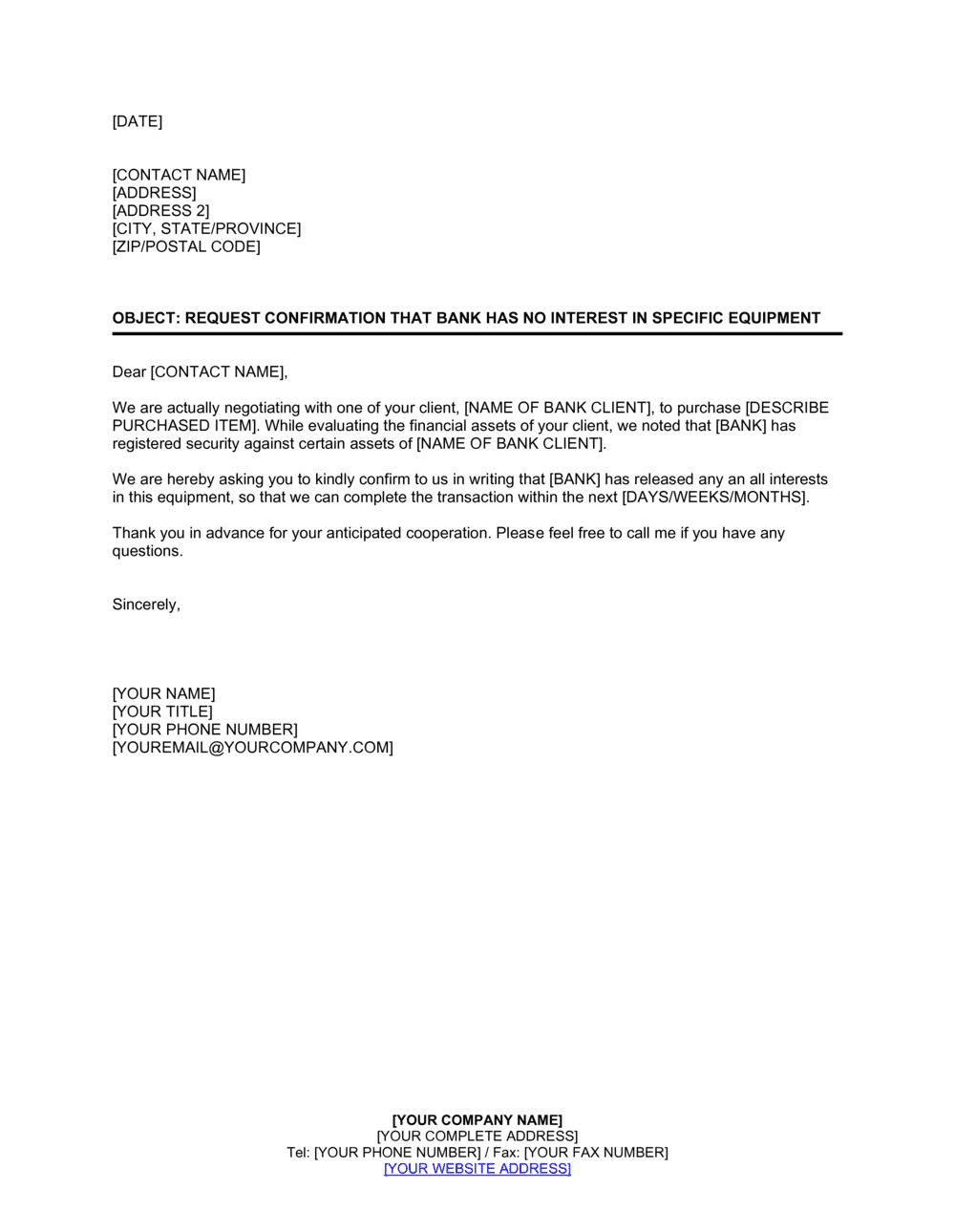
A Confirmation Requested Bank Has No Interest is a formal written statement issued by, or formally requested from, a bank or lending institution confirming that it holds no current security interest, lien, charge, or encumbrance over a specified asset, property, or company. This free Word download provides a structured template you can edit online and export as PDF for use in property transactions, business acquisitions, asset disposals, and due-diligence processes.
When you need it
Use it when a buyer, solicitor, or counterparty requires written confirmation that a named bank or lender has no registered or unregistered interest in a specific asset before a transaction can proceed. It is commonly required during property conveyancing, business sales, refinancing, and asset-backed lending arrangements.
What's inside
Identification of the requesting party and the bank, a precise description of the asset or property in question, a formal declaration that no interest is held, the scope and effective date of the confirmation, execution blocks for authorised signatories, and space for any qualifying conditions or caveats the bank wishes to attach.

What is a Confirmation Requested Bank Has No Interest?

A Confirmation Requested Bank Has No Interest is a formal written statement issued by a bank or lending institution — or formally solicited from one — confirming that it holds no mortgage, charge, lien, pledge, or other security interest over a specifically identified property or asset as at a stated effective date. The document names both the requesting party and the bank, precisely describes the asset in question, and contains a binding declaration that no encumbrance of the named lender exists over that asset at the time of confirmation. It is commonly used in property conveyancing, business acquisitions, refinancing arrangements, and insolvency proceedings wherever a buyer, incoming lender, or counterparty requires written assurance before a transaction can proceed.

Why You Need This Document

Without a properly executed bank no-interest confirmation, a transaction involving encumbered assets carries material risk for every party involved. A buyer who completes a property purchase without confirming that a prior lender's charge has been discharged may take title subject to that lender's security — meaning the lender could enforce against the property despite the change of ownership. In a business acquisition, undisclosed bank charges over company assets can reduce their realisable value and expose the buyer to unexpected creditor claims post-closing. Incoming lenders routinely require this confirmation before advancing funds secured against the same collateral, as an undisclosed prior charge could subordinate their new security interest. Title disputes arising from the absence of this single document have delayed completions, triggered indemnity claims, and in some cases unwound transactions entirely. This template gives you a structured, jurisdiction-aware starting point that covers all the critical elements — precise asset description, scope limitations, effective date, caveats, and authorised execution — so that the confirmation stands up to scrutiny when it matters most.

Which variant fits your situation?

If your situation is…Use this template
Bank confirming no interest in real property before conveyancing completesConfirmation Bank Has No Interest (Property)
Lender releasing a floating charge over all company assetsDeed of Release of Charge
Creditor confirming full repayment and discharge of a loanLoan Satisfaction and Release Letter
Bank formally discharging a registered mortgageMortgage Discharge Letter
Confirmation that no UCC financing statement is active against a debtorUCC Lien Release Letter
Seller confirming assets are free of all encumbrances at closingVendor's Statement of No Encumbrances
Company requesting bank confirmation for auditor or regulatorBank Confirmation Letter (Audit)

Common mistakes to avoid

❌ Accepting an unverified signatory

Why it matters: A confirmation signed by someone without authority to bind the bank is not enforceable. The bank can disclaim the document, leaving the transaction exposed to an undisclosed charge.

Fix: Always request proof of signatory authority — a current bank mandate, resolution, or letter of authority — and retain it alongside the executed confirmation.

❌ Limiting the declaration to registered interests only

Why it matters: Unregistered equitable charges and informal security arrangements can bind third parties with notice. A confirmation covering only registered interests leaves a material gap.

Fix: Ensure the declaration clause expressly covers 'all interests, whether registered or unregistered, legal or equitable' over the identified asset.

❌ Omitting a specific effective date

Why it matters: Without an effective date, it is unclear what point in time the confirmation covers. New charges registered between an undated confirmation and completion will not be caught.

Fix: Insert an exact calendar date aligned to the anticipated transaction date, and include a validity window beyond which the confirmation should be refreshed.

❌ Using an imprecise asset description

Why it matters: A vague description — 'the property at 12 High Street' without a title number — allows the bank to argue the confirmation does not cover the specific registered title in dispute.

Fix: Always include the land registry title number, company registration number, or asset serial number in addition to any descriptive name or address.

❌ Failing to record qualifications in the caveats clause

Why it matters: If a residual obligation exists — such as a pending redemption — and it is not disclosed, the bank faces liability for a misleading confirmation and the transaction may be unwound.

Fix: Review the bank's internal records before issuing the confirmation and record every live qualification, no matter how minor, in the caveats clause.

❌ Omitting the governing law clause on cross-border assets

Why it matters: Without a governing law clause, parties in different jurisdictions may apply conflicting legal standards to interpret the confirmation, leading to contradictory outcomes in enforcement.

Fix: Always specify the governing law, particularly when the bank and the asset or requesting party are located in different countries or states.

The 9 key clauses, explained

Parties and Identification

In plain language: Names the bank or lending institution issuing the confirmation and the party requesting it, including full legal names, registered addresses, and any account or reference numbers relevant to the enquiry.

Sample language
This Confirmation is issued by [BANK FULL LEGAL NAME], a [ENTITY TYPE] incorporated under the laws of [JURISDICTION], with registered address at [ADDRESS] ('the Bank'), in response to the written request dated [DATE] from [REQUESTING PARTY LEGAL NAME] of [ADDRESS] ('the Requesting Party').

Common mistake: Using a bank branch name instead of the bank's full registered legal entity name. The confirmation may be unenforceable if the issuing party cannot be precisely identified in a dispute or title query.

Description of the Asset or Property

In plain language: Precisely identifies the specific property, asset, or collateral about which the confirmation is made — including land registry title number, address, company registration number, or equipment serial number as applicable.

Sample language
This Confirmation relates solely to the property known as [FULL ADDRESS], registered at [LAND REGISTRY / COUNTY RECORDER] under Title Number [XXXXX] ('the Property'), and to no other asset of the Requesting Party or any associated entity.

Common mistake: Describing the asset in general terms without a unique identifier such as a title number or serial number. An ambiguous description allows the bank to argue the confirmation does not cover the specific asset in dispute.

Declaration of No Interest

In plain language: The core operative clause in which the bank formally states that it holds no security interest, charge, lien, mortgage, or other encumbrance over the identified asset as at the effective date.

Sample language
The Bank hereby confirms that, as at [EFFECTIVE DATE], it holds no mortgage, charge, lien, floating charge, fixed charge, pledge, or other security interest of any nature, whether registered or unregistered, over the Property described above.

Common mistake: Limiting the declaration to registered interests only. Unregistered equitable charges can exist and bind third parties with notice — the clause must expressly cover both registered and unregistered interests.

Scope and Limitations of Confirmation

In plain language: Sets out the precise scope of the bank's confirmation — what it does and does not cover — and confirms it relates only to the named asset and the named requesting party, not to any future transactions.

Sample language
This Confirmation is limited to the interest of the Bank as lender of record and relates solely to the Property as described herein. It does not constitute a confirmation regarding interests held by any third party, affiliate, or successor institution, nor does it apply to any asset other than the Property.

Common mistake: Omitting a scope limitation clause entirely, leaving the bank exposed to claims that the confirmation covers assets or obligations it never intended to address.

Effective Date and Currency of Confirmation

In plain language: Specifies the exact date as at which the confirmation is accurate, and states that the bank accepts no liability for changes in its position after that date.

Sample language
This Confirmation is accurate as at [DATE] and is issued solely for the purpose of [STATED PURPOSE — e.g., completion of the sale of the Property]. The Bank accepts no responsibility for any change in its interest or position arising after this date.

Common mistake: Leaving the effective date blank or using the date the letter is received rather than the date it is issued. Discrepancies between signing date and effective date create uncertainty about which point in time the confirmation actually covers.

Purpose and Permitted Use

In plain language: States the specific purpose for which the confirmation is issued — e.g., for use in a named property sale or business acquisition — and restricts reliance to the named recipient.

Sample language
This Confirmation is issued solely for the purpose of [TRANSACTION DESCRIPTION] and may be relied upon only by [REQUESTING PARTY NAME] and [NAMED SOLICITOR / LAW FIRM], if applicable. It may not be used for any other purpose or disclosed to any third party without the Bank's prior written consent.

Common mistake: Omitting the permitted-use restriction, which allows the document to be circulated and relied upon by parties the bank never intended to bind itself to.

Caveats and Qualifications

In plain language: Records any conditions, exceptions, or qualifications to the bank's confirmation — for example, pending searches, residual obligations, or assets the bank explicitly excludes from the confirmation.

Sample language
Notwithstanding the above, the Bank notes the following qualifications: [LIST QUALIFICATIONS, e.g., 'A redemption statement dated [DATE] has been issued and completion of discharge is subject to receipt of funds by [DATE]']. If no qualifications apply, insert: None.

Common mistake: Leaving this clause blank when qualifications do exist. Undisclosed residual obligations that surface post-transaction expose all parties to liability and can unwind a completed deal.

Authorised Signatory and Execution

In plain language: Provides the execution block for the bank's authorised signatory, including name, title, date of signing, and any required witness or notary line depending on jurisdiction.

Sample language
Signed for and on behalf of [BANK FULL LEGAL NAME] by its duly authorised signatory: Signature: _______________ Name: [SIGNATORY NAME] Title: [TITLE] Date: [DATE] Witness (if required): _______________

Common mistake: Accepting a confirmation signed by a branch manager or relationship officer without verifying they hold a current bank mandate to bind the institution. A signature from an unauthorised individual renders the confirmation worthless.

Governing Law

In plain language: Specifies the jurisdiction whose law governs the interpretation and enforcement of the confirmation.

Sample language
This Confirmation shall be governed by and construed in accordance with the laws of [JURISDICTION — e.g., England and Wales / State of [STATE], USA / Province of [PROVINCE], Canada].

Common mistake: Omitting a governing law clause on cross-border transactions, leaving the document's interpretation subject to conflicting jurisdictional claims when a dispute arises.

How to fill it out

  1. 1

    Identify the requesting party and the bank

    Enter the full legal names of both the party requesting the confirmation and the bank being asked to provide it. Include registered addresses and any account or loan reference numbers associated with the asset.

    💡 Check the bank's certificate of incorporation or public register to confirm its exact legal entity name — branch names and trading names are not sufficient for a binding confirmation.

  2. 2

    Describe the asset with a unique identifier

    Enter the precise description of the property or asset — street address and land registry title number for real property, or asset type, serial number, and acquisition date for equipment. Attach a schedule if multiple assets are covered.

    💡 For real property, cross-reference the title number against the most recent official search to ensure no new charges have been registered since the last inspection.

  3. 3

    Complete the declaration of no interest

    Confirm that the bank's declaration covers both registered and unregistered interests. If the bank held a charge that has now been discharged, add a recital confirming the discharge date and the reference number of the discharge filing.

    💡 Request a copy of the registered discharge document to attach as an exhibit — this prevents the counterparty from raising the same charge in a future dispute.

  4. 4

    Set the effective date explicitly

    Insert the specific calendar date as at which the confirmation is accurate. This date should match the date the bank's records were searched, not the date the letter will be received or relied upon.

    💡 For property transactions, align the effective date with the anticipated completion date rather than the date of issue — and build in a short validity window (typically 10–14 days).

  5. 5

    Define the purpose and limit permitted reliance

    Name the specific transaction and the parties permitted to rely on the confirmation. Add a restriction preventing third-party reliance to protect the bank from unintended liability.

    💡 If the confirmation will be shared with a solicitor or title insurer, name them explicitly — a blanket restriction that excludes named advisors creates friction at closing.

  6. 6

    Record any caveats or qualifications

    If any conditions remain — such as a pending redemption requiring funds to clear — record them precisely in the caveats clause. If there are none, insert the word 'None' rather than leaving the section blank.

    💡 A blank caveats field is ambiguous — it may be read as an oversight rather than an affirmative statement that no qualifications exist.

  7. 7

    Obtain execution by an authorised signatory

    Verify that the individual signing on behalf of the bank holds current authority to bind the institution on this type of confirmation. Request a copy of the bank's signatory mandate or board resolution if there is any doubt.

    💡 Ask the bank to provide its signatory list or letter of authority alongside the executed confirmation — this single step prevents the most common challenge to the document's validity.

  8. 8

    Retain executed copies for the transaction file

    Store the original executed confirmation — or a certified copy — in the transaction file alongside the title documents, discharge receipts, and completion statements. Provide a copy to each party permitted to rely on it.

    💡 Scan and timestamp the executed document immediately upon receipt. Digital records with metadata are increasingly accepted as evidence in disputes where an original cannot be located.

Frequently asked questions

What is a confirmation that a bank has no interest?

A confirmation that a bank has no interest is a formal written statement issued by a lending institution confirming it holds no mortgage, charge, lien, or other security interest over a specified property or asset as at a stated date. It is typically requested during property transactions, business sales, or refinancing to assure a buyer, incoming lender, or other counterparty that the asset is free of the named bank's claims. The document creates a record of the bank's position that can be relied upon at completion.

When do I need a bank no-interest confirmation?

You typically need this document when completing a property sale or purchase and the title register shows a prior lender's charge that must be confirmed as discharged, when acquiring a business and the due diligence process reveals an existing banking relationship over the target's assets, or when refinancing and the incoming lender requires confirmation that the outgoing lender's interest has been fully released. Insolvency practitioners also use it before realising assets in an administration or liquidation.

Is a confirmation that a bank has no interest legally binding?

Yes — when properly executed by an authorised signatory of the bank, this confirmation is generally a binding statement on which the named recipient can rely. If the bank subsequently asserts an interest that contradicts the confirmation, the recipient may have a cause of action for misrepresentation. However, its binding effect depends entirely on the authority of the signatory, the precision of the asset description, and the specific scope of the declaration.

What is the difference between a bank no-interest confirmation and a discharge of charge?

A discharge of charge is a formal document — often filed with a land registry or companies register — that extinguishes a previously registered security interest. A no-interest confirmation is a statement that, as at a specific date, no interest is held — it may accompany a discharge or may simply confirm that no interest was ever registered. The confirmation is the written assurance; the discharge is the operative act of release. Both are often needed to satisfy a buyer's solicitor or incoming lender.

Who has the authority to sign this confirmation on behalf of a bank?

An authorised signatory — typically a relationship director, senior lending manager, or legal counsel acting under a current bank mandate or board resolution — must sign. Branch managers and junior account officers generally do not hold authority to bind the bank on confirmations of this nature. Always request a copy of the signatory's authority before relying on the executed document.

How long is a bank no-interest confirmation valid?

Most banks issue confirmations with a stated validity period of 10 to 30 days from the effective date. After that window, the bank's position may have changed — a new charge could have been registered — and the confirmation should be refreshed. For property transactions, request the confirmation as close to the anticipated completion date as practicable, and build a short refresh window into the transaction timeline.

Can I use a bank no-interest confirmation template without a lawyer?

For straightforward domestic transactions where the bank's position is clearly already discharged, a well-prepared template is a reliable starting point. However, given the legal consequences of relying on an inaccurate or improperly executed confirmation — particularly in high-value property or M&A transactions — a lawyer's review of the final document and verification of the signatory's authority is strongly recommended before completion.

What happens if the bank issues a confirmation in error?

If a bank issues a confirmation that its interest has been discharged when in fact a live charge remains, the recipient who relied on the confirmation in good faith may have a claim for negligent misrepresentation or misrepresentation against the bank. The extent of liability will depend on the jurisdiction, the bank's internal procedures, and whether the recipient took reasonable steps to verify the confirmation. This risk underscores why obtaining proof of signatory authority and filing a formal search are best practice alongside the confirmation.

Does this document need to be notarised?

Notarisation is not typically required for a bank no-interest confirmation in the UK, Canada, or most US states when used in a standard domestic transaction. However, certain cross-border transactions, foreign land registries, or specific lender requirements may demand apostille certification or notarisation. Check the requirements of the jurisdiction where the asset is located and the requirements of any incoming lender before execution.

How this compares to alternatives

vs Discharge of Charge

A discharge of charge is the operative legal document that formally extinguishes a registered security interest and is typically filed with a land or companies registry. A no-interest confirmation is a written statement of the bank's current position — it may accompany a discharge or confirm no interest was ever registered. The discharge releases the right; the confirmation evidences the current state of affairs.

vs Loan Satisfaction Letter

A loan satisfaction letter confirms that a borrower has repaid a loan in full and that the lender's claim is extinguished. A no-interest confirmation is broader — it confirms no security interest of any kind is held over a specific asset, regardless of whether a loan was ever made. For transactions where a charge may exist independently of any outstanding loan balance, both documents may be required.

vs Release of Lien

A release of lien is a formal document signed by the lienholder that removes a specific lien from a property or asset, typically filed with a public registry. A no-interest confirmation does not release a lien — it states that none currently exists. Use a release of lien when a charge must be actively removed from the register; use a no-interest confirmation when a buyer or lender needs written assurance of the bank's current position.

vs Bank Confirmation Letter (Audit)

An audit bank confirmation letter is a document requested by auditors to verify account balances, loan balances, and security interests for financial statement purposes. A no-interest confirmation is requested by transactional parties — buyers, solicitors, and incoming lenders — to clear an asset for transfer. Both involve the bank confirming its position, but the audience, purpose, and legal consequences differ materially.

Industry-specific considerations

Real Estate and Property

Used by conveyancers and buyers to confirm a prior mortgagee's charge is discharged before title transfers — often required by the incoming lender's solicitor as a completion condition.

Mergers and Acquisitions

Buyers' legal teams request confirmation during asset or share purchase due diligence to ensure acquired assets are unencumbered by the target company's banking relationships.

Financial Services and Lending

Incoming lenders require confirmation from outgoing creditors before advancing new facilities secured against the same collateral, protecting first-priority security interests.

Insolvency and Restructuring

Administrators and liquidators confirm creditor positions over specific assets before realising them, ensuring proceeds are distributed to the correct parties in the correct priority.

Jurisdictional notes

United States

In the US, security interests in personal property are perfected by filing a UCC-1 financing statement with the relevant state's Secretary of State. A no-interest confirmation should be accompanied by a UCC search certificate confirming no active filings. For real property mortgages, a title search and endorsement from a title insurance company typically provides stronger protection than a standalone bank confirmation. State-specific recording requirements vary — ensure the confirmation references the correct county recorder's records.

Canada

Security interests in personal property in Canada are governed by provincial Personal Property Security Acts (PPSAs). A confirmation should be supported by a PPSA search against the debtor in the relevant province. For real property, each province maintains its own land registry — Ontario uses the Land Registry Act and Land Titles Act, while British Columbia uses the Land Title Act. Quebec operates under civil law, and security interests are governed by the Civil Code of Quebec — confirmation letters must comply with the distinct formality requirements of Quebec civil law.

United Kingdom

In England and Wales, charges over company assets must be registered at Companies House within 21 days of creation under the Companies Act 2006. A no-interest confirmation for real property should be supported by an official copy of the registered title from HM Land Registry confirming no charges are recorded. Scotland operates a separate land registration system under the Land Registration etc. (Scotland) Act 2012, and Northern Ireland uses Land Registry of Northern Ireland records. Solicitors acting in property transactions typically conduct official searches rather than relying solely on a bank confirmation.

European Union

Security interest regimes vary significantly across EU member states. Germany uses notarised land charge (Grundschuld) arrangements; France uses hypothèque and nantissement structures; the Netherlands uses recht van hypotheek. A bank confirmation that satisfies requirements in one member state may not meet formality requirements in another. Cross-border transactions should include local counsel review to confirm the confirmation's validity under the lex situs — the law of the jurisdiction where the asset is physically located — particularly given that EU private international law applies lex situs for immovable property.

Template vs lawyer — what fits your deal?

PathBest forCostTime
Use the templateStraightforward domestic transactions where the bank's charge is already confirmed discharged and the asset is clearly identifiedFree30–60 minutes to prepare and submit request
Template + legal reviewStandard property transactions, business sales, or refinancing where the value exceeds $100K and a solicitor is already engaged$200–$500 for a solicitor or conveyancer review1–3 days
Custom draftedHigh-value M&A transactions, cross-border asset transfers, or complex security structures involving multiple lenders or jurisdictions$800–$3,000+ depending on complexity and jurisdiction3–10 business days

Glossary

Security Interest
A legal right granted by a debtor to a creditor over the debtor's property, giving the creditor priority claim over that asset if the debtor defaults.
Charge
A form of security interest registered against a property or asset, entitling the chargeholder to enforce sale or take possession in the event of non-payment.
Encumbrance
Any claim, lien, mortgage, charge, or liability attached to a property or asset that limits the owner's ability to transfer it freely.
Floating Charge
A security interest over a class of changing assets — such as inventory or receivables — that crystallises into a fixed charge upon the occurrence of a specified trigger event.
Fixed Charge
A security interest attached to a specific, identified asset that prevents the owner from disposing of it without the lender's consent.
Discharge
The formal release of a registered security interest, charge, or lien, confirming the underlying obligation has been satisfied and the creditor's claim is extinguished.
UCC Financing Statement
A public notice filed under the US Uniform Commercial Code to perfect a secured party's interest in a debtor's personal property collateral.
Title Search
An examination of public records to identify all registered interests, charges, liens, and encumbrances affecting a property or asset.
Effective Date
The specific date on which the confirmation is stated to be accurate, beyond which the bank accepts no responsibility for subsequent changes in its position.
Authorised Signatory
An individual with documented authority to sign binding documents on behalf of a bank or corporate entity, typically evidenced by a board resolution or mandate.
Due Diligence
The process of investigating a business, asset, or transaction to verify material facts — including the absence of undisclosed liabilities or security interests — before committing to a deal.

Part of your Business Operating System

This document is one of 3,000+ business & legal templates included in Business in a Box.

  • Fill-in-the-blanks — ready in minutes
  • 100% customizable Word document
  • Compatible with all office suites
  • Export to PDF and share electronically

Create your document in 3 simple steps.

From template to signed document — all inside one Business Operating System.
1
Download or open template

Access over 3,000+ business and legal templates for any business task, project or initiative.

2
Edit and fill in the blanks with AI

Customize your ready-made business document template and save it in the cloud.

3
Save, Share, Send, Sign

Share your files and folders with your team. Create a space of seamless collaboration.

Save time, save money, and create top-quality documents.

★★★★★

"Fantastic value! I'm not sure how I'd do without it. It's worth its weight in gold and paid back for itself many times."

Managing Director · Mall Farm
Robert Whalley
Managing Director, Mall Farm Proprietary Limited
★★★★★

"I have been using Business in a Box for years. It has been the most useful source of templates I have encountered. I recommend it to anyone."

Business Owner · 4+ years
Dr Michael John Freestone
Business Owner
★★★★★

"It has been a life saver so many times I have lost count. Business in a Box has saved me so much time and as you know, time is money."

Owner · Upstate Web
David G. Moore Jr.
Owner, Upstate Web

Run your business with a system — not scattered tools

Stop downloading documents. Start operating with clarity. Business in a Box gives you the Business Operating System used by over 250,000 companies worldwide to structure, run, and grow their business.

Start free · No credit card required