Notice of Termination_Work Rules Violation Template

Free Word download β€’ Edit online β€’ Save & share with Drive β€’ Export to PDF

1 pageβ€’20–25 min to fillβ€’Difficulty: Standard
Learn more ↓
FreeNotice of Termination_Work Rules Violation Template

At a glance

What it is
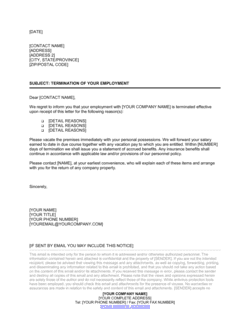
A Notice of Termination Work Rules Violation is a formal written letter an employer delivers to an employee whose employment is being ended because of a documented breach of workplace policy or conduct rules. This free Word download gives you a ready-to-edit template that records the specific violation, references prior disciplinary steps, states the effective termination date, and outlines offboarding instructions β€” all in a single professional letter.
When you need it
Use it when an employee has violated a workplace rule or policy and the employer has determined that termination is the appropriate outcome β€” whether the violation is a first-time severe infraction or the final step in a progressive discipline process.
What's inside
The letter covers the employer and employee identification block, a clear statement of termination, a description of the specific rule violation and supporting facts, a reference to any prior warnings or disciplinary actions, the effective date of termination, and instructions for returning company property and completing offboarding.

What is a Notice of Termination Work Rules Violation?

A Notice of Termination Work Rules Violation is a formal written letter an employer delivers to an employee whose employment is being ended because of a specific, documented breach of workplace policy or conduct rules. It states the reason for dismissal in plain terms, identifies the rule that was violated, references any prior disciplinary steps, sets the effective termination date, and outlines the employee's offboarding obligations. Unlike a general dismissal letter, this notice ties the termination explicitly to a named policy breach β€” creating a clear, defensible written record that documents the employer's reasoning and the factual basis for the decision.

Why You Need This Document

Terminating an employee without a written notice β€” or with a vague, undocumented one β€” exposes the employer to wrongful dismissal claims, unemployment disputes, and regulatory complaints that a properly drafted letter would have prevented. Employment tribunals and labor boards consistently look for documented evidence that the termination was based on a specific, communicated policy violation and not on a protected characteristic or arbitrary judgment. A termination letter that identifies the exact rule breached, the dates of prior warnings, and the factual basis for the decision is your first and most important line of defense. It also eliminates ambiguity for payroll, IT, and benefits teams who need a clear record of when and why the employment ended. This template gives you a professional, structured notice you can complete in under 30 minutes β€” with every component that HR and employment law practice require.

Which variant fits your situation?

If your situation is…Use this template
Terminating for a single severe violation such as theft or violenceNotice of Termination Work Rules Violation
Ending employment for general poor performance rather than a specific rule breachEmployee Termination Letter
Issuing a formal warning before escalating to terminationEmployee Warning Letter
Eliminating a role due to restructuring rather than employee faultNotice of Termination β€” Layoff
Documenting a suspension step before deciding on terminationEmployee Suspension Letter
Confirming mutual separation or resignation acceptanceAcceptance of Resignation Letter
Terminating a probationary employee within the initial evaluation periodProbationary Period Termination Letter

Common mistakes to avoid

❌ Vague description of the violation

Why it matters: A letter that says 'inappropriate workplace behavior' with no facts cannot be defended if the employee files an unfair dismissal claim. Adjudicators and courts require documented, specific evidence.

Fix: Describe the incident in factual terms β€” date, location, what was observed or reported, and which specific rule it breached. Attach the incident report as a supporting document.

❌ Omitting the effective termination date

Why it matters: Without an exact date, payroll does not know when to cut the final check, IT cannot schedule access revocation, and benefits administrators cannot process the termination correctly.

Fix: Always state a specific calendar date. Confirm it meets any notice-period obligations in the employment agreement or applicable law before finalizing the letter.

❌ Failing to cite the specific policy or handbook section

Why it matters: Terminating for a rule the employee cannot identify β€” or one that was never formally communicated β€” exposes the employer to wrongful termination claims and undermines the entire disciplinary rationale.

Fix: Reference the exact policy section number and title, confirm it was in the version of the handbook the employee acknowledged, and quote the relevant language directly if it is brief.

❌ Delivering the letter without a witness or delivery record

Why it matters: Employees sometimes deny receiving the notice, claim the meeting never occurred, or dispute the contents β€” especially when the termination is contested.

Fix: Deliver the letter in person with an HR witness present, obtain the employee's signature acknowledging receipt, or send via certified mail with return receipt to create a verifiable delivery record.

The 10 key clauses, explained

Header and parties block

In plain language: Identifies the employer, the employee, and the date the letter is issued β€” establishing who is communicating what to whom and when.

Sample language
[COMPANY NAME] | [COMPANY ADDRESS] | [DATE] | To: [EMPLOYEE FULL NAME] | Position: [JOB TITLE] | Department: [DEPARTMENT NAME]

Common mistake: Using an informal name or nickname instead of the employee's legal name as it appears in HR records β€” creating a mismatch with payroll and personnel files.

Termination statement

In plain language: A direct, unambiguous sentence stating that employment is being terminated and identifying work rules violation as the reason.

Sample language
This letter serves as formal notice that your employment with [COMPANY NAME] is terminated effective [TERMINATION DATE] due to a violation of company work rules.

Common mistake: Softening the language to the point of ambiguity β€” phrases like 'we are parting ways' or 'your position is being eliminated' obscure the reason and can create legal exposure.

Description of the violation

In plain language: A factual account of the specific rule or policy breached, including the date, location, and nature of the incident.

Sample language
On [DATE], you [DESCRIPTION OF SPECIFIC CONDUCT] in violation of [POLICY NAME / SECTION], which prohibits [SPECIFIC PROHIBITION].

Common mistake: Writing a vague description like 'inappropriate behavior' with no specifics. Vague language is harder to defend if the termination is challenged and may signal that the employer lacks documented evidence.

Reference to prior warnings or disciplinary record

In plain language: Cites any previous warnings, written notices, or disciplinary meetings related to the same or similar conduct to show that a progressive process was followed.

Sample language
You received a verbal warning on [DATE] and a written warning on [DATE] for related conduct. Despite these interventions, the behavior continued.

Common mistake: Omitting prior warnings when they exist. Failing to reference documented disciplinary history makes the termination appear sudden and arbitrary, weakening the employer's position in any dispute.

Company policy citation

In plain language: Quotes or references the specific handbook section, policy number, or code of conduct rule that was violated.

Sample language
This conduct is a direct violation of Section [X] of the [COMPANY NAME] Employee Handbook, effective [DATE], which states: '[QUOTED POLICY LANGUAGE].'

Common mistake: Citing a policy that was never formally distributed to or acknowledged by the employee. If the employee never signed a handbook acknowledgment, enforcing the policy becomes significantly more difficult.

Effective date and final day of work

In plain language: States the exact termination date and whether the employee is expected to work through that date or is relieved of duties immediately.

Sample language
Your last day of employment is [DATE]. You are [required to complete your shift today / relieved of your duties effective immediately].

Common mistake: Leaving the effective date vague or stating 'as soon as possible.' An exact date is required for payroll processing, benefits termination, and compliance with final-pay timing laws.

Final pay and benefits statement

In plain language: Advises the employee when and how they will receive their final paycheck, the status of accrued vacation payout, and when group benefits will end.

Sample language
Your final paycheck, including all wages earned through [DATE] and [accrued vacation / no accrued vacation per company policy], will be issued by [DATE] via [METHOD]. Your health benefits will remain active through [DATE].

Common mistake: Promising a final pay date that the company cannot meet. Final pay timing is regulated in many jurisdictions β€” confirm the legal deadline before drafting this clause.

Return of company property

In plain language: Lists items the employee must return β€” access cards, devices, keys, uniforms, documents β€” and the deadline and method for returning them.

Sample language
Please return the following company property by [DATE]: [LIST OF ITEMS β€” e.g., laptop, access badge, company vehicle keys, uniforms]. Items should be returned to [NAME / LOCATION].

Common mistake: Omitting specific items from the return list. A generic 'return all company property' instruction leads to disputes over what was actually owed β€” an itemized list eliminates ambiguity.

Confidentiality and post-employment obligations reminder

In plain language: Reminds the employee that any confidentiality, non-disclosure, or non-solicitation obligations from their employment agreement survive termination.

Sample language
Your obligations under the confidentiality and non-disclosure provisions of your [Employment Agreement / Offer Letter], dated [DATE], remain in full effect following your separation.

Common mistake: Skipping this clause entirely. Employees who are terminated for cause sometimes misunderstand that their post-employment obligations still apply β€” a written reminder creates a documented acknowledgment.

Contact for questions and signature block

In plain language: Provides a named HR or management contact for the employee to direct questions, and includes the employer's signature block.

Sample language
If you have questions regarding this notice or your separation, please contact [HR CONTACT NAME] at [EMAIL / PHONE]. Sincerely, [AUTHORIZED SIGNATORY NAME] | [TITLE] | [COMPANY NAME]

Common mistake: Leaving the signature block blank or unsigned. An unsigned termination letter lacks authority and can be challenged as unofficial or improperly issued.

How to fill it out

  1. 1

    Enter the employer and employee identification details

    Fill in the company's legal name and address, the employee's full legal name, job title, and department. Confirm the name matches HR and payroll records exactly.

    πŸ’‘ Pull the employee's name directly from their signed employment agreement or personnel file β€” not from a badge or email signature.

  2. 2

    State the termination and its reason clearly

    Write a single direct sentence confirming the employment is terminated and identifying work rules violation as the explicit reason. Do not soften or obscure the language.

    πŸ’‘ Read the termination statement aloud. If it could be misread as a layoff or resignation, rewrite it until the reason is unambiguous.

  3. 3

    Describe the specific violation with dates and facts

    Summarize the incident factually β€” what happened, when, where, and which policy was breached. Stick to documented, verifiable facts and avoid characterizations or opinions.

    πŸ’‘ Use the same language that appears in your incident report or investigation notes to keep internal records consistent.

  4. 4

    Reference prior warnings and disciplinary actions

    List any verbal warnings, written warnings, or suspensions that preceded this termination, with their dates. If this is a first-offense termination due to a severe violation, state that explicitly.

    πŸ’‘ Attach copies of prior written warnings to the termination letter when you deliver it, so the employee cannot later claim they were never formally warned.

  5. 5

    Cite the specific policy violated

    Reference the exact section of the employee handbook or policy document that was breached. If the policy language is brief, quote it directly in the letter.

    πŸ’‘ Confirm the cited policy version was in effect on the date of the violation β€” using a superseded policy undermines the notice.

  6. 6

    Set the effective termination date and final pay details

    Enter the exact last day of employment, whether the employee works through it or is released immediately, and the final pay date. Verify the final pay timing against your jurisdiction's requirements.

    πŸ’‘ In most US states, final pay for involuntary terminations is due on the last day of work or within 72 hours β€” check your state's labor department before confirming the date.

  7. 7

    List company property to be returned and add the signature block

    Itemize every piece of company property the employee holds, set a return deadline, and complete the authorized signatory block before delivery.

    πŸ’‘ Have the letter signed by the most senior person present at the termination meeting β€” a VP or HR director signature carries more weight than a direct supervisor's if the letter is later disputed.

Frequently asked questions

What is a notice of termination for work rules violation?

A notice of termination for work rules violation is a formal written letter an employer delivers to an employee whose employment is being ended because they breached a specific workplace policy or code of conduct rule. It documents the infraction, references any prior disciplinary steps, states the effective termination date, and outlines offboarding requirements. The letter creates a clear written record that protects the employer if the dismissal is later disputed.

When should a termination notice reference prior warnings?

Whenever the termination is the final step in a progressive discipline process, the notice should reference each prior warning by date and type. If the violation is a first-offense termination for a severe infraction β€” such as theft, violence, or fraud β€” the letter should explicitly note that the conduct is serious enough to warrant immediate dismissal without prior warnings. Either way, the reasoning should be stated clearly and supported by documented evidence.

Does a termination notice need to be signed by the employee?

The employee's signature is not required for the letter to be effective, but obtaining an acknowledgment of receipt is strongly recommended. If the employee refuses to sign, note that refusal in your HR file and ensure a witness cosigns confirming delivery. Sending a copy via certified mail provides an independent delivery record.

What is the difference between a termination notice and an employee warning letter?

An employee warning letter is a formal corrective action issued while the employee remains employed β€” it documents a violation and puts the employee on notice that further misconduct may result in dismissal. A termination notice ends the employment relationship. In a progressive discipline process, one or more warning letters typically precede the termination notice, and the termination notice should reference them.

Can I terminate an employee for a first offense?

Yes, in many jurisdictions and under most employment policies, a single severe violation β€” such as workplace violence, theft, harassment, or gross insubordination β€” is sufficient grounds for immediate termination without prior warnings. The termination notice should identify the severity of the violation and explain why it warranted dismissal without progressive discipline. Always confirm this is consistent with your employee handbook and applicable employment law.

What should I do if the employee refuses to return company property?

Document the refusal in writing immediately following the termination meeting. Your legal options depend on jurisdiction and the value of the property, but typically include deducting the value from the final paycheck (where permitted by law), pursuing a small claims action, or involving law enforcement for high-value items. Including an itemized return list in the termination letter with a specific deadline establishes a clear demand in writing before escalating.

How long should I keep a termination notice on file?

Most employment law practitioners recommend retaining termination letters and the associated disciplinary documentation for a minimum of three to seven years, depending on your jurisdiction's statute of limitations for employment claims. Some regulatory frameworks β€” such as EEOC record-keeping rules in the US β€” require retention of personnel records for at least one year after termination. When in doubt, keep records for the longest applicable period.

Should the termination letter mention severance?

If severance is being offered, a brief reference in the termination letter is appropriate, with the details handled in a separate severance agreement. If no severance is being paid β€” which is common in terminations for cause β€” the letter should be silent on the topic or explicitly state that no severance is owed per company policy. Avoid promising severance in the termination letter without a corresponding signed agreement, as the letter language may itself become contractually binding.

How this compares to alternatives

vs Employee Warning Letter

A warning letter is a corrective action issued while the employee is still employed, documenting a violation and warning that continued misconduct may lead to dismissal. A termination notice ends employment. Warning letters typically precede termination notices in a progressive discipline process, and the termination notice should reference them by date.

vs Employee Dismissal Letter

A general employee dismissal letter covers any type of employment ending initiated by the employer, including performance-based or mutual departures. This notice of termination specifically documents a work rules or policy violation as the stated cause, making it the appropriate choice when the reason for dismissal is a documented conduct breach rather than performance or business need.

vs Notice of Termination β€” Layoff

A layoff notice ends employment for business reasons β€” restructuring, budget cuts, or position elimination β€” with no fault attributed to the employee. A work rules violation termination ends employment due to specific employee misconduct. The distinction is legally significant: cause-based terminations typically carry no severance obligation, while layoffs often do.

vs Acceptance of Resignation Letter

An acceptance of resignation letter confirms a voluntary departure initiated by the employee. A termination notice is an involuntary separation initiated by the employer. Mischaracterizing a termination as a resignation β€” or the reverse β€” creates legal exposure and must be documented accurately from the outset.

Industry-specific considerations

Retail and Hospitality

High-frequency policy violations such as cash handling breaches, attendance no-shows, and customer conduct incidents make a standardized termination notice essential for consistent enforcement.

Manufacturing and Warehousing

Safety rule violations β€” operating equipment without certification, bypassing lockout/tagout procedures β€” often require immediate termination and must be documented precisely for OSHA compliance purposes.

Healthcare

HIPAA policy breaches, patient privacy violations, and credential misrepresentation require detailed termination notices that may also be reportable to licensing boards.

Professional Services

Conflicts of interest, client data misuse, and billing fraud violations are typically severe enough to warrant immediate termination, and the notice must reference the specific professional conduct policy breached.

Template vs pro β€” what fits your needs?

PathBest forCostTime
Use the templateSmall to mid-sized businesses terminating an employee for a documented policy violation with an existing disciplinary recordFree15–30 minutes
Template + professional reviewTerminations involving potential discrimination claims, complex prior disciplinary history, or senior employees with employment agreements$150–$400 for an HR consultant or employment lawyer review1–2 days
Custom draftedHigh-stakes dismissals involving executives, unionized workforces, regulated industries, or imminent litigation risk$500–$2,000+ for employment counsel2–5 days

Glossary

Work Rules Violation
A documented breach of a specific workplace policy, code of conduct rule, or procedural requirement stated in an employee handbook or contract.
Progressive Discipline
A graduated series of corrective actions β€” verbal warning, written warning, suspension, then termination β€” applied before dismissal for non-severe infractions.
Effective Date of Termination
The specific calendar date on which the employment relationship formally ends and the employee ceases to be on payroll.
At-Will Employment
An employment arrangement, common in the US, where either party may end the relationship at any time for any lawful reason β€” though a written notice letter is still best practice.
Wrongful Termination
A dismissal that violates employment law, a contract, or public policy β€” for example, firing someone in retaliation for filing a complaint or for a protected characteristic.
Offboarding
The administrative process of ending an employee's access, collecting company property, processing final pay, and completing separation paperwork.
Final Pay
The last paycheck owed to a terminated employee, which may include outstanding wages, accrued vacation, and any other earned compensation β€” the timing of which is governed by state or provincial law.
Employee Handbook
A written document distributed to all employees that describes workplace policies, standards of conduct, and the consequences for violations.
Cause (for Termination)
A specific, documented reason β€” such as a conduct rule violation, gross misconduct, or repeated policy breach β€” that justifies dismissal.
Documentation Trail
The chronological written record of incidents, warnings, and responses that supports a termination decision and defends against disputes or legal claims.

Part of your Business Operating System

This document is one of 3,000+ business & legal templates included in Business in a Box.

  • Fill-in-the-blanks β€” ready in minutes
  • 100% customizable Word document
  • Compatible with all office suites
  • Export to PDF and share electronically

Create your document in 3 simple steps.

From template to signed document β€” all inside one Business Operating System.
1
Download or open template

Access over 3,000+ business and legal templates for any business task, project or initiative.

2
Edit and fill in the blanks with AI

Customize your ready-made business document template and save it in the cloud.

3
Save, Share, Send, Sign

Share your files and folders with your team. Create a space of seamless collaboration.

Save time, save money, and create top-quality documents.

β˜…β˜…β˜…β˜…β˜…

"Fantastic value! I'm not sure how I'd do without it. It's worth its weight in gold and paid back for itself many times."

Managing Director Β· Mall Farm
Robert Whalley
Managing Director, Mall Farm Proprietary Limited
β˜…β˜…β˜…β˜…β˜…

"I have been using Business in a Box for years. It has been the most useful source of templates I have encountered. I recommend it to anyone."

Business Owner Β· 4+ years
Dr Michael John Freestone
Business Owner
β˜…β˜…β˜…β˜…β˜…

"It has been a life saver so many times I have lost count. Business in a Box has saved me so much time and as you know, time is money."

Owner Β· Upstate Web
David G. Moore Jr.
Owner, Upstate Web

Run your business with a system β€” not scattered tools

Stop downloading documents. Start operating with clarity. Business in a Box gives you the Business Operating System used by over 250,000 companies worldwide to structure, run, and grow their business.

Free Forever PlanΒ Β·Β No credit card required