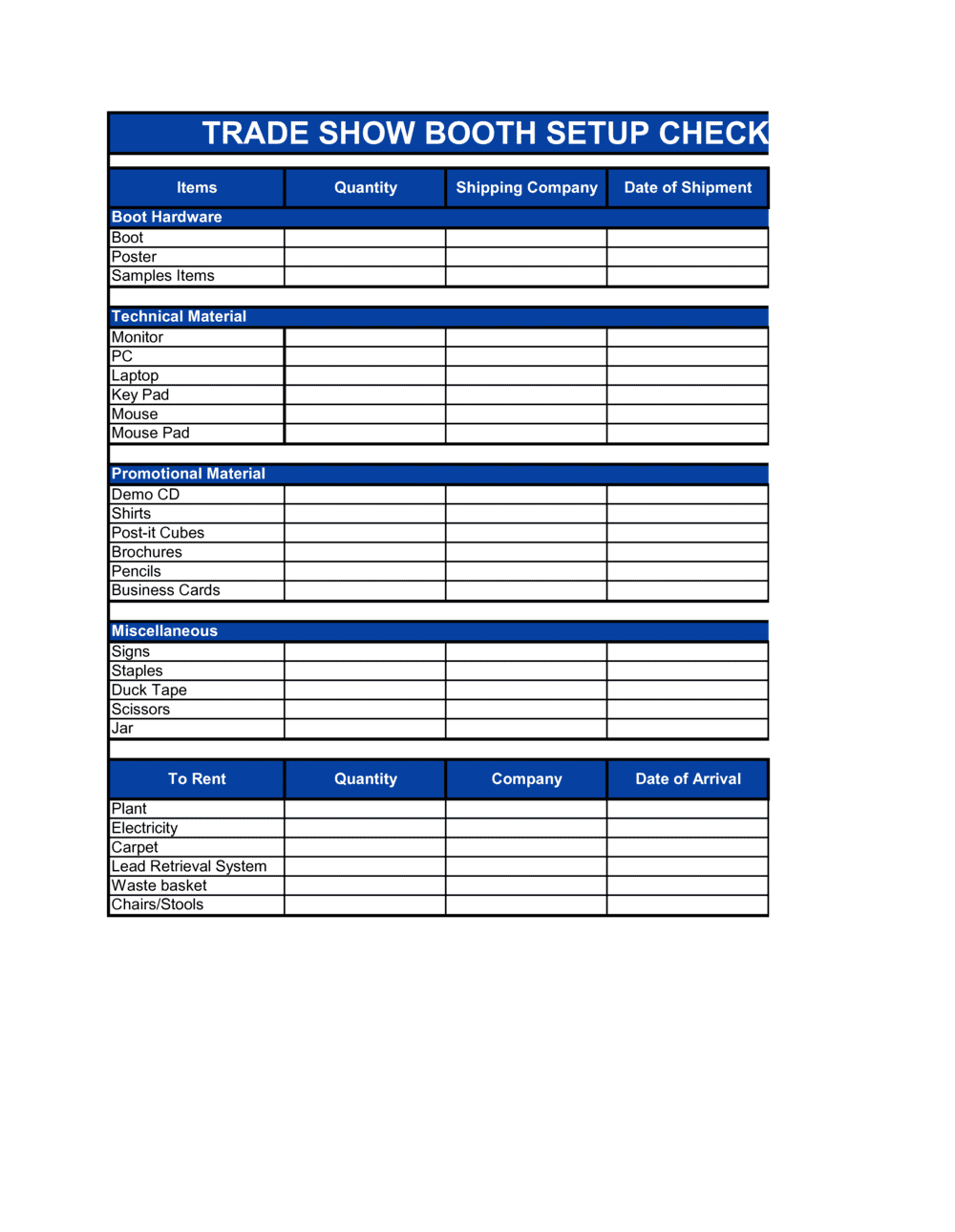
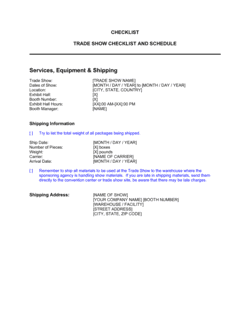
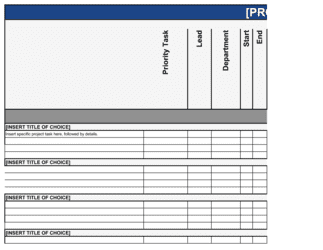
Checklist_Trade Show Booth Setup

Free Excel download β€’ Use online β€’ Print or share

2 pagesβ€’20–30 min to useβ€’Difficulty: Standardβ€’Signature requiredβ€’Legal review recommended
Learn more ↓
FreeXLSChecklist_Trade Show Booth Setup Template

At a glance

What it is
A Trade Show Booth Setup Checklist is a structured document that records every obligation, approval, and sign-off required before, during, and after an exhibitor deploys a booth at a trade show or exhibition. This free Word download covers venue compliance, contractor assignments, equipment delivery, health and safety acknowledgments, and post-show teardown β€” all in a single document that can be executed by the responsible party and retained as a binding record.
When you need it
Use it any time your company exhibits at a trade show, industry conference, or consumer exhibition β€” from a 10Γ—10 corner booth to a large island display. It is especially critical when multiple vendors, union labor, or international venues are involved.
What's inside
Pre-show logistics confirmations, venue and organizer compliance requirements, contractor and labor scheduling, electrical and AV equipment sign-offs, health and safety declarations, on-site setup responsibilities, and post-show teardown and freight instructions.

What is a Trade Show Booth Setup Checklist?

A Trade Show Booth Setup Checklist is a structured operational and compliance document that records every task, approval, and sign-off an exhibitor must complete before, during, and after deploying a booth at a trade show or exhibition. It functions as both a project management tool and a binding acknowledgment record β€” capturing vendor confirmations, insurance submissions, union-compliance declarations, utility orders, safety approvals, and teardown responsibilities in a single executable document. Because trade show participation involves multiple third-party contractors, venue-imposed rules, and time-critical deadlines, a signed checklist provides a dated paper trail that protects exhibitors in the event of disputes with organizers, general contractors, or labor crews.

Why You Need This Document

Trade show participation carries more contractual and compliance risk than most exhibitors anticipate: a missed COI deadline can result in booth access being denied on move-in day; non-union labor booked for a union-jurisdiction task can trigger a work stoppage that halts your entire installation; freight shipped outside the direct-ship window can arrive at a punitive storage rate that exceeds your entire freight budget. Without a documented checklist, these obligations exist only in scattered emails, PDFs, and verbal conversations β€” and when something goes wrong, there is no signed record confirming who was responsible for what. This template gives every person involved in your booth β€” from the exhibit house project manager to the on-site marketing coordinator β€” a single executable document that confirms every obligation has been met, every vendor has been authorized, and every sign-off has been obtained before the show floor opens.

Which variant fits your situation?

If your situation is…Use this template
Setting up a standard 10Γ—10 or 10Γ—20 inline boothChecklist Trade Show Booth Setup
Managing a large custom island booth with multiple contractorsEvent Project Plan
Coordinating a virtual or hybrid trade show exhibitVirtual Event Checklist
Engaging a third-party exhibit house for design and buildExhibit Services Agreement
Shipping and receiving freight to a convention centerFreight and Drayage Checklist
Tracking leads and follow-up actions from the show floorTrade Show Lead Tracking Form
Planning the full marketing campaign around a trade show appearanceEvent Marketing Plan

Common mistakes to avoid

❌ Missing advance-rate deadlines

Why it matters: Electrical, furniture, and material handling ordered on-site cost 40–100% more than advance-rate prices, and some services simply are not available at the last minute.

Fix: Extract every deadline from the exhibitor manual into a calendar on the day you receive the manual, with two-week lead reminders for each.

❌ Booking non-union labor for union-jurisdiction tasks

Why it matters: Work stoppages ordered by union stewards can halt your entire booth installation; the GC will then charge to have union workers redo the work at overtime rates.

Fix: Call the venue's labor coordinator before booking any EAC to confirm which tasks fall under union jurisdiction at that specific facility.

❌ Submitting a COI that expires before move-out

Why it matters: Show organizers conduct insurance audits and can bar access to a booth mid-show if coverage has lapsed, regardless of how much setup work was completed.

Fix: Always request a COI with an expiry date at least 30 days after the scheduled move-out and confirm the additional-insured endorsement lists the correct entity name.

❌ Shipping freight outside the venue's direct-ship window

Why it matters: Shipments arriving before the direct-ship open date or after the close date are refused at the dock or stored at punitive handling fees that can exceed the value of the shipment.

Fix: Use the advance-warehouse option when direct-ship timing is uncertain β€” advance warehouses accept shipments up to 30 days early at a predictable drayage rate.

❌ No authorized company representative sign-off at setup completion

Why it matters: Contractor-only sign-offs create liability gaps β€” if the booth is damaged or non-compliant, there is no exhibitor acknowledgment of acceptance to reference in a dispute.

Fix: Designate one named company representative to perform and sign the setup completion walk-through before the show opens.

❌ Neglecting NFPA 701 flame-retardancy compliance for booth materials

Why it matters: Fire marshals conduct pre-show inspections and will order non-compliant draping, fabric, or signage removed on the spot β€” often with 30 minutes to comply before the show floor opens.

Fix: Require all fabric, draping, and soft-goods suppliers to provide flame-retardancy certification matching NFPA 701 or the venue's equivalent standard before materials ship.

The 9 key clauses, explained

Exhibitor identification and show details

In plain language: Records the exhibiting company, show name, venue, booth number, and assigned square footage β€” establishing the scope of the checklist.

Sample language
Exhibitor: [COMPANY NAME] | Show: [EVENT NAME] | Venue: [VENUE NAME], [CITY, STATE] | Booth #: [BOOTH NUMBER] | Dimensions: [X ft Γ— Y ft] | Move-In Date: [DATE] | Show Open: [DATE]–[DATE] | Move-Out Deadline: [DATE]

Common mistake: Omitting the booth number and assigned space dimensions. Without them, contractors cannot confirm they are working in the correct location, causing costly setup errors.

Venue and organizer compliance confirmation

In plain language: Confirms that the exhibitor has reviewed and accepted the show's exhibitor manual, height restrictions, aisle clearance rules, and fire marshal requirements.

Sample language
Exhibitor confirms receipt and review of the [EVENT NAME] Exhibitor Manual (version [X], dated [DATE]) and agrees to comply with all regulations therein, including maximum booth height of [X ft] and a minimum [X-inch] aisle setback.

Common mistake: Skipping this clause because the manual was emailed months earlier. Booth designs frequently evolve after the manual is reviewed β€” failing to re-confirm compliance before move-in leads to on-site teardowns ordered by show management.

Certificate of insurance submission

In plain language: Records that a valid COI meeting the show's minimum coverage requirements has been submitted to the organizer and is on file.

Sample language
Exhibitor has submitted a Certificate of Insurance to [ORGANIZER NAME] on [DATE], evidencing general liability coverage of not less than $[AMOUNT] per occurrence and $[AMOUNT] aggregate, naming [ORGANIZER / VENUE] as additional insured.

Common mistake: Submitting a COI with expiry dates that lapse before the show's move-out date. Organizers can revoke booth access if coverage expires mid-show.

Contractor and labor scheduling

In plain language: Lists all approved contractors β€” exhibit house, electrician, AV vendor, flooring installer β€” with their move-in time slots and union-compliance status.

Sample language
Approved contractors: (1) [EXHIBIT HOUSE NAME] β€” move-in [DATE/TIME]; (2) [AV VENDOR] β€” move-in [DATE/TIME]; (3) [ELECTRICIAN] β€” [UNION / NON-UNION], booked through [GC NAME]. All EAC authorization forms submitted: Yes / No.

Common mistake: Booking non-union labor for tasks covered by union jurisdiction at the venue. This results in work stoppages, mandatory re-do by union crews at full overtime rates, and potential ejection from the show floor.

Electrical and utility order confirmation

In plain language: Confirms that electrical, internet, water, and compressed-air orders have been placed with the official show contractor and that capacities match booth requirements.

Sample language
Electrical order confirmed with [GC NAME]: [X] amps / [X] volts. Internet: [X Mbps dedicated / shared]. Water: [Yes / No]. All orders placed by advance-rate deadline of [DATE]. Order confirmation #: [NUMBER].

Common mistake: Ordering electrical after the advance-rate deadline and receiving insufficient amperage for AV equipment. On-site upgrades cost 40–100% more than advance orders and may not be available at peak move-in.

Freight and drayage authorization

In plain language: Documents the shipping carrier, estimated weight, targeted delivery window, and authorization for the GC to handle inbound and outbound freight.

Sample language
Freight shipped via [CARRIER NAME], tracking #[NUMBER], estimated [X lbs / X pieces], targeted delivery to advance warehouse by [DATE] or direct-to-show by [DATE]. Exhibitor authorizes [GC NAME] to receive and transport freight to Booth [NUMBER] at the standard drayage rate of $[X]/100 lbs.

Common mistake: Shipping freight direct-to-show without confirming the venue's direct-ship open dates. Shipments arriving outside the window are refused or stored at punitive rates.

Health, safety, and fire marshal acknowledgment

In plain language: Records that the exhibitor's booth materials, draping, structures, and any hanging elements comply with venue fire codes and that required approvals have been obtained.

Sample language
Exhibitor confirms that all booth materials meet NFPA 701 flame-retardancy standards or equivalent. Rigging plan submitted to [GC NAME] on [DATE] and approved on [DATE]. Fire marshal walk-through scheduled for [DATE/TIME].

Common mistake: Using fabric or draping not certified to NFPA 701. Fire marshals conduct pre-show walkthroughs and will order non-compliant materials removed β€” often 30 minutes before the show opens.

On-site setup completion sign-off

In plain language: A signed acknowledgment that the booth has been fully installed, all equipment is operational, and the space is ready for show opening β€” executed by the responsible exhibitor representative.

Sample language
I, [REPRESENTATIVE NAME], [TITLE], confirm that Booth [NUMBER] for [COMPANY NAME] is fully installed and operational as of [DATE/TIME], including all graphics, furnishings, electrical connections, and AV equipment. Signed: _______________________ Date: _____________

Common mistake: Delegating the sign-off to a contractor rather than an authorized company representative. If a dispute arises over setup quality or damage, the exhibitor's own signature is required to establish acceptance.

Post-show teardown and freight-out instructions

In plain language: Documents the move-out schedule, outbound freight labels, and the deadline by which the booth space must be cleared β€” with an acknowledgment of abandonment fees.

Sample language
Move-out window: [DATE/TIME] to [DATE/TIME]. Outbound freight carrier: [CARRIER NAME]. Labels printed and attached: Yes / No. Exhibitor acknowledges that materials not removed by [DATE/TIME] will be disposed of or stored at Exhibitor's expense, with a minimum handling fee of $[AMOUNT].

Common mistake: Failing to attach outbound freight labels before move-out begins. Unlabeled crates are separated from booth materials and may miss the carrier pickup β€” resulting in freight being shipped ground collect at full list rates.

How to fill it out

  1. 1

    Enter exhibitor and show details

    Fill in the company name, show name, venue, booth number, dimensions, and all key dates β€” move-in, show open, show close, and move-out deadline. This header anchors every downstream task.

    πŸ’‘ Confirm booth number and dimensions directly from the official space confirmation letter, not from an email thread β€” assignments occasionally change after initial notification.

  2. 2

    Obtain and review the exhibitor manual

    Download the current exhibitor manual from the show organizer, note all deadlines (advance electrical orders, EAC forms, COI submission), and enter the manual version and date into the compliance clause.

    πŸ’‘ Set calendar reminders for every deadline in the manual at least two weeks in advance β€” advance-rate windows typically close 4–6 weeks before move-in.

  3. 3

    Submit your certificate of insurance

    Contact your insurer to issue a COI meeting the show's requirements, naming the organizer and venue as additional insured. Log the submission date and expiry date in the checklist.

    πŸ’‘ Request a COI with an expiry date at least 30 days after the show's move-out date to avoid mid-show coverage lapses.

  4. 4

    Book and document all contractors

    List each approved contractor β€” exhibit house, AV, electrical, flooring β€” with their move-in time slot and union-compliance status. Submit all EAC authorization forms to the GC before the required deadline.

    πŸ’‘ Call the venue's labor office to confirm union jurisdiction rules before booking EACs. A single misstep triggers a work stoppage on the show floor.

  5. 5

    Place and confirm utility orders

    Order electrical, internet, water, and any other required utilities through the GC's online portal before the advance-rate deadline. Enter order confirmation numbers in the checklist.

    πŸ’‘ Order 20% more electrical capacity than your current equipment requires β€” adding capacity at the last minute is expensive and often unavailable.

  6. 6

    Arrange freight and document shipping

    Ship booth materials to the advance warehouse or confirm the direct-to-show delivery window. Enter the carrier name, tracking numbers, estimated weight, and drayage authorization in the freight clause.

    πŸ’‘ Take photos of all crates and shipments before they leave your facility. Damage claims are only actionable if pre-ship condition is documented.

  7. 7

    Complete the setup sign-off on-site

    Walk the fully installed booth with your checklist before show opening. Verify graphics, electrical connections, AV, furnishings, and product displays. Have the authorized company representative sign the setup completion clause.

    πŸ’‘ Do the final walk-through no later than one hour before show opening β€” that window gives you time to fix minor issues before attendees arrive.

  8. 8

    Execute teardown and freight-out documentation

    Attach outbound freight labels before teardown begins. Complete the post-show clause confirming the move-out schedule, carrier, and deadline β€” and retain a copy for insurance and expense records.

    πŸ’‘ Take photos of the empty booth space after teardown to document that you left it in the condition required by the venue agreement.

Frequently asked questions

What is a trade show booth setup checklist?

A trade show booth setup checklist is a structured document that records every logistical, compliance, and contractual requirement an exhibitor must complete before, during, and after a trade show appearance. It covers venue compliance, contractor scheduling, utility orders, freight authorization, safety approvals, and post-show teardown β€” and serves as an executable sign-off record that protects the exhibitor if disputes arise with the venue, GC, or organizer.

Why does a booth setup checklist need to be signed?

Signatures on key clauses β€” particularly the compliance confirmation, insurance submission, and on-site setup completion β€” create a dated, attributable record that the exhibitor acknowledged their obligations and accepted the condition of the booth. Without signed documentation, disputes over damage, non-compliance fines, or labor overcharges become he-said she-said situations that are difficult and expensive to resolve.

What is drayage and why does it matter for trade shows?

Drayage is the fee the official show contractor charges to move your freight from the loading dock to your booth space β€” and back again at move-out. It is billed by weight and is one of the most consistently underestimated costs in trade show budgeting. Rates typically range from $80–$200 per hundredweight (cwt), meaning a 1,000-lb booth shipment can generate $800–$2,000 in drayage fees each way before any other services are ordered.

Do I need a certificate of insurance to exhibit at a trade show?

Yes, in virtually every case. Show organizers and venues require exhibitors to carry general liability insurance β€” typically $1M per occurrence and $2M aggregate β€” and to name the organizer and venue as additional insured. Failure to submit a valid COI before the deadline can result in denial of booth access. Check the exhibitor manual for the specific requirements, which vary by show and venue.

What are union jurisdiction rules and how do they affect booth setup?

Many large convention centers in major North American cities have labor agreements that require certain tasks β€” electrical wiring, rigging, material handling, and sometimes even plugging in equipment β€” to be performed exclusively by union-affiliated workers. Bringing in outside labor for covered tasks results in work stoppages, mandatory union redo at overtime rates, and possible ejection from the show. Always confirm union jurisdiction rules with the venue before booking any EAC.

What flame-retardancy standards apply to trade show booth materials?

In the United States, most venues require booth draping, fabric graphics, and soft-goods to meet NFPA 701 (Standard Methods of Fire Tests for Flame Propagation of Textiles and Films). Canada uses equivalent provincial fire code standards. The UK follows BS 5867 and the EU member states apply national standards derived from EN 13501. Suppliers should provide a written flame-retardancy certification with each shipment, and you should keep that documentation on file at the booth during the show.

What happens if I miss the move-out deadline?

Materials not removed by the venue's move-out deadline are typically handled in one of two ways: the GC removes and stores them at the exhibitor's expense, or they are disposed of entirely. Minimum storage and handling fees commonly run $500–$2,000 per shipment, and retrieval requires coordinating with the GC at full list-rate freight charges. The checklist's teardown clause documents your acknowledgment of this obligation, which most show contracts also include in the fine print.

Can I use this checklist for international trade shows?

The core structure applies globally, but international shows introduce additional requirements: customs documentation and carnet books for temporary equipment importation, VAT registration in some EU countries, local electrical standards (voltage and socket types), and country-specific health and safety regulations. For shows outside your home country, use this checklist as a baseline and supplement it with local event counsel or a specialized international freight forwarder.

How far in advance should I start the booth setup checklist?

Start at least 90 days before move-in for any show with a custom or island booth, and at least 60 days out for a standard inline booth. Critical deadlines β€” COI submission, EAC authorization, advance electrical orders β€” typically fall 30–45 days before move-in. Beginning the checklist early ensures you catch these windows before they close at the more expensive on-site rates.

How this compares to alternatives

vs Event Planning Checklist

An event planning checklist covers the full lifecycle of organizing an event from the organizer's perspective β€” venue booking, speaker management, catering, AV, and attendee registration. A trade show booth setup checklist is specific to the exhibitor's obligations within a show someone else is organizing. Use the event planning checklist if you are running the show; use this one if you are exhibiting in it.

vs Exhibit Services Agreement

An exhibit services agreement is a binding contract between an exhibitor and their exhibit house or design-build contractor, covering scope of work, payment, IP in booth design, and liability. The booth setup checklist is the operational execution document β€” it confirms tasks are completed and obligations met. The two documents work together: the agreement governs the relationship; the checklist governs the event.

vs Event Marketing Plan

An event marketing plan governs pre-show promotion, lead generation targets, messaging strategy, and post-show follow-up campaigns. The booth setup checklist governs the physical and logistical execution of the booth itself. Both are needed for a successful trade show appearance, but they address completely different workstreams.

vs Vendor Agreement

A vendor agreement is a contractual document establishing the terms under which a supplier provides goods or services. A trade show booth setup checklist references vendor relationships but does not create them β€” it documents that contracted vendors have been scheduled and their deliverables confirmed. Execute vendor agreements with your exhibit house and AV supplier first, then use this checklist to manage execution.

Industry-specific considerations

Technology / SaaS

High AV and power requirements for demo stations, rigorous COI demands from major convention centers, and complex freight logistics for large custom island builds at shows like CES or Salesforce Dreamforce.

Manufacturing

Heavy equipment and machinery displays require deadweight load calculations, special rigging permits, and coordination with the venue's structural engineer well before move-in.

Healthcare / MedTech

FDA and CE-marked device display requirements, infection-control surface standards for booth furnishings, and show-floor regulations governing hands-on product demonstrations.

Retail / Consumer Goods

High-volume product sampling, refrigeration utility orders, branded display compliance with organizer brand guidelines, and tight move-out windows at consumer shows with back-to-back events.

Jurisdictional notes

United States

Union jurisdiction rules are most stringent at major convention centers in cities like Las Vegas, Chicago, New York, and San Francisco, where labor agreements may require union labor for tasks as basic as plugging in extension cords. OSHA regulations govern booth structure safety and electrical compliance. Fire marshal requirements are venue-specific but typically reference NFPA 101 and NFPA 701. State-by-state sales tax nexus considerations may arise if products are sold on the show floor.

Canada

Union labor agreements are common at major Canadian convention centers including the Metro Toronto Convention Centre and Vancouver Convention Centre. Provincial occupational health and safety regulations β€” including Ontario's OHSA and BC's WorkSafeBC rules β€” govern booth construction and signage height. Quebec events may require French-language compliance for signage and marketing materials under the Charter of the French Language. GST/HST implications apply to services purchased from Canadian vendors.

United Kingdom

The Health and Safety at Work Act 1974 and the Management of Health and Safety at Work Regulations 1999 impose duties on exhibitors for their booth structures and any manual handling activities. Venues such as ExCeL London and the NEC Birmingham have specific contractor approval requirements and risk-assessment submission processes. Electrical installations must comply with BS 7671 (IET Wiring Regulations). Flame-retardancy for draping and fabric must meet BS 5867 or equivalent.

European Union

EU member states each apply national health and safety regulations, but the EU Framework Directive 89/391/EEC sets the baseline for safe working environments at events. German trade shows (Messe Frankfurt, Messe München) apply strict TÜV certification requirements for booth structures over a certain height. French venues require a formal Dossier Technique for large installations. VAT registration and reverse-charge rules vary by country and may apply when purchasing local services. GDPR applies to any lead-capture activity at EU shows involving personal data of EU residents.

Template vs lawyer β€” what fits your deal?

PathBest forCostTime
Use the templateExhibitors managing standard inline booths at domestic trade shows with straightforward contractor arrangementsFree30–60 minutes to complete per show
Template + legal reviewLarge island booths, union-jurisdiction venues, international shows, or any booth involving rigging or heavy equipment$300–$800 for a one-hour review by an events or commercial attorney1–3 days
Custom draftedCustom multi-story booth structures, regulated-industry exhibitors (medical devices, pharmaceuticals), or shows in jurisdictions with complex local labor law$1,500–$4,000+1–2 weeks

Glossary

Drayage
The fee charged by the official show contractor to move freight from the loading dock to your booth space β€” one of the most commonly underestimated trade show costs.
EAC (Exhibitor Appointed Contractor)
A third-party vendor hired by the exhibitor rather than the show's official general contractor to perform specific services such as AV, flooring, or custom installation.
General Contractor (GC)
The show's officially designated vendor for material handling, furnishing, and labor β€” the entity exhibitors must coordinate with for most on-site services.
Deadweight Limit
The maximum floor-load per square foot permitted by the venue β€” critical for heavy equipment, vehicle displays, or multi-story booth structures.
Move-In / Move-Out
The scheduled time windows during which exhibitors and contractors may access the hall to install or dismantle booths; missing these windows typically results in labor overtime fees or loss of space.
Fire Marshal Approval
A required sign-off from the venue's fire marshal confirming that booth materials, draping, and structures comply with local fire and safety codes before the show opens.
Rigging
Hanging signage, banners, or truss structures from the venue ceiling β€” requires certified riggers and advance approval from the venue and GC.
Certificate of Insurance (COI)
A document issued by the exhibitor's insurer confirming coverage levels required by the venue or show organizer, typically including general liability of at least $1M per occurrence.
Union Jurisdiction
The labor agreement that determines which tasks must be performed exclusively by union-affiliated workers at a given venue β€” common in large convention centers in major US and Canadian cities.
Inline Booth
A standard booth configuration set within a row of other booths, open on one side only, typically in 10Γ—10 or 10Γ—20 foot increments.
Island Booth
A freestanding booth configuration open on all four sides, typically 20Γ—20 feet or larger, requiring a separate floor plan submission and additional safety review.

Part of your Business Operating System

This document is one of 3,000+ business & legal templates included in Business in a Box.

  • Fill-in-the-blanks β€” ready in minutes
  • 100% customizable Word document
  • Compatible with all office suites
  • Export to PDF and share electronically

Create your document in 3 simple steps.

From template to signed document β€” all inside one Business Operating System.
1
Download or open template

Access over 3,000+ business and legal templates for any business task, project or initiative.

2
Edit and fill in the blanks with AI

Customize your ready-made business document template and save it in the cloud.

3
Save, Share, Send, Sign

Share your files and folders with your team. Create a space of seamless collaboration.

Save time, save money, and create top-quality documents.

β˜…β˜…β˜…β˜…β˜…

"Fantastic value! I'm not sure how I'd do without it. It's worth its weight in gold and paid back for itself many times."

Managing Director Β· Mall Farm
Robert Whalley
Managing Director, Mall Farm Proprietary Limited
β˜…β˜…β˜…β˜…β˜…

"I have been using Business in a Box for years. It has been the most useful source of templates I have encountered. I recommend it to anyone."

Business Owner Β· 4+ years
Dr Michael John Freestone
Business Owner
β˜…β˜…β˜…β˜…β˜…

"It has been a life saver so many times I have lost count. Business in a Box has saved me so much time and as you know, time is money."

Owner Β· Upstate Web
David G. Moore Jr.
Owner, Upstate Web

Run your business with a system β€” not scattered tools

Stop downloading documents. Start operating with clarity. Business in a Box gives you the Business Operating System used by over 250,000 companies worldwide to structure, run, and grow their business.

Start freeΒ Β·Β No credit card required