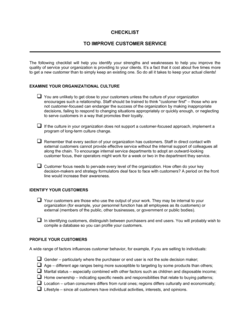
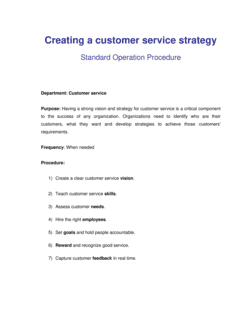
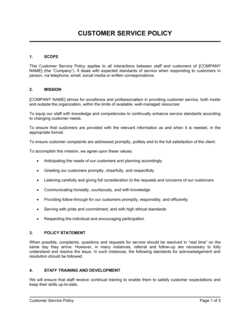
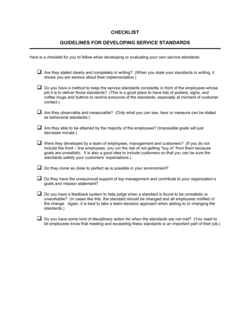
Checklist Service Strategy

Free download β€’ Use as a template β€’ Print or share

1 pageβ€’20–25 min to useβ€’Difficulty: Standard
Learn more ↓
FreeChecklist Service Strategy Template

At a glance

What it is
A Checklist Service Strategy is a structured operational document that breaks down every dimension of your customer service approach into discrete, actionable items β€” from channel coverage and staffing to escalation paths, feedback loops, and performance metrics. This free Word download gives you a ready-to-complete framework you can edit online and export as PDF to share with operations leads, team managers, or external consultants.
When you need it
Use it when launching a new service line, overhauling an underperforming support function, onboarding a new service manager, or preparing for a seasonal volume surge that will stress current delivery capacity.
What's inside
Service objectives and scope, channel and staffing inventory, standard operating procedures, escalation protocols, customer feedback mechanisms, technology and tools audit, KPIs and SLAs, training requirements, and a continuous improvement review schedule.

What is a Checklist Service Strategy?

A Checklist Service Strategy is a structured operational document that translates your customer service approach into a set of discrete, auditable items β€” covering every element from channel coverage and staffing levels to escalation paths, feedback loops, technology tools, and performance metrics. Unlike a narrative service plan written in prose, the checklist format makes gaps immediately visible: each item is either confirmed, flagged, or assigned to an owner for resolution. It functions equally well as a planning tool when building a service function from the ground up and as an audit tool when reviewing whether an existing operation is performing as intended.

Why You Need This Document

Operating a service function without a documented strategy means every manager, agent, and shift lead is working from their own interpretation of what "good service" looks like β€” and customers experience the inconsistency directly. Without a checklist, escalation paths go undocumented until a crisis exposes them, feedback data accumulates without anyone reviewing it, and staffing gaps during peak periods come as a surprise every single season. A completed service strategy checklist closes those gaps by forcing every assumption about how your service operates to be written down, measured, and owned. It gives new managers a standing brief on how the function works, gives leadership a clear picture of where investment is needed, and gives the whole team a shared definition of the standard they are accountable to meeting. This template provides the complete structure β€” you supply the numbers and owners.

Which variant fits your situation?

If your situation is…Use this template
Auditing an existing service operation against current standardsChecklist Service Strategy
Building a full multi-year customer service plan with budgetCustomer Service Plan
Documenting step-by-step procedures for a single service processStandard Operating Procedure (SOP)
Measuring and improving customer satisfaction scoresCustomer Satisfaction Survey
Defining service-level commitments for clients in a contractService Level Agreement (SLA)
Onboarding new service staff to consistent delivery standardsEmployee Onboarding Checklist
Tracking open service issues and resolution timelinesIssue Log Template

Common mistakes to avoid

❌ Vague, unmeasurable service objectives

Why it matters: Without a numeric target and a deadline, there is no basis for evaluating whether the strategy worked or holding anyone accountable for outcomes.

Fix: Rewrite each objective in the format '[METRIC] of [TARGET VALUE] by [DATE]' and confirm that the data to measure it is available in your current systems.

❌ Calculating staffing from average rather than peak volume

Why it matters: Average-based staffing produces SLA breaches during every foreseeable peak period β€” the very moments when service quality matters most to customers.

Fix: Identify your three busiest weeks in the past 12 months, calculate the agent-hours required to meet SLA during those weeks, and use that figure as your capacity baseline.

❌ SOPs listed by name with no accessible link

Why it matters: Agents under pressure during live interactions will not search a shared drive for an unlinked document β€” the SOP is effectively invisible.

Fix: Embed a direct link to the current version of each SOP in the checklist and confirm the links resolve before distribution.

❌ Collecting feedback data with no assigned review owner

Why it matters: CSAT and NPS scores logged without a defined review process become unused data β€” the feedback loop is broken and service issues repeat.

Fix: Assign a named individual (not a team) as the owner of each feedback mechanism review, with a specific meeting or report cadence written into the checklist.

❌ Tracking too many KPIs without prioritization

Why it matters: A dashboard with twelve KPIs dilutes attention β€” managers spend time producing reports instead of acting on the two or three metrics that actually drive customer outcomes.

Fix: Select a maximum of five KPIs for front-line operational tracking. Move secondary metrics to a monthly manager-level report rather than the primary dashboard.

❌ No date set for the first continuous improvement review

Why it matters: A service strategy with no scheduled review date remains a static document rather than a live management tool β€” it drifts out of alignment with actual operations within one quarter.

Fix: Book the first review meeting before distributing the strategy. Record the date and attendees in the checklist so accountability is visible to everyone who receives the document.

The 10 key sections, explained

Service objectives and scope

Service channel inventory

Staffing and coverage plan

Standard operating procedures (SOPs)

Escalation protocols

Customer feedback mechanisms

Technology and tools audit

KPIs, SLAs, and reporting cadence

Training and competency requirements

Continuous improvement review schedule

How to fill it out

  1. 1

    Define measurable service objectives

    Write one to three specific, time-bound objectives for the service strategy β€” e.g., 'Achieve FCR of 75% by Q4' or 'Reduce average handle time to under 6 minutes within 90 days.' Tie each objective to a KPI that will be tracked in the reporting section.

    πŸ’‘ If you cannot define how you will measure whether an objective was achieved, the objective is not specific enough.

  2. 2

    Inventory all active service channels

    List every channel customers use to reach you β€” including informal ones like social media DMs. For each, record current operating hours, agent headcount, and average monthly contact volume.

    πŸ’‘ Pull contact volume data from your CRM or ticketing system for the last 90 days rather than estimating β€” actual numbers reveal channel imbalances that assumptions hide.

  3. 3

    Map current staffing against projected demand

    Compare your current staffing model against peak demand periods β€” seasonal spikes, product launches, or campaign windows. Calculate the headcount gap and record it as a flagged item requiring action.

    πŸ’‘ Use your top three busiest weeks of the past year as the benchmark for peak staffing, not annual averages.

  4. 4

    Reference all active SOPs by name and link

    List every SOP that governs a service interaction in this section. Link directly to the current version of each document. Flag any process that has no documented SOP as a gap requiring one.

    πŸ’‘ A checklist entry that says 'follow standard procedure' without a link is not a usable reference β€” agents under pressure skip unlinked documentation.

  5. 5

    Define escalation tiers with time limits

    Write the criteria for each escalation tier and the maximum time an issue should remain at each tier before escalating. Assign a named role β€” not just a job title β€” to each tier.

    πŸ’‘ Test your escalation path by walking through your three most recent high-severity complaints β€” if the actual resolution path differed from the documented one, update the document.

  6. 6

    Confirm feedback tools and review owners

    For each feedback mechanism, record the tool name, the trigger for sending the survey, where results are logged, and who is responsible for reviewing them on what schedule.

    πŸ’‘ If no one is named as the review owner for a feedback mechanism, it will not be reviewed β€” assign a specific person, not a team.

  7. 7

    Set KPI targets and reporting owners

    Enter the numeric target for each KPI, the data source that will populate the measurement, and who produces and distributes the report on what cadence.

    πŸ’‘ Limit the dashboard to five or fewer KPIs for front-line reporting β€” supplement with a detailed monthly report for managers who need deeper visibility.

  8. 8

    Schedule the first continuous improvement review

    Book the first quarterly review before the strategy is distributed. Record the date, attendees, and the template agenda items in the review schedule section.

    πŸ’‘ A strategy document with no first review date is a document with no accountability β€” book it the same day you finalize the checklist.

Frequently asked questions

What is a checklist service strategy?

A checklist service strategy is a structured operational document that breaks your customer service approach into discrete, auditable items β€” covering channels, staffing, SOPs, escalation paths, feedback tools, technology, KPIs, and training. It functions as both a planning tool when building a service function and an audit tool when reviewing an existing one. Unlike a narrative service plan, the checklist format makes gaps immediately visible and assigns clear ownership to each item.

Who should use a service strategy checklist?

Customer service managers, operations directors, small business owners formalizing informal practices, startup founders building a service function from scratch, and consultants delivering service audits all use this document. It is equally useful for a five-person team running a single support email as for a 50-person contact center managing multiple channels and shift schedules.

How is a service strategy checklist different from a customer service plan?

A customer service plan is a narrative document describing strategy, goals, and approach in prose β€” often used for board presentations or investor briefings. A service strategy checklist is an operational working document that breaks the same content into discrete items with owners, targets, and completion status. The plan explains the why; the checklist manages the how. Most service functions need both.

What KPIs should a service strategy checklist include?

The most widely tracked service KPIs are CSAT (Customer Satisfaction Score), NPS (Net Promoter Score), FCR (First Contact Resolution rate), Average Handle Time, and SLA compliance (first response and resolution within the committed window). Limit your primary dashboard to five or fewer β€” tracking more than that typically signals that no single metric is being taken seriously enough to drive behavior.

How often should a service strategy checklist be reviewed?

A quarterly review is the minimum for most businesses. Service teams handling high volumes or operating in fast-changing environments should review monthly. The review should compare KPI actuals against targets, identify the top recurring complaint themes, and produce documented action items with named owners and due dates. A review that produces no action items is a sign the targets are set too low.

Can a small business use a service strategy checklist?

Yes β€” and it is often more valuable for small businesses than for larger ones, because small teams are more exposed when a single service gap affects every customer interaction. A small business version typically covers two or three channels, five or fewer staff, and a handful of core SOPs. The checklist format scales down without losing its usefulness as an accountability and audit tool.

What is the difference between an SLA and a KPI in a service context?

A KPI (Key Performance Indicator) is a metric used to measure service performance over time β€” for example, average handle time trending week over week. An SLA (Service Level Agreement) is a committed threshold that must be met on every interaction β€” for example, all emails answered within 24 hours. KPIs track direction and improvement; SLAs define the floor below which performance is a breach.

What should I do if my checklist reveals major service gaps?

Prioritize gaps by customer impact and effort to fix. Gaps in escalation paths and SLA coverage typically affect the most customers and should be addressed first. Document each gap as a named action item with an owner and a resolution date, and track it in the continuous improvement review schedule. Treat the discovery of gaps as the expected output of the checklist β€” a gap-free first audit usually means the checklist was not applied rigorously.

Does a service strategy checklist need to be approved or signed?

No formal signature is required for an internal operational checklist. However, distributing it to all stakeholders and recording that distribution creates informal accountability. For customer-facing service commitments or contractual SLAs, a separate Service Level Agreement with client signatures is the appropriate instrument.

How this compares to alternatives

vs Customer Service Plan

A customer service plan is a narrative strategic document β€” written in prose and used for board presentations or investor briefings β€” that describes goals, philosophy, and resource allocation. A service strategy checklist breaks those same elements into discrete, auditable action items with owners and targets. The plan communicates intent; the checklist operationalizes it. Teams that only have a plan often lack the accountability structure the checklist provides.

vs Service Level Agreement (SLA)

A service level agreement is a binding commitment β€” internal or contractual β€” specifying exact response and resolution times. A service strategy checklist is an internal operational planning document that defines how those commitments will be staffed, monitored, and met. The SLA states what you promise; the checklist documents how you deliver on that promise.

vs Standard Operating Procedure (SOP)

A standard operating procedure documents the step-by-step instructions for a single, specific service task β€” handling a refund, opening a ticket, or closing a call. A service strategy checklist operates at a higher level, inventorying all the SOPs in use and confirming they exist, are current, and are accessible. The checklist identifies whether you have the right SOPs; each SOP defines how to execute them.

vs Customer Satisfaction Survey

A customer satisfaction survey is a data-collection instrument that captures customer sentiment after a specific interaction. A service strategy checklist is the operational framework that determines how that feedback is collected, reviewed, and acted upon. The survey generates the signal; the checklist defines what you do with it.

Industry-specific considerations

Professional Services

Service strategy focuses on client communication standards, matter update frequency, escalation to senior partners, and NPS tracking across client accounts.

Retail / E-commerce

Channel mix includes returns and exchanges, live chat, and social DMs; peak staffing planning is critical around promotional events and holiday periods.

SaaS / Technology

Tiered support tiers (L1/L2/L3), knowledge base coverage rate, and integration between ticketing and CRM are the core checklist items alongside uptime SLAs.

Healthcare

Patient communication SOPs, appointment confirmation workflows, complaint escalation to clinical leads, and HIPAA-compliant feedback collection require dedicated checklist sections.

Hospitality / Food Service

Service standards cover in-person and digital channels; real-time complaint resolution at point of service and review-platform monitoring are critical checklist items.

Financial Services

Regulatory complaint-handling timelines, mandatory escalation documentation, and audit-ready record retention requirements shape the escalation and SOP sections.

Template vs pro β€” what fits your needs?

PathBest forCostTime
Use the templateSmall businesses, service managers, and ops teams building or auditing a service function without external supportFree2–4 hours to complete
Template + professional reviewGrowing businesses rolling out service standards across multiple locations or teams, or preparing for a third-party service audit$200–$800 for a business advisor or operations consultant review1–3 days
Custom draftedEnterprises with complex multi-channel contact centers, regulated industries with mandatory complaint-handling requirements, or businesses undergoing ISO 9001 or similar certification$2,000–$8,000 for a specialist service design consultant2–6 weeks

Glossary

Service Strategy
A deliberate plan that defines how a business will deliver, measure, and continuously improve its customer service across all touchpoints.
Service Level Agreement (SLA)
A formal commitment β€” internal or contractual β€” that specifies response times, resolution windows, and acceptable service quality thresholds.
Escalation Path
A documented sequence of steps and responsible parties that a service issue follows when it cannot be resolved at the first point of contact.
Customer Touchpoint
Any interaction between a customer and the business β€” phone, email, chat, in-person, or self-service β€” that shapes their experience.
Net Promoter Score (NPS)
A customer loyalty metric based on asking customers how likely they are to recommend the business on a 0–10 scale, reported as a single number from -100 to +100.
First Contact Resolution (FCR)
The percentage of customer issues resolved fully on the first interaction, without a follow-up contact or escalation required.
Channel Mix
The combination of communication channels β€” phone, email, chat, social, self-service portal β€” through which a business delivers customer support.
Voice of the Customer (VoC)
A structured process for capturing customer feedback, preferences, and pain points to inform service improvement decisions.
CSAT (Customer Satisfaction Score)
A post-interaction survey metric that measures how satisfied a customer was with a specific service experience, typically on a 1–5 scale.
Continuous Improvement Cycle
A recurring review process β€” typically quarterly β€” that compares service performance against targets and produces documented action items for the next period.

Part of your Business Operating System

This document is one of 3,000+ business & legal templates included in Business in a Box.

  • Fill-in-the-blanks β€” ready in minutes
  • 100% customizable Word document
  • Compatible with all office suites
  • Export to PDF and share electronically

Create your document in 3 simple steps.

From template to signed document β€” all inside one Business Operating System.
1
Download or open template

Access over 3,000+ business and legal templates for any business task, project or initiative.

2
Edit and fill in the blanks with AI

Customize your ready-made business document template and save it in the cloud.

3
Save, Share, Send, Sign

Share your files and folders with your team. Create a space of seamless collaboration.

Save time, save money, and create top-quality documents.

β˜…β˜…β˜…β˜…β˜…

"Fantastic value! I'm not sure how I'd do without it. It's worth its weight in gold and paid back for itself many times."

Managing Director Β· Mall Farm
Robert Whalley
Managing Director, Mall Farm Proprietary Limited
β˜…β˜…β˜…β˜…β˜…

"I have been using Business in a Box for years. It has been the most useful source of templates I have encountered. I recommend it to anyone."

Business Owner Β· 4+ years
Dr Michael John Freestone
Business Owner
β˜…β˜…β˜…β˜…β˜…

"It has been a life saver so many times I have lost count. Business in a Box has saved me so much time and as you know, time is money."

Owner Β· Upstate Web
David G. Moore Jr.
Owner, Upstate Web

Run your business with a system β€” not scattered tools

Stop downloading documents. Start operating with clarity. Business in a Box gives you the Business Operating System used by over 250,000 companies worldwide to structure, run, and grow their business.

Start freeΒ Β·Β No credit card required