Call Center Agent_Outbound_Telemarketing & Sales Job Description Template

Free Word download • Edit online • Save & share with Drive • Export to PDF

2 pages20–30 min to fillDifficulty: StandardSignature requiredLegal review recommended
Learn more ↓
FreeCall Center Agent_Outbound_Telemarketing & Sales Job Description Template

At a glance

What it is
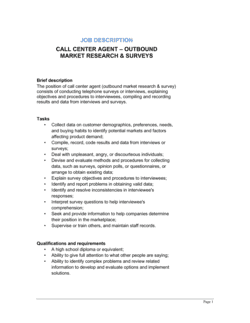
A Call Center Agent Outbound Telemarketing & Sales Job Description is a binding document that formally defines the role, responsibilities, performance expectations, compliance obligations, and compensation structure for an outbound telemarketing and sales agent. This free Word download is editable online and exportable as PDF, giving employers a structured, legally defensible starting point that can be signed by both employer and employee at onboarding.
When you need it
Use it when hiring a new outbound call center agent, restructuring an existing telemarketing role, or updating compensation and quota terms that affect performance-management and termination decisions. A signed job description is particularly important in regulated telemarketing environments where compliance duties must be documented.
What's inside
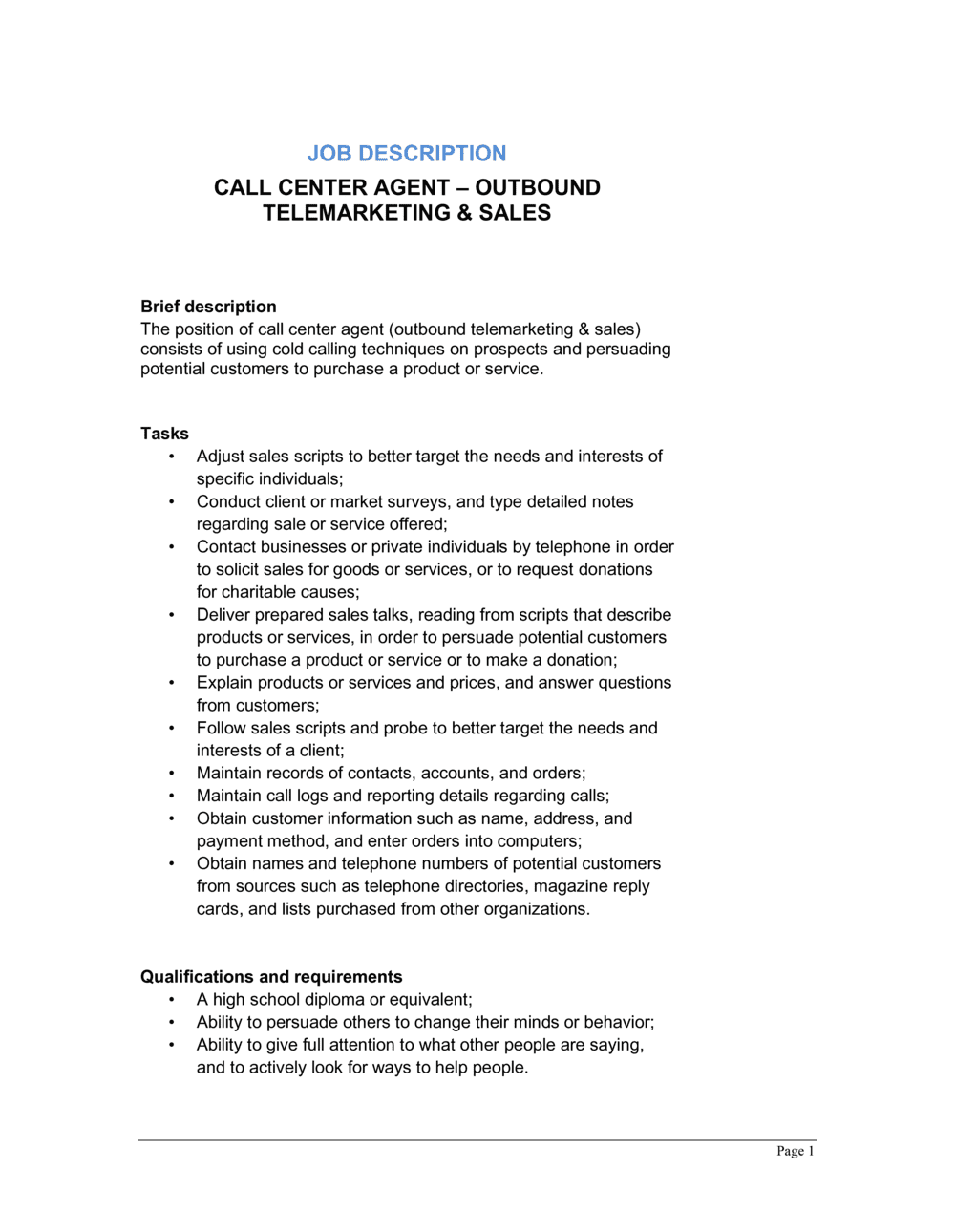
Role summary and reporting structure, core outbound calling duties, sales quota and KPI expectations, compliance obligations under telemarketing regulations, compensation and commission structure, required qualifications, and acknowledgment signature block for both parties.

What is a Call Center Agent Outbound Telemarketing & Sales Job Description?

A Call Center Agent Outbound Telemarketing & Sales Job Description is a formal document that defines the duties, performance standards, compliance obligations, and compensation terms for an employee whose primary function is making outbound calls to generate sales or qualify leads on behalf of an employer. Unlike a job posting designed to attract candidates, this signed document creates a documented record of what both parties agreed to at the start of the employment relationship — covering everything from daily call quotas and approved scripts to regulatory compliance requirements and commission chargeback terms. It is downloadable in Word, editable online, and exportable as PDF for signing at onboarding.

Why You Need This Document

Without a signed job description, outbound telemarketing employers face compounding exposure on three fronts simultaneously. First, vague or undocumented performance standards make progressive discipline and termination decisions legally vulnerable — labor tribunals and courts require documented evidence that the employee knew what was expected. Second, undocumented compliance obligations under the TCPA, TSR, CASL, and state-level DNC statutes leave the employer fully liable for regulatory fines that can run to $1,500 per call. Third, commission disputes without a documented formula and chargeback window become costly credibility contests rather than straightforward contract interpretation. A properly executed job description, signed before the first shift, establishes the evidentiary foundation for every subsequent performance, compliance, and compensation decision — and this template gives you that foundation in 30 minutes.

Which variant fits your situation?

If your situation is…Use this template
Hiring an inbound customer service agent rather than an outbound callerCall Center Agent Inbound Customer Service Job Description
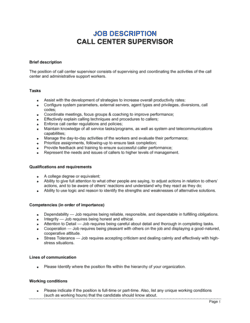
Defining a senior team-lead or supervisor role overseeing outbound agentsCall Center Supervisor Job Description
Engaging an outbound caller as an independent contractor rather than an employeeIndependent Contractor Agreement
Documenting the full employment relationship beyond the role descriptionEmployment Contract (At-Will)
Hiring a field-based or account-executive-level sales representativeSales Representative Job Description
Adding a formal commission and sales incentive plan alongside the job descriptionSales Commission Agreement
Hiring an agent focused exclusively on lead generation with no closing responsibilityBusiness Development Representative Job Description

Common mistakes to avoid

❌ Vague call activity targets

Why it matters: Terms like 'high call volume expected' give agents no measurable standard to meet and give managers no enforceable basis for disciplinary action when activity falls short.

Fix: State a specific daily or weekly call count — e.g., 'minimum 75 outbound dials per shift' — and reference the CRM system where activity is logged.

❌ Omitting state and provincial telemarketing regulations

Why it matters: Federal compliance language alone leaves the employer exposed to fines under state-level DNC statutes in Florida, Indiana, Texas, and others, as well as CASL violations for calls into Canada.

Fix: List every regulation applicable to the agent's calling territory by name and update the clause whenever the agent's territory changes.

❌ No chargeback or clawback provision in the commission clause

Why it matters: Without it, agents earn full commission on sales that cancel within days, creating a direct financial loss and incentivizing pressure tactics over quality customer acquisition.

Fix: Define a chargeback window — typically 30 to 90 days — during which commission on cancelled or returned sales is recovered from future earnings.

❌ Signing after the employee's first day

Why it matters: In common-law jurisdictions, obligations — including compliance duties and confidentiality terms — accepted after employment has already begun may be unenforceable without separate consideration.

Fix: Execute the document before the first shift. If circumstances require a later signature, document additional compensation or benefit as fresh consideration at the time of signing.

❌ No disclaimer that the document is not an employment contract

Why it matters: A detailed, signed job description without a disclaimer can be interpreted by courts as an implied employment agreement, creating term-of-employment or just-cause termination obligations.

Fix: Include a clear acknowledgment clause stating the document does not create a contract of employment for a specific term and does not modify the at-will or notice-based nature of the relationship.

❌ Leaving call recording consent obligations out of the document

Why it matters: In two-party consent jurisdictions — including California, Illinois, and Ontario — recording calls without documented employee consent creates wiretapping liability for the employer.

Fix: Add a sentence in the confidentiality or equipment clause confirming the employee consents to monitoring and recording of calls for quality and compliance purposes.

The 10 key clauses, explained

Role summary and reporting structure

In plain language: States the job title, the department the agent belongs to, and the name or title of their direct supervisor.

Sample language
The [JOB TITLE] reports directly to the [SUPERVISOR TITLE] within the [DEPARTMENT NAME] department and is responsible for conducting outbound telemarketing and sales calls on behalf of [COMPANY NAME].

Common mistake: Listing only the supervisor's name rather than their title. When the supervisor changes, the document becomes inaccurate and must be re-signed.

Core outbound calling duties

In plain language: Enumerates the agent's primary day-to-day responsibilities — prospecting, pitching, objection-handling, and pipeline documentation.

Sample language
Agent shall: (a) make a minimum of [X] outbound calls per [day/week]; (b) present [PRODUCT/SERVICE] to prospects using approved scripts; (c) accurately record call outcomes in [CRM SYSTEM]; and (d) follow up with warm leads within [X] business days.

Common mistake: Omitting the CRM documentation obligation. Without it, agents who fail to log calls cannot be managed against activity metrics, undermining performance reviews.

Sales quota and performance standards

In plain language: Sets measurable targets — number of sales, revenue, or conversion rate — and states the review period and consequence of missing them.

Sample language
Agent is expected to achieve a monthly sales quota of [X UNITS / $X REVENUE] and maintain a call-to-conversion rate of no less than [X]%. Performance will be reviewed [weekly/monthly]. Failure to meet quota for [X] consecutive periods may result in progressive disciplinary action.

Common mistake: Setting quotas without defining the review period or the consequence. Undefined consequences make progressive discipline legally vulnerable.

Compliance and regulatory obligations

In plain language: Requires the agent to follow applicable telemarketing laws — including DNC list scrubbing, TCPA restrictions, and required call disclosures — and makes the agent personally responsible for violations caused by their conduct.

Sample language
Agent shall comply with all applicable federal, state, and provincial telemarketing regulations, including the TCPA, TSR, CASL, and any applicable state-level do-not-call statutes. Agent shall not contact any number appearing on [COMPANY NAME]'s current DNC list. Willful violations of this clause may result in immediate termination.

Common mistake: Referencing only federal laws and omitting state or provincial statutes. State-level DNC laws — including those in Florida, Indiana, and Texas — impose additional restrictions beyond the federal TSR.

Call script and disclosure adherence

In plain language: Requires the agent to use only company-approved scripts and to deliver all legally mandated disclosures — including identity, purpose of call, and opt-out instructions — at the required points in each call.

Sample language
Agent shall use only scripts approved in writing by [SUPERVISOR TITLE]. Agent must deliver the required identity disclosure within the first [30] seconds of each call and the opt-out disclosure before closing any transaction, in accordance with [APPLICABLE REGULATION].

Common mistake: Failing to specify the timing of required disclosures. Regulators treat a disclosure buried at the end of a 10-minute call as non-compliant even if technically delivered.

Compensation, commission, and incentive terms

In plain language: States the base hourly rate or salary, the commission rate per completed sale, any bonus or incentive thresholds, and the payment cycle.

Sample language
Agent shall receive a base [hourly rate / salary] of [$X per hour / $X per year], payable [bi-weekly]. Agent is eligible to earn a commission of [X]% of net revenue on each completed sale, paid on the [15th] of the month following the close. Chargebacks apply on cancellations within [X] days of sale.

Common mistake: Omitting the chargeback or clawback provision. Without it, agents have no incentive to sell to qualified prospects, and commission on cancelled orders becomes a direct cost.

Confidentiality and data-handling obligations

In plain language: Prohibits the agent from disclosing prospect data, call lists, scripts, or pricing information to third parties, and requires secure handling of customer personal information.

Sample language
Agent shall treat all prospect lists, customer data, call recordings, scripts, and pricing information as Confidential Information of [COMPANY NAME] and shall not disclose or reproduce such information outside the scope of their duties. Agent shall comply with [COMPANY NAME]'s data security policy at all times.

Common mistake: No mention of call recordings. In two-party consent states and provinces, agents must also be informed that calls are recorded — omitting this creates compliance exposure for the employer.

Equipment use and remote work obligations

In plain language: Defines whether the agent uses company-provided or personal equipment, acceptable use standards, and — for remote agents — internet and workspace requirements.

Sample language
Agent shall use only [COMPANY-PROVIDED / APPROVED] equipment and telecommunications systems for outbound calls. Remote agents must maintain a private, secure workspace and an internet connection meeting [COMPANY NAME]'s minimum bandwidth requirements of [X Mbps upload / X Mbps download].

Common mistake: Leaving equipment obligations silent for remote agents. If an agent uses a personal phone or a shared household internet connection, call quality and recording compliance become unenforceable.

Termination and progressive discipline

In plain language: Describes the process for addressing underperformance or violations — from verbal warning through termination — and states which violations trigger immediate termination without prior warning.

Sample language
Performance deficiencies shall be addressed through [COMPANY NAME]'s progressive discipline policy: (1) verbal warning, (2) written warning, (3) performance improvement plan of [X] days, (4) termination. Willful regulatory violations, falsification of call records, or harassment of prospects shall result in immediate termination for cause.

Common mistake: Listing 'immediate termination' triggers without defining 'willful.' Courts and labor tribunals apply a reasonableness standard — undefined terms shift the burden of proof to the employer.

Acknowledgment and signature block

In plain language: Confirms that the employee has read, understood, and agreed to the job description, and that the document does not create a guarantee of employment for a specific term.

Sample language
By signing below, [EMPLOYEE NAME] acknowledges receipt and understanding of this Job Description and agrees to perform the duties described herein. This document does not constitute a contract of employment for any specific term and does not alter the [at-will / notice-based] nature of the employment relationship.

Common mistake: Omitting the disclaimer that the job description is not an employment contract. Without it, a court in a common-law jurisdiction could treat a signed detailed job description as an implied fixed-term agreement.

How to fill it out

  1. 1

    Enter company, department, and supervisor details

    Add the company's full legal name, the department (e.g., Outbound Sales, Telemarketing Division), and the supervisor's job title. Avoid using individual names in the supervisor field.

    💡 Use job titles rather than names throughout the document so it remains accurate after personnel changes without requiring a re-signature.

  2. 2

    Define daily or weekly call activity targets

    Enter the minimum number of outbound calls per shift or week, required follow-up windows, and the CRM system where call outcomes must be logged. Be specific — 'approximately 80 calls per day' is enforceable; 'high call volume' is not.

    💡 Cross-reference these numbers against your current team's verified attainment data before inserting them. Unachievable targets expose you to constructive-dismissal claims.

  3. 3

    Set the sales quota and review cadence

    Enter the monthly revenue or unit quota, the minimum acceptable conversion rate, and how often formal performance reviews will occur. State explicitly what happens after two or three consecutive periods below quota.

    💡 Tie the quota directly to the commission formula in the compensation clause — if the numbers don't align, agents will notice and trust in the document erodes.

  4. 4

    Populate the compliance obligations clause

    List every applicable regulation by name — TCPA, TSR, CASL, and any state or provincial statutes relevant to the agent's calling territory. Confirm that your DNC scrubbing process is referenced by name or policy number.

    💡 Have your compliance officer or legal counsel confirm the current regulation list before finalizing. Telemarketing compliance rules change frequently at the state and provincial level.

  5. 5

    Complete the compensation and commission block

    Enter the base rate, commission percentage, payment date, and chargeback window. If you use a tiered commission structure (e.g., higher rates above 110% of quota), include the tier table or reference the separate commission plan.

    💡 State commissions as 'earned on net revenue after returns and cancellations' to prevent disputes when orders cancel during the chargeback window.

  6. 6

    Add equipment and remote-work requirements if applicable

    For office-based agents, specify company-provided equipment and acceptable-use policy. For remote agents, add minimum bandwidth, workspace privacy requirements, and the policy on personal-device use.

    💡 A simple internet speed test screenshot submitted at onboarding creates a documented baseline for remote agents — useful if call quality issues arise later.

  7. 7

    Review termination triggers and progressive discipline steps

    Confirm that the list of immediate-termination triggers aligns with your company's HR policy and employment counsel's guidance. Ensure 'willful' and 'cause' are defined or cross-referenced to your employee handbook.

    💡 If your jurisdiction requires working notice or pay in lieu (Canada, UK, EU), add a notice-period clause here and remove any language implying at-will termination.

  8. 8

    Obtain signatures before the agent's first day

    Both the employer representative and the employee must sign and date the document before the employee's first shift. Deliver a countersigned copy to the employee for their records.

    💡 In common-law jurisdictions, a signed job description provided after day one may not create enforceable obligations without fresh consideration — execute before work begins.

Frequently asked questions

What is a call center agent outbound telemarketing and sales job description?

It is a formal document that defines the duties, performance standards, compliance obligations, and compensation terms for an employee whose primary function is making outbound telephone calls to sell products or services. Unlike a generic job posting, a signed job description creates a documented record of what both parties agreed to at the start of the employment relationship — which is essential for performance management, disciplinary action, and regulatory compliance in telemarketing environments.

Does a job description need to be signed to be legally binding?

A signed job description is not automatically an employment contract, but the signature creates documented evidence that the employee received and acknowledged the terms — including compliance duties and performance standards. In regulated industries like outbound telemarketing, documented acknowledgment of regulatory obligations is important because it shifts responsibility for willful violations to the agent. Always include a clause stating the document does not create a fixed-term employment guarantee.

What telemarketing regulations must an outbound call center job description reference?

In the US, agents calling consumers must comply with the FTC's Telemarketing Sales Rule (TSR) and the FCC's TCPA, plus any applicable state-level do-not-call statutes. In Canada, the CRTC's Unsolicited Telecommunications Rules and CASL govern outbound calls and electronic communications. In the UK, the Privacy and Electronic Communications Regulations (PECR) and ICO guidelines apply. The job description should list every regulation applicable to the agent's calling territory and require DNC list scrubbing before each campaign.

How should sales quotas be structured in an outbound telemarketing job description?

Quotas should be stated as specific, measurable targets — revenue per month, units sold per week, or a minimum conversion rate — paired with a defined review period and a stated consequence for consecutive misses. Vague language like 'meet sales expectations' is unenforceable in a performance-management context. Quotas should also be set at levels the employer can demonstrate are achievable based on current team performance data.

Can I use this job description for an independent contractor instead of an employee?

No. An outbound telemarketing agent classified as an independent contractor should be engaged under a separate Independent Contractor Agreement, not an employment job description. Providing a contractor with a signed job description that sets working hours, call quotas, scripts, and equipment requirements is one of the strongest indicators of employee misclassification — which triggers back taxes, benefit liability, and penalties in the US, Canada, and the UK.

What happens if a call center agent violates TCPA or DNC rules?

TCPA violations carry statutory damages of $500–$1,500 per call, which can be recovered from the employer. If the job description documents the agent's compliance obligations and the violation was willful, the employer may have a basis to pursue indemnification from the agent or support a for-cause termination. Without documented compliance duties, the employer bears the full regulatory exposure. Always pair the job description with DNC scrubbing procedures and call-monitoring protocols.

How often should an outbound telemarketing job description be updated?

Review and update the document at minimum annually, or immediately when quota targets change, compensation structures are revised, new regulations come into effect, or the agent's territory or calling responsibilities expand. Any material change to duties or compensation terms should be acknowledged in writing — either through a revised signed document or a formal addendum — to maintain the evidentiary value of the original agreement.

What is the difference between this job description and a sales commission agreement?

A job description defines the role, duties, and performance standards. A commission agreement is a standalone contract that governs the exact formula, payment timing, chargeback terms, and dispute resolution for variable compensation. For outbound sales agents with significant commission exposure, best practice is to use both: the job description covers duties and compliance; the commission agreement governs pay mechanics in legally enforceable detail.

Should the job description address remote work requirements for home-based agents?

Yes. For remote outbound agents, the document should specify minimum internet bandwidth, workspace privacy requirements, equipment standards, and acceptable- use obligations. These terms matter for call quality, call recording compliance, and data security under applicable privacy laws. A clause confirming that remote agents are subject to the same monitoring and recording standards as office-based agents is also important in two-party consent jurisdictions.

How this compares to alternatives

vs Employment Contract (At-Will)

An employment contract governs the entire employment relationship — compensation, benefits, IP assignment, confidentiality, and termination — as a single binding agreement. A job description defines the specific role, duties, and performance standards within that relationship. For outbound agents, best practice is to execute both: the employment contract as the governing agreement and the job description as the role-specific attachment that can be updated without re-signing the full contract.

vs Sales Commission Agreement

A commission agreement is a standalone contract that defines variable pay formulas, tier structures, chargeback terms, and dispute resolution for sales compensation in legally binding detail. A job description covers duties and performance standards but typically provides only a summary of commission terms. Outbound agents with material commission income should have both documents executed to prevent compensation disputes.

vs Independent Contractor Agreement

An independent contractor agreement engages a self-employed caller on a project or campaign basis with no employment entitlements. Using a detailed job description — with fixed hours, scripts, and quotas — for a contractor is a leading misclassification indicator. If the working relationship involves this level of control, the caller should be engaged as an employee with a job description, not as a contractor.

vs Employee Offer Letter

An offer letter confirms the role and compensation package to secure acceptance before a start date. It is not a detailed operational document and typically lacks compliance duties, quota mechanics, and performance standards. The job description is the operational document that specifies how the role is performed day-to-day; it should be provided at or before onboarding as a complement to the offer letter.

Industry-specific considerations

Financial Services

Agents selling financial products face FINRA, FCA, and FSRA registration requirements; the job description must reference licensing obligations and the prohibition on misrepresenting investment products.

Healthcare and Insurance

Outbound agents selling health plans or insurance must comply with CMS calling rules, state insurance licensing requirements, and HIPAA data-handling obligations for any prospect health information collected during calls.

Retail and E-commerce

High call volume, seasonal surges, and frequent product-line changes mean quotas and scripts require regular revision; chargeback windows aligned to return policies are critical to prevent commission manipulation.

Technology and SaaS

SDR and BDR outbound roles in SaaS companies focus on appointment-setting and pipeline generation rather than direct closes; quotas are typically expressed as qualified meetings booked per week rather than closed revenue.

Real Estate

Cold-calling prospects for real estate listings or mortgage products requires compliance with state real estate licensing law and the TCPA; the job description should require agents to hold or be supervised by a licensed broker.

Telecommunications

Outbound agents for telecoms carriers operate under FCC TCPA and TSR rules with heavy DNC obligations; win-back calling to former customers requires separate consent tracking from acquisition campaigns.

Jurisdictional notes

United States

The FTC's Telemarketing Sales Rule and the FCC's TCPA set federal floors for outbound calling — including mandatory DNC list scrubbing, call-time restrictions (8 a.m.–9 p.m. local time), and required identity disclosures. More than 40 states have their own DNC statutes with additional restrictions; Florida, Indiana, and Texas impose some of the strictest penalties. At-will employment is the default in 49 states, but California imposes additional wage, commission payment, and non-compete restrictions that affect how the compensation clause must be drafted.

Canada

The CRTC's Unsolicited Telecommunications Rules and CASL govern outbound calls and electronic follow-ups. CASL's express consent requirements apply when calls are followed by commercial electronic messages. Employment standards across provinces set minimum notice and termination obligations — at-will termination language is not enforceable. Quebec requires that employee-facing documents be provided in French for provincially regulated employers. Commission terms must align with each province's Employment Standards Act on wage-payment timing and deduction rules.

United Kingdom

The Privacy and Electronic Communications Regulations (PECR) and ICO guidance govern outbound telephone marketing in the UK, including TPS (Telephone Preference Service) opt-out compliance. Employers must provide a written statement of employment particulars on or before day one under the Employment Rights Act 1996. Minimum notice entitlements apply from day one. Commission arrangements must comply with the National Minimum Wage Act — commission-only structures can breach NMW if calls volumes don't generate sufficient earnings per hour.

European Union

GDPR imposes strict rules on processing prospect data collected during outbound calls — agents must be trained on lawful basis, data minimization, and subject-access obligations. The ePrivacy Directive restricts unsolicited calls to consumers in many member states, with opt-in requirements in Germany, France, and Spain going beyond standard DNC compliance. EU employment law requires written employment terms within 7 days of hire, and post-employment non-competes typically require financial compensation. Quota and commission structures must not result in effective hourly pay falling below the applicable national minimum wage.

Template vs lawyer — what fits your deal?

PathBest forCostTime
Use the templateSmall business owners and call center managers hiring standard outbound agents in a single US state or Canadian province with straightforward commission structuresFree30 minutes
Template + legal reviewMulti-state or cross-border calling campaigns, regulated industries (financial services, insurance, healthcare), or roles with complex tiered commission and chargeback terms$300–$700 for a one-hour employment or compliance counsel review2–4 days
Custom draftedLarge call centers operating across multiple jurisdictions, agents selling heavily regulated products (securities, Medicare plans), or where TCPA class-action exposure is material$1,500–$4,000+1–3 weeks

Glossary

Outbound Calling
Agent-initiated telephone contact with prospects or existing customers, as opposed to inbound calls received from customers.
KPI (Key Performance Indicator)
A measurable target — such as calls per hour, conversion rate, or average handle time — used to evaluate agent performance.
Do Not Call (DNC) Registry
A government-maintained list of telephone numbers whose owners have opted out of telemarketing calls; calling a registered number is a regulatory violation.
TCPA (Telephone Consumer Protection Act)
A US federal law restricting autodialed calls, prerecorded messages, and calls to numbers on the DNC registry, with per-call fines for violations.
Conversion Rate
The percentage of outbound calls or contacts that result in a completed sale or desired action, calculated as sales divided by total contacts.
Average Handle Time (AHT)
The average total duration of a single call interaction, including talk time and any after-call work such as logging notes.
Sales Quota
A defined revenue, unit, or activity target an agent is expected to meet within a set period — typically daily, weekly, or monthly.
Commission Structure
The formula determining variable pay earned on completed sales, expressed as a flat rate per sale, a percentage of revenue, or a tiered rate based on quota attainment.
Call Script
An approved sequence of talking points, objection-handling responses, and required disclosures an agent must follow during an outbound call.
Progressive Discipline
A structured escalation of corrective action — verbal warning, written warning, performance improvement plan, termination — applied when performance or compliance standards are not met.
At-Will Employment
Employment that either party may end at any time for any lawful reason without advance notice — the default in most US states.

Part of your Business Operating System

This document is one of 3,000+ business & legal templates included in Business in a Box.

  • Fill-in-the-blanks — ready in minutes
  • 100% customizable Word document
  • Compatible with all office suites
  • Export to PDF and share electronically

Create your document in 3 simple steps.

From template to signed document — all inside one Business Operating System.
1
Download or open template

Access over 3,000+ business and legal templates for any business task, project or initiative.

2
Edit and fill in the blanks with AI

Customize your ready-made business document template and save it in the cloud.

3
Save, Share, Send, Sign

Share your files and folders with your team. Create a space of seamless collaboration.

Save time, save money, and create top-quality documents.

★★★★★

"Fantastic value! I'm not sure how I'd do without it. It's worth its weight in gold and paid back for itself many times."

Managing Director · Mall Farm
Robert Whalley
Managing Director, Mall Farm Proprietary Limited
★★★★★

"I have been using Business in a Box for years. It has been the most useful source of templates I have encountered. I recommend it to anyone."

Business Owner · 4+ years
Dr Michael John Freestone
Business Owner
★★★★★

"It has been a life saver so many times I have lost count. Business in a Box has saved me so much time and as you know, time is money."

Owner · Upstate Web
David G. Moore Jr.
Owner, Upstate Web

Run your business with a system — not scattered tools

Stop downloading documents. Start operating with clarity. Business in a Box gives you the Business Operating System used by over 250,000 companies worldwide to structure, run, and grow their business.

Start free · No credit card required