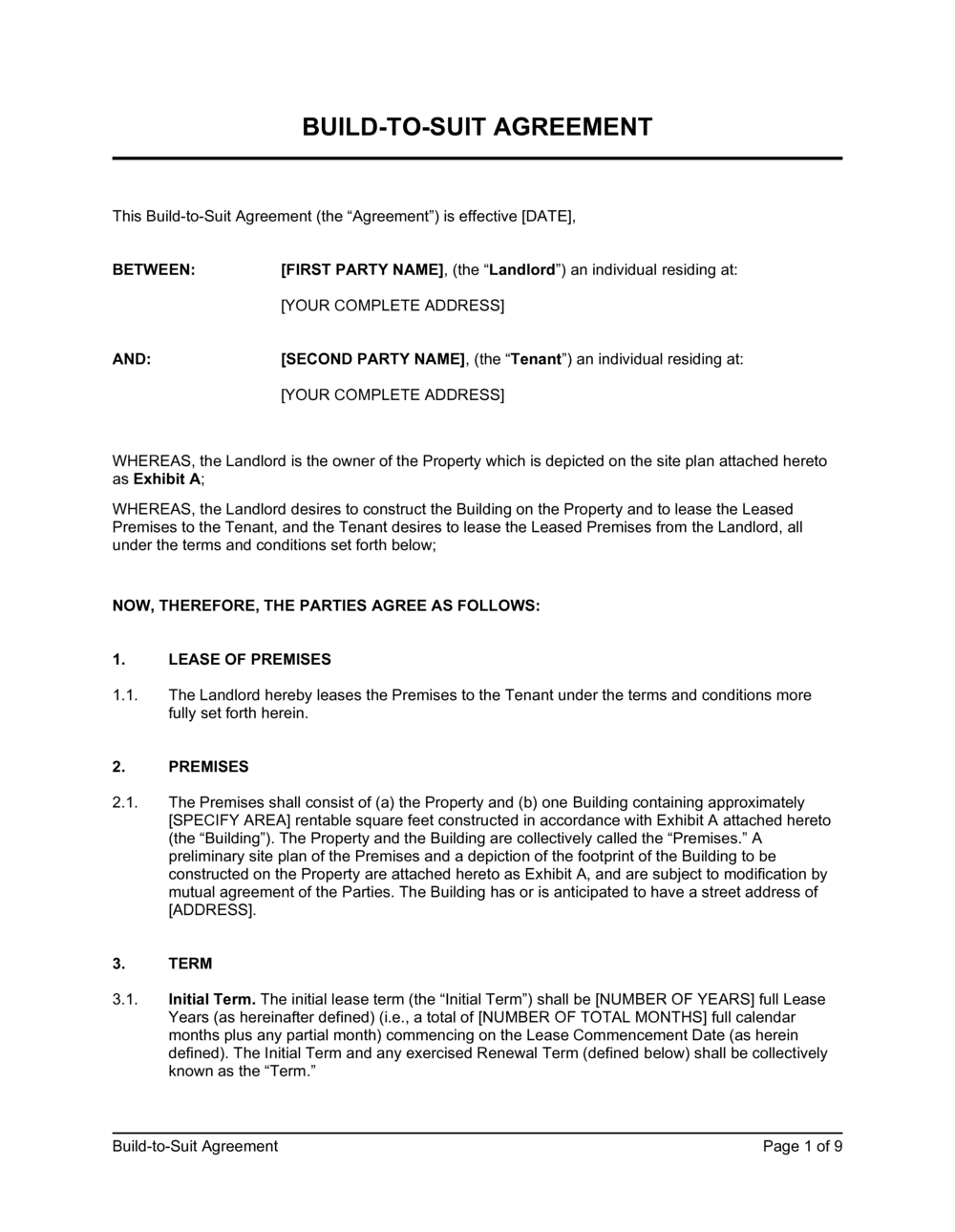
Build To Suit Agreement Template

Free Word download • Edit online • Save & share with Drive • Export to PDF

9 pages30–40 min to fillDifficulty: ComplexSignature requiredLegal review recommended
Learn more ↓
FreeBuild To Suit Agreement Template

At a glance

What it is
A Build To Suit Agreement is a legally binding contract between a property developer or landlord and a tenant in which the developer agrees to construct a commercial building to the tenant's specific requirements, with the tenant committing to a long-term lease upon completion. This free Word download gives you a structured, attorney-ready starting point you can edit online and export as PDF to share with your legal counsel, lender, or counterparty.
When you need it
Use it when a business needs a purpose-built facility — a warehouse, retail location, distribution center, or office — and a developer or landlord is willing to finance and construct the building in exchange for a long-term lease commitment. It is executed before construction begins to lock in specifications, costs, and lease terms.
What's inside
Site description and legal parcel identification, construction specifications and approved plans, project milestones and completion deadlines, rent commencement triggers, base rent and escalation schedule, tenant improvement allowances, default and termination rights, and governing law provisions.

What is a Build To Suit Agreement?

A Build To Suit Agreement is a legally binding contract between a property developer (or landlord) and a commercial tenant in which the developer agrees to construct a purpose-built facility to the tenant's precise specifications, in exchange for the tenant's commitment to occupy and pay rent on the completed building under a long-term lease. Unlike a standard commercial lease — which governs occupancy of an existing structure — a build to suit agreement is executed before the building exists and governs two distinct phases: the pre-construction and construction phase (specifications, milestones, cost allocation, and delivery obligations) and the post-completion lease phase (rent, term, renewal options, and tenant rights). The agreement functions as both a construction delivery contract and a lease instrument, creating enforceable obligations that run for the full economic life of the project.

Why You Need This Document

Without a properly executed build to suit agreement in place before construction begins, a tenant has no contractual basis to enforce the specifications to which the building was promised, no defined remedy if delivery is late or the facility is materially deficient, and no protection if the developer sells the property or defaults on its construction loan mid-project. Developers face equivalent exposure: without a binding tenant commitment, they cannot secure permanent financing, and a tenant who walks away after groundbreaking leaves the developer with a partially completed, purpose-built facility that is difficult to re-let. The agreement locks both parties into their obligations before capital is deployed, converts vague understandings about building quality and delivery timing into enforceable standards, and — when a memorandum is recorded against title — protects the tenant's leasehold rights against subsequent purchasers and encumbrances for the full lease term. This template gives you the structural framework to capture all of those obligations in a single, organized document that legal counsel can review and finalize efficiently.

Which variant fits your situation?

If your situation is…Use this template
Tenant occupies and owns the building at lease endBuild To Suit Agreement with Purchase Option
Developer retains ownership; tenant signs a triple-net lease on completionBuild To Suit Net Lease Agreement
Tenant already owns the land and hires a developer to buildDesign-Build Contract
Existing shell building to be finished to tenant specificationsTenant Improvement Addendum to Commercial Lease
Short-term occupancy while permanent facility is builtTemporary Commercial Lease Agreement
Landlord and tenant share construction risk on a joint venture basisCommercial Real Estate Joint Venture Agreement
Industrial facility with environmental compliance requirementsIndustrial Lease Agreement

Common mistakes to avoid

❌ No outside delivery deadline with a termination right

Why it matters: Without a hard deadline and a genuine termination right, a developer facing cost overruns or financing problems has no contractual incentive to deliver on time. Tenants have been left waiting for facilities 12–24 months past the expected completion date with no remedy.

Fix: Set a specific outside delivery date with a clean termination right and, for long-lead construction projects, negotiate liquidated damages for each month of delay beyond a grace period.

❌ Attaching schematic drawings instead of construction documents

Why it matters: Schematic drawings leave material selections, system specifications, and dimensions undefined, giving the developer broad discretion to reduce quality while claiming compliance. Disputes over finish levels and system capacity are the most common BTS litigation trigger.

Fix: Require construction documents — or at minimum design development drawings with a detailed specification sheet — as the binding exhibit. Include a right to approve any value-engineering substitutions before they are made.

❌ Linking rent commencement only to certificate of occupancy

Why it matters: CO issuance depends on municipal inspectors and can lag substantial completion by weeks or months in busy jurisdictions. During that gap, the tenant cannot occupy but rent has not yet started — or the developer claims completion and the tenant owes rent on a building it cannot legally occupy.

Fix: Define rent commencement as the later of substantial completion (engineer's certification) or the date the CO is issued, and include a date-certain backstop after which rent commences regardless, to motivate the developer to resolve inspection delays promptly.

❌ Not recording a memorandum of agreement

Why it matters: An unrecorded BTS agreement is invisible to subsequent purchasers, lenders, and judgment creditors of the developer. If the developer sells or refinances the property before construction is complete, the tenant's rights may not bind the new owner.

Fix: Execute and record a short-form memorandum of the BTS agreement in the county land records immediately after signing. The memo needs only identify the parties, the property, the lease term, and any purchase options — it does not expose confidential rent terms.

❌ Omitting tiered default cure periods

Why it matters: A single 30-day cure period for all developer defaults treats a late insurance certificate the same as a structural defect or project abandonment. By the time a 30-day notice period lapses for a serious default, the tenant may be unable to source an alternative site in time.

Fix: Tier cure periods by severity: 5 business days for insurance lapses, 15 days for plan deviations, 30 days for project abandonment — with a right to cure by a substitute developer for defaults not curable in 30 days.

❌ No guaranteed maximum price or cost cap

Why it matters: When base rent is calculated as a function of total development cost, an open-ended cost structure allows the developer to pass cost overruns through to the tenant via higher rent. A 10% cost overrun on a $5M project translates to materially higher annual rent over a 10-year lease term.

Fix: Negotiate a guaranteed maximum price before execution and specify that any costs above the GMP are the developer's sole responsibility, with savings shared or credited to the TIA.

The 10 key clauses, explained

Parties, Recitals, and Defined Terms

In plain language: Identifies the developer and tenant as legal entities, states the purpose of the agreement, and defines capitalized terms used throughout the contract.

Sample language
This Build To Suit Agreement ('Agreement') is entered into as of [DATE] by and between [DEVELOPER LEGAL NAME], a [STATE] [ENTITY TYPE] ('Developer'), and [TENANT LEGAL NAME], a [STATE] [ENTITY TYPE] ('Tenant'). Developer agrees to construct the Project on the Site described in Exhibit A in accordance with the terms hereof.

Common mistake: Using trade names instead of registered legal entity names. If the contracting entity differs from the operating entity, enforcing construction obligations or lease terms against the correct party becomes difficult.

Site Description and Title

In plain language: Identifies the specific parcel of land where construction will occur using legal description, assessor's parcel number, and address, and confirms the developer's title or ground lease interest sufficient to perform.

Sample language
The Site is the real property located at [ADDRESS], [CITY], [STATE] [ZIP], described legally as [LEGAL DESCRIPTION], Assessor's Parcel No. [APN]. Developer represents that it holds [fee simple title / a ground lease interest expiring no earlier than [DATE]] sufficient to grant the leasehold interest contemplated herein.

Common mistake: Failing to attach the full legal description or APN as an exhibit. An address alone is insufficient for a recorded instrument and can create title disputes when the lease is later assigned or refinanced.

Construction Specifications and Plans

In plain language: Incorporates the approved construction drawings, performance specifications, and any tenant-required design standards, and establishes the process for approving changes to the plans.

Sample language
Developer shall construct the Project substantially in accordance with the Plans and Specifications attached as Exhibit B. Any material modification to the Plans requires Tenant's prior written approval, not to be unreasonably withheld, within [10] business days of Developer's written request.

Common mistake: Attaching only schematic-level drawings rather than construction documents. Vague specifications give the developer latitude to substitute materials or systems that reduce quality while remaining technically 'in compliance.'

Construction Schedule and Milestones

In plain language: Sets the project commencement date, key milestone dates (foundation pour, roof, substantial completion), and the outside delivery deadline after which the tenant may terminate.

Sample language
Developer shall commence construction no later than [DATE] and achieve Substantial Completion no later than [DATE] ('Outside Delivery Date'). Developer shall provide Tenant a written construction schedule within [30] days of execution, updated monthly. If Substantial Completion has not occurred by the Outside Delivery Date (as extended for Force Majeure), Tenant may terminate this Agreement by written notice.

Common mistake: Setting a single delivery date with no intermediate milestones. Without checkpoints, a tenant may not discover that construction is fatally behind schedule until it is too late to make alternative arrangements.

Cost, Budget, and Change Orders

In plain language: States who bears construction costs, whether a guaranteed maximum price applies, and the process for authorizing and pricing scope changes requested by either party.

Sample language
Developer shall construct the Project for a total cost not to exceed $[GMP AMOUNT] ('Guaranteed Maximum Price'). Tenant-initiated scope changes ('Change Orders') shall be priced within [10] business days of request. Change Orders increasing the GMP require Tenant's written approval before Developer proceeds. Cost savings below the GMP shall be [shared equally / retained by Developer].

Common mistake: Omitting a guaranteed maximum price and relying on 'reasonable cost' language. Open-ended cost structures expose the tenant to rent increases tied to cost overruns, particularly on projects with long construction timelines.

Rent Commencement and Base Rent Schedule

In plain language: Defines exactly when rent begins — typically on substantial completion or a fixed number of days after the certificate of occupancy — and sets the base rent, annual escalation rate, and total lease term.

Sample language
Base Rent shall commence on the date that is [30] days after the Rent Commencement Date, defined as the later of (a) the date of Substantial Completion or (b) [DATE CERTAIN]. Base Rent for Lease Year 1 shall be $[AMOUNT] per month, increasing by [3]% per annum on each anniversary of the Rent Commencement Date. The initial Lease Term is [10] years.

Common mistake: Linking rent commencement solely to a certificate of occupancy without a date-certain backstop. CO issuance can be delayed by municipal backlogs unrelated to construction quality, leaving both parties in limbo.

Tenant Improvement Allowance and Completion Obligations

In plain language: Specifies the dollar amount the developer will contribute toward tenant-specific finishes, the scope of work it covers, the disbursement process, and what happens if the tenant's improvements exceed the allowance.

Sample language
Developer shall provide Tenant an improvement allowance of $[AMOUNT] per square foot ('TIA'). The TIA shall be disbursed against Tenant's invoices within [30] days of submission with lien waivers. Amounts expended by Tenant in excess of the TIA are Tenant's sole responsibility.

Common mistake: Not specifying the disbursement trigger or lien waiver requirement. Developers have been held liable for subcontractor mechanics' liens on tenant improvement work when allowance payments were made without collecting conditional lien releases.

Default, Remedies, and Termination Rights

In plain language: Defines what constitutes a developer default (failure to construct, insolvency, material deviation from plans) and a tenant default (failure to execute the lease on substantial completion), the notice and cure periods, and each party's remedies.

Sample language
Developer shall be in default if it (a) fails to commence construction by [DATE], (b) abandons the Project for more than [30] consecutive days, or (c) materially deviates from the approved Plans without Tenant's consent. Tenant shall provide [30] days' written notice to cure. If uncured, Tenant may terminate and recover [liquidated damages of $[AMOUNT] / actual damages including relocation costs].

Common mistake: Providing identical cure periods for all default types. A material structural deviation requires immediate action, not 30 days — tiered cure periods calibrated to default severity protect the tenant more effectively.

Insurance and Risk of Loss During Construction

In plain language: Allocates risk between the parties for damage or destruction to the project during construction, specifies required builder's risk and general liability coverage amounts, and names each party as an additional insured.

Sample language
Developer shall maintain builder's risk insurance in an amount not less than the full replacement cost of the Project, and commercial general liability insurance with limits of not less than $[AMOUNT] per occurrence. Tenant shall be named as an additional insured on all policies. Risk of loss passes to Tenant on the Rent Commencement Date.

Common mistake: Not requiring the developer to maintain builder's risk through the punch-list period. A fire or major casualty between substantial completion and the rent commencement date can fall into a coverage gap if builder's risk lapses at CO issuance.

Governing Law, Dispute Resolution, and Recording

In plain language: Specifies the jurisdiction whose law governs the agreement, how disputes are resolved, and whether a memorandum of the agreement will be recorded against title to provide constructive notice to third parties.

Sample language
This Agreement shall be governed by the laws of [STATE]. Any dispute shall be submitted to binding arbitration administered by [AAA] in [CITY], except claims for injunctive relief. A Memorandum of this Agreement in the form of Exhibit C shall be recorded in the [COUNTY] land records within [30] days of execution.

Common mistake: Not recording a memorandum of agreement. Without a recorded instrument, a subsequent buyer or lender who takes the property without actual knowledge of the BTS arrangement may claim priority over the tenant's rights.

How to fill it out

  1. 1

    Identify the parties using full legal entity names

    Enter the developer's and tenant's full registered legal names, states of formation, and entity types. Confirm both entities have authority to enter into a real estate transaction of this type.

    💡 Request a current certificate of good standing from both parties before execution — an entity that has lapsed may lack legal capacity to contract.

  2. 2

    Attach the full legal description and site exhibit

    Obtain the current legal description from a title commitment or county assessor record and attach it as Exhibit A. Include the APN and confirm the site boundaries match the intended construction footprint.

    💡 If the parcel has not yet been subdivided from a larger tract, include a condition precedent requiring subdivision completion before construction commences.

  3. 3

    Incorporate construction plans and specifications as an exhibit

    Attach the approved construction drawings (at minimum design development documents, updated to construction documents before groundbreaking) as Exhibit B. Define the approval process for any future plan revisions.

    💡 Require the developer to use a licensed architect and state-licensed general contractor — name them in the agreement or require tenant approval of each.

  4. 4

    Set milestone dates and the outside delivery deadline

    Define the commencement date, key construction milestones, the targeted substantial completion date, and an outside delivery deadline with a clear termination right if it is missed. Allow force majeure extensions but cap the total extension period.

    💡 Cap force majeure delays at 180 days total. Uncapped force majeure provisions have allowed developers to delay delivery by years without remedy.

  5. 5

    Negotiate and document the cost and GMP structure

    Agree on whether construction proceeds on a fixed-price, GMP, or cost-plus basis. Enter the agreed dollar amount, define what costs are included and excluded, and set the change order approval process with pricing timelines.

    💡 Require the developer to provide a construction cost breakdown by trade at execution so you have a baseline against which to evaluate change order pricing.

  6. 6

    Define rent commencement and the full lease economics

    State the exact rent commencement trigger, initial base rent per square foot per year, the annual escalation formula, and the full lease term including any renewal options. Attach a rent schedule exhibit if the escalation is non-linear.

    💡 Negotiate a free-rent period of 30–90 days after substantial completion to allow fit-out and occupancy without double-carrying construction loan interest and base rent.

  7. 7

    Complete the insurance and risk allocation section

    Set minimum coverage amounts for builder's risk, commercial general liability, and workers' compensation. Name both parties as additional insureds and specify when each policy must be in force through.

    💡 Require the developer to deliver certificates of insurance before construction commences, not after — waiting until groundbreaking is too late.

  8. 8

    Have legal counsel review and arrange for recording

    Submit the final draft to a real estate attorney familiar with the applicable state's commercial landlord-tenant and construction law. Execute before construction begins and record a memorandum of agreement in the county land records.

    💡 Recording costs $50–$200 and protects the tenant's leasehold interest against subsequent liens and encumbrances — it is always worth the cost.

Frequently asked questions

What is a build to suit agreement?

A build to suit agreement is a contract between a property developer and a commercial tenant in which the developer agrees to construct a building to the tenant's specific requirements on a designated site, and the tenant commits to a long-term lease of the completed facility. The agreement is executed before construction begins and governs specifications, costs, milestones, rent commencement, and each party's rights if construction is delayed or defective.

What is the difference between a build to suit lease and a standard commercial lease?

A standard commercial lease is signed for an existing building. A build to suit lease is executed before the building exists and includes a pre-construction phase governing how the facility will be designed and built to the tenant's requirements. The BTS agreement also allocates construction risk — delays, cost overruns, defective work — that a standard lease never addresses because the building is already complete when the parties sign.

Who typically pays for construction in a build to suit arrangement?

In most build to suit arrangements, the developer finances and pays for construction, recovering the investment through above-market rent over the lease term. The tenant may contribute a tenant improvement allowance for custom interior finishes above a base building specification. In some structures — particularly sale-leaseback or ground lease BTS deals — the tenant funds construction and a developer or investor purchases and leases back the completed asset.

How long are build to suit leases typically?

Build to suit leases typically run 10 to 20 years, with 10 to 15 years being most common for industrial and distribution facilities and 15 to 20 years for healthcare and mission-critical facilities. The long term is necessary to justify the developer's upfront construction investment and to satisfy lender requirements for permanent financing of the completed project. Shorter terms of 5 to 7 years are possible for smaller construction budgets.

What happens if construction is not completed on time?

The consequences depend entirely on what the agreement says. A well-drafted BTS agreement gives the tenant a termination right if substantial completion is not achieved by an outside delivery date, often with liquidated damages for delay beyond a grace period. Without these provisions, the tenant's only remedy is a general breach of contract claim, which requires proving actual damages — a costly and uncertain process. Always negotiate a specific outside delivery deadline with a clear termination right before executing.

What is substantial completion in a build to suit context?

Substantial completion is the point at which construction is sufficiently complete for the building to be used for its intended purpose, even if minor punch-list items remain. It is typically evidenced by an architect's or engineer's certificate and triggers rent commencement under most BTS agreements. The definition matters enormously — a tenant should ensure that substantial completion requires all major systems (HVAC, electrical, plumbing, loading dock equipment) to be operational, not just the shell.

Should a build to suit agreement be reviewed by a lawyer?

Yes, for virtually all BTS transactions. The agreement creates obligations worth millions of dollars over a decade or more, allocates construction and financing risk between sophisticated parties, and intersects with real property law, construction law, and commercial landlord-tenant law — all of which vary significantly by state and province. A real estate attorney familiar with construction contracts and commercial leasing should review the agreement before execution, particularly for first-time tenants or developers entering a new jurisdiction.

What is the difference between a build to suit agreement and a design-build contract?

A build to suit agreement is primarily a real estate and leasing instrument — it governs the landlord-tenant relationship from pre-construction through the end of the lease term. A design-build contract is a construction procurement contract in which a single entity handles both design and construction, typically used when the owner (not a landlord) is procuring a building on their own land. A BTS deal may incorporate design-build delivery as the construction method, but the BTS agreement itself covers far more than construction — it governs rent, lease terms, and tenant rights for the building's entire economic life.

Can a build to suit agreement include a purchase option?

Yes. Many BTS agreements include a tenant purchase option exercisable at the end of the initial lease term or at defined points during the lease. The option price is typically tied to a cap rate applied to then-current rent, a fixed price agreed at execution, or fair market value at time of exercise. Purchase options add meaningful complexity — tax treatment, financing contingencies, and title transfer mechanics — and should always be drafted with real estate counsel.

How this compares to alternatives

vs Commercial Lease Agreement

A commercial lease agreement governs the rental of an existing building. A build to suit agreement covers both the pre-construction and leasing phases — including who builds what, to what standard, and by when. If the building already exists, use a commercial lease; if it needs to be built to your specifications, a BTS agreement is required.

vs Tenant Improvement Addendum

A tenant improvement addendum modifies an existing lease to govern interior fit-out work within a completed shell building. A build to suit agreement governs the construction of the entire building from the ground up. Use a TI addendum when the structure exists and only interior work is needed; use a BTS agreement when the building itself does not yet exist.

vs Design-Build Contract

A design-build contract is a construction procurement document between an owner and a single entity responsible for both design and construction. A build to suit agreement is a real estate instrument that creates a landlord-tenant relationship lasting well beyond construction completion. A BTS deal may use design-build delivery, but the BTS agreement governs the full economic relationship for the entire lease term.

vs Ground Lease Agreement

A ground lease gives a tenant the right to use land and construct improvements that revert to the landowner at lease end. A build to suit agreement transfers construction risk to the developer and typically results in the developer owning both land and building, with the tenant as a pure lessee. Ground leases shift ownership of improvements; BTS arrangements typically do not.

Industry-specific considerations

Logistics and Distribution

Clear heights (typically 32–40 feet), dock door ratios, truck court depth, and power specifications must be embedded in the construction exhibit to avoid costly retrofits after occupancy.

Healthcare and Medical Facilities

Regulatory compliance requirements — ADA, NFPA, state health department standards — must be incorporated into the construction specifications, with the developer warranting compliance as a condition of rent commencement.

Retail and Quick-Service Restaurants

Prototype plan compliance, drive-through lane geometry, signage rights, and exclusivity restrictions on co-tenancy are standard BTS provisions for chain retailers and QSR operators expanding to new markets.

Manufacturing and Industrial

Heavy floor load ratings, utility service capacity (gas, three-phase power, water), environmental permitting conditions, and rail or port access tie-ins require detailed specification and permitting milestones in the construction schedule.

Jurisdictional notes

United States

BTS agreements are governed by state law, and commercial landlord-tenant statutes vary significantly across states. California, New York, and Texas have well-developed case law on construction completion standards and tenant remedy rights. Non-compete and exclusivity provisions within BTS retail leases may be subject to antitrust scrutiny in certain jurisdictions. Recording a memorandum of agreement in the county land records is advisable in all US states to protect against bona fide purchasers and construction lenders.

Canada

Canadian BTS agreements are governed by provincial law, with Ontario, Alberta, and British Columbia having the most active commercial construction and leasing markets. Provincial construction lien legislation — including Ontario's Construction Act — imposes holdback requirements on construction payments that must be reflected in the BTS cost and disbursement structure. Quebec BTS transactions must comply with the Civil Code of Quebec, which differs materially from common-law provinces on property rights and contract remedies.

United Kingdom

UK build to suit arrangements are typically structured as an agreement for lease with a collateral development agreement, rather than a single BTS instrument. The Landlord and Tenant Act 1954 gives commercial tenants security of tenure rights that can materially affect the developer's ability to recover possession at lease end — most BTS leases are contracted out of the Act. RICS guidance on construction cost management and the JCT suite of building contracts are standard references for UK BTS construction obligations.

European Union

EU member states have divergent commercial property and construction law frameworks, making cross-border BTS portfolios complex to standardize. GDPR considerations arise where tenant data infrastructure is incorporated into the building specification. In Germany, the notarial form requirement for real property transfers and long-term leases means that BTS agreements and any memoranda must be notarized. French BTS transactions often use the 'bail en état futur d'achèvement' (BEFA) structure, a civil-law instrument with specific statutory requirements for construction guarantee and rent commencement.

Template vs lawyer — what fits your deal?

PathBest forCostTime
Use the templateSmaller build to suit projects under $1M in construction value where both parties are experienced in commercial real estate transactionsFree1–3 days to draft and negotiate
Template + legal reviewProjects between $1M and $5M in construction value, first-time BTS tenants or developers, or transactions in states with complex landlord-tenant law$1,500–$4,000 for a real estate attorney review and negotiation support1–2 weeks
Custom draftedProjects exceeding $5M, sale-leaseback structures, healthcare or regulated facilities, multi-jurisdiction portfolios, or transactions with institutional lenders requiring bespoke documentation$5,000–$25,000+3–8 weeks

Glossary

Build To Suit (BTS)
A real estate arrangement in which a developer constructs a commercial building to a specific tenant's requirements in exchange for a long-term lease commitment.
Rent Commencement Date
The contractually defined date on which the tenant's obligation to pay base rent begins, typically tied to a certificate of occupancy or substantial completion milestone.
Substantial Completion
The point at which construction is complete enough for its intended use, even if minor punch-list items remain — the trigger for most rent commencement clauses.
Tenant Improvement Allowance (TIA)
A dollar amount the landlord or developer agrees to contribute toward finishing or customizing interior spaces to the tenant's specifications.
Triple Net Lease (NNN)
A lease structure in which the tenant pays base rent plus all operating expenses — property taxes, insurance, and maintenance — in addition to any build-out costs.
Punch List
A list of minor incomplete or defective construction items identified at substantial completion that the developer must remedy before the lease obligation fully commences.
Construction Specifications
Detailed technical documents describing the materials, dimensions, systems, and standards to which the building must be constructed.
Force Majeure
A clause that excuses a party from performance obligations when construction delays are caused by events outside their control, such as natural disasters, labor strikes, or material shortages.
Guaranteed Maximum Price (GMP)
A contractual ceiling on total construction cost, above which the developer — not the tenant — bears the cost overrun risk.
Certificate of Occupancy (CO)
A document issued by the local building authority confirming that a structure meets applicable building codes and is safe for its intended use.
Estoppel Certificate
A signed statement by the tenant confirming the current status of the lease — commencement date, rent amount, and absence of defaults — often required by lenders financing the project.

Part of your Business Operating System

This document is one of 3,000+ business & legal templates included in Business in a Box.

  • Fill-in-the-blanks — ready in minutes
  • 100% customizable Word document
  • Compatible with all office suites
  • Export to PDF and share electronically

Create your document in 3 simple steps.

From template to signed document — all inside one Business Operating System.
1
Download or open template

Access over 3,000+ business and legal templates for any business task, project or initiative.

2
Edit and fill in the blanks with AI

Customize your ready-made business document template and save it in the cloud.

3
Save, Share, Send, Sign

Share your files and folders with your team. Create a space of seamless collaboration.

Save time, save money, and create top-quality documents.

★★★★★

"Fantastic value! I'm not sure how I'd do without it. It's worth its weight in gold and paid back for itself many times."

Managing Director · Mall Farm
Robert Whalley
Managing Director, Mall Farm Proprietary Limited
★★★★★

"I have been using Business in a Box for years. It has been the most useful source of templates I have encountered. I recommend it to anyone."

Business Owner · 4+ years
Dr Michael John Freestone
Business Owner
★★★★★

"It has been a life saver so many times I have lost count. Business in a Box has saved me so much time and as you know, time is money."

Owner · Upstate Web
David G. Moore Jr.
Owner, Upstate Web

Run your business with a system — not scattered tools

Stop downloading documents. Start operating with clarity. Business in a Box gives you the Business Operating System used by over 250,000 companies worldwide to structure, run, and grow their business.

Start free · No credit card required