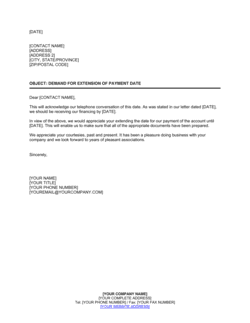
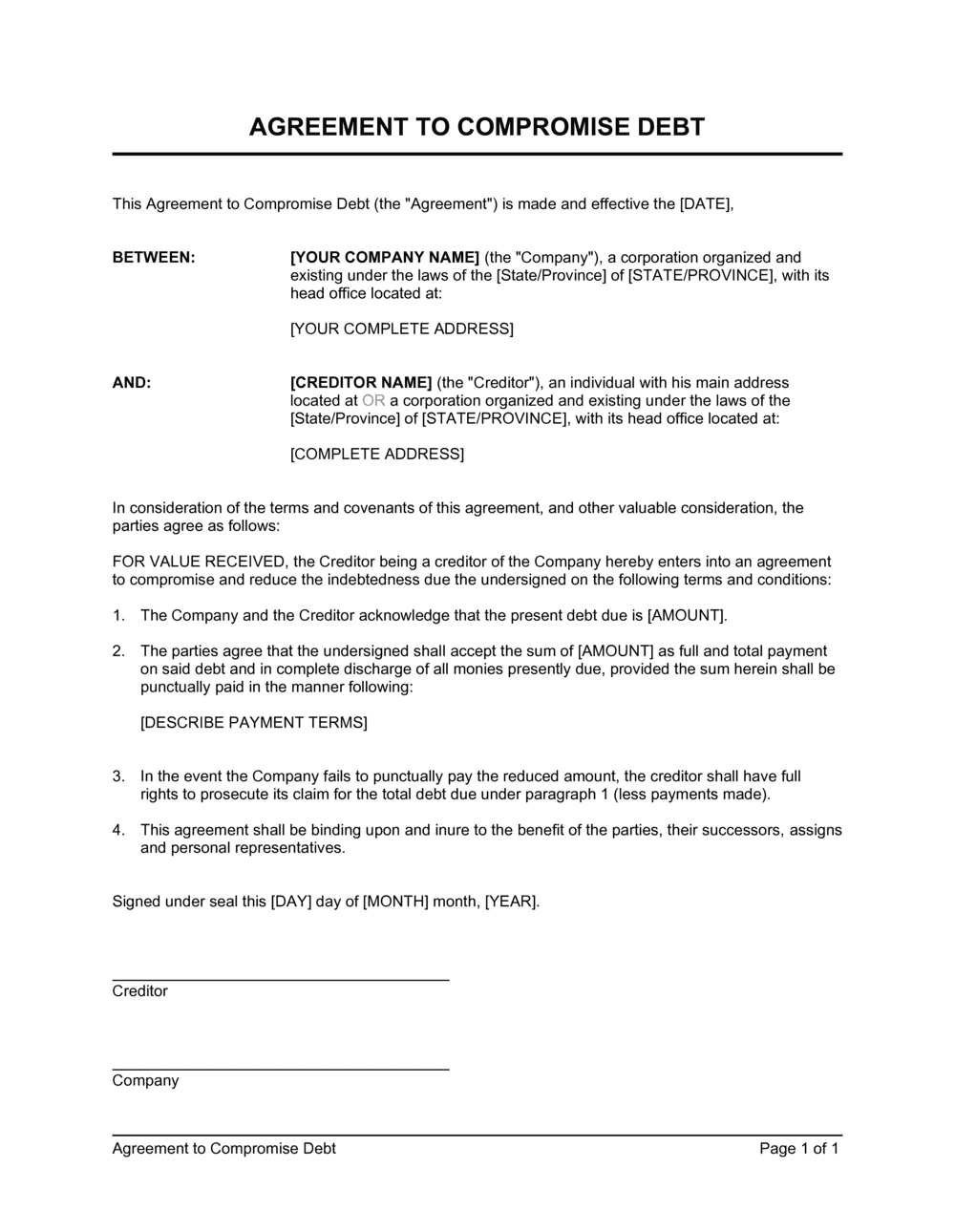
Agreement to Compromise Debt Template

Free Word download • Edit online • Save & share with Drive • Export to PDF

1 page20–30 min to fillDifficulty: StandardSignature requiredLegal review recommended
Learn more ↓
FreeAgreement to Compromise Debt Template

At a glance

What it is
An Agreement to Compromise Debt is a legally binding contract between a creditor and a debtor in which both parties agree to settle an outstanding debt for less than the full amount originally owed. This free Word download lets you document the negotiated settlement amount, payment schedule, and mutual release of claims in a single enforceable document you can edit online and export as PDF.
When you need it
Use it when a creditor is willing to accept partial payment in full satisfaction of a debt — typically because collecting the full balance would be impractical, costly, or unlikely — and both parties want a written record that eliminates future claims over the original obligation.
What's inside
Identification of both parties and the original debt, the agreed compromise amount and payment terms, conditions for default, a mutual release of claims, confidentiality provisions, and governing law. Each clause is designed to close the liability loop on both sides cleanly.

What is an Agreement to Compromise Debt?

An Agreement to Compromise Debt is a legally binding contract in which a creditor agrees to accept a reduced amount as full and final settlement of an outstanding debt, and a debtor agrees to pay that reduced sum by a specified date or according to an agreed installment schedule. Once the compromise amount is paid in full, the remaining balance is permanently extinguished and both parties release each other from further claims arising from the original obligation. The agreement draws on the common-law doctrine of accord and satisfaction — the creditor's release of the unpaid balance constitutes valid consideration for the debtor's payment, making the contract enforceable even though the debtor pays less than originally owed.

Why You Need This Document

Without a written compromise agreement, a verbal settlement is nearly impossible to enforce — a creditor who later changes their mind can still pursue the full original balance, and a debtor who paid the agreed reduced amount has no written proof the payment discharged the debt. The consequences of leaving a debt compromise undocumented include renewed collection calls, litigation over the amount allegedly still owed, and disputes over whether a partial payment constituted a settlement or merely a partial payment on account. A properly executed agreement closes all of those gaps: it specifies the exact amount that settles the debt, conditions the release on actual receipt of funds, and restores the creditor's full legal remedies if the debtor defaults. For creditors, it also creates the paper trail required by tax authorities to support a bad-debt write-down. This template gives both parties a professionally structured, enforceable document without the cost of custom drafting for straightforward commercial settlements.

Which variant fits your situation?

If your situation is…Use this template
Settling a debt with a single lump-sum paymentAgreement to Compromise Debt (Lump Sum)
Settling over multiple installments with a payment scheduleDebt Installment Settlement Agreement
Releasing a debtor from all remaining obligations after partial paymentDebt Release Agreement
Acknowledging the debt exists and setting a repayment plan without reductionPromissory Note
Restructuring a business loan with modified terms and extended repaymentLoan Modification Agreement
Settling a debt dispute between two businesses after a contractual disagreementSettlement Agreement
Formally waiving interest and penalties while preserving the principalDebt Waiver Agreement

Common mistakes to avoid

❌ Releasing the debt before receiving full payment

Why it matters: An unconditional release signed before the compromise amount is paid extinguishes the creditor's claim — leaving no enforceable remedy if the debtor defaults.

Fix: Draft the release as expressly conditional: 'effective only upon Creditor's receipt of the full Compromise Amount.' Keep the original debt claim alive until the final dollar clears.

❌ Omitting the debt acknowledgment clause

Why it matters: Without a written acknowledgment, a debtor who later disputes the original debt can claim the compromise was coerced or based on a non-existent obligation, undermining the agreement's enforceability.

Fix: Include a clause in which the debtor unambiguously acknowledges the debt amount, its origin, and that no defenses, offsets, or counterclaims exist as of the agreement date.

❌ No default reinstatement provision

Why it matters: If the debtor misses an installment and there is no reinstatement clause, the creditor has only the compromise amount as a claim — not the full original debt — making recovery far more limited.

Fix: Add explicit language stating that upon uncured default, the original outstanding balance (minus payments received) becomes immediately due and all collection remedies are restored.

❌ Using the wrong entity name for one or both parties

Why it matters: Misidentifying a party — using a trade name or an outdated corporate name — can make the agreement unenforceable against the intended legal entity and complicate tax treatment of the write-down.

Fix: Verify both parties' registered legal names in the relevant corporate registry before drafting, and have signatories confirm their authority to bind the entity in writing.

❌ Failing to address tax consequences in the agreement

Why it matters: Forgiven debt is generally treated as taxable income for the debtor under US and Canadian tax law. A debtor who is surprised by a 1099-C or T4A in the next tax year may claim the settlement was misrepresented.

Fix: Add a clause stating each party is responsible for their own tax obligations arising from the compromise and that neither party has relied on the other for tax advice.

❌ Setting no payment method or account details

Why it matters: Vague payment instructions — 'by wire transfer' with no account number — give the debtor cover to claim they were unable to complete payment, delaying the settlement and complicating a default finding.

Fix: State the exact payment instructions in the body of the agreement or in an attached schedule: bank name, account number, routing number, and reference to include on the transfer.

The 10 key clauses, explained

Parties and recitals

In plain language: Identifies the creditor and debtor by full legal name and entity type, states the nature of the original debt, and sets the factual background for the compromise.

Sample language
This Agreement to Compromise Debt ('Agreement') is entered into as of [DATE] between [CREDITOR LEGAL NAME], a [STATE/PROVINCE] [ENTITY TYPE] ('Creditor'), and [DEBTOR LEGAL NAME], a [STATE/PROVINCE] [ENTITY TYPE] ('Debtor'). Creditor holds an outstanding obligation from Debtor in the original principal amount of $[ORIGINAL AMOUNT] arising from [DESCRIPTION OF DEBT] dated [ORIGINAL DEBT DATE] ('Original Debt').

Common mistake: Using trade names instead of registered legal entity names. If the parties' names don't match their corporate registry records, the agreement may be difficult to enforce or assign.

Acknowledgment of debt

In plain language: The debtor formally acknowledges the existence and validity of the original debt and the amount owed, preventing later claims that the debt was disputed or unenforceable.

Sample language
Debtor acknowledges and agrees that as of [DATE], the total outstanding balance of the Original Debt, including principal, accrued interest, and fees, is $[TOTAL OUTSTANDING AMOUNT], and that such amount is due, owing, and not subject to any defense, offset, or counterclaim.

Common mistake: Skipping the acknowledgment clause when the debt amount is disputed. Without it, the debtor may later argue the debt was not valid, undermining the entire compromise.

Compromise amount and payment terms

In plain language: States the reduced amount the creditor agrees to accept in full satisfaction of the debt, and sets out whether it is a lump sum or installment schedule with specific due dates.

Sample language
In full and final settlement of the Original Debt, Debtor agrees to pay Creditor the sum of $[COMPROMISE AMOUNT] ('Compromise Amount') as follows: [LUMP SUM on or before DATE / installments of $[X] on the [DAY] of each month beginning [DATE] through [DATE]]. Payment shall be made by [WIRE TRANSFER / CHECK / ACH] to [PAYMENT DETAILS].

Common mistake: Stating a compromise amount without specifying the payment method and exact due dates. Ambiguous timing gives the debtor room to delay and the creditor no clear basis to declare default.

Conditions to effectiveness

In plain language: Sets out what must happen before the compromise becomes binding — typically delivery of the first payment — and clarifies that the original debt remains enforceable in full until conditions are met.

Sample language
This Agreement shall become effective only upon Creditor's receipt of the first payment specified in Section [X]. Until such payment is received, the Original Debt remains due and owing in full and this Agreement shall be of no force or effect.

Common mistake: Omitting this clause and treating the signed agreement alone as discharge of the debt. A creditor who has not yet received any funds can find themselves holding an agreement but no money and no clear path back to the original claim.

Default and reinstatement of original debt

In plain language: Defines what constitutes a default (missed or late payment), gives the debtor a cure period, and specifies that if the debtor defaults, the full original debt balance — less any payments already made — becomes immediately due.

Sample language
If Debtor fails to make any payment within [10] days of its due date ('Default'), Creditor shall provide written notice. If Debtor does not cure the Default within [5] business days of such notice, the original outstanding balance of $[TOTAL OUTSTANDING AMOUNT], less any amounts paid under this Agreement, shall become immediately due and payable, and Creditor may pursue all available remedies.

Common mistake: Setting no cure period at all. Courts in many jurisdictions expect a reasonable opportunity to cure before acceleration, and omitting one can make the reinstatement clause unenforceable.

Mutual release of claims

In plain language: Upon receipt of the full compromise amount, both parties release each other from all claims, actions, and liabilities arising out of the original debt — preventing either side from reopening the matter.

Sample language
Upon Creditor's receipt of the Compromise Amount in full, each party hereby releases and forever discharges the other, and their respective successors and assigns, from any and all claims, demands, and causes of action arising out of or related to the Original Debt. This release does not extend to obligations arising under this Agreement.

Common mistake: Making the release unconditional and inserting it before the compromise amount is paid. The release should be expressly conditioned on receipt of full payment — an unconditional release signed before payment leaves the creditor with no leverage if the debtor defaults.

Confidentiality

In plain language: Restricts both parties from disclosing the existence or terms of the compromise to third parties, protecting the creditor's credit policies and the debtor's financial reputation.

Sample language
Each party agrees to keep the terms of this Agreement strictly confidential and shall not disclose them to any third party without the prior written consent of the other party, except as required by applicable law, court order, or to legal and financial advisors bound by equivalent confidentiality obligations.

Common mistake: Omitting confidentiality entirely. A debtor who knows the creditor settled for 50 cents on the dollar with a competitor has a bargaining chip in future disputes; a creditor whose write-down policy becomes public may face pressure from other debtors.

No admission of liability

In plain language: Clarifies that neither party's agreement to the compromise constitutes an admission of wrongdoing, fault, or liability with respect to the original debt or any related dispute.

Sample language
This Agreement is a compromise of a disputed or doubtful claim. Neither the execution of this Agreement nor any payment made hereunder shall be construed as an admission of liability or wrongdoing by either party.

Common mistake: Omitting this clause when the underlying debt arose from a disputed invoice or service claim. Without it, the debtor's agreement to pay could be used as evidence of the debt's validity in unrelated proceedings.

Governing law and dispute resolution

In plain language: Specifies which jurisdiction's law governs the agreement and how disputes will be resolved — court, arbitration, or mediation — and in which venue.

Sample language
This Agreement shall be governed by the laws of [STATE / PROVINCE / COUNTRY], without regard to conflict-of-law principles. Any dispute arising under this Agreement shall be resolved by [binding arbitration before [AAA/JAMS] in [CITY] / litigation in the courts of [JURISDICTION]], and the prevailing party shall be entitled to recover reasonable attorneys' fees.

Common mistake: Choosing a governing law with no connection to where either party operates. Some jurisdictions — California in particular — apply their own consumer-protection rules to debt settlements regardless of a contrary choice-of-law clause.

Entire agreement and severability

In plain language: Confirms that the written agreement is the complete and final expression of the parties' understanding, superseding all prior discussions, and that if any clause is found unenforceable, the rest of the agreement survives.

Sample language
This Agreement constitutes the entire agreement between the parties with respect to the subject matter hereof and supersedes all prior negotiations, representations, and agreements. If any provision of this Agreement is found unenforceable, the remaining provisions shall continue in full force and effect.

Common mistake: Relying on prior email negotiations as part of the agreement without an integration clause. Without one, courts may admit emails and term sheets as evidence of additional obligations beyond what the written agreement states.

How to fill it out

  1. 1

    Identify both parties with full legal names

    Enter the creditor's and debtor's complete registered legal names and entity types — corporation, LLC, sole proprietor, or individual. Confirm names match government registry or ID documents.

    💡 For individuals, include their full legal name and address; for entities, confirm the name against your state or provincial business registry before signing.

  2. 2

    Document the original debt in detail

    State the origin of the debt — invoice number, loan agreement date, or contract reference — the original principal amount, and the total outstanding balance including any accrued interest and fees as of the agreement date.

    💡 Pull the exact figure from your accounting system and attach a statement of account as an exhibit. This eliminates any dispute about what the compromise is settling.

  3. 3

    Set the compromise amount and payment schedule

    Enter the reduced amount the creditor agrees to accept, and specify whether it is a lump sum or a series of installments with exact due dates, dollar amounts, and the accepted payment method.

    💡 If paying in installments, add a running balance column to Schedule A so both parties can track cumulative payments without confusion.

  4. 4

    Define the default and cure provisions

    Specify the number of days after a missed payment that triggers a default notice, the cure period the debtor has to remedy it, and the acceleration language that reinstates the original debt balance.

    💡 A 10-day payment grace period plus a 5-business-day cure period after notice is a widely accepted standard that courts view as reasonable.

  5. 5

    Draft the mutual release conditions

    Confirm the release is triggered only upon receipt of the full compromise amount — not upon signing. Include language covering successors and assigns so the release binds future owners of either claim.

    💡 If the creditor is a company, have legal counsel confirm whether board authorization or a resolution is needed to bind the entity to a write-down of this size.

  6. 6

    Add confidentiality and no-admission language

    Insert the confidentiality clause restricting disclosure to third parties and the no-admission-of-liability clause. Both are standard in commercial debt settlements and should not be removed.

    💡 If either party is a public company, coordinate with your compliance team before including a confidentiality clause — disclosure obligations under securities law may override it.

  7. 7

    Confirm governing law and dispute resolution

    Select the jurisdiction whose law governs the agreement and the dispute resolution mechanism. Ensure the chosen jurisdiction is where at least one party operates and that it does not have conflicting consumer-debt regulations.

    💡 If the debtor is an individual consumer rather than a business, check your jurisdiction's consumer protection statutes before finalizing — they may impose additional disclosure or waiting-period requirements.

  8. 8

    Execute before first payment is made

    Both parties must sign and date the agreement before any compromise payment is transferred. File the executed original securely and send a countersigned copy to each party.

    💡 Use a timestamped electronic signature with an audit trail; this creates irrefutable proof of the date of execution if the debtor later disputes the timeline.

Frequently asked questions

What is an agreement to compromise debt?

An agreement to compromise debt is a legally binding contract in which a creditor agrees to accept a reduced payment as full and final satisfaction of an outstanding debt, and the debtor agrees to pay that reduced amount by a specified date or schedule. Once the compromise amount is paid in full, the remaining balance is extinguished and both parties release each other from further claims related to the original obligation. It is commonly used in business-to-business disputes, trade credit situations, and collections scenarios where recovering the full balance is unlikely.

Is an agreement to compromise debt legally binding?

Yes, an agreement to compromise debt is generally enforceable as a binding contract when it contains the essential elements: offer, acceptance, and consideration. The creditor's consideration is the release of the remaining balance; the debtor's consideration is the agreed payment. Most jurisdictions recognize the doctrine of accord and satisfaction, under which a lesser payment accepted in full settlement discharges the original debt. Proper execution — signed by authorized representatives of both parties — is critical to enforceability.

What is the difference between a debt compromise agreement and a debt forgiveness letter?

A debt compromise agreement is a bilateral contract — both parties sign, both accept obligations, and both receive something in exchange. A debt forgiveness letter is a unilateral statement from the creditor waiving all or part of a debt without requiring anything in return from the debtor. Compromise agreements are more enforceable because they are bilateral and supported by consideration on both sides; forgiveness letters can be revoked more easily and raise different tax implications for the debtor.

Does the debtor owe tax on forgiven debt?

In most cases, yes. Under US federal tax law, a creditor that forgives $600 or more of debt must issue a Form 1099-C, and the debtor must report the forgiven amount as ordinary income. In Canada, forgiven debt may trigger income inclusion under the debt-forgiveness rules in the Income Tax Act. Exceptions exist for insolvency and bankruptcy. Both parties should consult a tax advisor before finalizing any compromise agreement to understand their reporting obligations.

Can a creditor still sue after signing a debt compromise agreement?

Generally, no — once the compromise amount has been paid in full and the mutual release takes effect, the creditor cannot sue for the remaining balance. However, if the debtor defaults before completing all payments, most properly drafted agreements reinstate the creditor's right to pursue the full original balance (minus any amounts already paid) through litigation or other collection remedies.

What happens if the debtor defaults on a compromise agreement?

A well-drafted default clause allows the creditor to reinstate the full original debt balance (less any payments received under the compromise) and pursue all available legal remedies — including litigation, judgment, wage garnishment, or lien. Without a default and reinstatement clause, the creditor may be limited to suing only for the compromise amount, significantly weakening their position.

Do I need a lawyer to prepare an agreement to compromise debt?

For straightforward business-to-business settlements at relatively modest amounts, a well-drafted template is typically sufficient. Legal review is advisable when the debt is large (generally over $25,000), the parties are in different jurisdictions, the debtor is an individual consumer subject to consumer-protection regulations, or when there is a related dispute or litigation. A lawyer can also advise on tax structuring and whether additional documents — such as a deed of release or UCC termination — are needed.

Should the compromise agreement reference the original contract or invoice?

Yes. Identifying the original debt by contract number, invoice number, or loan agreement date prevents ambiguity about which obligation is being settled. Attaching the original document or a statement of account as an exhibit strengthens the agreement by making clear exactly what is being compromised and for how much. This is especially important when a creditor holds multiple invoices or claims against the same debtor.

Can an agreement to compromise debt be used for consumer debt?

Yes, but with additional caution. Consumer debt compromises in the US may be subject to the Fair Debt Collection Practices Act, state consumer protection statutes, and specific disclosure requirements. In Canada, the UK, and the EU, consumer credit regulations impose additional obligations on creditors. A template designed for commercial debt should be reviewed by a lawyer before being used in any consumer-debt settlement context.

How this compares to alternatives

vs Promissory Note

A promissory note is a unilateral written promise by the debtor to repay the full outstanding debt — no reduction, no release. An agreement to compromise debt reduces the amount owed and extinguishes the remainder upon payment. Use a promissory note when the debtor acknowledges the full debt and you are simply documenting a repayment plan; use a compromise agreement when you are accepting less than the full balance.

vs Settlement Agreement

A settlement agreement is a broader instrument used to resolve disputes, claims, or litigation between parties — it may or may not involve a debt. An agreement to compromise debt is specifically designed to reduce and discharge a financial obligation. When a debt dispute involves additional claims such as breach of contract or damages, a full settlement agreement is the more appropriate document.

vs Release of Debt

A release of debt is a unilateral document in which the creditor forgives a debt entirely without requiring any payment in return. A compromise agreement is bilateral — the debtor pays a reduced amount in exchange for the release. A release of debt may have different tax and accounting consequences and should only be used when the creditor intends to receive nothing further.

vs Loan Modification Agreement

A loan modification agreement restructures the existing debt — extending the term, reducing the interest rate, or changing payment amounts — without reducing the principal balance owed. An agreement to compromise debt permanently reduces the principal. Use a loan modification when the debtor can ultimately repay in full with adjusted terms; use a compromise agreement when partial recovery is the realistic outcome.

Industry-specific considerations

Wholesale and Distribution

Suppliers settling aged trade receivables at fiscal year-end to clean up balance sheets and avoid the cost of collections litigation.

Construction and Contracting

Subcontractors and general contractors resolving disputed invoices or change-order balances with a partial settlement to close out a project.

Financial Services and Lending

Commercial lenders and collections agencies formalizing lump-sum payoff offers on non-performing loans and purchased debt portfolios.

Professional Services

Law firms, consultancies, and agencies accepting partial payment on disputed or uncollectable client invoices in lieu of protracted collections.

Jurisdictional notes

United States

Debt compromise agreements are governed by state contract law; enforceability is generally strong when supported by adequate consideration. Creditors forgiving $600 or more must issue IRS Form 1099-C, and debtors must recognize the forgiven amount as ordinary income unless an insolvency or bankruptcy exception applies. California, New York, and several other states impose additional requirements on consumer-debt settlements, including written disclosure of the compromise terms.

Canada

Compromise agreements are enforceable under provincial contract law across all provinces. Canada's Income Tax Act debt-forgiveness rules may require the debtor to reduce tax attributes (such as non-capital losses and adjusted cost base) by the forgiven amount, with any excess included in income. Quebec agreements must be available in French for provincially regulated entities. Consumer debt compromises may trigger obligations under provincial consumer protection legislation.

United Kingdom

In English law, a compromise agreement is enforceable as a contract provided both parties receive consideration; the creditor's release of the balance is sufficient consideration for the debtor's reduced payment. Deeds of release may be required where consideration is nominal. HMRC generally treats forgiven commercial debt as a taxable receipt for the debtor. Consumer-debt compromises involving regulated credit agreements are subject to FCA requirements under the Consumer Credit Act 1974.

European Union

Debt compromise treatment varies significantly across EU member states. In Germany, France, and the Netherlands, forgiven debt is generally taxable income for the debtor and a deductible loss for the creditor, subject to local tax authority documentation requirements. Consumer-debt compromises must comply with the EU Consumer Credit Directive and applicable national implementation. GDPR applies to the processing of personal data in connection with any individual debtor's settlement documentation.

Template vs lawyer — what fits your deal?

PathBest forCostTime
Use the templateBusiness-to-business debt settlements under $25,000 between domestic parties with no related litigationFree30–60 minutes
Template + legal reviewSettlements above $25,000, cross-border arrangements, or situations involving a disputed underlying contract$300–$800 for a lawyer review1–3 days
Custom draftedLarge commercial debt workouts, multi-creditor arrangements, or consumer-debt settlements subject to regulatory requirements$1,000–$5,000+1–3 weeks

Glossary

Compromise of Debt
A mutual agreement in which a creditor accepts less than the full amount owed as complete satisfaction of the debt, extinguishing the remaining balance.
Creditor
The party to whom money is owed — a lender, supplier, or service provider holding an outstanding receivable.
Debtor
The party who owes the debt and is seeking to settle it for less than the full outstanding amount.
Accord and Satisfaction
A common-law doctrine under which a disputed or unliquidated debt is discharged when the creditor accepts a lesser amount offered in full settlement.
Mutual Release
A provision in which both parties agree to release each other from all claims, obligations, and liabilities arising from the original debt after the compromise payment is made.
Deficiency Balance
The portion of the original debt that remains after a partial payment — extinguished by the agreement once the compromise amount is paid in full.
Consideration
Something of value exchanged between parties to make a contract binding — in a debt compromise, the creditor's release of the remaining balance is the consideration for the debtor's agreed payment.
Default Clause
A provision specifying what constitutes a missed or late payment under the compromise agreement and what remedies the creditor retains if the debtor defaults.
Novation
The substitution of a new obligation for an existing one — a compromise agreement creates a novation when it replaces the original debt terms with the new settlement terms.
Forbearance
A creditor's agreement to refrain from taking legal action to collect a debt for a defined period, often a condition the debtor must meet through timely payments under the compromise.
Deed of Release
A formal document, sometimes separate from the compromise agreement, that evidences the creditor's surrender of all remaining claims once the settlement amount has been paid.

Part of your Business Operating System

This document is one of 3,000+ business & legal templates included in Business in a Box.

  • Fill-in-the-blanks — ready in minutes
  • 100% customizable Word document
  • Compatible with all office suites
  • Export to PDF and share electronically

Create your document in 3 simple steps.

From template to signed document — all inside one Business Operating System.
1
Download or open template

Access over 3,000+ business and legal templates for any business task, project or initiative.

2
Edit and fill in the blanks with AI

Customize your ready-made business document template and save it in the cloud.

3
Save, Share, Send, Sign

Share your files and folders with your team. Create a space of seamless collaboration.

Save time, save money, and create top-quality documents.

★★★★★

"Fantastic value! I'm not sure how I'd do without it. It's worth its weight in gold and paid back for itself many times."

Managing Director · Mall Farm
Robert Whalley
Managing Director, Mall Farm Proprietary Limited
★★★★★

"I have been using Business in a Box for years. It has been the most useful source of templates I have encountered. I recommend it to anyone."

Business Owner · 4+ years
Dr Michael John Freestone
Business Owner
★★★★★

"It has been a life saver so many times I have lost count. Business in a Box has saved me so much time and as you know, time is money."

Owner · Upstate Web
David G. Moore Jr.
Owner, Upstate Web

Run your business with a system — not scattered tools

Stop downloading documents. Start operating with clarity. Business in a Box gives you the Business Operating System used by over 250,000 companies worldwide to structure, run, and grow their business.

Start free · No credit card required