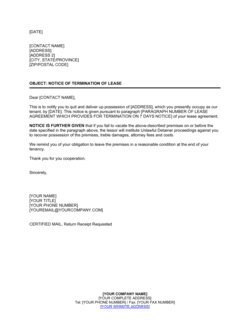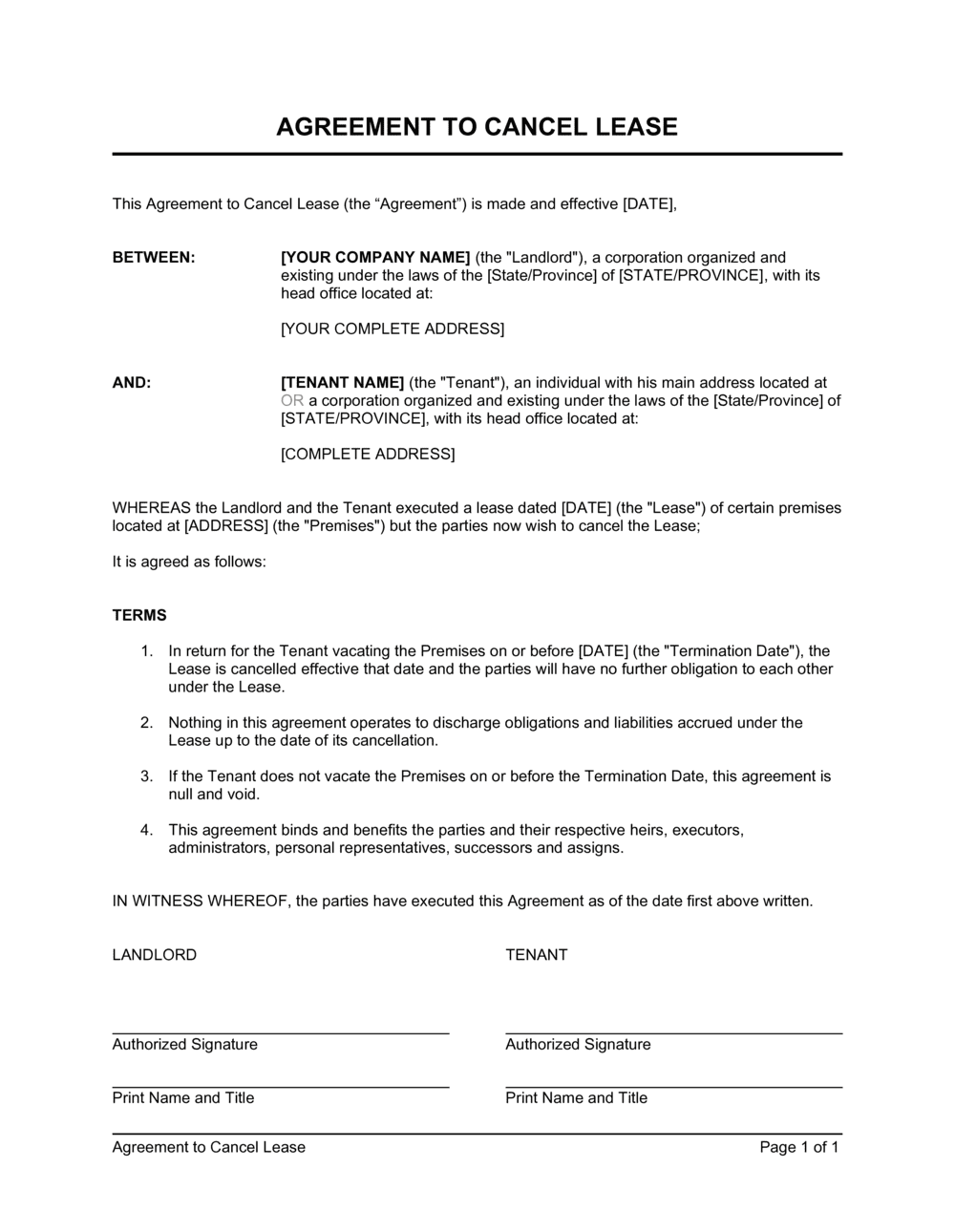
Agreement to Cancel Lease Template

Free Word download β€’ Edit online β€’ Save & share with Drive β€’ Export to PDF

1 pageβ€’20–30 min to fillβ€’Difficulty: Standardβ€’Signature requiredβ€’Legal review recommended
Learn more ↓
FreeAgreement to Cancel Lease Template

At a glance

What it is
An Agreement to Cancel Lease is a binding legal document signed by both a landlord and a tenant that mutually terminates an existing lease before its natural expiry date. This free Word download lets you document the agreed termination date, surrender conditions, deposit handling, and mutual release of ongoing obligations β€” then export as PDF for signature.
When you need it
Use it when both parties have agreed to end a commercial or residential lease early β€” whether due to a business closure, relocation, landlord redevelopment plans, or a negotiated buy-out of the remaining lease term. It replaces informal email exchanges with a single enforceable record.
What's inside
Party identification and original lease reference, agreed termination date, premises surrender and condition requirements, deposit return terms, outstanding rent and arrears settlement, mutual release of claims, and governing law. The template covers both commercial and residential lease cancellation scenarios.

What is an Agreement to Cancel Lease?

An Agreement to Cancel Lease is a legally binding document signed by both a landlord and a tenant that mutually terminates an existing lease before its scheduled expiry date. It records the agreed termination date, specifies the condition in which the tenant must surrender the premises, addresses any outstanding rent and financial obligations, governs the return of the security deposit, and releases both parties from future claims arising under the original lease. Rather than relying on informal email exchanges or verbal assurances, a properly executed cancellation agreement creates a single enforceable record of the entire exit arrangement.

Why You Need This Document

Without a written agreement to cancel a lease, the original lease remains legally in force β€” meaning the tenant can be held liable for every remaining month of rent, regardless of whether they have vacated the premises. Verbal agreements to cancel are unenforceable in most jurisdictions for leases that were originally required to be in writing, and informal key handovers can trigger an implied surrender with terms far less favorable than a negotiated exit. Landlords face their own risks: without a signed mutual release, a vacating tenant may later claim damages for interference with quiet enjoyment, wrongful eviction, or failure to return the deposit on agreed terms. A completed cancellation agreement eliminates these exposure points for both sides β€” documenting the buy-out payment, make-good obligations, deposit timeline, and guarantor release in a single document that withstands scrutiny from a court, auditor, or future property purchaser.

Which variant fits your situation?

If your situation is…Use this template
Both parties agree to end a commercial lease before expiryAgreement to Cancel Lease (Mutual)
Tenant provides formal written notice of intent to vacateLease Termination Letter (Tenant)
Landlord initiates termination for non-payment or breachLease Termination Notice (Landlord)
Tenant sublets space to a third party instead of cancellingSublease Agreement
Tenant assigns remaining lease term to a new occupantLease Assignment Agreement
Parties amend lease terms but continue the tenancyLease Amendment Agreement
New tenant takes over from departing tenant with landlord consentCommercial Lease Agreement

Common mistakes to avoid

❌ Not referencing the original lease precisely

Why it matters: A vague reference leaves room for a party to argue the cancellation agreement applies to a different lease or is ineffective, keeping the original lease and its obligations technically in force.

Fix: Identify the original lease by execution date, parties, and property address in the opening clause, and attach a copy of the original lease as an exhibit if there is any ambiguity.
❌ Leaving arrears unquantified at signing

Why it matters: Undefined outstanding balances are the most common trigger for post-termination disputes. Each party recalls the amount differently once the relationship is over.

Fix: Calculate and agree on the total arrears figure before signing and state it explicitly in the financial obligations clause. If the exact amount is unknown, include a process for final reconciliation within a specified number of days.

❌ Making the mutual release unconditional

Why it matters: An unconditional release takes effect at signing β€” before the tenant has vacated, before make-good is complete, and before the deposit is returned. The releasing party then has no contractual remedy for non-performance.

Fix: Condition the mutual release on full performance of all obligations in the cancellation agreement β€” surrender, payment, and restoration β€” and specify that the release does not take effect until all conditions are satisfied.

❌ Omitting the guarantor's consent or release

Why it matters: If a personal or corporate guarantor backed the original lease, cancelling the lease without addressing the guarantee may leave the guarantor's obligations in dispute β€” or the landlord may later pursue the guarantor for losses.

Fix: Identify any guarantors in the agreement and include a clause confirming whether the guarantee is released on the termination date or whether it survives to cover outstanding obligations.

❌ Signing after the tenant has already vacated

Why it matters: Once the tenant has surrendered keys and vacated, a court may find an implied surrender by operation of law β€” which can differ from the negotiated terms and may not include a mutual release or buy-out payment.

Fix: Execute the cancellation agreement before the tenant vacates or hands over keys. If execution is delayed, have the tenant confirm in writing that no implied surrender is intended until the formal agreement is signed.

❌ Using an oral agreement instead of a written cancellation

Why it matters: Verbal agreements to cancel a lease are unenforceable in most jurisdictions for leases originally required to be in writing. The original lease remains legally in force, and the landlord can claim rent for the full remaining term.

Fix: Always document a mutual lease termination in writing, signed by both parties, regardless of how informal the landlord-tenant relationship has been in practice.

The 10 key clauses, explained

Parties and original lease reference

In plain language: Identifies the landlord and tenant by full legal name and references the original lease β€” property address, lease date, and term β€” that this agreement cancels.

Sample language
This Agreement to Cancel Lease is entered into on [DATE] between [LANDLORD LEGAL NAME] ('Landlord') and [TENANT LEGAL NAME] ('Tenant'), in respect of the Lease Agreement dated [ORIGINAL LEASE DATE] for the premises at [PROPERTY ADDRESS] (the 'Original Lease').

Common mistake: Referencing the lease by a nickname or informal description instead of its exact execution date and parties. A vague reference creates doubt about which document is being cancelled and can leave the original lease technically in force.

Agreed termination date

In plain language: States the specific calendar date on which the lease ends and all tenant rights and obligations under the original lease cease.

Sample language
The parties agree that the Original Lease shall terminate and be of no further force or effect as of [TERMINATION DATE] (the 'Effective Termination Date').

Common mistake: Setting a termination date that conflicts with a notice period required in the original lease. If the original lease required 60 days' notice, a termination date less than 60 days from signing may be invalid unless both parties expressly waive that requirement in this agreement.

Surrender of premises and condition

In plain language: Specifies the condition in which the tenant must return the premises and the date by which vacant possession must be given to the landlord.

Sample language
Tenant shall vacate and surrender the Premises to Landlord on or before the Effective Termination Date in [BROOM-CLEAN / ORIGINAL] condition, with all fixtures, fittings, and equipment belonging to Tenant removed, and all keys and access devices returned.

Common mistake: Not defining the required condition of the premises specifically enough. 'Good condition' is interpreted differently by both parties; specifying broom-clean, painted, or restored to original layout eliminates post-surrender disputes.

Outstanding rent and financial obligations

In plain language: Addresses any unpaid rent, operating costs, or other charges owed under the original lease up to and including the termination date.

Sample language
Tenant shall pay all rent, operating costs, utilities, and other amounts due under the Original Lease up to and including the Effective Termination Date. Any outstanding amounts as of [DATE] are acknowledged to total $[AMOUNT].

Common mistake: Leaving arrears unquantified at the time of signing. If the agreement is silent on outstanding balances, both parties later dispute what was owed, and the mutual release clause may be challenged.

Security deposit return

In plain language: States how and when the landlord will return the security deposit, or specifies deductions the landlord is entitled to apply before returning the balance.

Sample language
Landlord shall return the security deposit of $[AMOUNT] to Tenant within [30] days of the Effective Termination Date, less any deductions for unpaid rent, damage beyond normal wear and tear, or cleaning costs, itemized in writing.

Common mistake: Not specifying the return timeline. Without a deadline, landlords in most jurisdictions are still bound by statutory return periods β€” but a contractual deadline in the agreement provides an additional, clearer enforcement mechanism.

Lease buy-out payment (if applicable)

In plain language: Records any lump-sum payment made by one party to the other as consideration for the early termination β€” typically tenant to landlord, or landlord to tenant in a redevelopment scenario.

Sample language
In consideration of Landlord's consent to cancel the Original Lease, Tenant shall pay Landlord a buy-out amount of $[AMOUNT] on or before [PAYMENT DATE], which the parties agree constitutes full and final settlement of any early termination liability under the Original Lease.

Common mistake: Omitting the buy-out clause when a payment has been verbally agreed. Without written confirmation of the amount and payment date, the landlord may later claim additional damages for the remaining lease term.

Make-good and restoration obligations

In plain language: Details any specific restoration work the tenant must complete before vacating β€” removing fit-outs, repainting, patching, or returning mechanical systems to original specification.

Sample language
Prior to the Effective Termination Date, Tenant shall [REMOVE ALL TENANT FIT-OUTS / REPAINT WALLS TO ORIGINAL COLOR / RESTORE FLOORING] at Tenant's sole expense. Failure to complete make-good works entitles Landlord to deduct the cost from the security deposit.

Common mistake: Using the make-good clause only to list what must be done without specifying who bears the cost or the consequence of non-completion. Ambiguity here routinely leads to post-vacancy disputes over deposit deductions.

Mutual release of claims

In plain language: Both parties release each other from all claims, actions, and liabilities arising under or related to the original lease, effective from the termination date.

Sample language
Effective as of the Effective Termination Date and subject to the obligations in this Agreement being fulfilled, each party releases and forever discharges the other from all claims, demands, and liabilities arising under or in connection with the Original Lease.

Common mistake: Making the mutual release unconditional before all obligations under the agreement (surrender, deposit return, arrears payment) have been fulfilled. The release should be explicitly conditioned on performance of all terms of the cancellation agreement.

Representations and warranties

In plain language: Each party confirms they have authority to enter into the cancellation, that no third-party consents are outstanding, and that there are no undisclosed sub-tenants or assignments.

Sample language
Each party represents and warrants that it has full authority to execute this Agreement, that no consent of any third party is required that has not been obtained, and that there are no subtenants or assignees in possession of the Premises.

Common mistake: Skipping this clause when the tenant is a corporate entity. If a director signs without board authority, or if there is a guarantor on the original lease whose release has not been obtained, the cancellation agreement may be challenged.

Governing law and entire agreement

In plain language: Specifies the jurisdiction whose law governs the agreement and confirms that this document supersedes all prior negotiations and representations about ending the lease.

Sample language
This Agreement is governed by the laws of [STATE / PROVINCE / COUNTRY]. It constitutes the entire agreement between the parties with respect to the cancellation of the Original Lease and supersedes all prior discussions, correspondence, and representations.

Common mistake: Omitting an entire-agreement clause. Without it, prior email exchanges in which the landlord made concessions (waiving arrears, agreeing to a shorter notice period) can be introduced in court as part of the agreement.

How to fill it out

  1. 1

    Identify both parties and the original lease

    Enter the full legal names of the landlord and tenant exactly as they appear on the original lease. Reference the original lease by its execution date, property address, and lease term start and end dates.

    πŸ’‘ If the tenant is a company, use the registered corporate name β€” not a trading name β€” to ensure the release binds the correct legal entity.

  2. 2

    Set the effective termination date

    Agree on a specific calendar date for the lease to end. Check the original lease for any minimum notice period requirements and confirm whether this agreement expressly waives them.

    πŸ’‘ Build in at least 5–10 days between signing and the termination date to allow for make-good works and key handover logistics.

  3. 3

    Document outstanding financial obligations

    Calculate all rent, operating costs, and charges owed up to the termination date. Enter the agreed total in the financial obligations clause so both parties acknowledge the amount at signing.

    πŸ’‘ Request a final rent statement from the landlord before signing β€” surprises about arrears after the agreement is executed are a common source of disputes.

  4. 4

    Agree on the security deposit treatment

    Specify the deposit amount, the deadline for return, and any agreed deductions. If the landlord is applying the deposit to outstanding rent, itemize that in this clause rather than leaving it to post-vacancy negotiation.

    πŸ’‘ Statutory deposit return periods apply in most jurisdictions even if the contract is silent β€” but a specific contractual deadline gives you a cleaner enforcement path.

  5. 5

    Specify make-good and surrender conditions

    List every restoration obligation the tenant must complete before vacating β€” removing fit-outs, repainting, cleaning, returning keys and access cards. Be specific about standard and who bears the cost.

    πŸ’‘ Attach a condition report or photo log as an exhibit to the agreement so the baseline for make-good comparison is documented and undisputed.

  6. 6

    Include the buy-out amount if applicable

    If the early termination involves a payment by either party, record the exact amount, payment method, and due date in the buy-out clause. Confirm this amount settles all early termination liability under the original lease.

    πŸ’‘ Express the buy-out as 'full and final settlement of all early termination liability' to prevent the landlord from later claiming additional loss of rent damages.

  7. 7

    Execute before the termination date with both signatures

    Both the landlord and tenant must sign and date the agreement. For corporate entities, the signatory must have authority β€” a director, officer, or property manager with a power of attorney.

    πŸ’‘ Use a witnessed or notarized execution if the original lease required it, or if the jurisdiction where the property is located requires formal execution for lease surrenders.

Frequently asked questions

What is an agreement to cancel a lease?

An agreement to cancel a lease is a legally binding document signed by both the landlord and tenant that mutually terminates an existing lease before its scheduled expiry date. It records the agreed termination date, the conditions of premises surrender, the treatment of the security deposit, any outstanding rent obligations, and a mutual release of future claims β€” replacing informal email negotiations with a single enforceable record.

Do I need a written agreement to cancel a lease early?

In most jurisdictions, a lease that was required to be in writing can only be cancelled by a written agreement signed by both parties. Verbal agreements to end a lease early are generally unenforceable, meaning the original lease and its full rent obligations remain in force. A written cancellation agreement is the only reliable way to document a mutual termination and release both parties from future obligations.

What is the difference between a lease cancellation and a lease termination notice?

A lease cancellation agreement is a mutual document β€” both parties sign and agree to end the lease on specific terms. A termination notice is a unilateral act β€” typically issued by one party under a break clause or for cause (such as non-payment). A cancellation agreement is more comprehensive because it negotiates and documents the financial settlement, deposit return, and make-good terms that a simple notice does not cover.

Can a landlord charge a fee to cancel a lease early?

Yes. A landlord may require a lease buy-out payment as a condition of consenting to early termination. The amount is negotiable and often represents some portion of the remaining rent due under the original lease. Some jurisdictions limit early termination fees β€” particularly for residential leases β€” so the enforceability of any buy-out amount should be checked against local law before it is agreed in the contract.

What happens to the security deposit when a lease is cancelled?

The treatment of the security deposit must be addressed explicitly in the cancellation agreement. Typically, the landlord returns the deposit within a specified period after the termination date, less any agreed deductions for unpaid rent, cleaning, or damage beyond normal wear and tear. Statutory deposit protection rules in most jurisdictions set maximum return timelines and require itemized deduction notices β€” the cancellation agreement should be consistent with those rules.

Does an agreement to cancel a lease need to be notarized?

In most jurisdictions, notarization is not required for a lease cancellation agreement to be enforceable β€” signatures from both parties are generally sufficient. However, if the original lease was notarized or recorded with a government authority, the cancellation may need to meet the same formal requirements to be effective against third parties such as a buyer of the property. Check the requirements of the jurisdiction where the property is located before executing.

What should I do if there is a guarantor on the original lease?

The guarantor's position must be addressed in the cancellation agreement. If the lease is cancelled without the guarantor's explicit release, their guarantee obligation may remain in force for any outstanding amounts at termination β€” or the landlord may argue it survives the cancellation. Include a clause confirming whether the guarantee is released effective on the termination date or whether it continues to cover any unresolved obligations.

Can a tenant cancel a commercial lease without the landlord's consent?

A tenant cannot unilaterally cancel a commercial lease without the landlord's consent unless the original lease contains a break clause or the landlord is in material breach. Without one of those grounds, the tenant remains liable for rent for the full remaining term. Engaging the landlord early and documenting the exit through a mutual cancellation agreement is nearly always preferable β€” and cheaper β€” than abandoning the premises and disputing liability afterward.

What is a make-good obligation and how does it affect lease cancellation?

A make-good obligation requires the tenant to restore the premises to its original condition before vacating β€” removing fit-outs, repainting walls, repairing damage, and returning mechanical systems to their prior state. In a lease cancellation agreement, make-good obligations should be listed specifically, with a deadline and the consequence of non-completion (typically, the landlord deducts the cost from the security deposit or invoices the tenant directly). Vague make-good terms are the most frequent source of post-vacancy disputes.

How this compares to alternatives

vs Lease Termination Letter

A lease termination letter is a unilateral notice from one party to the other, typically exercising a break clause or giving contractual notice. An agreement to cancel a lease is bilateral β€” both parties sign and agree on the terms of exit, including financial settlement and mutual release. The letter triggers an end date; the agreement documents the full negotiated deal.

vs Sublease Agreement

A sublease agreement allows the tenant to transfer possession to a subtenant while remaining on the hook to the landlord under the original lease. An agreement to cancel a lease ends the tenant's obligations entirely. Use a sublease when you want to recover rent costs without permanently exiting; use a cancellation when you want a clean break from all obligations.

vs Lease Amendment Agreement

A lease amendment modifies specific terms of the original lease β€” rent amount, permitted use, or term length β€” while keeping the lease itself in force. An agreement to cancel a lease terminates the lease entirely. If the goal is to renegotiate rather than exit, a lease amendment is the right document.

vs Commercial Lease Agreement

A commercial lease agreement creates the tenancy and governs the entire relationship. An agreement to cancel a lease ends it. The cancellation agreement must reference the original lease precisely and should be read alongside it to ensure all obligations β€” notice periods, make-good, guarantor provisions β€” are addressed consistently.

Industry-specific considerations

Retail

Retail tenants frequently negotiate early exits when foot traffic declines or a store underperforms, making buy-out amount and make-good scope the critical negotiating points.

Professional Services

Law firms, accountants, and consultancies consolidating office space use lease cancellation agreements to exit surplus floors or satellite locations cleanly, often with fit-out restoration obligations.

Technology / SaaS

Fast-growing or contracting tech companies regularly exit office leases early as headcount changes; remote-work transitions have made mutual lease cancellations common across the sector.

Food and Beverage

Restaurant and hospitality operators face complex make-good requirements β€” kitchen fit-outs, grease traps, and signage β€” making detailed restoration clauses and condition-report exhibits essential in any lease cancellation.

Jurisdictional notes

United States

Lease cancellation requirements vary by state. Most states require commercial lease surrenders to be in writing if the original lease was written. Security deposit return timelines are set by statute β€” ranging from 14 days (California) to 45 days (some states) β€” and the cancellation agreement must not waive statutory protections. Early termination fees in residential leases are capped or regulated in several states including California, Texas, and New York.

Canada

Commercial lease cancellations are governed by provincial property law; no federal standard applies. In Ontario, a lease surrender must be by deed if the unexpired term exceeds three years. Quebec civil law treats lease cancellation differently from common-law provinces and requires specific formalities. Residential lease terminations are heavily regulated by provincial residential tenancy acts, which limit early exit terms and buy-out amounts.

United Kingdom

In England and Wales, a lease surrender must be by deed if the lease has more than three years remaining β€” a simple signed agreement is insufficient. The surrender must be registered at HM Land Registry if the original lease was registered. Landlord and Tenant Act 1954 security of tenure protections may apply to commercial tenancies, potentially requiring a formal procedure to exclude or end them. Scottish law applies distinct rules under the Leases Act 1449.

European Union

Lease cancellation formalities vary significantly across EU member states. Germany requires notarization for commercial lease surrenders in some circumstances. France mandates written termination with specific notice periods under the bail commercial regime. The EU does not harmonize commercial tenancy law, so local legal advice is essential for any cross-border property arrangement. GDPR considerations apply if the agreement involves personal data of individuals named as guarantors or contacts.

Template vs lawyer β€” what fits your deal?

PathBest forCostTime
Use the templateStandard mutual lease exits where both parties have agreed on termination date, deposit return, and basic make-good termsFree20–40 minutes
Template + legal reviewCommercial leases with personal guarantors, substantial buy-out payments, complex fit-out restoration, or leases longer than 3 years remaining$300–$800 for a real estate solicitor or attorney review2–5 business days
Custom draftedHigh-value commercial properties, multi-site portfolios, leases with registered interests or mortgagee consent requirements, or cross-border arrangements$1,500–$5,000+1–3 weeks

Glossary

Lease Cancellation
The mutual agreement between landlord and tenant to end a lease before its scheduled expiry, releasing both parties from future obligations.
Surrender of Premises
The formal act of the tenant returning possession of the leased property to the landlord in an agreed condition on or before the termination date.
Mutual Release
A clause in which both parties give up any future claims against each other arising from the original lease, effective from the termination date.
Security Deposit
Funds held by the landlord as financial protection against unpaid rent or damage, which must be returned or applied to outstanding obligations on termination.
Arrears
Any rent or other lease payments that are overdue and unpaid at the time the cancellation agreement is executed.
Break Clause
A pre-negotiated provision in the original lease that permits either party to terminate at a specified date without mutual consent.
Make-Good Obligation
A tenant's contractual duty to restore the premises to its original condition β€” removing fit-outs, repainting, or repairing damage β€” before vacating.
Lease Buy-Out
A payment made by the tenant to the landlord (or vice versa) in exchange for the landlord's consent to cancel the remaining lease term early.
Holdover Tenancy
The situation that arises when a tenant remains in possession of the premises after the lease or cancellation date has passed, potentially creating a new month-to-month tenancy.
Effective Termination Date
The specific calendar date on which the lease legally ends and the tenant's obligation to pay rent ceases, as stated in the cancellation agreement.

Part of your Business Operating System

This document is one of 3,000+ business & legal templates included in Business in a Box.

  • Fill-in-the-blanks β€” ready in minutes
  • 100% customizable Word document
  • Compatible with all office suites
  • Export to PDF and share electronically

Create your document in 3 simple steps.

From template to signed document β€” all inside one Business Operating System.
1
Download or open template

Access over 3,000+ business and legal templates for any business task, project or initiative.

2
Edit and fill in the blanks with AI

Customize your ready-made business document template and save it in the cloud.

3
Save, Share, Send, Sign

Share your files and folders with your team. Create a space of seamless collaboration.

Save time, save money, and create top-quality documents.

β˜…β˜…β˜…β˜…β˜…

"Fantastic value! I'm not sure how I'd do without it. It's worth its weight in gold and paid back for itself many times."

Managing Director Β· Mall Farm
Robert Whalley
Managing Director, Mall Farm Proprietary Limited
β˜…β˜…β˜…β˜…β˜…

"I have been using Business in a Box for years. It has been the most useful source of templates I have encountered. I recommend it to anyone."

Business Owner Β· 4+ years
Dr Michael John Freestone
Business Owner
β˜…β˜…β˜…β˜…β˜…

"It has been a life saver so many times I have lost count. Business in a Box has saved me so much time and as you know, time is money."

Owner Β· Upstate Web
David G. Moore Jr.
Owner, Upstate Web

Run your business with a system β€” not scattered tools

Stop downloading documents. Start operating with clarity. Business in a Box gives you the Business Operating System used by over 250,000 companies worldwide to structure, run, and grow their business.

Start freeΒ Β·Β No credit card required