15 Things You Dont Have Time For When Pursuing Big Goals Template

Free download β€’ Use as a template β€’ Print or share

2 pagesβ€’15–25 min to useβ€’Difficulty: Standard
Learn more ↓
Free15 Things You Dont Have Time For When Pursuing Big Goals Template

At a glance

What it is
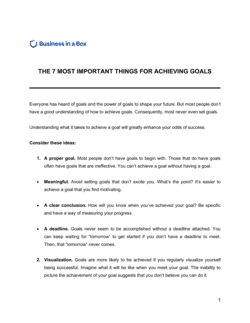
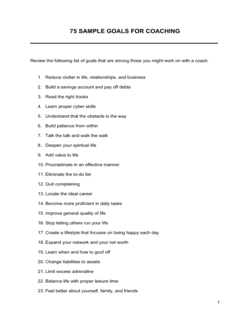
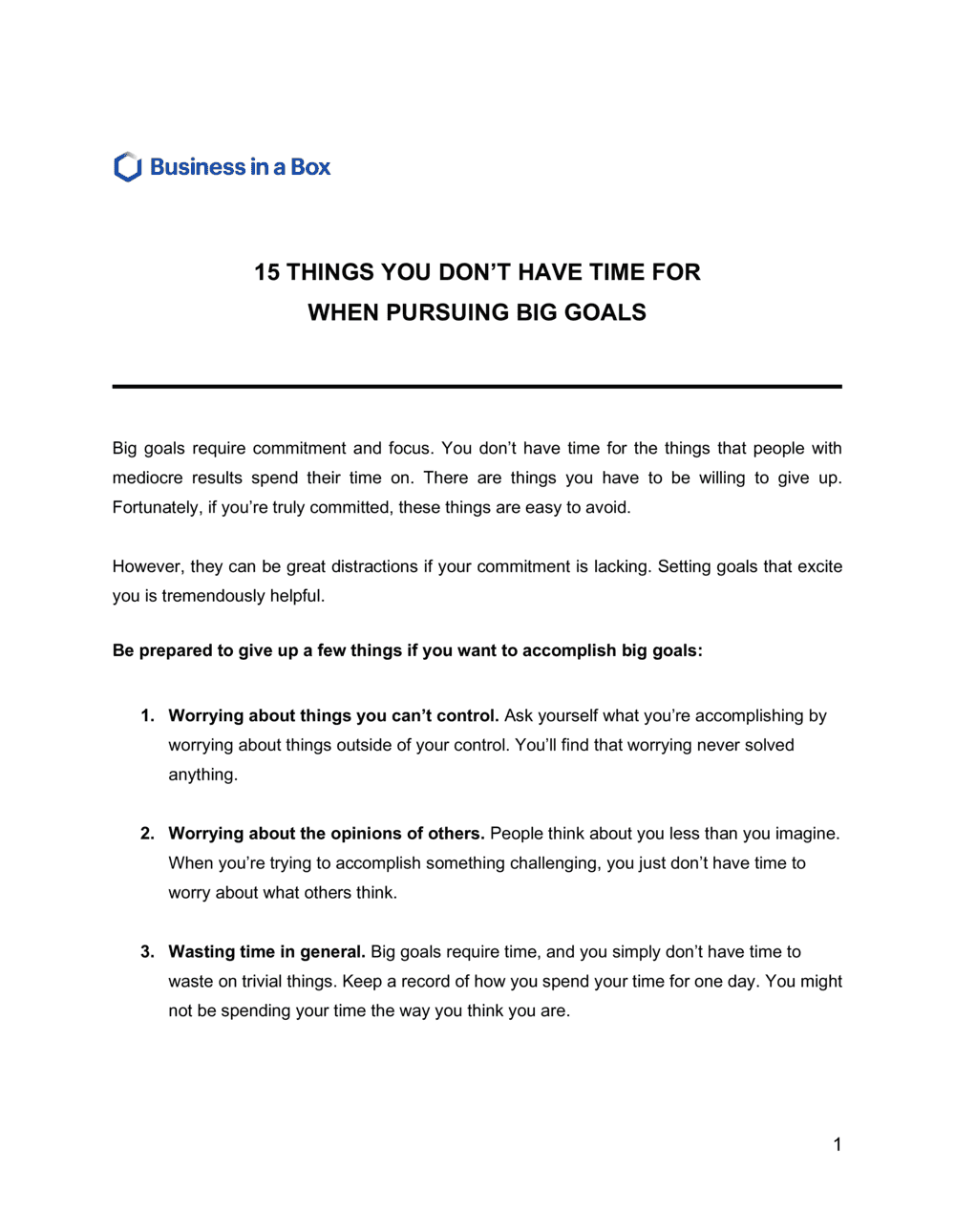
This template is a structured, one-to-two page Word document that catalogs 15 specific behaviors, habits, and activities that consume time and attention without moving you meaningfully closer to a significant goal. It functions as a personal and professional focus audit β€” a free Word download you can edit online, annotate with your own context, and export as PDF to keep visible during an active goal sprint.
When you need it
Use it when you have committed to a high-stakes goal β€” launching a product, completing a degree, scaling revenue to a new threshold, or executing a strategic pivot β€” and find that weeks are passing without measurable progress. It is equally useful at the start of a quarterly planning cycle to establish intentional constraints before distraction accumulates.
What's inside
The template covers 15 named distractions across five thematic categories: time-wasting social habits, low-return communication patterns, energy-draining comparison behaviors, reactive rather than proactive work modes, and perfectionistic delay tactics. Each item includes a brief rationale and a space to record your personal commitment to eliminating or minimizing it.

What is a 15 Things You Don't Have Time For When Pursuing Big Goals Template?

The 15 Things You Don't Have Time For When Pursuing Big Goals template is a structured Word document that catalogs 15 specific behaviors, habits, and activity patterns β€” organized across five thematic categories β€” that consistently consume time and attention without advancing a significant objective. Unlike a goal-setting worksheet, which defines where you are going, this document defines what to stop doing while you get there. It operates as a focus audit and written commitment tool, prompting users to identify which low-return patterns are currently active in their routine and to record concrete behavioral changes for each one.

Why You Need This Document

Most goal failures are not caused by a lack of ambition or a flawed plan β€” they are caused by the steady accumulation of low-value activity that fills the hours a goal requires. Without a structured mechanism for identifying and eliminating these patterns, reactive communication habits, comparison behaviors, and perfectionistic delay tactics quietly consume the time reserved for execution. A written commitment document changes the dynamic: research on behavior change consistently shows that people who write down specific behavioral boundaries are far more likely to maintain them than those who rely on mental resolutions alone. This template gives you a named, auditable list of the 15 most common focus-killers during high-stakes goal periods, a fillable commitment section that converts awareness into action, and a review protocol that keeps the commitments active across the full duration of a goal sprint.

Which variant fits your situation?

If your situation is…Use this template
Running a structured quarterly planning session for a teamQuarterly Business Review
Setting and tracking measurable objectives over a 90-day periodOKR Template
Prioritizing tasks by urgency and importance across a full workloadEisenhower Matrix / Priority Matrix
Conducting a personal or professional time auditTime Management Plan
Mapping high-level personal and professional goals for the yearPersonal Development Plan
Documenting a 90-day execution roadmap for a specific goalAction Plan Template
Coaching a team through a strategic focus or performance improvement cyclePerformance Improvement Plan

Common mistakes to avoid

❌ Reading the list without writing personal commitments

Why it matters: Passive recognition of a problem pattern without a written behavioral commitment produces almost no lasting change. The document functions as a mirror, not a plan.

Fix: Complete the personal commitment section in writing before closing the document β€” even rough notes are more effective than mental resolutions.

❌ Attempting to eliminate all 15 items simultaneously

Why it matters: Behavior change has a cognitive load cost. Trying to enforce 15 new rules at once depletes willpower faster than the habits being eliminated, causing regression within days.

Fix: Select the two or three highest-cost items and enforce those boundaries for two weeks before addressing the next tier.

❌ Applying the framework without anchoring it to a specific goal

Why it matters: Without a defined goal as a reference point, the exercise becomes abstract self-improvement rather than a focused decision filter β€” and users cannot accurately assess which items are truly costly.

Fix: Write the primary goal at the top of the document before reviewing any of the 15 items. Re-read it before each review session.

❌ Treating structural problems as personal discipline failures

Why it matters: Many of the 15 items β€” reactive inbox habits, notification-driven work, obligation accumulation β€” are structural and environmental, not character flaws. Framing them as discipline failures produces guilt without solutions.

Fix: For each marked item, ask whether the behavior is enabled by a system or environment that can be changed β€” then change the system, not just the intention.

The 8 key sections, explained

Introduction and Purpose Statement

Time-Wasting Social and Communication Habits

Comparison and Validation-Seeking Behaviors

Reactive Work Patterns

Perfectionistic and Avoidance Behaviors

Energy and Attention Drains

Personal Commitment and Accountability Section

Review and Iteration Protocol

How to fill it out

  1. 1

    State your primary goal at the top of the document

    Before engaging with the 15 items, write your single most important current goal in one sentence at the top of the template. Everything else in the document is evaluated relative to this anchor.

    πŸ’‘ If you cannot state the goal in one sentence without qualifiers, your goal is not yet specific enough to protect with a focus framework.

  2. 2

    Read each item and mark those currently active in your routine

    Go through all 15 items honestly. Mark each one that you recognize as a pattern in the past two weeks β€” not as a rare occurrence, but as a recurring habit.

    πŸ’‘ Aim to mark honestly rather than aspirationally. Under-marking produces a document that reflects who you want to be, not what you need to change.

  3. 3

    Write a specific behavior change for each marked item

    For every item you marked, write one concrete action: a new rule, a system change, or a boundary you will enforce. Vague intentions ('spend less time on email') are less effective than specific protocols ('no email before 10am').

    πŸ’‘ The more specific the protocol, the less willpower it requires to execute β€” you are replacing a decision with a rule.

  4. 4

    Identify the two or three items with the highest opportunity cost

    Of all your marked items, rank them by estimated time lost per week. Prioritize eliminating the top two or three before addressing the rest β€” trying to change all 15 at once produces none.

    πŸ’‘ A conservative estimate of one hour per day lost to a single distraction equals 90+ hours over a 90-day sprint β€” enough to complete a significant project milestone.

  5. 5

    Name an accountability structure

    Decide whether you will review this document alone on a set schedule, share it with a coach or manager, or discuss it with a peer who is pursuing a comparable goal.

    πŸ’‘ External accountability increases follow-through rates on behavior change significantly. Even a brief weekly check-in with one other person produces better outcomes than solo review.

  6. 6

    Set a review date and a specific trigger for early review

    Enter a review date β€” two to four weeks out β€” and define one specific trigger that would prompt an earlier review: a major context shift, a missed milestone, or re-emergence of a behavior you committed to eliminate.

    πŸ’‘ Treat the review date as a non-negotiable calendar appointment, not a suggestion.

Frequently asked questions

What is the '15 Things You Don't Have Time For When Pursuing Big Goals' template?

It is a structured Word document that identifies 15 specific behaviors, habits, and activity patterns that consume time and attention without contributing meaningfully to a significant goal. It functions as a focus audit and commitment tool β€” guiding users to recognize which low-return activities are currently active in their routine and to make specific written commitments to reduce or eliminate them during a defined goal pursuit period.

Who should use this template?

Anyone in an active, high-stakes goal period β€” a product launch, a revenue milestone, a degree completion, a career transition β€” will find it useful. It is particularly valuable for founders, managers, freelancers, and coaches who operate with significant autonomy over their schedule and need a structured mechanism for protecting execution time from accumulating low-value commitments.

How is this different from a standard to-do list or goal-setting template?

A to-do list defines what to do. This template defines what to stop doing. Goal-setting frameworks like OKRs or SMART goals focus on output targets and milestones; this document focuses on removing the input behaviors that prevent those targets from being reached. The two are complementary β€” this template works best alongside, not instead of, a structured goal-setting document.

How often should I review this document?

A review every two to four weeks is appropriate for most active goal sprints. Set a fixed review date when you first complete the template. Review earlier if you notice a committed behavior re-emerging, if your goal timeline shifts significantly, or if you add a major new commitment to your workload. Each review should check whether your commitments are holding and whether new items have emerged.

Can this template be used in a team or coaching context?

Yes. Executive coaches, team leaders, and managers use it as a shared reflection exercise at the start of a focused initiative or performance cycle. In a team context, each member completes the personal commitment section individually, then shares two or three items with the group to build mutual accountability. Coaches use it as a session prompt to surface where a client's time and energy are actually going.

Is this a productivity system or a one-time exercise?

It is designed as a recurring reference document, not a one-time exercise. The first pass produces initial commitments. Subsequent reviews check whether those commitments are holding, add new items that have emerged, and retire items that have been successfully eliminated. Over multiple goal cycles, the document becomes a personal record of focus patterns and behavioral change.

What format does this template come in?

The template is available as a free Word download from Business in a Box. You can edit it online in your browser, customize the 15 items and commitment fields with your own language and context, and export it as a PDF to keep visible during your goal sprint or share with a coach or accountability partner.

How does this template relate to time management?

It operates one level upstream of time management. Time management tools allocate the hours you have; this template challenges whether the activities filling those hours are worth keeping at all. Eliminating even one or two high-cost distraction patterns from the list typically recovers more usable time than any scheduling optimization β€” making it a prerequisite to effective time management during a goal sprint.

How this compares to alternatives

vs Personal Development Plan

A personal development plan maps skills, learning goals, and career milestones over a 6-to-12-month horizon. This template is narrower and more immediate β€” it identifies specific behaviors to eliminate during an active goal sprint rather than capabilities to build over time. The two documents work in sequence: use the personal development plan to set the direction, then use this template to protect the execution window.

vs Action Plan Template

An action plan defines what to do, in what sequence, by what date. This template defines what to stop doing. Both are required for effective goal execution β€” the action plan structures your forward path while this template clears the behavioral obstacles standing in it.

vs OKR Template

OKRs define the objective and quantify the key results that measure success. This template does not set goals β€” it removes the recurring behaviors that prevent OKR progress from happening. Use OKRs to define the destination and this framework to audit whether your daily habits are aligned with reaching it.

vs Performance Improvement Plan

A performance improvement plan is a managed HR document addressing a documented performance gap, typically involving a manager and formal accountability checkpoints. This template is a self-directed focus tool with no HR context β€” it is used proactively by high-performers during ambitious goal periods, not reactively in response to underperformance.

Industry-specific considerations

Technology / SaaS

Founders and product managers use it at the start of a product sprint to eliminate reactive Slack habits, over-monitoring competitor releases, and premature roadmap expansion.

Professional Services

Consultants and lawyers apply it to reduce low-billable-value obligations, obligation-driven committee participation, and perfectionism-driven over-revision of deliverables.

Education and Coaching

Coaches and instructors distribute it at the start of a program cohort as a shared commitment exercise, then revisit it at the midpoint to assess whether stated boundaries held.

Creative and Marketing Agencies

Creative directors use it during campaign execution phases to protect deep work time from client-reactive interruptions and internal meeting accumulation.

Template vs pro β€” what fits your needs?

PathBest forCostTime
Use the templateIndividuals and team leads completing the framework independently during a goal sprint or quarterly planning cycleFree30–60 minutes to complete; 15 minutes per review session
Template + professional reviewProfessionals working with an executive coach who wants to incorporate a structured focus audit into a coaching engagement$150–$500 per coaching session1–2 coaching sessions to integrate and calibrate
Custom draftedOrganizations embedding a customized focus framework into a formal leadership development or high-performance team program$500–$2,500 for a consultant or facilitator to adapt and deliver the framework1–3 weeks for program design and delivery

Glossary

Goal Sprint
A defined time window β€” typically 30 to 90 days β€” during which all discretionary effort is concentrated on a single significant objective.
Opportunity Cost
The value of the best alternative foregone when you choose to spend time or energy on a lower-priority activity.
Cognitive Load
The total amount of mental effort actively used in working memory at any given time; excessive load slows decision-making and reduces output quality.
Parkinson's Law
The observation that work expands to fill the time available for its completion β€” used here to explain why unconstrained schedules breed low-value activity.
Deep Work
Cognitively demanding, distraction-free work that pushes your abilities and creates significant value β€” contrasted with shallow, reactive tasks.
Reactive Mode
A work pattern driven by incoming demands β€” notifications, requests, and interruptions β€” rather than proactive execution of planned priorities.
Comparison Trap
The habit of measuring your progress against others' visible outputs, which consistently distorts self-assessment and redirects attention from your own path.
Perfectionistic Delay
Postponing execution because conditions, information, or preparation do not yet feel sufficient β€” a recognized pattern that delays progress without improving outcomes.
Energy Management
The deliberate allocation of physical and mental energy to tasks according to their priority β€” distinct from time management, which tracks hours not quality of focus.
Scope Creep (personal)
The gradual addition of commitments, favors, and side projects that expand personal workload beyond what serves the primary goal.

Part of your Business Operating System

This document is one of 3,000+ business & legal templates included in Business in a Box.

  • Fill-in-the-blanks β€” ready in minutes
  • 100% customizable Word document
  • Compatible with all office suites
  • Export to PDF and share electronically

Create your document in 3 simple steps.

From template to signed document β€” all inside one Business Operating System.
1
Download or open template

Access over 3,000+ business and legal templates for any business task, project or initiative.

2
Edit and fill in the blanks with AI

Customize your ready-made business document template and save it in the cloud.

3
Save, Share, Send, Sign

Share your files and folders with your team. Create a space of seamless collaboration.

Save time, save money, and create top-quality documents.

β˜…β˜…β˜…β˜…β˜…

"Fantastic value! I'm not sure how I'd do without it. It's worth its weight in gold and paid back for itself many times."

Managing Director Β· Mall Farm
Robert Whalley
Managing Director, Mall Farm Proprietary Limited
β˜…β˜…β˜…β˜…β˜…

"I have been using Business in a Box for years. It has been the most useful source of templates I have encountered. I recommend it to anyone."

Business Owner Β· 4+ years
Dr Michael John Freestone
Business Owner
β˜…β˜…β˜…β˜…β˜…

"It has been a life saver so many times I have lost count. Business in a Box has saved me so much time and as you know, time is money."

Owner Β· Upstate Web
David G. Moore Jr.
Owner, Upstate Web

Run your business with a system β€” not scattered tools

Stop downloading documents. Start operating with clarity. Business in a Box gives you the Business Operating System used by over 250,000 companies worldwide to structure, run, and grow their business.

Start freeΒ Β·Β No credit card required