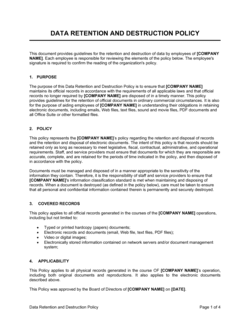
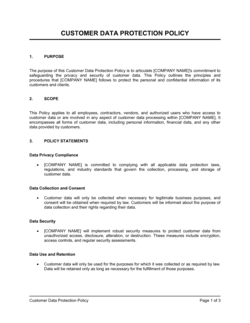
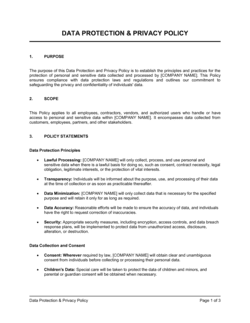
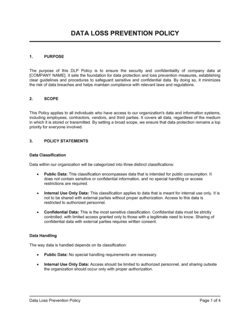
Data Governance Templates
★★★★★4.7from 280+ reviews· Trusted by 20M+ businesses
Establish clear rules for how your organization collects, stores, protects, and retires data.
WordEditable onlinePDF20+ data governance templates
Other Software & Technology categories
Most popular data governance templates
Data protection and privacy policies
Governance frameworks and IT policy
250K+Clients
20M+Free users
20+Years
190+Countries
10,000+Law firms
50M+Downloads
Trusted across review platforms
- Capterra★★★★☆4.649 reviews
- G2★★★★☆4.713 reviews
- GetApp★★★★☆4.649 reviews
- Google Play★★★★☆4.6179 ratings
- Google Reviews★★★★☆4.567 reviews
Frequently asked questions
What is a data governance policy?
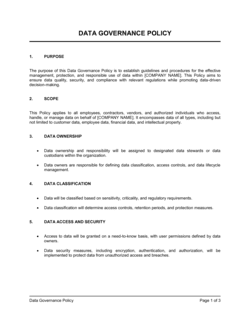
A data governance policy is a formal document that sets out the rules, roles, and processes an organization uses to manage its data assets consistently and responsibly. It defines who owns data, how data is classified, how long it is kept, who can access it, and what happens when data is compromised. Most organizations use it as the top-level document that other data-related policies sit beneath.
Who needs a data governance framework?
Any organization that collects, stores, or processes significant volumes of data — especially personal, financial, or regulated data — benefits from a governance framework. Regulatory requirements such as GDPR, HIPAA, and CCPA effectively mandate documented governance programs for companies in scope. Even smaller businesses benefit: a framework reduces the risk of accidental breaches, data loss, and inconsistent handling practices as the company grows.
What is the difference between data governance and data management?
Data governance defines the rules, accountability structures, and decision-making processes for how an organization uses its data. Data management is the operational practice of collecting, storing, processing, and maintaining data in line with those rules. Governance is strategic and sets the policy; management is operational and executes it. You need both, and governance should come first.
Is a data governance policy the same as a privacy policy?
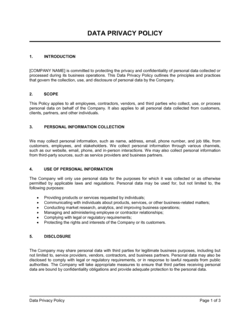
No. A privacy policy is primarily an external disclosure — it tells customers and regulators what personal data you collect and how you use it. A data governance policy is an internal document covering all organizational data (not just personal data) and addressing roles, classification, retention, and enforcement. Both are typically required for GDPR-compliant organizations, but they serve different audiences.
What should a data classification policy include?
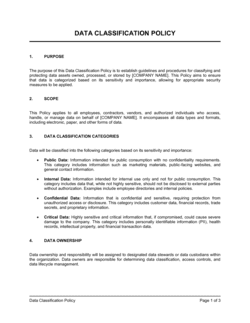
A data classification policy should define the classification tiers (commonly public, internal, confidential, and restricted), describe the criteria for assigning data to each tier, specify the handling requirements for each tier (encryption, access controls, labeling), and name who is responsible for classifying new data. It should also cover how to handle data that spans multiple tiers or changes classification over time.
When is a data processing agreement legally required?
Under GDPR Article 28, a data processing agreement is required any time a controller engages a processor to handle personal data on its behalf. This includes cloud service providers, payroll processors, email marketing platforms, and any SaaS vendor that touches personal data. The DPA must specify the subject matter, duration, nature, and purpose of the processing, among other mandatory elements.
How long should data be retained?
Retention periods depend on the type of data and the applicable legal requirements. Financial records commonly require seven years, employment records three to seven years, and personal marketing data typically no longer than necessary for the stated purpose. A data retention policy should map each data category to the specific legal or business requirement driving its retention period, rather than applying a single blanket rule.
What must a data breach response policy cover?
At minimum, a data breach response policy should cover how breaches are detected and reported internally, who leads the response team, the timeline for notifying regulators (72 hours under GDPR), when and how affected individuals are notified, containment and remediation steps, and a post-incident review process. Many regulators treat a documented and practiced response plan as a mitigating factor when assessing fines.
Can I use templates for data governance documents?
Yes. Templates provide a legally structured starting point that covers the standard provisions required under common frameworks and regulations. They are most effective when tailored to your specific data environment, industry sector, and applicable jurisdictions. For complex regulatory situations — HIPAA-covered entities, cross-border data transfers, or publicly traded companies — consider having a lawyer review the completed documents.
Data Governance vs. related documents
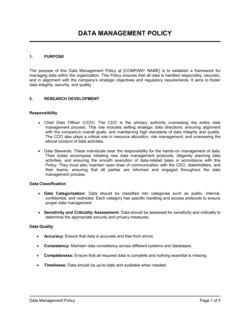
A data governance policy defines who is responsible for data, what the rules are, and how compliance is enforced — it is about authority and accountability. A data management policy covers the operational procedures for collecting, storing, and maintaining data — it is about day-to-day practices. Governance sets the rules; management executes them. Most organizations need both, starting with governance to provide the framework that management procedures sit within.
A data governance framework is the overarching structural document that defines roles (data owners, stewards, custodians), committees, and decision-making processes across the entire program. A data governance policy is one of several policies that operate within that framework, addressing a specific domain such as classification or retention. Build the framework first; individual policies flow from it.
A data privacy policy explains to users and regulators what personal data the organization collects, why, and how it is used — it is largely an external-facing disclosure. A data protection policy is an internal document describing the technical and organizational controls used to keep data safe. Both are typically required under GDPR and similar regulations; they serve different audiences.
A data sharing agreement governs the transfer of data between two independent controllers who each determine their own purposes for using the data. A data processing agreement (DPA) governs a relationship where one party (the controller) instructs another (the processor) to handle data strictly on its behalf. The distinction matters legally: GDPR mandates a DPA for controller-processor relationships but not for controller-to-controller transfers.
Key clauses every Data Governance contains
Most data governance documents — whether policies, frameworks, or agreements — share a core set of provisions that define scope, accountability, and enforcement.
- Scope and applicability. Identifies which systems, data types, business units, and personnel the document applies to.
- Data classification tiers. Labels data by sensitivity — typically public, internal, confidential, and restricted — to drive handling rules.
- Roles and responsibilities. Assigns named roles such as data owner, data steward, and data custodian with specific accountabilities.
- Retention and disposal schedule. States how long each category of data must be kept and the approved methods for secure disposal.
- Access control requirements. Defines who may access which data, under what conditions, and how access is granted and revoked.
- Breach notification procedure. Outlines the steps for detecting, containing, and reporting a data breach to regulators and affected parties.
- Third-party obligations. Sets conditions under which data may be shared with or processed by vendors, partners, or contractors.
- Compliance and audit. Specifies how compliance is monitored, who conducts reviews, and the consequences of non-compliance.
- Policy review cycle. States how frequently the document must be reviewed and who is responsible for keeping it current.
How to write a data governance policy
A data governance policy needs to be specific enough to guide behavior and broad enough to cover the full data lifecycle — here is how to structure one from scratch.
1
Define the scope
Identify which data types, systems, and business units the policy covers, and explicitly state what is out of scope.
2
Inventory your data assets
List the categories of data the organization holds — personal, financial, operational, intellectual property — before assigning rules to them.
3
Classify data by sensitivity
Assign each data category to a tier (public, internal, confidential, restricted) that determines how it must be handled and protected.
4
Assign roles and ownership
Name a data owner for each major category and define the responsibilities of stewards, custodians, and processors.
5
Set retention and disposal rules
Specify how long each data category is retained, where it is stored, and how it is securely destroyed at end of life.
6
Document access controls and sharing conditions
State who can access which data, what approval is needed, and what conditions must be met before sharing data externally.
7
Add a breach response procedure
Include a summary of detection, containment, and notification steps, and reference the standalone breach response policy for detail.
8
Schedule reviews and assign accountability
State how often the policy is reviewed (annually is standard), who owns the review, and how changes are approved and communicated.
At a glance
- What it is
- Data governance is the set of policies, processes, and assigned accountabilities that control how an organization manages its data assets. Data governance documents define who can access data, how it is classified, how long it is kept, and what happens when it is compromised.
- When you need one
- Any time your organization handles personal, financial, or proprietary data — or is subject to GDPR, HIPAA, CCPA, or similar regulations — a documented data governance framework is required. Without it, audits, breaches, and regulatory fines become significantly harder to defend against.
Which Data Governance do I need?
The right data governance document depends on what problem you are solving — regulatory compliance, data access control, breach readiness, or third-party data sharing. Match your situation below.
Your situation
Recommended template
Building a company-wide governance program from scratch
Provides the structural blueprint before any individual policies are written.Formalizing rules for how the organization manages all data assets
Establishes ownership, stewardship, and accountability across the data lifecycle.Labeling data by sensitivity level to control access and handling
Defines tiers such as public, internal, confidential, and restricted.Meeting GDPR, CCPA, or similar privacy regulation requirements
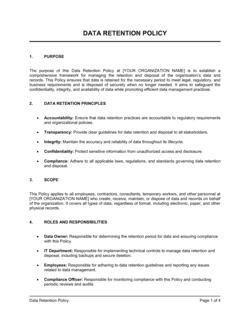
Addresses lawful basis for processing, data subject rights, and consent.Defining how long records are kept and how they are destroyed
Covers retention schedules, secure disposal, and legal hold procedures.Preparing a documented response plan for a data breach
Sets out detection, containment, notification, and post-incident review steps.Sharing data with a third-party vendor or partner
Sets binding conditions on how shared data may be used, stored, and returned.Engaging a processor to handle personal data on your behalf
Required under GDPR Article 28 when a controller engages a processor.Glossary
- Data governance
- The set of policies, roles, and processes that define how an organization manages, protects, and uses its data assets.
- Data owner
- The person or role accountable for a specific data asset, including decisions about access, classification, and retention.
- Data steward
- The individual responsible for day-to-day management and quality of a data asset on behalf of the data owner.
- Data custodian
- The technical role responsible for the storage, maintenance, and security of data infrastructure.
- Data classification
- The process of labeling data by sensitivity level to determine appropriate handling, access, and protection controls.
- Data lifecycle
- The stages data passes through from creation or collection through active use, archiving, and final destruction.
- Retention schedule
- A table mapping each category of data to the minimum and maximum period it must be kept before destruction.
- Data controller
- The organization that determines the purposes and means of processing personal data, as defined under GDPR.
- Data processor
- A third party that processes personal data strictly on the instructions of the controller.
- Personal data
- Any information that relates to an identified or identifiable living individual, as defined under GDPR and similar laws.
- Legal hold
- A directive to suspend normal data destruction because data may be relevant to pending or anticipated litigation.
- Data breach
- A security incident resulting in unauthorized access to, disclosure of, or loss of personal or confidential data.
What is a data governance policy?
A data governance policy is a formal internal document that establishes the rules, roles, and processes an organization uses to manage its data assets consistently, securely, and in compliance with applicable regulations. It assigns accountability — naming data owners, stewards, and custodians — and defines how data must be classified, accessed, retained, and eventually destroyed across its full lifecycle. Rather than addressing one narrow topic, a data governance policy sits at the top of a broader documentation hierarchy: individual policies on classification, retention, privacy, and breach response all operate within the framework it defines.
Data governance as a discipline encompasses every document and process that keeps an organization in control of its data. This includes frameworks that define program structure, policies that govern specific data practices, agreements that bind third parties, and job descriptions that staff the function. Together, these documents ensure that data is treated as a managed asset — with known owners, defined handling rules, and documented procedures for when things go wrong.
When you need a data governance policy
If your organization collects personal data, holds financial records, runs a cloud-based platform, or operates in a regulated industry, you need documented data governance. Regulatory frameworks including GDPR, HIPAA, CCPA, and SOC 2 all require evidence of structured governance as a condition of compliance — and auditors, customers, and enterprise procurement teams increasingly ask to see it before signing contracts.
Common triggers:
- Preparing for a GDPR, HIPAA, or CCPA compliance audit
- Onboarding a cloud provider, data processor, or analytics vendor
- Experiencing a data breach and needing a formal response procedure
- Expanding into a new market or jurisdiction with data protection laws
- Reaching a headcount or data volume that makes informal practices inadequate
- Closing an enterprise sales deal that requires a data protection questionnaire
- Establishing a data team and needing documented roles and responsibilities
The cost of undocumented governance is not abstract. Regulatory fines for GDPR violations alone have reached into the hundreds of millions of euros for large organizations, and even small companies face enforcement action for lacking documented policies. Starting with a structured template shortens the time from zero to audit-ready, giving your legal and technical teams a solid foundation to build from rather than a blank page.
Award-winning platform
- Great Place to Work 2025
- BIG Award — Product of the Year 2025
- Smartest Companies 2025
- Global 100 Excellence 2026
- Best of the Best 2025