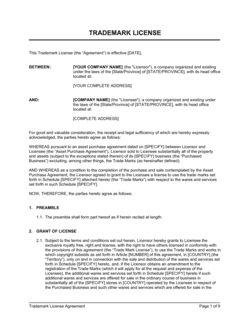
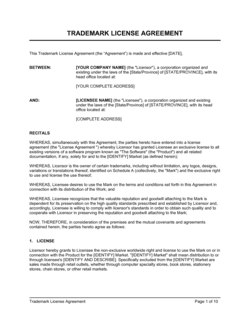
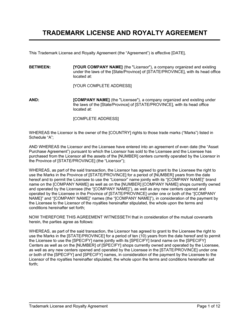
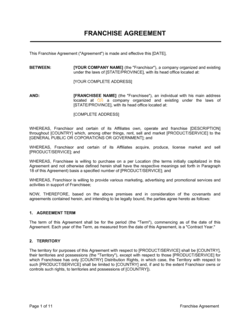
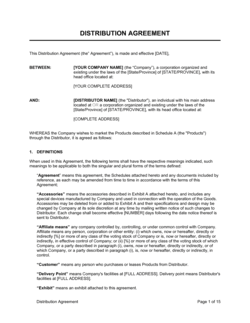
Trademark Licensing Agreement Template

Free Word download • Edit online • Save & share with Drive • Export to PDF

7 pages30–40 min to fillDifficulty: ComplexSignature requiredLegal review recommended
Learn more ↓
FreeTrademark Licensing Agreement Template

At a glance

What it is
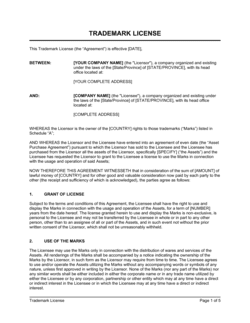
A Trademark Licensing Agreement is a legally binding contract in which a trademark owner (licensor) grants another party (licensee) the right to use a registered or common-law trademark — a brand name, logo, or slogan — under defined conditions. This free Word download covers license scope, royalties, quality control, term, renewal, and termination in a single professionally structured document you can edit online and export as PDF.
When you need it
Use it whenever a business allows a third party to sell, manufacture, or distribute products or services under its brand — including franchising arrangements, co-branding deals, merchandise licensing, and distribution agreements that grant branded use rights.
What's inside
Grant of license and exclusivity, permitted territory and channels, royalty structure and payment terms, quality control and approval procedures, term and renewal, infringement reporting obligations, indemnification, and termination conditions with post-termination obligations.

What is a Trademark Licensing Agreement?

A Trademark Licensing Agreement is a legally binding contract in which a trademark owner — the licensor — grants another party — the licensee — the right to use a registered or common-law trademark in connection with specified products or services, in a defined territory, and for a defined period. The licensor retains full ownership of the mark throughout; the agreement creates a permission structure, not a transfer of title. In exchange for usage rights, the licensee typically pays ongoing royalties calculated as a percentage of net sales, adheres to brand quality standards set by the licensor, and operates within the geographic and product-category boundaries the agreement defines. Trademark licensing is the mechanism behind virtually every branded franchise, co-manufactured consumer product, and character merchandise program in commerce.

Why You Need This Document

Allowing a third party to use your trademark without a written agreement puts your ownership of that mark at risk. In the United States and most common-law jurisdictions, a licensor who cannot demonstrate active quality control over how its trademark is used faces a "naked license" finding — a legal determination that the mark has been abandoned, stripping the licensor of all rights. Beyond the abandonment risk, an undocumented licensing arrangement leaves royalties uncollectable, territory boundaries unenforceable, and post-termination obligations undefined. When the relationship breaks down — and without a contract, it will — you have no mechanism to compel the former licensee to stop using your brand, pull branded inventory from shelves, or pay arrears. A properly executed Trademark Licensing Agreement establishes the rules before use begins, preserves the legal validity of your trademark, and gives you enforceable remedies if those rules are broken.

Which variant fits your situation?

If your situation is…Use this template
Granting rights in a specific country or region onlyTrademark Licensing Agreement (Territorial)
Licensing a trademark exclusively to a single licenseeExclusive Trademark License Agreement
Licensing to multiple licensees in the same marketNon-Exclusive Trademark License Agreement
Bundling trademark rights with a full franchise systemFranchise Agreement
Licensing both trademark and underlying technology togetherTechnology and IP License Agreement
Short-term promotional co-branding with another companyCo-Branding Agreement
Licensing a trademark for a defined product category onlyProduct License Agreement

Common mistakes to avoid

❌ Issuing a naked license with no quality control

Why it matters: US trademark law requires the licensor to exercise actual control over the quality of licensed goods. A license with no genuine quality oversight can be deemed a 'naked license,' which courts have used to find trademark abandonment — extinguishing the licensor's rights entirely.

Fix: Include a detailed quality control clause requiring pre-approval of products and marketing materials, retain written approvals on file, and conduct at least annual compliance reviews of the licensee's branded output.

❌ Failing to specify the licensed trademark by registration number

Why it matters: A vague reference to 'the brand' creates disputes about whether future trademark registrations, new logos, or international marks are included in the license — or whether the licensee can challenge the licensor's ownership of a specific mark.

Fix: Attach a Schedule A listing every mark by registration number, filing jurisdiction, and trademark class. Update the schedule by written amendment whenever new marks are registered.

❌ No minimum royalty or performance threshold

Why it matters: Without a minimum, a licensee can sit on an exclusive license and pay nothing while competitors are locked out — effectively blocking the licensor from revenue and the market.

Fix: Set an annual minimum guaranteed royalty and tie renewal rights to meeting a minimum net sales threshold. If minimums are not met, the licensor can convert an exclusive to a non-exclusive or terminate.

❌ Omitting a change-of-control clause

Why it matters: If the licensee is acquired by a competitor, the acquiring company inherits the trademark license — potentially giving a direct competitor the right to use your brand in its products.

Fix: Include a clause requiring the licensor's written consent for any assignment of the agreement, change of control of the licensee, or transfer arising from merger or acquisition.

❌ No sell-off period on termination

Why it matters: An immediate hard cutoff leaves the licensee with unsaleable branded inventory and distribution channel stock, creating a near-certain dispute over damages and brand materials still in the market.

Fix: Grant a 60–90 day sell-off period for existing finished goods inventory, subject to continued royalty payments on those sales and a prohibition on producing new branded product after the termination date.

❌ Allowing sublicensing without explicit quality control pass-through

Why it matters: If the licensee grants sublicenses to manufacturers or distributors without binding them to the same quality standards, the licensor's brand control breaks down at the sublicensee level — undermining the trademark's validity.

Fix: Prohibit sublicensing without written licensor consent and require any permitted sublicense to incorporate quality control obligations at least as stringent as those in the main agreement, with the licensor named as a third-party beneficiary.

The 10 key clauses, explained

Grant of License and Exclusivity

In plain language: Defines exactly which trademark(s) are licensed, whether the grant is exclusive or non-exclusive, and which products or services the licensee may brand.

Sample language
Licensor hereby grants to Licensee a [exclusive / non-exclusive], non-transferable license to use the Trademark identified in Schedule A solely in connection with the manufacture, marketing, and sale of [LICENSED PRODUCTS] during the Term.

Common mistake: Failing to attach a Schedule A listing every trademark registration number and jurisdiction. An ambiguous description of 'the brand' creates disputes about what is actually licensed when new marks are registered.

Territory

In plain language: Specifies the geographic boundaries within which the licensee may use the trademark, preventing unauthorized expansion into unlicensed markets.

Sample language
The license granted herein is limited to the following territory: [COUNTRY / REGION / LIST OF COUNTRIES] ('Territory'). Licensee shall not use the Trademark outside the Territory or facilitate sales outside the Territory.

Common mistake: Using loose geographic descriptions like 'North America' without specifying whether it includes Mexico. Vague territory definitions are frequently litigated when the licensee expands.

Term and Renewal

In plain language: Sets the initial duration of the agreement, the conditions for renewal, and whether renewal is automatic or requires affirmative action by both parties.

Sample language
This Agreement commences on [START DATE] and continues for an initial term of [X] years ('Initial Term'). It shall automatically renew for successive [X]-year terms unless either party provides written notice of non-renewal at least [90] days prior to the end of the then-current term.

Common mistake: Omitting minimum performance thresholds tied to renewal. An automatic renewal with no sales minimums locks the licensor into a long relationship with an underperforming licensee.

Royalties and Payment Terms

In plain language: Establishes the royalty rate, the royalty base (e.g., net sales), payment frequency, reporting obligations, audit rights, and any minimum guaranteed royalty.

Sample language
Licensee shall pay Licensor a royalty of [X]% of Net Sales of Licensed Products, payable quarterly within [30] days of each calendar quarter end. 'Net Sales' means gross invoice amounts less returns, allowances, and applicable taxes. Minimum annual royalty: $[AMOUNT].

Common mistake: Failing to define 'Net Sales' with sufficient specificity. Licensees may deduct freight, co-op advertising, or currency conversion losses unless these are explicitly excluded from the definition.

Quality Control and Approval

In plain language: Requires the licensee to meet the licensor's brand standards and submit product samples, packaging, and marketing materials for approval before use — legally essential to prevent abandonment of the trademark.

Sample language
Licensee shall submit representative samples of Licensed Products and all associated packaging and promotional materials to Licensor for written approval prior to any commercial use. Licensor shall respond within [15] business days; silence shall not constitute approval.

Common mistake: Treating quality control as a formality with no documented approval process. A trademark owner who cannot demonstrate active quality oversight risks a 'naked license' finding, which can invalidate the trademark entirely.

Sublicensing

In plain language: States whether the licensee may grant sublicenses to third parties and, if so, under what conditions and with what licensor oversight.

Sample language
Licensee shall not sublicense any rights granted under this Agreement without the prior written consent of Licensor. Any permitted sublicense must be in writing, incorporate quality control standards no less stringent than those in this Agreement, and terminate automatically upon termination of this Agreement.

Common mistake: Allowing sublicensing without requiring that sublicenses contain equivalent quality control obligations. Brand standards enforced at the licensee level but not passed down to sub-licensees undermine the licensor's trademark control.

Intellectual Property Ownership and Goodwill

In plain language: Confirms that the licensor retains all ownership of the trademark and that any goodwill generated by the licensee's use inures to the benefit of the licensor — a legal requirement for trademark validity.

Sample language
Licensee acknowledges that Licensor is the sole owner of the Trademark and all associated goodwill. Any goodwill arising from Licensee's use of the Trademark shall inure exclusively to the benefit of Licensor. Licensee shall not contest the validity of the Trademark or Licensor's ownership during or after the Term.

Common mistake: Omitting the goodwill-inurement clause. Without it, courts in some jurisdictions have found that long-term licensee use creates a co-ownership claim, particularly when the licensee invested heavily in brand development.

Infringement Reporting and Enforcement

In plain language: Requires the licensee to promptly notify the licensor of any third-party infringement of the trademark and defines which party bears the cost and control of enforcement actions.

Sample language
Licensee shall promptly notify Licensor of any actual or suspected infringement of the Trademark. Licensor shall have the first right, but not the obligation, to prosecute infringement. If Licensor elects not to act within [60] days, Licensee may take action with Licensor's written consent.

Common mistake: Giving the licensee unilateral enforcement rights without licensor approval. An enforcement action brought by a licensee that the licensor does not control can damage the trademark's scope or create unwanted precedents.

Indemnification

In plain language: Allocates legal and financial responsibility between the parties — typically requiring the licensee to indemnify the licensor against claims arising from the licensee's products or conduct, and the licensor to indemnify for IP ownership disputes.

Sample language
Licensee shall indemnify, defend, and hold harmless Licensor from any claims, losses, or damages arising from Licensee's use of the Trademark, Licensee's products, or Licensee's breach of this Agreement. Licensor shall indemnify Licensee against third-party claims that the Trademark infringes another party's intellectual property rights.

Common mistake: Using a one-way indemnification in favor of the licensor only. If the licensed trademark is later found to infringe a third-party mark, the licensee has no contractual remedy without a reciprocal licensor indemnity.

Termination and Post-Termination Obligations

In plain language: Specifies the grounds for termination — including for cause, insolvency, or regulatory loss of trademark — and the licensee's obligations upon termination, such as ceasing use and destroying inventory.

Sample language
Either party may terminate this Agreement immediately upon written notice if the other party commits a material breach and fails to cure within [30] days. Upon termination, Licensee shall immediately cease all use of the Trademark and, within [60] days, destroy or return all materials bearing the Trademark, providing written certification of destruction.

Common mistake: No sell-off period for existing inventory. A hard cutoff without a defined wind-down period leaves the licensee with unsaleable branded stock and creates disputes over product already in distribution channels.

How to fill it out

  1. 1

    Identify the parties and describe the trademark precisely

    Enter the licensor's and licensee's full legal entity names and attach a Schedule A listing every trademark by registration number, jurisdiction, and class of goods or services.

    💡 Include both registered marks and any common-law marks used in commerce — failing to list a mark means it is not licensed and can be used by the licensee without authorization.

  2. 2

    Define the scope: exclusivity, territory, and licensed products

    Choose exclusive or non-exclusive, specify the exact geographic territory with country codes, and list the precise product or service categories covered. Use trademark classification codes (Nice classes) for precision.

    💡 If you want to retain the right to use your own trademark in the licensee's territory, use a 'sole license' rather than an 'exclusive' grant — exclusive licenses typically bar the licensor too.

  3. 3

    Set the royalty rate, base, and minimum guarantee

    Enter the royalty percentage, define Net Sales with all deductions listed explicitly, specify the payment frequency, and set an annual minimum guaranteed royalty that gives you a floor regardless of sales performance.

    💡 Industry royalty rates vary significantly by sector — consumer goods average 4–8%, entertainment and character licensing 10–15%, software and technology 15–25%. Research comparable deals before setting your rate.

  4. 4

    Draft the quality control procedures

    Define the approval process for products, packaging, and marketing materials, the timeline for licensor responses, and the brand standards the licensee must follow. Reference a separate brand guidelines document if one exists.

    💡 Document every approval in writing and retain samples of approved products. This paper trail is your primary defense against a naked license challenge.

  5. 5

    Set the term and renewal conditions

    Enter the initial term length, the notice period required for non-renewal, and any performance thresholds — minimum annual sales or royalties — that must be met for renewal to activate.

    💡 Short initial terms (1–2 years) with performance-gated renewals give you more leverage to renegotiate or exit a low-performing relationship.

  6. 6

    Address sublicensing, assignment, and change of control

    State whether sublicensing is prohibited or requires consent, and include a change-of-control clause that terminates or requires licensor consent if the licensee is acquired.

    💡 Change-of-control clauses are especially important in brand licensing — you may not want your trademark used by a competitor that acquires your licensee.

  7. 7

    Complete the termination and wind-down provisions

    Specify cure periods for material breach (typically 30 days), immediate termination triggers (insolvency, trademark challenge, regulatory action), and a sell-off period of 60–90 days for existing inventory.

    💡 Require the licensee to provide a written inventory of branded stock on the date of termination notice — this makes the wind-down audit straightforward.

  8. 8

    Execute before any use of the trademark begins

    Both parties must sign before the licensee uses the trademark in any commercial context. Obtain signatures in counterpart if parties are in different locations, and retain a fully executed copy in your IP records.

    💡 Record the executed license with the relevant trademark office (e.g., USPTO, UKIPO) where registration is available — recordal provides constructive notice to third parties and strengthens enforceability.

Frequently asked questions

What is a trademark licensing agreement?

A trademark licensing agreement is a legally binding contract in which a trademark owner (licensor) grants another party (licensee) the right to use a trademark — a brand name, logo, or slogan — in connection with specific products or services, in a defined territory, and for a defined period. The licensor retains ownership of the mark while the licensee pays royalties and operates within the quality and conduct standards the licensor sets. Without this agreement, any use of the trademark by a third party is unauthorized and potentially infringing.

What is the difference between an exclusive and non-exclusive trademark license?

An exclusive license grants the licensee sole rights in the specified territory and product category — barring the licensor from granting the same rights to anyone else, and typically even from using the mark itself in that scope. A non-exclusive license allows the licensor to grant identical rights to multiple licensees simultaneously. Exclusive licenses typically command higher royalty rates or guaranteed minimums because the licensee is taking on market risk alone. Choose exclusivity carefully; it limits your flexibility for the full term.

Why is quality control so important in a trademark license?

Quality control is not just a commercial preference — it is a legal requirement for trademark validity in most jurisdictions, particularly the United States. A licensor who fails to exercise genuine control over how its trademark is used risks a finding of 'naked licensing,' which courts have used to declare the trademark abandoned. This means the licensor could lose the trademark entirely. Quality control provisions should include pre-approval of products and materials, ongoing audit rights, and documented compliance reviews.

Do I need to register a trademark before I can license it?

Registration is not legally required to license a trademark in most jurisdictions — common-law trademarks arising from actual use in commerce can be licensed. However, a registered trademark provides significantly stronger protection: it gives constructive notice to third parties, creates a presumption of validity, and allows the licensor to record the license agreement with the trademark office for public notice. For cross-border licensing, registration in each relevant country is strongly recommended.

What royalty rate is typical for a trademark license?

Royalty rates vary substantially by industry and the strength of the trademark. Consumer goods and apparel typically range from 4–8% of net sales. Entertainment and character licensing commonly runs 10–15%. Software and technology brands may command 15–25%. Rates also depend on exclusivity (exclusive licenses typically carry lower percentage rates offset by minimum guarantees), territory, and the licensee's distribution strength. Review comparable industry benchmarks and consider engaging a valuation professional for high-value brands.

Can a trademark license be terminated early?

Yes, most trademark licenses include termination for cause provisions allowing either party to end the agreement if the other commits a material breach and fails to cure within a defined period — typically 30 days. Common cause events include non-payment of royalties, breach of quality standards, insolvency, or a challenge by the licensee to the validity of the trademark. Some agreements also include termination for convenience with a longer notice period, though licensors granting exclusive rights are generally reluctant to offer this.

What happens to branded inventory when a trademark license terminates?

Upon termination, the licensee is generally required to immediately cease all production of branded goods and to destroy or return materials bearing the trademark within a specified period — typically 30–60 days — with written certification of destruction. Most agreements include a sell-off period, often 60–90 days, during which the licensee may sell existing finished goods inventory with continued royalty obligations. Any stock not sold within the sell-off period must be destroyed or transferred to the licensor.

Does a trademark license need to be recorded with the trademark office?

Recordal is not mandatory in most jurisdictions but is strongly advisable. In the United States, recording a trademark license with the USPTO provides constructive notice to third parties and can be important in priority disputes. In the EU and UK, recorded licenses are enforceable against subsequent transferees of the trademark. In Canada, unrecorded licenses may create complications if the trademark is later assigned. The cost of recordal is low relative to the legal certainty it provides.

What is the risk of allowing sublicensing without restrictions?

Unrestricted sublicensing creates several serious risks: the licensor loses visibility into who is actually using the trademark; sublicensees may not be bound by the same quality standards; and the licensor's ability to enforce brand consistency — required to maintain trademark validity — is undermined. Courts have held that a licensor cannot rely on a licensee to exercise quality control on the licensor's behalf. Any permitted sublicense should require the licensor's written consent and bind the sublicensee to equivalent quality and conduct obligations.

Do I need a lawyer to draft a trademark licensing agreement?

For most trademark licensing arrangements, a high-quality template is a sound starting point. Engaging a trademark attorney is advisable when the licensed trademark is a core business asset, the license is exclusive, royalties are material (above $50,000 annually), the arrangement involves multiple jurisdictions, or the licensee is being granted rights to use the mark on physical products with consumer safety implications. Attorney review typically costs $500–$2,000 for a straightforward license and $3,000–$8,000 for complex international or exclusive arrangements.

How this compares to alternatives

vs Franchise Agreement

A franchise agreement bundles trademark rights with a full operating system — including procedures, supplier relationships, training, and ongoing support — and is subject to pre-sale disclosure regulations in the US, Canada, and Australia. A trademark licensing agreement grants only the right to use the mark under quality controls, without the comprehensive operational framework. Use a franchise agreement when the licensor is providing a replicable business model; use a trademark license when the grant is limited to brand use on specified products or services.

vs Brand Ambassador Agreement

A brand ambassador agreement engages an individual to promote a brand in exchange for compensation, typically without granting any intellectual property rights to the ambassador. A trademark licensing agreement grants a legal right to use the mark commercially — to manufacture, sell, or distribute branded goods. Brand ambassadors represent the brand; trademark licensees commercialize it.

vs Co-Branding Agreement

A co-branding agreement covers a mutual arrangement in which two brands appear together on a product or campaign, with each party retaining ownership of its own marks and both parties granting limited rights to the other. A trademark licensing agreement is a one-directional grant from licensor to licensee. Use co-branding when both parties are contributing brand equity; use a trademark license when one party is the sole brand owner and the other is a commercial operator.

vs IP Assignment Agreement

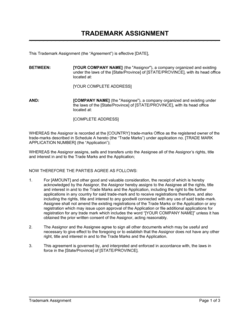
An IP assignment agreement permanently transfers ownership of a trademark from one party to another — after execution, the original owner has no rights. A trademark licensing agreement grants usage rights while the licensor retains ownership indefinitely. Choose an assignment when the brand is being sold as part of a business sale or divestiture; choose a license when the owner wants to monetize the mark while retaining long-term control.

Industry-specific considerations

Consumer Goods and Retail

Licensors grant rights to manufacturers to produce branded apparel, accessories, or homeware, with per-unit royalties and seasonal approval cycles for new product lines.

Entertainment and Media

Character and franchise trademarks are licensed for merchandise, video games, and promotional tie-ins, typically with advance royalties against a percentage of net sales and strict brand-usage guidelines.

Food and Beverage

Restaurant and consumer brand trademarks are licensed to co-packers, regional distributors, or ghost kitchen operators, with quality control provisions covering recipe compliance, sourcing standards, and packaging approval.

Technology and SaaS

Software companies license brand marks alongside APIs or SDKs, requiring co-branded product approval, restrictions on how the mark appears relative to the licensee's own brand, and immediate termination triggers tied to certification status.

Jurisdictional notes

United States

US trademark law under the Lanham Act requires licensors to exercise genuine quality control over licensees or risk a 'naked license' finding that can result in trademark abandonment. Non-exclusive licenses do not need to be recorded with the USPTO, but recordal is advisable for exclusive licenses and provides constructive notice. State franchise disclosure laws may apply if the license is combined with a fee and a business system, triggering FTC Franchise Rule requirements.

Canada

Under the Canadian Trademarks Act, a license must be in writing and the licensor must control the character or quality of the goods or services to avoid losing rights. Trademark licenses can be recorded with the Canadian Intellectual Property Office (CIPO). Provincial franchise legislation in Ontario, Alberta, British Columbia, and others may apply if the arrangement involves a fee and the right to sell goods or services associated with the licensor's trademark, triggering disclosure obligations under those statutes.

United Kingdom

UK trademark licenses may be recorded on the UK Intellectual Property Office (UKIPO) register and are enforceable against third parties once recorded. The Trade Marks Act 1994 distinguishes between exclusive and non-exclusive licensees, granting exclusive licensees broader rights to bring infringement proceedings. Post-Brexit, EU trademark licenses no longer automatically extend to the UK — separate UK license terms and recordal are required for marks originating from EU registrations.

European Union

EU trademark licenses can be recorded with the European Union Intellectual Property Office (EUIPO) for a single registration covering all member states. The EU Trademark Regulation (2017/1001) permits exclusive, non-exclusive, and territorial licenses. Recordal provides third-party enforceability. GDPR considerations apply when licensees collect consumer data on behalf of the brand — a data processing addendum may be required alongside the trademark license.

Template vs lawyer — what fits your deal?

PathBest forCostTime
Use the templateNon-exclusive licenses for lower-value marks, single-territory arrangements, or internal brand extensions with affiliated entitiesFree30–60 minutes
Template + legal reviewExclusive licenses, royalties above $50,000 annually, multi-territory arrangements, or licenses covering consumer products with safety implications$500–$2,0003–7 days
Custom draftedInternational licensing programs, franchise-adjacent arrangements, entertainment or celebrity brand licensing, or where the trademark is a primary business asset$3,000–$8,000+2–6 weeks

Glossary

Licensor
The party that owns the trademark and grants another party the right to use it under the agreement's terms.
Licensee
The party that receives the right to use the licensor's trademark within the scope defined by the agreement.
Exclusive License
A grant that prevents the licensor from authorizing any other party — including itself — to use the trademark in the same territory and category.
Non-Exclusive License
A grant that allows the licensor to issue the same rights to multiple licensees simultaneously in the same or overlapping territory.
Royalty
A recurring fee paid by the licensee to the licensor, typically calculated as a percentage of net sales of licensed products or services.
Quality Control
The licensor's contractual right to review and approve products, services, and marketing materials that bear its trademark, protecting brand standards and legal validity.
Naked License
A trademark license that lacks adequate quality control provisions — a defect that can cause the licensor to lose trademark rights through abandonment.
Sublicense
A right granted by the licensee to a third party to use the trademark, typically requiring prior written approval from the licensor.
Territory
The geographic area — country, region, or list of countries — within which the licensee is permitted to use the trademark.
Registered Trademark
A trademark that has been formally registered with a government intellectual property office, granting statutory rights and public notice of ownership.
Goodwill
The reputational value and consumer recognition associated with a trademark, which must inure to the benefit of the licensor under a valid licensing arrangement.
Termination for Cause
A provision allowing one party to end the agreement immediately upon a material breach by the other party, such as failure to pay royalties or loss of trademark registration.

Part of your Business Operating System

This document is one of 3,000+ business & legal templates included in Business in a Box.

  • Fill-in-the-blanks — ready in minutes
  • 100% customizable Word document
  • Compatible with all office suites
  • Export to PDF and share electronically

Create your document in 3 simple steps.

From template to signed document — all inside one Business Operating System.
1
Download or open template

Access over 3,000+ business and legal templates for any business task, project or initiative.

2
Edit and fill in the blanks with AI

Customize your ready-made business document template and save it in the cloud.

3
Save, Share, Send, Sign

Share your files and folders with your team. Create a space of seamless collaboration.

Save time, save money, and create top-quality documents.

★★★★★

"Fantastic value! I'm not sure how I'd do without it. It's worth its weight in gold and paid back for itself many times."

Managing Director · Mall Farm
Robert Whalley
Managing Director, Mall Farm Proprietary Limited
★★★★★

"I have been using Business in a Box for years. It has been the most useful source of templates I have encountered. I recommend it to anyone."

Business Owner · 4+ years
Dr Michael John Freestone
Business Owner
★★★★★

"It has been a life saver so many times I have lost count. Business in a Box has saved me so much time and as you know, time is money."

Owner · Upstate Web
David G. Moore Jr.
Owner, Upstate Web

Run your business with a system — not scattered tools

Stop downloading documents. Start operating with clarity. Business in a Box gives you the Business Operating System used by over 250,000 companies worldwide to structure, run, and grow their business.

Free Forever Plan · No credit card required