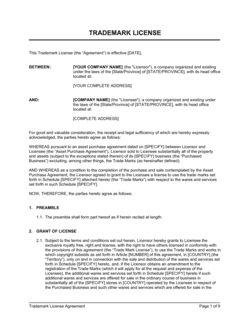
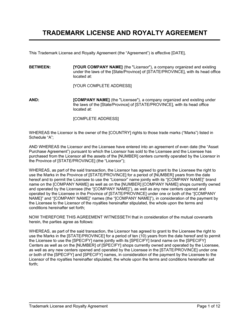
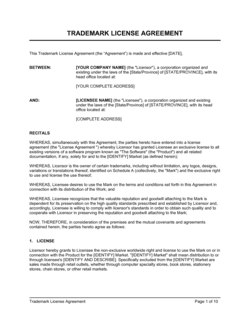
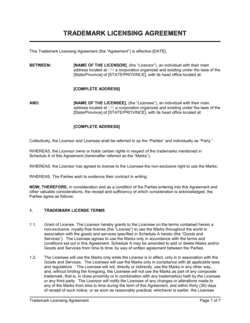
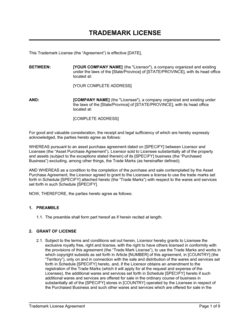
Trademark License Template

Free Word download • Edit online • Save & share with Drive • Export to PDF

5 pages25–35 min to fillDifficulty: ComplexSignature requiredLegal review recommended
Learn more ↓
FreeTrademark License Template

At a glance

What it is
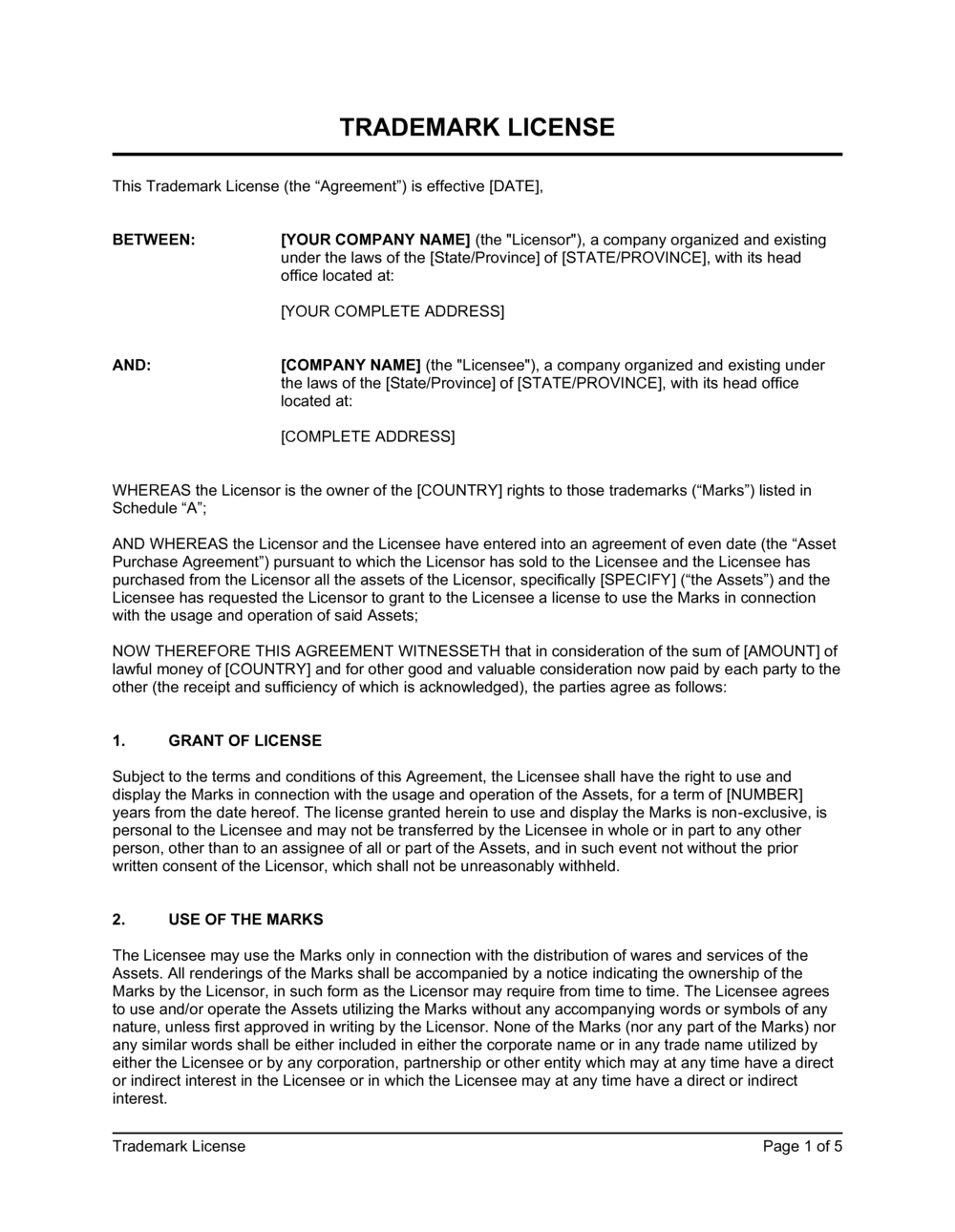
A Trademark License is a legally binding agreement in which a trademark owner (the licensor) grants another party (the licensee) the right to use a registered or common-law trademark — a brand name, logo, or slogan — under defined conditions. This free Word download is editable online and exportable as PDF, covering scope of use, territory, royalties, quality control, and termination in a single document.
When you need it
Use it whenever you permit a third party to use your brand mark on their products, services, or marketing — whether for a franchise arrangement, co-branded promotion, distributor relationship, or licensing revenue stream. It is equally necessary when you are the licensee formalizing permission to use another company's mark.
What's inside
Grant of license and permitted use, territory and exclusivity terms, royalty structure and payment schedule, quality control and approval rights, representations and warranties, indemnification, term and termination, and governing law.

What is a Trademark License?

A Trademark License is a legally binding agreement in which a trademark owner (the licensor) grants another party (the licensee) permission to use a registered or common-law trademark — a brand name, logo, slogan, or other identifier — within a defined scope, territory, and time period. Unlike a trademark assignment, the licensor retains full ownership of the mark and all goodwill it generates; the licensee receives only the right to use it under the conditions set out in the agreement. Trademark licenses underpin franchise systems, brand extensions, retail distribution deals, co-manufacturing arrangements, and co-branded promotions across virtually every industry.

The quality control obligation is the element that separates a valid trademark license from a legally dangerous one. Courts in the United States and other common-law jurisdictions have held that a licensor who grants use of a mark without genuinely controlling the quality of the associated goods or services issues what is called a "naked license" — and has, in several landmark cases, lost trademark rights entirely as a result. A properly drafted trademark license is therefore both a commercial arrangement and a legal housekeeping tool that keeps the underlying mark enforceable.

Why You Need This Document

Permitting another party to use your brand without a written trademark license exposes you to three concrete risks simultaneously. First, your trademark can be weakened or invalidated: uncontrolled third-party use is the legal definition of a naked license, and a court finding of naked licensing can strip you of the mark permanently — wiping out the brand equity you built. Second, you lose the ability to control how your brand appears in the market: without an approval process and quality standards in writing, a licensee's substandard products or inconsistent branding can damage consumer perception with no contractual remedy available. Third, you forgo the royalty and audit protections that define your revenue stream: without a documented royalty formula and audit rights, collecting what you are owed and verifying the numbers becomes a dispute rather than a routine process.

For licensees, operating without a signed agreement creates equally concrete exposure — every use of another party's mark without documented permission is potential infringement, and verbal arrangements evaporate precisely when the relationship deteriorates. This template gives both parties a clear, enforceable starting point: defined scope, royalties, quality controls, and exit terms, ready in Word format and exportable as PDF for signature before the first branded product ships or the first co-branded campaign goes live.

Which variant fits your situation?

If your situation is…Use this template
Granting exclusive rights in a single territory to one licenseeExclusive Trademark License Agreement
Allowing multiple licensees to use the same mark simultaneouslyNon-Exclusive Trademark License Agreement
Permitting the licensee to sublicense the mark to third partiesTrademark License with Sublicense Rights
Short-term promotional or co-branded campaign useCo-Branding Agreement
Licensing brand as part of a full franchise systemFranchise Agreement
Licensing both a trademark and related technology or know-howIntellectual Property License Agreement
Licensing a trademark in connection with a software productSoftware License Agreement

Common mistakes to avoid

❌ Granting a naked license with no genuine quality control

Why it matters: US courts have held that trademark owners who license without meaningful quality oversight can lose their trademark rights entirely — the mark is deemed abandoned because the owner no longer controls the nature of the goods it identifies.

Fix: Include a substantive quality control clause with sample approval rights, brand guideline compliance, and an audit mechanism. Document your actual exercise of those rights throughout the relationship.

❌ Failing to define 'Net Sales' before setting the royalty rate

Why it matters: Without a precise definition specifying which deductions are permitted — returns, discounts, shipping, taxes — licensees and licensors routinely reach opposite calculations, creating disputes that can unwind the entire agreement.

Fix: Define Net Sales explicitly in the definitions section, listing every permitted deduction individually. Standard exclusions are actual returns, trade discounts, and sales taxes collected on behalf of a government authority.

❌ Omitting minimum royalty or performance obligations in exclusive licenses

Why it matters: An exclusive licensee with no minimum obligations can sit on the mark, block competitors from using it, and pay nothing — effectively shelving the brand at no cost while the licensor loses revenue from other potential licensees.

Fix: Tie exclusivity to annual minimum royalties or sales thresholds. If the licensee fails to meet the minimum, the license either converts to non-exclusive or terminates.

❌ No change-of-control provision

Why it matters: Without one, a licensee can be acquired by a direct competitor, and the license — and your brand — travels with the acquisition by operation of law.

Fix: Include a clause stating that any change of control of the licensee constitutes an assignment requiring the licensor's prior written consent, which may be withheld in the licensor's sole discretion.

❌ Choosing a governing law with no nexus to the parties or the mark

Why it matters: Trademark law is territorial and registration-based. A governing law clause selecting an unrelated jurisdiction can leave the licensor without the trademark-specific remedies — seizure orders, border measures, statutory damages — available under the mark's registration jurisdiction.

Fix: Choose the law of the jurisdiction where the mark is registered, or where the majority of the licensed activity will occur. For international licenses, consider a neutral arbitration seat with trademark-experienced arbitrators.

❌ No post-termination obligations for the licensee

Why it matters: Without a clear wind-down obligation, a terminated licensee may continue selling branded inventory, maintain a branded website, or retain branded packaging — all of which can constitute infringement and create consumer confusion.

Fix: Include explicit post-termination obligations: immediate cessation of use, destruction or return of branded materials within a defined period, and a written certification of compliance.

The 10 key clauses, explained

Grant of license

In plain language: States whether the license is exclusive or non-exclusive, identifies the mark being licensed, and defines the permitted field of use — the specific products, services, or channels covered.

Sample language
Licensor hereby grants to Licensee a [exclusive / non-exclusive], non-transferable license to use the Licensed Mark solely in connection with [DESCRIPTION OF GOODS/SERVICES] in the Territory during the Term.

Common mistake: Failing to specify the field of use. A grant that says only 'use of the mark' without limiting it to specific products or channels can be interpreted to cover categories the licensor never intended.

Territory

In plain language: Defines the geographic boundaries within which the licensee may use the mark. This can be a single country, a list of countries, a region, or worldwide.

Sample language
The license granted herein is limited to the following territory: [COUNTRY / REGION / WORLDWIDE] ('Territory'). Any use of the Licensed Mark outside the Territory is expressly prohibited without prior written consent.

Common mistake: Leaving territory undefined or writing 'worldwide' without assessing whether existing licenses in other markets create conflicts with third-party rights.

Term and renewal

In plain language: Sets the start and end date of the license, and specifies whether it renews automatically, requires notice to renew, or expires without renewal.

Sample language
This Agreement shall commence on [START DATE] and continue for an initial term of [X] years ('Initial Term'), unless earlier terminated. This Agreement shall [automatically renew / expire] unless either party provides [X] days' written notice of non-renewal prior to the end of the then-current term.

Common mistake: Auto-renewal without a notice period. Licensors have inadvertently locked themselves into multi-year renewals they could not exit because the notice window passed unnoticed.

Royalties and payment terms

In plain language: Specifies how much the licensee pays, the calculation basis (percentage of net sales, fixed fee per unit, or flat annual fee), payment frequency, and audit rights.

Sample language
Licensee shall pay Licensor a royalty of [X]% of Net Sales of Licensed Products during each calendar quarter, due within [30] days of quarter-end, accompanied by a royalty statement. Licensor may audit Licensee's records upon [30] days' written notice, no more than once per calendar year.

Common mistake: Omitting the definition of 'Net Sales.' Disputes over what deductions (returns, taxes, shipping) are permitted when calculating the royalty base are among the most common trademark license disputes.

Quality control and approval

In plain language: Requires the licensee to meet defined quality standards, submit samples or proofs for licensor approval before first use and at intervals, and comply with brand guidelines.

Sample language
Licensee shall submit representative samples of all products, packaging, and marketing materials bearing the Licensed Mark to Licensor for approval before commercial use. Licensor shall have [15] business days to approve or reject each submission. Licensee shall not use the mark in a manner that, in Licensor's reasonable judgment, diminishes the goodwill associated with the mark.

Common mistake: Including a quality control clause in name only — without audit rights, sample review requirements, or consequences for non-compliance. Courts have found that nominal oversight without genuine control still constitutes a naked license.

Ownership and goodwill

In plain language: Confirms that the licensor retains all ownership of the mark and that all goodwill generated by the licensee's use inures to the licensor. Prevents the licensee from claiming any ownership interest.

Sample language
Licensee acknowledges that Licensor owns all right, title, and interest in and to the Licensed Mark. All use of the Licensed Mark by Licensee, and all goodwill arising from such use, shall inure solely to the benefit of Licensor. Licensee shall not contest or challenge Licensor's ownership of the Licensed Mark.

Common mistake: No goodwill inurement clause. Without it, a licensee who has been using a mark for years could theoretically argue it has acquired independent rights — particularly in jurisdictions that recognize use-based trademark rights.

Representations and warranties

In plain language: States what each party promises to be true — the licensor warrants it owns the mark and has authority to license it; the licensee warrants it will use the mark only as permitted.

Sample language
Licensor represents and warrants that: (a) it is the owner of the Licensed Mark; (b) it has the full right and authority to grant the license herein; and (c) to its knowledge, the Licensed Mark does not infringe any third-party rights. Licensee represents and warrants that it will use the Licensed Mark solely in accordance with this Agreement and Licensor's brand guidelines.

Common mistake: Licensor warranting 'non-infringement' absolutely rather than 'to licensor's knowledge.' An absolute IP warranty exposes the licensor to liability if an unknown prior mark surfaces after execution.

Indemnification

In plain language: Allocates liability between the parties — typically the licensor indemnifies against third-party claims arising from the mark itself, and the licensee indemnifies against claims arising from its use of the mark.

Sample language
Licensor shall indemnify Licensee against third-party claims arising from Licensor's ownership or registration of the Licensed Mark. Licensee shall indemnify Licensor against all claims, losses, and expenses arising from Licensee's use of the Licensed Mark, including any unauthorized use or use that departs from the approved brand guidelines.

Common mistake: One-sided indemnification that places all risk on the licensee. A balanced structure protects both parties and is more likely to hold up when challenged in disputes.

Termination and post-termination obligations

In plain language: Defines the events that allow either party to terminate — breach, insolvency, challenge to the mark — and what the licensee must do after termination: cease use, destroy materials, and confirm compliance.

Sample language
Either party may terminate this Agreement upon [30] days' written notice if the other party materially breaches and fails to cure within the notice period. Upon termination, Licensee shall immediately cease all use of the Licensed Mark, destroy or return all materials bearing the mark, and certify destruction in writing within [15] days.

Common mistake: No cure period for breach. Immediate termination rights on first breach — without giving the breaching party a chance to remedy — can be disproportionate and, in some jurisdictions, unenforceable.

Governing law and dispute resolution

In plain language: Specifies which jurisdiction's law governs the agreement and how disputes are resolved — litigation, arbitration, or mediation first.

Sample language
This Agreement shall be governed by the laws of [STATE / PROVINCE / COUNTRY], without regard to conflict-of-law principles. Any dispute arising hereunder shall be submitted to binding arbitration administered by [AAA / ICC / LCIA] in [CITY], except that either party may seek injunctive relief in any court of competent jurisdiction.

Common mistake: Choosing a governing law with no connection to either party's location or the mark's registration jurisdiction. Some trademark-specific protections are jurisdiction-dependent and choosing an unrelated governing law can create gaps.

How to fill it out

  1. 1

    Identify the parties and the licensed mark precisely

    Enter the licensor's and licensee's full legal entity names, jurisdictions of formation, and registered addresses. Identify the mark by its exact form — the word mark, logo, or both — and include registration number(s) if registered.

    💡 Attaching a Schedule A with a visual reproduction of each mark eliminates ambiguity about what is and is not covered by the license.

  2. 2

    Define the scope: field of use and territory

    Specify exactly which product categories, service lines, or distribution channels are covered. Set the geographic territory — list countries explicitly rather than using broad terms like 'the Americas' that can be disputed.

    💡 Narrow the field of use to what the licensee actually needs today. Expanding scope later via amendment is straightforward; retracting an overly broad grant is not.

  3. 3

    Choose exclusivity and document the business rationale

    Decide whether the license is exclusive or non-exclusive. If exclusive, confirm no conflicting licenses already exist in that territory. Document the business rationale in your files — this supports enforcement and valuation later.

    💡 An exclusive license typically commands a higher royalty or upfront fee. If you are granting exclusivity, ensure the licensee has minimum performance obligations (minimum annual royalties) to keep the exclusivity.

  4. 4

    Set the royalty structure and define net sales

    Enter the royalty rate or fee, payment frequency, and the definition of 'Net Sales' including permitted deductions. Add minimum royalty commitments if granting exclusivity, and specify the audit rights and record-keeping obligations.

    💡 A quarterly payment cycle with a 30-day payment window is standard. Annual payments increase your collection risk if the relationship deteriorates late in the year.

  5. 5

    Draft quality control procedures with real substance

    Define the quality standards the licensee must meet, the sample submission and approval process, and the consequences of non-compliance. Reference any brand guidelines as an exhibit.

    💡 A quality control clause with no enforcement mechanism is legally equivalent to a naked license. At minimum, include an annual review right and the ability to terminate if standards fall below an objectively defined threshold.

  6. 6

    Address sublicensing, assignment, and change of control

    State explicitly whether the licensee may sublicense or assign the agreement. Include a change-of-control provision terminating or requiring consent for the license if the licensee is acquired.

    💡 Most licensors prohibit sublicensing without prior written consent. A change-of-control clause prevents your mark from ending up under the control of a competitor through an acquisition.

  7. 7

    Set term, renewal, and termination triggers

    Enter start and end dates, renewal mechanics, and the full list of termination triggers — breach, insolvency, challenge to the mark's validity, and cessation of business. Include a post-termination wind-down period for selling through existing inventory.

    💡 A 90-day sell-off period for existing licensed inventory is standard and prevents the licensee from suffering a windfall loss from immediate cessation.

  8. 8

    Execute before the licensee makes any use of the mark

    Both parties must sign before the licensee begins using the mark. Retroactive licenses create gaps in quality control coverage and may compromise the mark's enforceability during the uncovered period.

    💡 Use dated signature blocks and consider countersigning in a single session — email exchanges with unsigned drafts can create confusion about which version governs.

Frequently asked questions

What is a trademark license?

A trademark license is a legal agreement in which a trademark owner (the licensor) grants another party (the licensee) the right to use a brand name, logo, or other registered mark under defined conditions. The licensor retains ownership of the mark and all goodwill generated by the licensee's use. A well-drafted trademark license sets out the scope of permitted use, territory, royalties, quality standards, and what happens at termination.

What is the difference between an exclusive and a non-exclusive trademark license?

An exclusive license grants the licensee sole rights to use the mark within a defined scope or territory — the licensor cannot license the same mark to anyone else in that space. A non-exclusive license allows the licensor to grant the same rights to multiple licensees simultaneously. Exclusive licenses typically command higher royalties or upfront fees and should include minimum performance obligations to prevent the licensee from shelving the brand without using it.

Why is a quality control clause required in a trademark license?

Trademark law requires owners to control the nature and quality of goods or services sold under their mark. A license that grants use without any quality oversight is called a 'naked license' and courts in the United States and other jurisdictions have held that naked licenses can result in the trademark owner losing their rights entirely. A quality control clause — with sample approvals, brand guidelines, and audit rights — is not optional; it is what keeps the mark legally valid.

Does a trademark license need to be registered?

In the United States, recording a trademark license with the USPTO is not required for the license to be valid between the parties, but it provides constructive notice to third parties. In several other jurisdictions — including parts of the EU and many countries in Latin America and Asia — recording the license with the national trademark office is required for the licensee's use to count as use by the owner for renewal purposes. Always check local requirements before relying solely on the signed agreement.

Can a trademark licensee sublicense the mark to others?

Only if the license agreement expressly permits sublicensing. By default, trademark licenses are personal to the licensee and cannot be sublicensed or assigned without the licensor's written consent. If sublicensing is permitted, the agreement should require that any sublicense contains quality control obligations at least as stringent as those in the master license, and that the licensor is named as a third-party beneficiary of those obligations.

What royalty rate is standard for a trademark license?

Rates vary widely by industry and mark strength. Consumer goods licenses for recognizable brands typically range from 3–8% of net sales. Fashion and luxury brand licenses commonly run 10–15%. Character and entertainment licenses can reach 15–20%. Factors affecting the rate include the mark's commercial recognition, the exclusivity of the grant, the licensee's distribution volume, and the level of marketing support the licensor provides. A fixed annual fee or per-unit fee is common for simpler arrangements.

What happens to the trademark if the licensee goes bankrupt?

Trademark licenses are generally treated as executory contracts in bankruptcy. In the United States, a bankrupt licensee's trustee may assume or reject the license. If rejected, the licensor typically regains full control of the mark. However, the licensor's ability to terminate and recover the mark quickly depends on the contract having a clear insolvency-triggered termination clause and on the applicable bankruptcy court's interpretation. A well-drafted agreement addresses this explicitly.

How is a trademark license different from a trademark assignment?

An assignment transfers ownership of the mark permanently from the original owner to the buyer — the assignor retains no rights. A license grants temporary permission to use the mark while the licensor retains ownership. Assignments are typically one-time transactions recorded with the trademark office; licenses are ongoing relationships with royalty payments, quality controls, and expiration dates. If your intent is to monetize the mark while keeping it, use a license. If you are selling the mark outright, use an assignment.

Do I need a lawyer to draft a trademark license?

For straightforward domestic licenses with a known partner, a high-quality template reviewed by your legal counsel is generally adequate. Engage a trademark attorney for international licenses in jurisdictions with recording requirements, exclusive licenses with material royalty streams, licenses involving famous or high-value marks, or any situation where the licensee could challenge the mark's validity. The cost of a template review is typically $500–$1,500 and is warranted for any license generating more than $10,000 per year in royalties.

What is a co-existence agreement, and how does it differ from a trademark license?

A co-existence agreement is made between two parties who each own similar marks in different markets or categories, agreeing not to challenge each other's rights within their respective territories or fields. A trademark license, by contrast, involves a single owner granting use rights to another party. Co-existence agreements delineate boundaries between competing owners; trademark licenses establish a controlled use relationship between an owner and a non-owner.

How this compares to alternatives

vs Trademark Assignment

A trademark assignment permanently transfers full ownership of the mark to the buyer — the seller has no further rights or royalty stream. A trademark license grants temporary, controlled use while the licensor retains ownership and ongoing royalties. Use an assignment when you are selling the mark outright; use a license when you want to monetize it while keeping ownership.

vs Intellectual Property License Agreement

An IP license agreement covers a broader bundle of intellectual property — patents, trade secrets, copyrights, and trademarks together. A trademark license focuses exclusively on brand marks. If the commercial relationship involves both a brand and underlying technology or know-how, an IP license agreement or a combined license with separate schedules per IP type is more appropriate.

vs Franchise Agreement

A franchise agreement grants the right to operate a complete business system — including the trademark, business model, operations manual, and support obligations — under a franchisor's brand. A trademark license grants only the right to use the mark itself. Franchises are heavily regulated in many jurisdictions and require disclosure documents; trademark licenses generally are not.

vs Co-Branding Agreement

A co-branding agreement covers a promotional or product partnership between two independent brand owners, where both marks appear together temporarily. A trademark license is a longer-term arrangement granting one party ongoing rights to use the other's mark. Co-branding agreements typically do not involve royalties or quality control obligations as extensive as a trademark license.

Industry-specific considerations

Consumer Goods and Retail

Licensed brand applied to physical products requires detailed approval of packaging, labeling, and point-of-sale materials before distribution.

Franchise and Hospitality

Trademark license is typically one component of a broader franchise agreement, requiring alignment between the brand license and the operations manual obligations.

Technology and SaaS

Co-branding and OEM arrangements involve licensing marks for use in software interfaces, app stores, and partner marketing — quality control must extend to digital brand usage guidelines.

Entertainment and Media

Character marks and entertainment IP licenses carry high royalty rates (10–20%), strict approval chains for every product category, and short terms tied to content release windows.

Manufacturing

Brand owners license marks to contract manufacturers who apply the mark to finished goods, requiring quality audits of production facilities and strict labeling controls.

Professional Services

Licensing a professional certification or association mark requires compliance with membership standards and ongoing credential verification as a condition of continued use.

Jurisdictional notes

United States

US trademark rights are use-based and registration is not required for a license to be valid between the parties. However, the quality control doctrine is strictly applied — courts have invalidated marks for naked licensing. Recording the license with the USPTO is optional but provides constructive notice. Non-compete and exclusivity terms in trademark licenses are generally enforceable when reasonable in scope.

Canada

Under the Canadian Trademarks Act, a licensee's use of a mark accrues to the owner's benefit only if the owner has direct or indirect control of the character or quality of the goods or services. Recording the license with CIPO is not mandatory but is recommended for the owner's use claims to be uncontested. Quebec licensees may require French-language contract versions under the Charter of the French Language.

United Kingdom

The UK Trade Marks Act 1994 recognizes registered and unregistered licenses. A registered licensee can record the license at the UK IPO, which gives third-party notice and allows the licensee to bring infringement proceedings in some circumstances. Quality control obligations are not codified as strictly as in the US but remain important for maintaining distinctiveness. Post-Brexit, EU trademark registrations no longer cover the UK.

European Union

EU trademark licenses can be recorded in the EUIPO register and with national trademark offices in member states. Recording is not required for validity but is recommended for the licensee to invoke rights against third-party infringers. GDPR considerations apply if the quality control process involves transferring personal data between licensor and licensee. National laws on sublicensing and assignment vary by member state.

Template vs lawyer — what fits your deal?

PathBest forCostTime
Use the templateNon-exclusive domestic licenses with known partners, low royalty values, and straightforward brand guidelinesFree30–60 minutes
Template + legal reviewExclusive licenses, royalty streams above $10,000 per year, or licensees operating in multiple countries$500–$1,5003–5 business days
Custom draftedHigh-value marks, international licenses with local recording requirements, franchise-adjacent arrangements, or licensees in regulated industries$2,000–$8,000+2–4 weeks

Glossary

Licensor
The trademark owner who grants permission to another party to use the mark under defined conditions.
Licensee
The party who receives the right to use the trademark as defined by the license agreement.
Licensed Mark
The specific trademark — name, logo, slogan, or other identifier — that is the subject of the license grant.
Exclusive License
A grant that prevents the licensor from licensing the same mark to any other party within the agreed scope or territory.
Non-Exclusive License
A grant that allows the licensor to simultaneously license the same mark to other parties.
Royalty
A periodic payment made by the licensee to the licensor, typically calculated as a percentage of net sales or a fixed fee per unit sold.
Quality Control Clause
A provision requiring the licensor to maintain oversight of how the licensee uses the mark, essential for preventing trademark abandonment through a 'naked license.'
Naked License
A trademark license that lacks any quality control provisions — courts have held that naked licenses can result in the licensor losing trademark rights entirely.
Sublicense
Permission granted by a licensee to a third party to use the mark, which requires express authorization from the original licensor in the license agreement.
Goodwill
The commercial reputation and consumer recognition associated with a trademark, which accrues to the licensor even when the mark is used by a licensee.
Territory
The geographic area — country, region, or worldwide — within which the licensee is permitted to use the mark.
Inurement
The legal principle that all goodwill generated by the licensee's use of the mark inures to the benefit of the licensor, not the licensee.

Part of your Business Operating System

This document is one of 3,000+ business & legal templates included in Business in a Box.

  • Fill-in-the-blanks — ready in minutes
  • 100% customizable Word document
  • Compatible with all office suites
  • Export to PDF and share electronically

Create your document in 3 simple steps.

From template to signed document — all inside one Business Operating System.
1
Download or open template

Access over 3,000+ business and legal templates for any business task, project or initiative.

2
Edit and fill in the blanks with AI

Customize your ready-made business document template and save it in the cloud.

3
Save, Share, Send, Sign

Share your files and folders with your team. Create a space of seamless collaboration.

Save time, save money, and create top-quality documents.

★★★★★

"Fantastic value! I'm not sure how I'd do without it. It's worth its weight in gold and paid back for itself many times."

Managing Director · Mall Farm
Robert Whalley
Managing Director, Mall Farm Proprietary Limited
★★★★★

"I have been using Business in a Box for years. It has been the most useful source of templates I have encountered. I recommend it to anyone."

Business Owner · 4+ years
Dr Michael John Freestone
Business Owner
★★★★★

"It has been a life saver so many times I have lost count. Business in a Box has saved me so much time and as you know, time is money."

Owner · Upstate Web
David G. Moore Jr.
Owner, Upstate Web

Run your business with a system — not scattered tools

Stop downloading documents. Start operating with clarity. Business in a Box gives you the Business Operating System used by over 250,000 companies worldwide to structure, run, and grow their business.

Start free · No credit card required