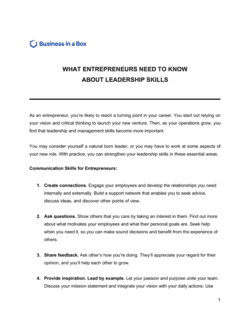
The Participative Approach To Leadership Template

Free Word download • Edit online • Save & share with Drive • Export to PDF

3 pages25–30 min to fillDifficulty: StandardSignature requiredLegal review recommended
Learn more ↓
FreeThe Participative Approach To Leadership Template

At a glance

What it is
A Participative Approach to Leadership agreement is a binding organizational document that formalizes how decision-making authority is shared between management and employees or team members. This free Word download defines consultation rights, voting thresholds, escalation procedures, and governance safeguards in a single structured document you can edit online and export as PDF.
When you need it
Use it when transitioning from a top-down management structure to a collaborative model, when formalizing employee involvement in strategic or operational decisions, or when a board, investor, or regulator requires documented governance procedures for shared leadership arrangements.
What's inside
Scope of participative authority, consultation and voting procedures, decision escalation framework, confidentiality obligations for deliberative information, conflict-of-interest disclosures, implementation timelines, amendment procedures, and governing law. Each clause defines the boundaries of shared authority so no party operates beyond their documented mandate.

What is a Participative Approach to Leadership Agreement?

A Participative Approach to Leadership Agreement is a binding organizational document that formally structures how decision-making authority is shared between management and employees or designated participant groups. Unlike a general management policy or employee handbook statement, it creates enforceable rights and obligations on all parties: it defines which categories of decisions require collective input, the procedures for consultation and voting, the thresholds for a binding decision, veto and reserved-power protections for management, and the escalation path when agreement cannot be reached. The document translates a leadership philosophy — one that values employee voice and collaborative governance — into a legally operative framework with clear accountability mechanisms.

Why You Need This Document

Without a formal participative leadership agreement, organizations that adopt collaborative decision-making models operate in a governance vacuum. Employees who believe they have input rights but find no documented procedure for exercising them will escalate informally or raise claims that management acted without required consultation. Managers who lack a clear definition of which decisions are covered — and which are reserved — face accusations of bypassing the participative model every time they act unilaterally. In jurisdictions with statutory information and consultation requirements (the UK's ICE Regulations, the EU's Information and Consultation Directive, and Canada's provincial labor codes), operating a participative program without documented procedures exposes the organization to regulatory enforcement. A properly executed agreement closes all of these gaps: it gives participants a concrete enforcement mechanism, gives management a defensible scope of authority, and gives the organization a documented governance record that satisfies both regulators and investors who require evidence of structured internal governance.

Which variant fits your situation?

If your situation is…Use this template
Establishing participative governance for a worker cooperativeCooperative Governance Agreement
Formalizing employee input on strategic planning onlyEmployee Consultation Policy
Shared leadership between two or more co-founders or co-executivesCo-Leadership Agreement
Board-level employee representation with voting rightsBoard Observer or Director Appointment Agreement
Participative decision-making limited to a single department or teamTeam Charter and Decision-Making Policy
Documenting shared authority within a joint ventureJoint Venture Agreement
Transitioning a partnership to shared governance with documented rolesPartnership Agreement

Common mistakes to avoid

❌ Defining covered decisions too broadly

Why it matters: Requiring collective input on routine operational matters bogs down day-to-day management and creates procedural liability every time a manager acts without triggering the consultation process.

Fix: Limit covered decisions to material categories — budget variances above a defined threshold, headcount changes, restructuring — and use a Schedule to list them explicitly.

❌ No escalation or deadlock-resolution mechanism

Why it matters: Without a defined path out of disagreement, a single impasse can freeze operations for weeks and expose the organization to claims that the participative process was used in bad faith.

Fix: Include a two-stage escalation clause with hard deadlines — internal review within 5 days, external mediation within 15 — and name the governing body that holds final decision-making authority.

❌ Allowing unilateral management amendment

Why it matters: If the organization can change the agreement without participant consent, no participant will trust the framework — and courts in several jurisdictions treat unilateral amendment of a governance agreement as a breach of good faith.

Fix: Require a two-thirds participant vote plus 30 days' written notice for any amendment, and document each amendment as a signed addendum to the original agreement.

❌ Omitting post-termination confidentiality obligations

Why it matters: Participants who leave the group or organization retain access to deliberative information — financial projections, personnel decisions, strategic plans — shared during consultations. A clause that expires at termination leaves this information unprotected.

Fix: Include a survival clause extending confidentiality obligations for 2–3 years after a participant leaves the group, consistent with your standard NDA terms.

❌ Using unanimous consent as the default decision threshold

Why it matters: A single participant can block any decision indefinitely, incentivizing bad-faith obstruction and making the participative framework functionally unworkable.

Fix: Use a simple majority for routine decisions and a two-thirds supermajority for structural changes. Reserve unanimous consent only for amendments to the agreement itself.

❌ Executing the agreement after the participative program has already launched

Why it matters: Once participants are already engaged and forming expectations, they can negotiate from a position of entitlement rather than agreement — and post-launch signatures may be challenged for lack of fresh consideration.

Fix: Execute the agreement before the program is announced internally, and include an effective date that predates the first consultation session.

The 10 key clauses, explained

Parties and Scope of Authority

In plain language: Identifies all parties bound by the agreement and defines the precise categories of decisions subject to the participative process versus those reserved exclusively for management or the board.

Sample language
This Agreement governs the participative decision-making process between [ORGANIZATION LEGAL NAME] ('Organization') and [PARTICIPANT GROUP / EMPLOYEE COUNCIL NAME] ('Participants') with respect to [SCOPE OF DECISIONS, e.g., annual operating budget, headcount changes above [X] FTEs, and departmental restructuring].

Common mistake: Defining scope so broadly that routine operational decisions require collective input — this creates procedural bottlenecks and erodes management's ability to act quickly in time-sensitive situations.

Consultation Procedure and Timelines

In plain language: Sets out the required steps for consulting participants before a covered decision is made, including notice periods, information disclosure obligations, and the window for participant input.

Sample language
The Organization shall provide Participants with no less than [X] business days' written notice of any covered decision, together with all material information reasonably necessary for informed consultation. Participants shall submit written input within [Y] business days of receipt.

Common mistake: Failing to specify what 'material information' means — leaving management to decide what to share, which undermines the participation right and invites disputes about whether the consultation was genuine.

Voting Rights and Decision Thresholds

In plain language: Specifies which participants have voting rights, the quorum required for a vote to be valid, and the threshold — simple majority, supermajority, or unanimous consent — needed for a collective decision to bind the organization.

Sample language
Decisions under this Agreement shall be made by [simple majority / two-thirds supermajority] of eligible Participants, provided a quorum of [X]% of eligible Participants is present or represented. Voting may be conducted [in person / electronically] with results recorded in writing within [24] hours.

Common mistake: Using unanimous consent as the default threshold for all decisions. A single dissenter can block any action, making the entire framework unworkable and incentivizing bad-faith obstruction.

Management Veto and Reserved Powers

In plain language: Reserves specific categories of decisions exclusively for management or the board, and grants a defined veto right over collective decisions that conflict with legal obligations, fiduciary duties, or strategic constraints.

Sample language
Notwithstanding any collective decision by Participants, the [Board / CEO / Managing Director] retains sole authority over [RESERVED MATTERS, e.g., equity issuances, acquisitions, regulatory filings, and emergency expenditures]. The [DESIGNATED OFFICER] may veto any collective decision that conflicts with applicable law, the Organization's governing documents, or a material contractual obligation.

Common mistake: Omitting a reserved-powers clause entirely. Without it, participants may claim authority over matters — such as equity compensation or key executive hiring — that create legal liability if decided by a non-fiduciary group.

Escalation and Deadlock Resolution

In plain language: Defines the process for resolving disagreements between management and participants, including time limits for escalation, the authority to which disputes are escalated, and whether mediation or arbitration applies.

Sample language
If the Organization and Participants cannot reach agreement on a covered decision within [X] business days of the initial consultation, either party may escalate to the [ESCALATION AUTHORITY, e.g., Executive Committee / Independent Mediator]. If no resolution is reached within a further [Y] days, the [GOVERNING BODY] shall have final and binding decision-making authority.

Common mistake: No escalation clause at all — leaving the agreement silent on deadlocks. Without a resolution mechanism, operational paralysis becomes the default outcome of any serious disagreement.

Confidentiality of Deliberative Information

In plain language: Requires participants to keep internal proposals, financial data, personnel matters, and other sensitive information shared during the consultation process strictly confidential.

Sample language
All Deliberative Information disclosed to Participants in connection with any covered decision shall be treated as confidential and shall not be disclosed to any third party without the prior written consent of the Organization. This obligation survives termination of this Agreement for a period of [X] years.

Common mistake: Restricting confidentiality only to the consultation period and failing to include a post-termination tail. Former participants remain in possession of sensitive information after they leave the group.

Conflict of Interest and Disclosure

In plain language: Requires participants to disclose any personal, financial, or professional interest that could affect their impartiality on a covered decision, and establishes a recusal procedure.

Sample language
Each Participant shall disclose in writing any Conflict of Interest with respect to a covered decision as soon as it becomes known and no later than [48] hours before any vote or formal consultation. A Participant with a disclosed Conflict of Interest shall recuse themselves from deliberation and voting on the affected decision.

Common mistake: Defining conflict of interest by example only — listing specific scenarios without a general catch-all. Novel situations that are not listed go undisclosed, creating governance risk.

Implementation and Accountability

In plain language: Sets out who is responsible for implementing collective decisions, the timeline for implementation, and how progress will be reported back to participants.

Sample language
Collective decisions ratified under this Agreement shall be implemented by [RESPONSIBLE OFFICER / DEPARTMENT] within [X] business days unless a longer implementation period is approved in writing by Participants. A written status update shall be provided to Participants within [Y] days of the implementation deadline.

Common mistake: No implementation accountability clause. Participants ratify decisions and then receive no follow-through — corroding trust in the entire participative model and undermining future engagement.

Amendment Procedure

In plain language: Specifies how and when the terms of this agreement can be changed, including required notice, the vote threshold for amendments, and the documentation standard.

Sample language
This Agreement may be amended only by written instrument signed by [ORGANIZATION REPRESENTATIVE] and approved by no less than [two-thirds] of eligible Participants, with no less than [30] days' prior written notice of the proposed amendment provided to all parties.

Common mistake: Allowing the organization to amend the agreement unilaterally by management decision. This defeats the entire purpose of a participative framework and exposes the organization to claims of bad faith.

Governing Law and Dispute Resolution

In plain language: States which jurisdiction's law governs the agreement and how disputes — including those about the scope or exercise of participative rights — will be resolved.

Sample language
This Agreement is governed by the laws of [STATE / PROVINCE / COUNTRY]. Any dispute arising out of or relating to this Agreement shall be submitted to [binding arbitration / mediation followed by arbitration] administered by [ARBITRATION BODY] in [CITY], except where injunctive relief is required to prevent immediate irreparable harm.

Common mistake: Choosing a governing jurisdiction that has no connection to where employees work or where the organization is registered. Courts in the employee's actual jurisdiction may apply local employment or labor law regardless of the contractual choice.

How to fill it out

  1. 1

    Identify the parties and define the participant group

    Enter the organization's full legal name and precisely define who constitutes the 'Participants' — a named employee council, all employees above a certain level, or a specific committee. Ambiguity about who is covered is the single most litigated issue in participative governance documents.

    💡 If the participant group will change over time (e.g., new hires, departures), include a mechanism — such as an election or appointment process — in a Schedule A rather than in the body of the agreement.

  2. 2

    Map which decisions are covered and which are reserved

    List every category of decision subject to the participative process in a Schedule B. For each category, note whether participants have a consultation right only or a binding vote. Then list reserved management powers explicitly — anything not on the reserved list may be claimed by participants.

    💡 Start with a short list of high-stakes covered decisions (budget, headcount, restructuring) rather than a broad all-inclusive scope. You can expand coverage by amendment once the process matures.

  3. 3

    Set consultation timelines and information disclosure standards

    Fill in the notice period (typically 5–10 business days for most decisions), the categories of information the organization must provide, and the format for participant input. Precision here prevents disputes about whether the consultation obligation was met.

    💡 Build in an 'emergency exception' for decisions that cannot wait for the full consultation window — but require written rationale and retroactive participant notification within 48 hours.

  4. 4

    Define voting thresholds and quorum requirements

    Choose decision thresholds proportionate to the importance of each decision category. A simple majority works for routine operational decisions; a two-thirds supermajority is appropriate for structural changes. Set quorum at a level achievable in practice — 50–60% of eligible participants is standard.

    💡 Test your quorum number against your actual participant group size. If 60% quorum requires 18 people in a 30-person group, confirm that attendance is realistically achievable given work schedules and locations.

  5. 5

    Draft the escalation and deadlock procedure

    Name the specific escalation authority — not just 'senior management' — and set hard deadlines for each escalation stage. If external mediation or arbitration applies, name the administering body and the seat of arbitration.

    💡 A two-stage escalation (internal review → external mediation) resolves most deadlocks without arbitration costs. Reserve binding arbitration for disputes that exhaust the internal stages.

  6. 6

    Complete the confidentiality and conflict-of-interest clauses

    Define 'Deliberative Information' by reference to categories — financial projections, personnel matters, strategic plans, third-party proposals — rather than a vague 'all information shared.' Enter the post-termination confidentiality period (typically 2–3 years). Add a general catch-all to the conflict-of-interest definition.

    💡 Cross-reference the confidentiality clause with any existing NDA or employee handbook confidentiality policy to avoid conflicting standards.

  7. 7

    Specify the governing law and execute before implementation

    Choose the governing jurisdiction based on where the organization is registered and where the majority of participants work. Obtain signatures from the authorized organizational representative and, where the agreement covers a formal employee council, from the council's elected or appointed representative.

    💡 Execute this agreement before announcing the participative program to staff — post-announcement execution creates a leverage dynamic where participants can negotiate terms from a position of expectation rather than agreement.

Frequently asked questions

What is a participative approach to leadership agreement?

A participative approach to leadership agreement is a binding organizational document that formalizes how employees or team members share in the decision-making process with management. It defines which decisions require collective input, how consultations are conducted, what voting thresholds apply, and how disputes are resolved. Unlike a general management policy, it creates enforceable rights and obligations on all parties and is typically signed by organizational leadership and a designated participant representative.

Is a participative leadership agreement legally binding?

Yes, when properly drafted and executed, a participative leadership agreement is generally enforceable as a binding contract between the organization and its participants. Enforceability depends on whether the agreement meets the basic requirements of a valid contract in the governing jurisdiction — offer, acceptance, and consideration. In employment contexts, consideration typically consists of the organization's promise to consult and the participants' promise to engage constructively. Legal review is recommended before execution, particularly where the agreement interacts with existing employment contracts or collective bargaining agreements.

When should a business use a participative leadership framework?

A participative framework is most effective when decisions benefit from diverse operational input — annual budgeting, process redesign, workplace policy changes, and strategic planning. Organizations transitioning from hierarchical management, implementing employee ownership structures, or operating in industries where employee expertise is central to operational quality (healthcare, professional services, technology) gain the most from a formalized participative model. It is also required in some jurisdictions for businesses above a certain employee threshold.

What decisions should be excluded from a participative leadership agreement?

Reserved management powers should include legally or fiducially sensitive decisions: equity issuances, mergers and acquisitions, regulatory filings, executive compensation, terminations for cause, and emergency expenditures. These require speed, confidentiality, or fiduciary authority that cannot be shared with a participant group. Any decision that legally requires board approval under the organization's articles or governing documents should also be explicitly excluded from the participative scope.

How does a participative leadership agreement interact with existing employment contracts?

A participative leadership agreement supplements — rather than replaces — individual employment contracts. It operates at the organizational or group level and does not alter individual compensation, duties, or termination rights unless the employment contracts are separately amended. Where an existing employment contract or collective bargaining agreement already addresses consultation or participation rights, the participative agreement must be consistent with those provisions or the conflict must be resolved by explicit supersession language. Legal review is essential wherever both instruments coexist.

What is the difference between participative leadership and democratic management?

Participative leadership gives employees meaningful input into decisions while management retains ultimate authority — consultation rights and voting thresholds apply to defined categories of decisions, but a governing body veto and reserved powers clause preserve managerial accountability. Democratic management typically implies that the majority vote of all employees is binding on management without a veto mechanism. Most formal governance agreements use the participative model precisely because it balances employee voice with the legal accountability that management and directors carry under corporate law.

Do I need a lawyer to draft a participative leadership agreement?

For straightforward internal governance arrangements in a single jurisdiction, a high-quality template provides sufficient structure for most organizations. Engage a lawyer when the agreement interacts with a collective bargaining agreement, when the participant group includes directors or equity holders with fiduciary duties, when the organization operates across multiple jurisdictions with different labor law requirements, or when the agreement grants participants binding votes on matters that have regulatory implications. A 1–2 hour template review typically costs $300–$600 and is worthwhile for any organization with more than 25 participants.

What quorum and voting thresholds are typical in participative leadership agreements?

A quorum of 50–66% of eligible participants is standard for most organizations, ensuring decisions reflect a genuine majority without making attendance impractical. Simple majority (50% plus one) applies to routine operational decisions; a two-thirds supermajority is appropriate for structural changes such as amendments to the agreement itself, major policy shifts, or decisions affecting the scope of the participative framework. Unanimous consent is generally reserved for amendments to reserved management powers, where the stakes of getting it wrong are highest.

How should disputes about the participative process be resolved?

Most disputes arise from disagreements about whether the consultation obligation was properly fulfilled — did the organization share sufficient information within the required timeframe? A well-drafted escalation clause handles these by providing an internal review step (typically 5 business days), followed by external mediation if unresolved, and binding arbitration as a final backstop. Courts in most jurisdictions will enforce arbitration clauses in organizational governance agreements, making arbitration preferable to litigation for cost and confidentiality reasons.

How this compares to alternatives

vs Employee Handbook

An employee handbook describes company policies, culture, and general management philosophy in an informational format — it does not create enforceable consultation rights or binding governance procedures. A participative leadership agreement is a contract with defined obligations, thresholds, and remedies. Use the handbook to communicate the existence and intent of the program; use the agreement to make it legally binding.

vs Partnership Agreement

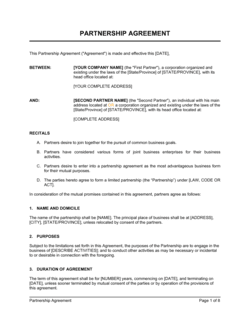
A partnership agreement governs the legal relationship and financial rights between co-owners of a business. A participative leadership agreement governs how employees or non-owner participants share in decision-making without granting ownership rights. If participants hold equity, a partnership or shareholder agreement must also be in place — the two documents serve distinct functions and should cross-reference each other.

vs Joint Venture Agreement

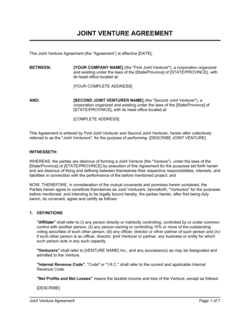
A joint venture agreement defines shared governance and profit-sharing between two or more independent legal entities forming a new venture. A participative leadership agreement operates within a single organization, distributing decision-making input among employees or internal groups without creating a separate legal entity. Both require clear escalation mechanisms but address fundamentally different governance structures.

vs Employment Contract

An employment contract governs the bilateral relationship between an employer and an individual employee — duties, compensation, IP, and termination. A participative leadership agreement governs the collective decision-making relationship between the organization and a group of participants. They operate at different levels and should not be conflated; individual employment contracts should be updated to acknowledge the existence of the participative framework.

Industry-specific considerations

Technology / SaaS

Engineering and product teams routinely use participative models for sprint planning, technical architecture decisions, and product roadmap prioritization — the agreement formalizes input rights that are otherwise informal.

Healthcare

Clinical staff participation in care protocol design, resource allocation, and safety policy is both a quality-of-care imperative and a regulatory expectation in many jurisdictions — a formal agreement documents compliance.

Professional Services

Partnership structures and professional firms use participative agreements to define how non-equity staff participate in practice management decisions, including client assignment, compensation band reviews, and strategy.

Manufacturing

Works councils and joint labor-management committees in manufacturing environments often require a formal participative agreement to document consultation rights on production changes, shift scheduling, and workplace safety policy.

Jurisdictional notes

United States

Federal law does not require participative governance outside of unionized environments governed by the National Labor Relations Act, but the NLRA prohibits management-dominated 'company unions' — formal participative agreements should be structured to avoid NLRA Section 8(a)(2) violations by ensuring the participant group does not 'deal with' management on wages, hours, or conditions. State-level worker cooperative statutes in states like California, New York, and Colorado provide additional governance frameworks for equity-based participation.

Canada

Canadian labor law varies significantly by province. In unionized environments, participative arrangements must be consistent with the applicable collective agreement and cannot usurp bargaining rights. Ontario's Occupational Health and Safety Act mandates joint health and safety committees — a participative agreement that encompasses safety governance must align with these statutory requirements. Quebec employers must ensure any participative document is provided in French for provincially regulated employees.

United Kingdom

The UK's Information and Consultation of Employees (ICE) Regulations 2004 require employers with 50 or more employees to establish information and consultation procedures if 10% of the workforce requests it. A participative leadership agreement can satisfy the ICE Regulations if it meets the required standards for coverage and procedure. Post-Brexit, UK employers are no longer subject to the EU Directive but the ICE Regulations remain in force. Works council-style arrangements are voluntary in the UK but increasingly common in professional services firms.

European Union

The EU Directive on Employee Involvement (2001/86/EC) and the Information and Consultation Directive (2002/14/EC) require formal employee information and consultation mechanisms in companies above defined thresholds — typically 50 employees at national level and 1,000 across EU member states. A participative leadership agreement that does not meet these statutory minimums does not satisfy the Directive's requirements. Germany's Works Constitution Act (Betriebsverfassungsgesetz) is among the most prescriptive — German employers should obtain local counsel before relying on this template.

Template vs lawyer — what fits your deal?

PathBest forCostTime
Use the templateOrganizations formalizing internal participative processes for a single domestic jurisdiction with fewer than 50 participantsFree2–4 hours
Template + legal reviewOrganizations with existing employment contracts or HR policies that need to be reconciled with the new agreement, or with 50–200 participants across multiple locations$300–$8003–5 business days
Custom draftedMulti-jurisdictional operations, organizations with collective bargaining agreements, worker cooperatives with binding equity participation, or participant groups that include directors with fiduciary duties$2,000–$6,000+2–4 weeks

Glossary

Participative Leadership
A management style in which leaders actively involve team members or employees in identifying problems, generating solutions, and making decisions.
Consultation Right
A documented entitlement of an employee or group to be informed of and given the opportunity to comment on a decision before it is finalized.
Decision-Making Threshold
The minimum level of consensus, vote count, or quorum required before a shared decision becomes binding on the organization.
Escalation Procedure
A defined sequence of steps that moves an unresolved or contested decision up to a higher authority when the participative process reaches an impasse.
Deliberative Information
Internal data, proposals, or discussion materials shared with participants during a decision-making process that are subject to confidentiality obligations.
Quorum
The minimum number of eligible participants who must be present or voting for a collective decision to be valid and binding.
Conflict of Interest
A situation in which a participant's personal, financial, or professional interests could improperly influence their participation in a decision.
Mandate
The specific scope of authority granted to a participant or group under this agreement — decisions within the mandate are binding; decisions outside it require escalation.
Veto Right
An express power held by a designated party — typically senior management or the board — to block a collective decision that falls outside agreed parameters.
Amendment Protocol
The formal process — including notice periods, required vote thresholds, and documentation — by which the terms of this agreement may be changed.
Governing Body
The entity — board of directors, executive committee, or partnership council — that retains ultimate legal authority and accountability for decisions made under this agreement.
Good Faith Obligation
A duty requiring all parties to engage honestly and constructively in the participative process, without obstruction, bad-faith delay, or misrepresentation.

Part of your Business Operating System

This document is one of 3,000+ business & legal templates included in Business in a Box.

  • Fill-in-the-blanks — ready in minutes
  • 100% customizable Word document
  • Compatible with all office suites
  • Export to PDF and share electronically

Create your document in 3 simple steps.

From template to signed document — all inside one Business Operating System.
1
Download or open template

Access over 3,000+ business and legal templates for any business task, project or initiative.

2
Edit and fill in the blanks with AI

Customize your ready-made business document template and save it in the cloud.

3
Save, Share, Send, Sign

Share your files and folders with your team. Create a space of seamless collaboration.

Save time, save money, and create top-quality documents.

★★★★★

"Fantastic value! I'm not sure how I'd do without it. It's worth its weight in gold and paid back for itself many times."

Managing Director · Mall Farm
Robert Whalley
Managing Director, Mall Farm Proprietary Limited
★★★★★

"I have been using Business in a Box for years. It has been the most useful source of templates I have encountered. I recommend it to anyone."

Business Owner · 4+ years
Dr Michael John Freestone
Business Owner
★★★★★

"It has been a life saver so many times I have lost count. Business in a Box has saved me so much time and as you know, time is money."

Owner · Upstate Web
David G. Moore Jr.
Owner, Upstate Web

Run your business with a system — not scattered tools

Stop downloading documents. Start operating with clarity. Business in a Box gives you the Business Operating System used by over 250,000 companies worldwide to structure, run, and grow their business.

Free Forever Plan · No credit card required