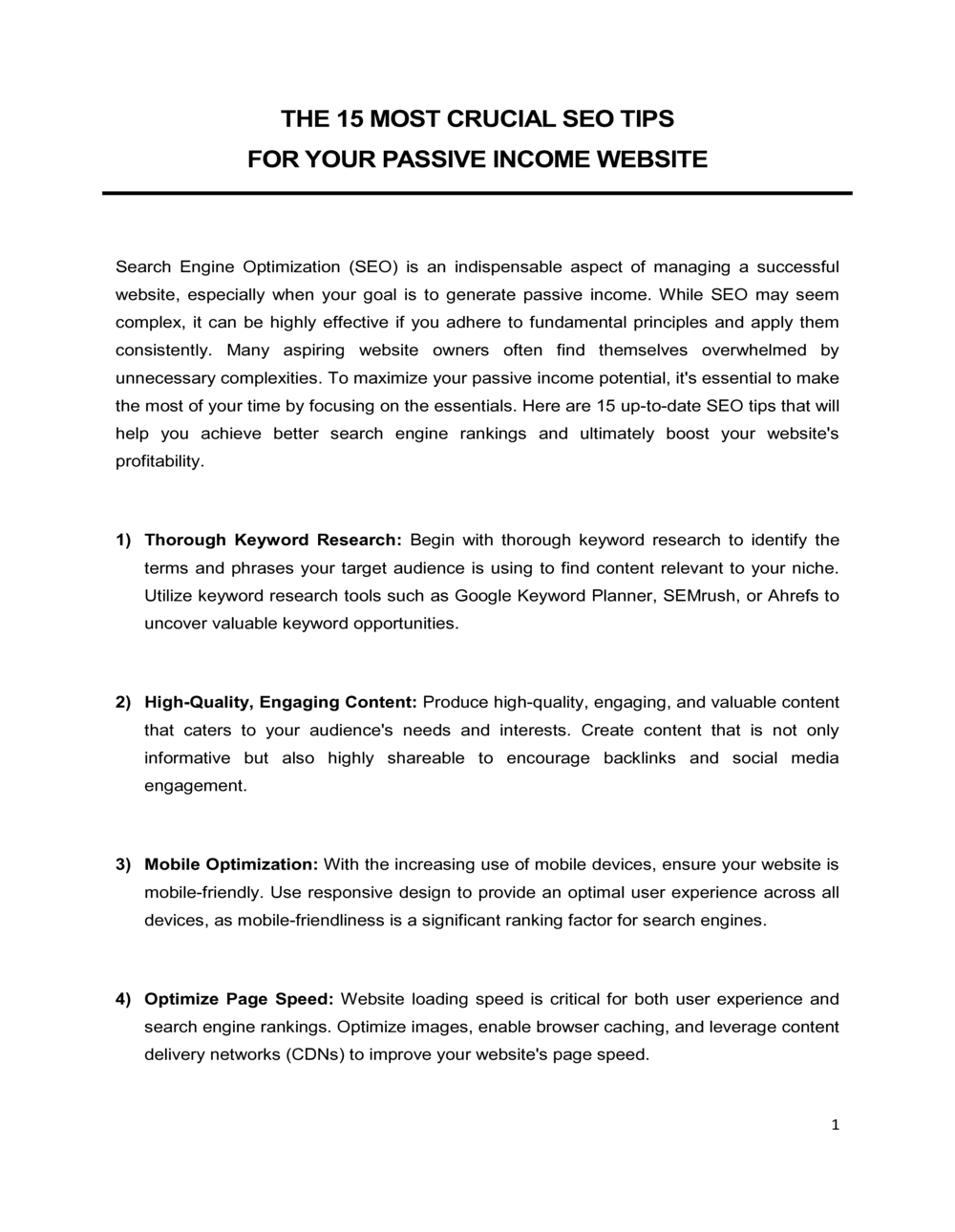
The 15 Most Crucial SEO Tips For Your Passive Income Website

Free Word download β€’ Edit online β€’ Save & share with Drive β€’ Export to PDF

3 pagesβ€’25–30 min to fillβ€’Difficulty: Standardβ€’Signature requiredβ€’Legal review recommended
Learn more ↓
FreeThe 15 Most Crucial SEO Tips For Your Passive Income Website Template

At a glance

What it is
This document is a binding legal agreement governing the creation, optimization, and monetization of a passive income website through defined SEO strategies. It formalizes the relationship between a site owner and any SEO consultant, content partner, or affiliate marketer, covering keyword targeting obligations, content standards, revenue allocation, and intellectual property ownership. This free Word download can be edited online and exported as PDF.
When you need it
Use it when engaging an SEO contractor or content partner to build or optimize a passive income site, when entering a revenue-sharing arrangement tied to organic search performance, or when licensing content to a third party for monetization through affiliate links, display advertising, or digital product sales.
What's inside
Scope of SEO services, keyword strategy and content obligations, affiliate program participation terms, revenue sharing formula and payment schedule, intellectual property assignment, confidentiality, performance benchmarks, and termination conditions.

What is a Passive Income Website SEO Agreement?

A Passive Income Website SEO Agreement is a legally binding contract that governs the relationship between a website owner and any SEO consultant, content partner, or affiliate marketer engaged to build, optimize, and monetize a passive income website. It defines exactly what SEO services will be delivered, what content standards apply, how affiliate commissions and advertising revenue will be split between the parties, and who owns the intellectual property produced under the arrangement. Because passive income sites generate ongoing revenue from content that continues to rank and earn long after it is published, this agreement must address not just the active engagement period but also post-termination rights to content and commissions.

Why You Need This Document

Operating a passive income website through informal arrangements β€” email threads, verbal agreements, or a handshake revenue split β€” leaves you exposed on every front that matters. Without a written IP assignment, the SEO consultant or content creator may retain copyright to every article and keyword report they produced, giving them the legal right to demand payment for continued use or to republish your content on competing sites. Without a clear revenue-sharing formula tied to net rather than gross figures, commission disputes will surface the moment any affiliate network deducts its fees. Without performance benchmarks and a termination clause, a partner who underdelivers faces no consequences, and you have no clean exit. This template closes all of those gaps in a single document, giving both parties a clear, enforceable record of their obligations before any content is written or any optimization work begins.

Which variant fits your situation?

If your situation is…Use this template
Hiring a freelance SEO specialist for a one-time optimization projectSEO Consulting Agreement
Entering a long-term revenue-share arrangement with a content partnerRevenue Sharing Agreement
Licensing existing SEO-optimized content to a third-party websiteContent Licensing Agreement
Engaging an affiliate marketer to drive traffic to a passive income siteAffiliate Marketing Agreement
Selling or transferring ownership of a passive income websiteWebsite Purchase and Sale Agreement
Contracting a writer for keyword-targeted blog content on a per-article basisFreelance Writing Agreement
Setting up a joint venture to co-own and monetize multiple niche sitesJoint Venture Agreement

Common mistakes to avoid

❌ No quality standard for backlinks

Why it matters: Agreeing to a backlink count without specifying minimum domain authority or prohibiting link schemes can result in the partner building spammy links that trigger a Google manual penalty, deindexing the entire site.

Fix: Add a clause requiring all acquired backlinks to originate from domains with a domain authority above [MINIMUM SCORE] and explicitly prohibiting private blog networks, paid links, and reciprocal schemes.

❌ Defining revenue as gross rather than net

Why it matters: Affiliate networks and ad platforms deduct fees before remitting payment β€” if the revenue-share formula applies to gross figures, the owner pays the partner more than the site actually earned.

Fix: Define 'Net Revenue' explicitly as gross receipts minus payment processing fees, network deductions, and chargebacks, and confirm that all revenue reporting uses net figures.

❌ No post-termination revenue tail provision

Why it matters: SEO-optimized content continues generating affiliate commissions for months or years after termination β€” without a tail clause, the allocation of those ongoing commissions is undefined and leads to disputes.

Fix: Include a clause entitling the partner to their revenue share on commissions attributable to pre-termination content for a defined period β€” 90 days is a common standard.

❌ Vague IP assignment language

Why it matters: Phrases like 'all content belongs to the owner' are not a legal assignment β€” in most jurisdictions, copyright vests in the creator by default and requires an explicit written transfer to move ownership.

Fix: Use the phrase 'irrevocably assigns to Owner all rights, title, and interest including copyright' and confirm the assignment takes effect upon payment for each deliverable.

❌ No cure period before termination for missed benchmarks

Why it matters: Search engine algorithm updates can cause temporary traffic drops outside the partner's control β€” immediate termination rights triggered by a single missed benchmark create disproportionate consequences and invite breach claims.

Fix: Require written notice of any benchmark failure and provide a cure period of at least 30 days before any termination right or fee reduction is triggered.

❌ Signing the agreement after work has already started

Why it matters: In common-law jurisdictions, IP created before the agreement is signed may not be covered by the assignment clause β€” leaving ownership of early content legally ambiguous.

Fix: Execute the agreement before any content is published or any SEO work begins. If work has already started, add a clause specifically assigning all pre-execution work product for documented additional consideration.

The 10 key clauses, explained

Parties, Scope, and Purpose

In plain language: Identifies the site owner and the SEO partner or consultant, defines the passive income website(s) covered by the agreement, and states the overall purpose of the engagement.

Sample language
This Agreement is entered into on [DATE] between [SITE OWNER LEGAL NAME] ('Owner') and [CONSULTANT / PARTNER LEGAL NAME] ('Partner'). Partner agrees to provide SEO optimization and content services for the website(s) listed in Schedule A ('Sites') with the goal of increasing organic traffic and monetization revenue.

Common mistake: Describing the site by its current URL without including a clause covering future related domains or subdomains, which creates gaps when the Owner expands the property.

SEO Services and Keyword Strategy Obligations

In plain language: Details the specific SEO deliverables β€” keyword research, on-page optimization, technical audits, link building β€” and the keyword targets the partner is obligated to pursue.

Sample language
Partner shall deliver: (a) a keyword strategy report targeting no fewer than [NUMBER] primary keywords with monthly search volume exceeding [VOLUME]; (b) on-page optimization of [NUMBER] pages per month; and (c) acquisition of no fewer than [NUMBER] quality backlinks per [PERIOD], all in compliance with Google's Webmaster Guidelines.

Common mistake: Specifying deliverable counts without defining quality standards β€” agreeing to '20 backlinks per month' without excluding spammy or penalized domains exposes the site to algorithmic penalties.

Content Creation and Publication Standards

In plain language: Sets minimum content quality requirements β€” word count, factual accuracy, originality, and publication frequency β€” and confirms that all published content must be free of plagiarism.

Sample language
All content produced under this Agreement shall: (a) be original and free of plagiarism as verified by [TOOL NAME]; (b) target the primary keyword at a density between [X]% and [X]%; (c) be no fewer than [WORD COUNT] words; and (d) be published at a minimum frequency of [NUMBER] articles per [PERIOD].

Common mistake: Omitting an originality verification requirement. Content duplicated from other sites can trigger Google duplicate-content filters and result in deindexing of the entire site.

Affiliate Program Participation and Commission Terms

In plain language: Identifies which affiliate programs the site participates in, who manages enrollment, and how affiliate commissions are tracked, collected, and allocated between the parties.

Sample language
Owner enrolls the Sites in affiliate programs including [PROGRAM NAMES]. All affiliate commissions are collected by Owner via [NETWORK / PLATFORM]. Partner's share of gross affiliate commissions is [X]%, payable within [NUMBER] days of Owner's receipt from the network.

Common mistake: Failing to address what happens when an affiliate network reverses or voids a commission after payout β€” leaving no mechanism to claw back the partner's share already distributed.

Revenue Sharing Formula and Payment Schedule

In plain language: States the exact formula for splitting all site revenue β€” display ads, affiliate commissions, digital product sales β€” and sets the payment date, method, and reporting requirements.

Sample language
Net monthly revenue from all monetization sources shall be allocated as follows: Owner: [X]%; Partner: [X]%. 'Net Revenue' means gross receipts less payment processing fees and platform commissions. Payment shall be made by [METHOD] on or before the [DAY] of each month for the prior month's revenue, accompanied by a detailed revenue report.

Common mistake: Defining revenue as 'gross' without deducting platform fees β€” leading to disputes when the Owner receives significantly less than the gross figure after network and processor deductions.

Intellectual Property Ownership and Assignment

In plain language: Confirms that all content, keyword research, and SEO assets produced under the agreement are owned by the site owner upon payment, and that the partner retains no residual rights.

Sample language
Upon receipt of full payment for each deliverable, Partner irrevocably assigns to Owner all rights, title, and interest β€” including copyright β€” in all content, research, data, and materials created under this Agreement. Partner waives any moral rights to the extent permitted by law.

Common mistake: Using language like 'work product belongs to Owner' without a formal assignment clause β€” in many jurisdictions, copyright vests in the creator by default and a vague ownership statement is insufficient to transfer it.

Performance Benchmarks and Remedies

In plain language: Sets measurable SEO or revenue milestones the partner must achieve within defined timeframes, and states what happens β€” fee reduction, cure period, or termination β€” if benchmarks are missed.

Sample language
Partner shall achieve the following milestones: (a) [X] monthly organic sessions within [NUMBER] months of commencement; (b) domain authority of [SCORE] or above within [NUMBER] months. Failure to achieve any milestone entitles Owner to reduce Partner's revenue share by [X]% for each missed period, with a [NUMBER]-day cure period before termination for cause.

Common mistake: Setting benchmarks without a cure period β€” immediately triggering termination for a missed traffic target leaves no room for algorithm fluctuations outside the partner's control, creating breach disputes.

Confidentiality and Non-Disclosure

In plain language: Prohibits both parties from disclosing the site's revenue figures, keyword strategy, content pipeline, or monetization methods to third parties during and after the agreement.

Sample language
Each party shall keep confidential all non-public information disclosed by the other party, including revenue data, keyword strategy, content calendars, and affiliate program terms. This obligation survives termination for [NUMBER] years. Neither party shall disclose this Agreement's financial terms to any third party without prior written consent.

Common mistake: Omitting a specific list of what constitutes confidential information and relying on 'all business information.' Overbroad definitions are often unenforceable and leave both parties uncertain about what they can and cannot share.

Termination, Transition, and Continuity

In plain language: States the notice period required to end the agreement, what happens to published content and ongoing SEO work during the transition, and whether the partner must assist with handover.

Sample language
Either party may terminate this Agreement with [NUMBER] days' written notice. Upon termination: (a) all published content and assets remain the property of Owner; (b) Partner shall provide a transition document including keyword rankings, backlink profile, and pending deliverables within [NUMBER] days of notice; (c) revenue sharing continues for any commissions attributable to content published before termination for [NUMBER] months.

Common mistake: No post-termination revenue tail provision β€” when an affiliate article continues earning commissions for months after termination, the absence of a clear allocation clause generates disputes.

Governing Law, Dispute Resolution, and Entire Agreement

In plain language: Specifies which jurisdiction's law governs the contract, how disputes are resolved (arbitration, mediation, or litigation), and confirms that this document supersedes all prior agreements and communications.

Sample language
This Agreement is governed by the laws of [STATE / PROVINCE / COUNTRY]. Disputes shall first be submitted to non-binding mediation; if unresolved within [NUMBER] days, to binding arbitration administered by [BODY] in [CITY]. This Agreement constitutes the entire agreement between the parties and supersedes all prior representations, term sheets, and correspondence.

Common mistake: Selecting a governing jurisdiction with no meaningful connection to either party's location β€” courts in several jurisdictions will apply local law regardless, rendering the governing-law clause meaningless.

How to fill it out

  1. 1

    Identify the parties and list all covered websites

    Enter both parties' full legal names and entity types. In Schedule A, list every domain name and URL covered by the agreement, including any subdomains or sister sites you anticipate launching during the term.

    πŸ’‘ Include a catch-all clause β€” 'and any additional domains mutually agreed upon in writing' β€” so new sites can be added without a full contract amendment.

  2. 2

    Define the SEO deliverables with measurable specifics

    List every deliverable the partner must produce β€” keyword reports, on-page edits, technical audits, backlink acquisitions β€” with a quantity and frequency for each. Attach a Schedule B if the deliverable list is long.

    πŸ’‘ Require all link-building activity to comply with Google's Search Essentials (formerly Webmaster Guidelines) and explicitly prohibit link schemes, paid links, and private blog network links.

  3. 3

    Set the content quality standards and publication schedule

    Specify minimum word count, originality requirements, keyword density range, required internal linking, and the publication frequency. Reference the content calendar in a separate appendix if the pipeline is defined upfront.

    πŸ’‘ Require the partner to submit content through a shared CMS or folder β€” not by email β€” so revision history and approval timestamps are automatically preserved.

  4. 4

    Complete the affiliate and revenue terms

    List each affiliate program by name, state who holds the account, and enter the exact revenue-split percentages. Define 'Net Revenue' clearly, deducting fees before calculating shares, and set the payment date and reporting format.

    πŸ’‘ Add a minimum payment threshold β€” e.g., revenue shares below $50 roll over to the next month β€” to avoid the administrative cost of micro-payments.

  5. 5

    Enter the performance benchmarks

    Set specific, measurable milestones for organic traffic and revenue, tied to realistic timeframes based on the site's current domain authority. Include a cure period of at least 30 days before any penalty or termination right is triggered.

    πŸ’‘ Base benchmarks on trailing 90-day averages, not single-month snapshots, to smooth out seasonal traffic fluctuations and algorithm update volatility.

  6. 6

    Confirm IP assignment and confidentiality obligations

    Verify the IP assignment clause is explicit β€” 'irrevocably assigns all rights' β€” and that the confidentiality clause lists specific categories of protected information. Set the post-termination confidentiality period to at least 2 years.

    πŸ’‘ Have the partner sign a standalone IP assignment confirmation at the delivery of each major content batch if your jurisdiction requires formalities beyond a contract clause.

  7. 7

    Set termination notice and transition requirements

    Enter the notice period (30–60 days is standard), the number of days the partner has to deliver the transition document, and the duration of the post-termination revenue tail for existing content.

    πŸ’‘ A 90-day revenue tail on existing affiliate content is a common and reasonable standard β€” shorter than that often fails to cover the full commission cycle of most affiliate networks.

  8. 8

    Sign before any SEO or content work begins

    Both parties must execute the agreement before the partner publishes any content or begins any optimization work. Post-commencement signatures raise enforceability issues for IP assignment and non-disclosure in common-law jurisdictions.

    πŸ’‘ Use a dated e-signature platform so the execution timestamp is automatically recorded and cannot be disputed later.

Frequently asked questions

What is a passive income website SEO agreement?

A passive income website SEO agreement is a binding legal contract between a website owner and an SEO consultant, content partner, or affiliate marketer that defines the SEO services to be delivered, the content obligations, the revenue-sharing formula, and the intellectual property ownership of all work produced. It replaces informal arrangements and email threads with enforceable obligations on both sides, protecting the owner's revenue and IP while giving the partner clear performance expectations.

Who should sign this type of agreement?

Any site owner who engages a third party to create content, build links, or optimize a monetized website should sign a formal agreement before work begins. This includes owners working with freelance SEO specialists, content agencies, affiliate partners, or joint-venture co-owners. The agreement is equally important for the partner, who needs documented payment terms and a defined scope to avoid scope creep.

Does this agreement cover affiliate marketing commissions?

Yes. The affiliate program participation clause identifies which networks and programs the site is enrolled in, who holds the account, and how commissions are tracked and split between the parties. The revenue-sharing clause sets the exact percentage allocation and payment schedule. Both clauses should be completed carefully β€” ambiguity in commission allocation is the most common source of disputes in passive-income site partnerships.

Who owns the content created under this agreement?

The intellectual property assignment clause transfers ownership of all content, keyword research, and SEO assets to the site owner upon payment. Without this clause, copyright vests in the creator by default in most jurisdictions β€” meaning the partner could legally restrict the owner's use of the content or demand additional compensation. The assignment must be explicit and in writing to be effective.

What performance benchmarks are typical in SEO agreements?

Common benchmarks include a target number of monthly organic sessions within a defined timeframe (e.g., 10,000 sessions within 6 months), a minimum domain authority score, a target number of keywords ranking in positions 1–10, or a revenue threshold from affiliate commissions or display advertising. Benchmarks should always include a cure period of at least 30 days to account for algorithm volatility before any penalty or termination right applies.

What happens to the content and SEO work if the agreement is terminated?

The termination clause should confirm that all published content and SEO assets remain the property of the site owner. The partner is typically required to deliver a transition document β€” including current keyword rankings, a backlink profile export, and any pending deliverables β€” within a defined number of days after notice. A post-termination revenue tail clause entitles the partner to their share of commissions earned by pre-termination content for a defined period, commonly 90 days.

Is this agreement enforceable internationally?

Generally yes, when the governing law and dispute resolution clauses are properly completed. Choose a governing jurisdiction with a meaningful connection to at least one party's location β€” courts in several countries will apply local law regardless of what the contract says if the chosen jurisdiction has no real connection to the transaction. For cross-border arrangements, consider adding a clause confirming each party's obligation to comply with their local data protection and advertising disclosure laws.

Do I need a lawyer to use this template?

For straightforward domestic arrangements with a clear scope and standard revenue split, a well-completed template is typically sufficient. Engage a lawyer when the revenue share involves complex multi-tier affiliate structures, when the site operates in a regulated niche (financial, health, legal), when significant upfront investment is at stake, or when the parties are in different jurisdictions. A legal review of an SEO or content partnership agreement typically costs $300–$800 and is worthwhile when monthly revenue exceeds a few thousand dollars.

What white-hat SEO practices should the agreement require?

The agreement should explicitly require compliance with the search engine's published guidelines β€” Google's Search Essentials is the most commonly referenced standard. It should prohibit link schemes, private blog networks, keyword stuffing, cloaking, and paid links. It should also require that all affiliate relationships be disclosed in compliance with FTC guidelines (US), ASA rules (UK), or applicable local advertising disclosure regulations. Violations of these standards can result in algorithmic penalties or manual actions that destroy the site's organic traffic entirely.

How this compares to alternatives

vs SEO Consulting Agreement

A standard SEO consulting agreement covers services, fees, and deliverables for a defined optimization engagement but does not include revenue sharing, affiliate commission allocation, or post-termination content rights. Use a consulting agreement when paying a flat fee for SEO work; use this template when the compensation is tied to site revenue or the partner co-owns the monetization upside.

vs Affiliate Marketing Agreement

An affiliate marketing agreement governs the referral relationship between a merchant and a marketer β€” commission rates, cookie windows, and prohibited promotion methods. This passive income website agreement is broader: it also covers SEO deliverables, content creation standards, and IP ownership. Use the affiliate agreement for pure referral arrangements; use this template when the partner both creates content and earns a revenue share.

vs Revenue Sharing Agreement

A revenue sharing agreement splits income between parties but typically does not specify the SEO or content obligations that generate that income. This template combines the revenue-split mechanics with detailed service obligations, making it appropriate when the partner's contribution is specifically organic search optimization and content production rather than capital, technology, or distribution.

vs Joint Venture Agreement

A joint venture agreement creates a shared enterprise with co-ownership of assets and liability. This passive income website SEO agreement is a service and revenue-sharing contract β€” it does not create a joint entity or shared ownership of the domain itself. Use a joint venture agreement when both parties will co-own the website as an asset; use this template when one party owns the site and the other provides SEO services in exchange for a revenue share.

Industry-specific considerations

Digital Publishing and Media

High content volume, display ad revenue sharing via Mediavine or AdThrive, and strict originality requirements to protect editorial credibility and ad network eligibility.

Affiliate Marketing and E-commerce

Commission tracking across multiple networks, cookie window alignment, and seasonal traffic benchmarks tied to peak shopping periods like Q4 and Black Friday.

Financial Services and Fintech

Content accuracy obligations for compliance with FCA, SEC, or FINRA guidance, affiliate disclosure requirements, and restrictions on specific financial product recommendations without proper licensing.

Health and Wellness

Medical disclaimer requirements, FTC health claim restrictions, YMYL (Your Money or Your Life) content standards that affect Google rankings, and heightened originality and citation obligations.

Technology and SaaS

Software affiliate programs with recurring commission structures, review and comparison content obligations, and API or tool usage terms that may restrict certain SEO data collection methods.

Professional Services

Lead generation through organic search, referral fee structures linked to client conversions, and bar association or regulatory restrictions on attorney, accountant, and financial adviser advertising.

Jurisdictional notes

United States

FTC guidelines require clear and conspicuous affiliate relationship disclosures on all content monetized through affiliate links β€” non-compliance can result in fines of up to $51,744 per violation. IP assignment clauses for independent contractors are generally enforceable under federal copyright law, but the agreement must be in writing. Non-compete clauses tied to SEO partnerships are subject to state-level enforceability rules; California and Minnesota impose near-total bans.

Canada

CASL (Canada's Anti-Spam Legislation) applies to any commercial electronic message sent in connection with the site, including email marketing tied to the passive income strategy. Copyright in commissioned content vests in the creator by default under the Copyright Act β€” a written assignment is required to transfer ownership to the site owner. Quebec's Consumer Protection Act imposes additional disclosure requirements for affiliate content targeting Quebec residents.

United Kingdom

ASA and CAP rules require that affiliate and sponsored content be clearly labeled as advertising β€” failure to do so can result in ASA rulings and reputational damage. Under UK copyright law, ownership of commissioned content vests in the creator unless a written assignment is executed. Post-Brexit, GDPR-equivalent obligations under the UK GDPR apply to any personal data collected through the website, including email subscriber lists and analytics data.

European Union

GDPR applies to any passive income site that collects personal data from EU residents β€” including cookies used for affiliate tracking β€” regardless of where the site owner is based. The EU's Unfair Commercial Practices Directive requires disclosure of affiliate relationships; non-disclosure can constitute a misleading commercial practice. Copyright ownership in commissioned works varies by member state β€” France and Germany impose stronger moral rights than common-law jurisdictions, limiting the scope of IP assignment clauses.

Template vs lawyer β€” what fits your deal?

PathBest forCostTime
Use the templateSite owners partnering with a single SEO contractor or content creator in a straightforward domestic arrangementFree30–45 minutes
Template + legal reviewRevenue shares above $2,000 per month, cross-border partnerships, or sites in regulated niches (health, finance, legal)$300–$8002–4 days
Custom draftedMulti-party joint ventures, portfolio sites with complex affiliate structures, or arrangements involving equity or site co-ownership$1,500–$4,000+1–3 weeks

Glossary

Passive Income Website
A website designed to generate ongoing revenue β€” through affiliate commissions, display ads, or digital product sales β€” with minimal ongoing active effort after initial setup.
SEO (Search Engine Optimization)
The practice of improving a website's content, structure, and authority so it ranks higher in unpaid search engine results.
Affiliate Commission
A percentage of a sale or a fixed fee paid to a marketer for referring a customer who completes a qualifying transaction.
Revenue Sharing
A contractual arrangement where two or more parties split a defined percentage of revenue generated by a website or campaign.
Keyword Strategy
A documented plan identifying which search terms a site will target, their estimated monthly search volume, and the content format used to rank for each.
Organic Traffic
Website visitors who arrive through unpaid search engine results, as opposed to paid advertisements.
Intellectual Property Assignment
A contractual clause transferring ownership of content, code, or creative work produced under the agreement from the creator to the commissioning party.
Backlink
A hyperlink from one website pointing to another, used by search engines as a signal of authority and relevance.
Domain Authority
A third-party score estimating how likely a website is to rank in search results, based on the volume and quality of inbound links.
White-Hat SEO
SEO techniques that comply with search engine guidelines, including quality content creation, ethical link building, and accurate metadata.
Performance Milestone
A measurable SEO or revenue target β€” such as reaching 10,000 monthly organic sessions or $500 monthly affiliate revenue β€” used to trigger payment or contract renewal.

Part of your Business Operating System

This document is one of 3,000+ business & legal templates included in Business in a Box.

  • Fill-in-the-blanks β€” ready in minutes
  • 100% customizable Word document
  • Compatible with all office suites
  • Export to PDF and share electronically

Create your document in 3 simple steps.

From template to signed document β€” all inside one Business Operating System.
1
Download or open template

Access over 3,000+ business and legal templates for any business task, project or initiative.

2
Edit and fill in the blanks with AI

Customize your ready-made business document template and save it in the cloud.

3
Save, Share, Send, Sign

Share your files and folders with your team. Create a space of seamless collaboration.

Save time, save money, and create top-quality documents.

β˜…β˜…β˜…β˜…β˜…

"Fantastic value! I'm not sure how I'd do without it. It's worth its weight in gold and paid back for itself many times."

Managing Director Β· Mall Farm
Robert Whalley
Managing Director, Mall Farm Proprietary Limited
β˜…β˜…β˜…β˜…β˜…

"I have been using Business in a Box for years. It has been the most useful source of templates I have encountered. I recommend it to anyone."

Business Owner Β· 4+ years
Dr Michael John Freestone
Business Owner
β˜…β˜…β˜…β˜…β˜…

"It has been a life saver so many times I have lost count. Business in a Box has saved me so much time and as you know, time is money."

Owner Β· Upstate Web
David G. Moore Jr.
Owner, Upstate Web

Run your business with a system β€” not scattered tools

Stop downloading documents. Start operating with clarity. Business in a Box gives you the Business Operating System used by over 250,000 companies worldwide to structure, run, and grow their business.

Start freeΒ Β·Β No credit card required