Team Building Exercises Template

Free Word download • Edit online • Save & share with Drive • Export to PDF

5 pages25–30 min to fillDifficulty: ComplexSignature requiredLegal review recommended
Learn more ↓
FreeTeam Building Exercises Template

At a glance

What it is
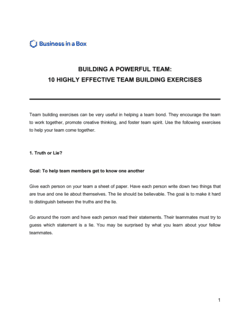
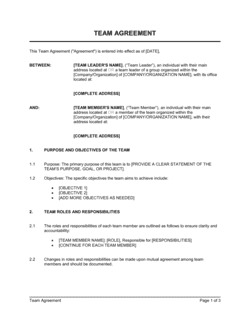
A Team Building Exercises document is a formal agreement between an employer (or event organizer) and participating employees that defines the scope, rules, liability terms, and expectations for structured team activities. This free Word download gives HR managers, operations leads, and corporate event planners a structured starting point they can edit online and export as PDF before any team activity — whether an indoor workshop, outdoor challenge, or off-site retreat.
When you need it
Use it whenever your organization is planning a structured team activity that carries any physical, emotional, or logistical risk — such as outdoor adventure programs, trust exercises, or facilitated workshops involving third-party vendors. It is especially important when contractors or external facilitators are involved, or when attendance is mandatory.
What's inside
Activity scope and description, participant eligibility, attendance and participation obligations, health and safety disclosures, liability waiver and indemnification, facilitator responsibilities, confidentiality of in-session content, data and photo consent, and governing law with dispute resolution terms.

What is a Team Building Exercises Document?

A Team Building Exercises Document is a formal agreement between an employer or event organizer and participating employees that governs the terms, expectations, and legal protections surrounding structured team activities. It defines the scope of the activity, sets participation rules, discloses risks, obtains informed consent for data and image collection, protects the confidentiality of personal disclosures made during facilitated sessions, and establishes the liability framework for all parties involved. Unlike an informal sign-in sheet or verbal briefing, a properly drafted team building agreement creates an enforceable record of consent and shared obligations — available as a free Word download you can edit online and export as a PDF before any team event.

Why You Need This Document

Running a team activity without a signed participation agreement exposes your organization to liability claims, privacy complaints, and post-event disputes that a single document could have prevented. If an employee is injured during a physical exercise, a well-scoped assumption-of-risk clause and liability waiver provide your first line of legal defense. If a participant later objects to how their image was used in company marketing, a documented photo consent form resolves the dispute instantly. If sensitive disclosures from a facilitated trust exercise surface outside the organization, a session confidentiality clause gives you a contractual basis to act. Without this document, each of those scenarios becomes a credibility contest rather than a contract interpretation — and HR teams, not lawyers, absorb the operational fallout. This template gives you a structured, jurisdiction-aware starting point that covers every major exposure point before your next team activity begins.

Which variant fits your situation?

If your situation is…Use this template
Outdoor or physical adventure activities with injury riskActivity Liability Waiver
Facilitated workshop with a third-party vendorEvent Vendor Agreement
Retreat involving overnight travel and accommodationCorporate Retreat Agreement
Virtual team building session conducted onlineVirtual Event Participation Agreement
Mandatory training disguised as a team activityEmployee Training Agreement
Team activity that involves media production or recorded contentPhoto and Video Release Form
Ongoing team coaching or group development programCoaching Services Agreement

Common mistakes to avoid

❌ Distributing the waiver on the day of the event

Why it matters: Last-minute waivers signed under time pressure may be challenged as lacking informed consent, particularly for mandatory attendance events where employees feel they have no real choice.

Fix: Distribute the document at least five to seven business days before the activity to give participants time to read, ask questions, and sign voluntarily.

❌ Using a generic liability waiver not tailored to the specific activity

Why it matters: A waiver that describes 'any activities' without identifying the specific risks of the actual event provides weak protection. Courts examine whether participants were genuinely informed of the specific risks they faced.

Fix: Customize the assumption-of-risk clause and activity description for each distinct event. A ropes course, a cooking class, and a trust workshop each carry different risks and require different disclosures.

❌ Omitting the confidentiality-of-session-content clause

Why it matters: Facilitated team building exercises often elicit personal disclosures — career frustrations, interpersonal conflicts, and personal vulnerabilities. Without a confidentiality clause, those disclosures have no legal protection after the session ends.

Fix: Add a session confidentiality clause that covers disclosures by all participants, not just the organizer's proprietary materials.

❌ Failing to address mandatory versus voluntary participation

Why it matters: When participation is mandatory, the 'voluntary assumption of risk' logic underlying many waiver clauses is legally weakened. Employees who felt compelled to sign may later argue they had no meaningful choice.

Fix: If the activity is mandatory, acknowledge this in the document and ensure the liability waiver is narrowly scoped to inherent risks — not negligence — and has been reviewed by employment counsel.

❌ Not securing a separate agreement with the third-party facilitator

Why it matters: A participant-facing document does not create obligations for the facilitator. If the facilitator causes an injury and has no signed contract with the organizer, the organizer may bear full liability with no recourse.

Fix: Always execute a separate vendor or services agreement with any third-party facilitator that includes duty-of-care obligations, insurance requirements, and indemnification flowing to the organizer.

❌ Ignoring GDPR and privacy law requirements for photo and data consent

Why it matters: Bundling image and recording consent into a mandatory participation document violates GDPR's 'freely given' consent standard and equivalent privacy statutes in Canada and several US states.

Fix: Separate photo and data consent into a standalone opt-in form. For EU employees, document the legal basis for data collection independently of the activity consent.

The 10 key clauses, explained

Parties and Activity Description

In plain language: Identifies the employer or organizer, the participating employee or contractor, and provides a clear description of the specific team building activity covered by the agreement.

Sample language
This Agreement is entered into between [EMPLOYER LEGAL NAME] ('Organizer') and [PARTICIPANT FULL NAME] ('Participant') for participation in [ACTIVITY NAME], scheduled on [DATE] at [LOCATION].

Common mistake: Using a program name or brand name instead of the registered legal entity as the organizer. If an incident occurs, the enforcing party must be identifiable as a legal entity.

Scope of Activity and Participation Rules

In plain language: Describes exactly what the activity involves, what is required of participants, and any rules or conduct standards they must follow during the event.

Sample language
The Activity consists of [DESCRIPTION OF EXERCISES]. Participants are required to [RULES / CONDUCT STANDARDS]. Participation in optional sub-activities is voluntary and subject to separate consent.

Common mistake: Describing the activity too vaguely — 'team exercises' without specifics. If the activity changes from what was described, the waiver may not cover the actual events that led to an injury or complaint.

Eligibility and Health Disclosure

In plain language: States who is eligible to participate, requires participants to self-disclose any physical or mental health conditions that could affect their participation, and reserves the organizer's right to exclude participants for safety reasons.

Sample language
Participant confirms they are physically and mentally fit to participate in the Activity and have disclosed any conditions — including [SPECIFIC CONDITIONS] — that may affect their ability to participate safely. Organizer reserves the right to exclude any Participant for safety reasons.

Common mistake: Asking for detailed medical information on the form itself rather than requesting a self-certification. Detailed health data collection triggers privacy law obligations under HIPAA, PIPEDA, GDPR, and equivalent statutes.

Assumption of Risk

In plain language: Confirms that the participant understands and voluntarily accepts the inherent risks of the activity, including physical injury, property damage, and emotional discomfort.

Sample language
Participant acknowledges that the Activity involves inherent risks including but not limited to [LIST OF RISKS]. Participant voluntarily assumes all such risks and agrees that the Organizer is not responsible for injuries or losses arising from these inherent risks.

Common mistake: Using a generic assumption-of-risk clause that does not list the specific risks of the particular activity. Courts give greater weight to risk clauses that identify the actual hazards involved.

Liability Waiver and Release

In plain language: The participant releases the organizer and its agents from liability for injuries, damages, or losses arising from the activity, except where caused by the organizer's gross negligence or willful misconduct.

Sample language
Participant hereby releases and discharges [EMPLOYER LEGAL NAME], its officers, employees, agents, and contractors from any and all claims, demands, or causes of action arising out of or related to participation in the Activity, except to the extent caused by Organizer's gross negligence or willful misconduct.

Common mistake: Attempting to waive liability for gross negligence or intentional acts. Most jurisdictions will void that portion of the clause, potentially bringing scrutiny to the entire waiver.

Indemnification

In plain language: Requires the participant to indemnify the organizer against losses resulting from the participant's own misconduct or breach of the agreement's rules during the activity.

Sample language
Participant agrees to indemnify, defend, and hold harmless [EMPLOYER LEGAL NAME] from any claims, losses, or expenses — including reasonable attorneys' fees — arising from Participant's breach of this Agreement or Participant's own negligent or wrongful conduct during the Activity.

Common mistake: Including a broad mutual indemnification that requires the employer to indemnify the participant for the employee's own misconduct. Review the clause direction carefully before execution.

Photo, Video, and Data Consent

In plain language: Obtains the participant's consent for the organizer to photograph, film, or record the activity and to use that content for internal communications, training, or marketing, subject to any limitations the participant specifies.

Sample language
Participant consents to being photographed, filmed, or recorded during the Activity. Organizer may use such content for [INTERNAL / EXTERNAL] purposes. Participant may opt out of external use by notifying Organizer in writing at least [X] days before the Activity.

Common mistake: Assuming blanket consent covers all uses, including public social media or marketing campaigns. EU GDPR and several North American privacy statutes require specific, informed consent for each distinct use of personal image or data.

Confidentiality of Session Content

In plain language: Requires participants to keep personal disclosures made during the activity, group dynamics observations, and any proprietary workshop materials confidential after the event.

Sample language
Participants agree not to disclose personal information shared by colleagues or proprietary facilitation materials disclosed during the Activity to any third party without written consent of the disclosing party or Organizer.

Common mistake: Omitting this clause entirely. Without it, sensitive disclosures made in trust exercises or group coaching sessions — including personal or professional vulnerabilities — may be shared outside the organization with no recourse.

Facilitator Obligations

In plain language: Where a third-party facilitator is engaged, defines their duty of care, insurance requirements, and obligations with respect to participant safety and professional standards.

Sample language
Facilitator shall [DESCRIPTION OF OBLIGATIONS], maintain professional liability insurance of at least $[AMOUNT], and comply with all applicable safety standards and Organizer's workplace health and safety policies.

Common mistake: Listing facilitator obligations in a separate vendor contract only and not referencing them in the participant-facing document. Participants have no visibility into safety standards unless they are disclosed here or incorporated by reference.

Governing Law and Dispute Resolution

In plain language: Specifies the jurisdiction whose law governs the agreement and the process for resolving disputes — typically mediation before arbitration or litigation.

Sample language
This Agreement is governed by the laws of [STATE / PROVINCE / COUNTRY]. Any dispute arising under this Agreement shall first be submitted to non-binding mediation before either party may commence arbitration or litigation.

Common mistake: Selecting a governing law that differs from the jurisdiction where the activity takes place. Workplace injury and occupational health laws are territorial — a New York choice-of-law clause does not override California workplace safety statutes for an event held in California.

How to fill it out

  1. 1

    Identify the parties and confirm the organizer's legal entity

    Enter the employer's full registered legal entity name — not a brand or division name — and each participant's legal name as it appears on their employment record.

    💡 Cross-reference the corporate registry to confirm the exact entity before the document is distributed. The executing entity must match payroll and insurance records.

  2. 2

    Describe the activity with enough specificity to be enforceable

    Fill in the activity name, date, location, duration, and a description of what participants will actually do. If the program includes optional sub-activities, list each one separately with its own risk disclosure.

    💡 Vague descriptions ('team exercises') provide weak legal protection. Name the specific activities: 'high-ropes course,' 'facilitated trust fall,' or 'improv-based communication workshop.'

  3. 3

    Complete the eligibility and health self-certification block

    Ask participants to confirm they are fit to participate and to disclose any conditions that could affect safety. Do not design the form to collect specific diagnoses — ask only for a self-certification and a flag for organizer follow-up.

    💡 For activities with elevated physical risk, add a checkbox for participants to request a private conversation with HR before confirming participation.

  4. 4

    Tailor the assumption-of-risk clause to the specific activity

    List the actual risks of the activity in the clause — not a generic list. For a ropes course, include fall risk and equipment failure. For a facilitated workshop, include emotional discomfort and privacy risk.

    💡 Courts in most jurisdictions give significantly more weight to specific risk disclosures than to boilerplate 'any and all risks' language.

  5. 5

    Review the liability waiver scope against local law

    Confirm the waiver does not attempt to release liability for gross negligence or willful misconduct — those exclusions are void in virtually every jurisdiction. Confirm the scope is consistent with your jurisdiction's occupational health and safety statutes.

    💡 In Quebec and several EU member states, employee waivers for workplace activities are heavily restricted. Have local counsel review before distribution.

  6. 6

    Complete the photo and data consent section

    Specify each distinct use of participant images or recordings — internal newsletter, training materials, company social media, external marketing. Provide a clear opt-out mechanism for external uses.

    💡 Under GDPR, consent must be freely given, specific, informed, and unambiguous. Bundling image consent with participation consent in a mandatory-attendance context may not satisfy the 'freely given' standard.

  7. 7

    Insert the governing law and dispute resolution terms

    Choose the jurisdiction where the activity will take place as the governing law. Add a mediation-first dispute resolution step before arbitration or litigation.

    💡 If your organization operates across multiple jurisdictions, consider using a single-state governing law only for contractual terms — make clear that local workplace safety statutes apply regardless.

  8. 8

    Distribute, collect signatures, and retain executed copies

    Send the completed document to all participants at least [X] days before the activity. Collect signed copies before the event date and store executed copies in your HR records system.

    💡 Use an eSign platform to timestamp execution and create an audit trail. A signed PDF returned by email is acceptable in most jurisdictions but harder to authenticate in a dispute.

Frequently asked questions

What is a team building exercises document?

A team building exercises document is a formal agreement between an employer or event organizer and participating employees that defines the scope of the planned activity, participation rules, health and safety disclosures, liability waivers, data consent, and confidentiality obligations. It protects both the organizer and participants by establishing clear expectations and documented consent before any structured team activity takes place.

Are liability waivers for team building activities enforceable?

In most US jurisdictions, liability waivers for voluntary recreational activities are generally enforceable when they are clearly worded, specific about the risks involved, and signed before the activity. They typically cannot waive liability for gross negligence or intentional misconduct. Enforceability in Canada, the UK, and the EU varies significantly by jurisdiction — and waivers for mandatory workplace activities face additional scrutiny in all regions. Consider having local counsel review any waiver used for mandatory company events.

Can an employer require employees to sign a liability waiver for team activities?

An employer can require participation in a team activity as a condition of employment, but requiring a broad liability waiver for mandatory events weakens the 'voluntary assumption of risk' argument courts rely on to uphold waivers. In practice, the safest approach is to scope the waiver narrowly to inherent risks, exclude negligence claims, and give employees adequate time to review and sign — rather than presenting waivers at the door on the day of the event.

What should a team building activity agreement include?

At minimum, it should include the parties' names, a specific description of the activity, participation eligibility and health disclosure, assumption of risk for the specific hazards involved, a liability waiver excluding gross negligence, indemnification, photo and data consent with opt-out rights, session confidentiality for facilitated exercises, any facilitator obligations, and governing law. Missing any of these leaves identifiable legal gaps.

Does a virtual team building event need a participation agreement?

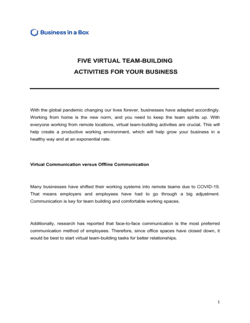
Virtual events carry fewer physical injury risks but still involve data collection, video recording, personal disclosures during facilitated sessions, and potential emotional discomfort. A streamlined participation agreement covering data consent, session confidentiality, and acceptable use of the platform is still recommended — particularly when a third-party facilitator is involved or sessions are recorded.

What is the difference between a team building agreement and an employee training agreement?

An employee training agreement governs formal skill development tied to job performance — often including training cost repayment obligations if the employee leaves within a defined period. A team building agreement covers structured activities designed to build cohesion, communication, and trust. The two documents serve different purposes, though some mandatory training programs are delivered in a team building format and may require elements of both.

Do I need a separate agreement with a third-party team building facilitator?

Yes. The participant-facing document creates obligations between the organizer and participants only. A separate vendor or services agreement with the facilitator should define their duty of care, minimum insurance coverage, safety certifications, indemnification running to the organizer, and what happens if the facilitator cancels or modifies the program. Without it, the organizer may bear full liability for facilitator errors with no contractual recourse.

What jurisdictions restrict employee liability waivers most strictly?

Quebec prohibits most waivers of liability for bodily injury in consumer and employment contexts under the Civil Code. Several EU member states — including Germany and France — limit waivers for workplace activities to inherent risks only and require employers to carry statutory workplace accident insurance. In the UK, the Unfair Contract Terms Act 1977 restricts exclusion of liability for death or personal injury caused by negligence. US states vary widely — California courts scrutinize mandatory activity waivers closely, while most other states are more permissive for clearly worded voluntary activity releases.

How this compares to alternatives

vs Employee Training Agreement

An employee training agreement governs formal skill development with defined learning outcomes and often includes a training cost repayment clause if the employee leaves within a set period. A team building exercises document focuses on structured cohesion and communication activities with no direct performance assessment. Some mandatory programs blend both elements and may require clauses from each document.

vs Event Vendor Agreement

An event vendor agreement governs the relationship between the organizer and a third-party facilitator or supplier — covering deliverables, fees, cancellation, and indemnification. A team building exercises document governs the relationship between the organizer and participants. Both are needed when a third-party facilitator is engaged; they operate in parallel, not as substitutes.

vs General Liability Waiver

A general liability waiver is a standalone release used for any activity with physical risk. A team building exercises document is a more comprehensive agreement that incorporates a liability waiver alongside participation rules, health disclosures, data consent, facilitator obligations, and session confidentiality. The team building document is the appropriate choice when the activity is employer-organized and involves multiple structured components.

vs Non-Disclosure Agreement

An NDA covers confidential business information shared in a commercial or professional context. A team building exercises document includes a narrower session confidentiality clause covering personal disclosures made during facilitated group exercises — not trade secrets or business data. If proprietary business information is expected to surface during the activity, supplementing with a full NDA is advisable.

Industry-specific considerations

Technology / SaaS

Distributed and remote teams often attend in-person offsites for the first time; the agreement must address both in-person physical activities and virtual sessions in a single cohesive document.

Professional Services

Client-facing firms use facilitated exercises to build cross-practice collaboration; session confidentiality clauses are critical to protect client-related information disclosed in group settings.

Healthcare

Team activities for clinical staff must account for shift patterns and mandatory participation constraints; health disclosure provisions must avoid collecting protected health information.

Manufacturing

Physical team activities in manufacturing settings carry elevated injury risk given participants' existing occupational hazard exposure; assumption-of-risk clauses must be carefully distinguished from workplace safety obligations.

Retail / Hospitality

High staff turnover means agreements must be re-executed frequently; streamlined digital signature workflows and clear opt-out provisions for part-time and seasonal workers are essential.

Financial Services

Regulatory obligations around information handling mean session confidentiality clauses must be drafted consistently with existing employee NDA and information-security policies.

Jurisdictional notes

United States

Liability waiver enforceability varies by state — California scrutinizes waivers for mandatory workplace activities closely and may not enforce them for employer negligence. Illinois BIPA imposes strict requirements on biometric data collected at events, including facial recognition used in photo tagging. Federal OSHA regulations apply to workplace activities regardless of whether a waiver is signed. State workers' compensation laws may provide parallel remedies that a waiver cannot extinguish.

Canada

Quebec's Civil Code significantly restricts liability waivers for bodily injury in employment contexts — waivers in that province should be reviewed by Quebec counsel before use. Ontario's Occupational Health and Safety Act imposes non-waivable employer duties that apply to off-site team activities. PIPEDA and provincial privacy statutes govern photo and data consent; Alberta, British Columbia, and Quebec have substantially equivalent legislation with additional requirements. French-language versions are required for Quebec employees under the Charter of the French Language.

United Kingdom

The Unfair Contract Terms Act 1977 prohibits contractual exclusion of liability for death or personal injury caused by negligence, rendering any such clause in an employee waiver void. The Health and Safety at Work Act 1974 imposes non-waivable employer duties for all work-related activities, including off-site events. UK GDPR requires lawful basis for processing participant image data; legitimate interests or explicit consent are the most commonly applicable bases, but must be assessed case by case. Employment contracts may impose implied obligations that interact with team building participation requirements.

European Union

EU GDPR classifies photographic and video data as personal data — consent for image use must be freely given, specific, and separate from mandatory participation consent, which means bundling it into an attendance requirement is generally non-compliant. Member states impose varying employer liability standards: German labor courts apply a graduated fault system that limits employee liability for workplace events; French law requires employer-funded accident insurance for all work-related activities. Non-compete and confidentiality provisions in employee-facing documents are subject to member-state employment law, which in many countries is more protective of employees than the contractual terms allow.

Template vs lawyer — what fits your deal?

PathBest forCostTime
Use the templateLow-risk voluntary team activities for domestic employees with no third-party facilitatorFree20–30 minutes
Template + legal reviewMandatory activities, cross-border employee groups, events with physical risk, or third-party facilitators$300–$7002–4 days
Custom draftedLarge-scale multi-jurisdiction events, regulated industries, or programs with elevated physical or psychological risk$1,000–$3,500+1–2 weeks

Glossary

Participation Agreement
A signed document in which a participant acknowledges the terms, risks, and rules of an activity before taking part.
Liability Waiver
A clause or standalone document in which a participant releases the organizer from legal responsibility for injuries or losses arising from the activity.
Indemnification
A contractual obligation by one party to compensate the other for specified losses, damages, or legal costs that arise from the agreement.
Facilitator
An individual or third-party organization contracted to design, lead, and manage the team building activity on the organizer's behalf.
Assumption of Risk
A legal doctrine where a participant acknowledges awareness of the inherent risks of an activity and agrees to accept those risks voluntarily.
Mandatory Participation
A condition of employment or contract where attendance at a team activity is required, which affects how consent and waivers must be framed in several jurisdictions.
Data Consent
A participant's written permission for the organizer to collect, use, or share personal data — including photos, video, and performance notes — generated during the activity.
Force Majeure
A clause excusing a party from its obligations when performance is prevented by an unforeseen event outside their control, such as extreme weather or a public health emergency.
Confidentiality of Session Content
A restriction preventing participants from disclosing personal disclosures, group dynamics, or proprietary workshop materials shared during a team building session.
Duty of Care
The legal obligation of an organizer or facilitator to take reasonable steps to protect participant health, safety, and wellbeing during an activity.
Governing Law
The jurisdiction whose laws will be used to interpret and enforce the agreement, typically the state, province, or country where the activity takes place.

Part of your Business Operating System

This document is one of 3,000+ business & legal templates included in Business in a Box.

  • Fill-in-the-blanks — ready in minutes
  • 100% customizable Word document
  • Compatible with all office suites
  • Export to PDF and share electronically

Create your document in 3 simple steps.

From template to signed document — all inside one Business Operating System.
1
Download or open template

Access over 3,000+ business and legal templates for any business task, project or initiative.

2
Edit and fill in the blanks with AI

Customize your ready-made business document template and save it in the cloud.

3
Save, Share, Send, Sign

Share your files and folders with your team. Create a space of seamless collaboration.

Save time, save money, and create top-quality documents.

★★★★★

"Fantastic value! I'm not sure how I'd do without it. It's worth its weight in gold and paid back for itself many times."

Managing Director · Mall Farm
Robert Whalley
Managing Director, Mall Farm Proprietary Limited
★★★★★

"I have been using Business in a Box for years. It has been the most useful source of templates I have encountered. I recommend it to anyone."

Business Owner · 4+ years
Dr Michael John Freestone
Business Owner
★★★★★

"It has been a life saver so many times I have lost count. Business in a Box has saved me so much time and as you know, time is money."

Owner · Upstate Web
David G. Moore Jr.
Owner, Upstate Web

Run your business with a system — not scattered tools

Stop downloading documents. Start operating with clarity. Business in a Box gives you the Business Operating System used by over 250,000 companies worldwide to structure, run, and grow their business.

Start free · No credit card required