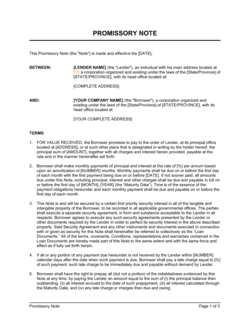
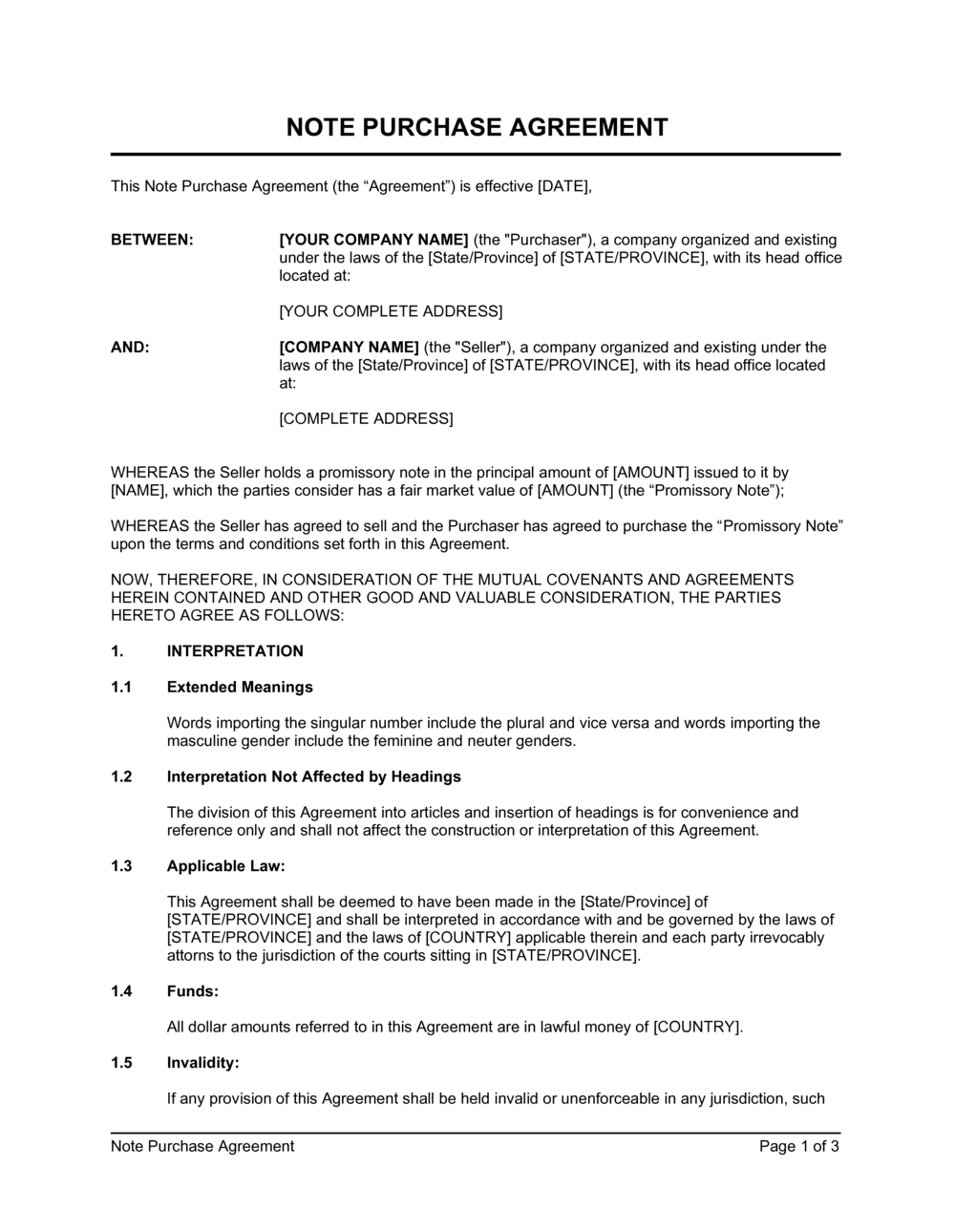
Note Purchase Agreement Template

Free Word download • Edit online • Save & share with Drive • Export to PDF

3 pages25–30 min to fillDifficulty: ComplexSignature requiredLegal review recommended
Learn more ↓
FreeNote Purchase Agreement Template

At a glance

What it is
A Note Purchase Agreement is a legally binding contract between an issuer (borrower) and one or more purchasers (lenders or investors) that governs the sale of a promissory note — documenting the principal amount, interest rate, maturity date, repayment terms, and the conditions under which the note is issued. This template is a free Word download you can edit online and export as PDF, covering all material terms from issuance through default in a single document.
When you need it
Use it when a company raises debt capital from private investors, issues bridge notes before a priced equity round, or borrows from institutional lenders outside of a traditional bank facility. It is also used when an investor purchases an existing note from a third party.
What's inside
Issuance and purchase terms, principal amount and interest rate, maturity and repayment schedule, representations and warranties from both parties, covenants, events of default, remedies, and governing law. Convertible variants include conversion mechanics and valuation cap provisions.

What is a Note Purchase Agreement?

A Note Purchase Agreement is a legally binding contract between an issuer — the company or individual borrowing capital — and one or more purchasers — private investors or lenders — that governs the sale and purchase of a promissory note. It documents every material term of the debt transaction: the principal amount, annual interest rate, maturity date, repayment or conversion mechanics, representations and warranties from both parties, ongoing covenants, events of default, and the remedies available to the note holder if the issuer fails to perform. Unlike a standalone promissory note, which contains only the bare payment promise, a note purchase agreement is a comprehensive contract that allocates risk, defines obligations, and protects both sides for the life of the instrument.

Why You Need This Document

Closing a private debt transaction without a note purchase agreement leaves both parties dangerously exposed. For the investor, there are no representations confirming the issuer is solvent or authorized to borrow, no covenants preventing the company from taking on senior debt that subordinates the note, and no default triggers that create enforceable remedies before the company is already insolvent. For the issuer, there is no transfer restriction preventing the note from being sold to an adversarial party, no clear record of the securities law exemption relied upon, and no certainty about how conversion works if the note is meant to bridge to an equity round. In a dispute, courts look for the written agreement — not the email thread or term sheet — to determine what the parties actually agreed. A properly executed note purchase agreement, signed before any funds are transferred, is the only document that holds up to that scrutiny and ensures both sides remain accountable to the terms they negotiated.

Which variant fits your situation?

If your situation is…Use this template
Startup raising pre-seed or seed bridge capital from angelsConvertible Note Purchase Agreement
Company borrowing a fixed sum with scheduled principal repaymentsNote Purchase Agreement (Term Loan)
Investor purchasing an existing promissory note from a third partyNote Assignment and Purchase Agreement
Short-term working capital loan between related partiesIntercompany Loan Agreement
Lender issuing a secured loan backed by real propertyMortgage Note and Deed of Trust
Multiple investors participating in a single debt roundNote Purchase Agreement (Multi-Purchaser)
Early-stage company using a SAFE instead of a convertible noteSimple Agreement for Future Equity (SAFE)

Common mistakes to avoid

❌ Omitting the accredited investor representation

Why it matters: Issuing a promissory note as an unregistered security to a non-accredited investor without a valid exemption violates SEC Regulation D and state blue-sky laws, exposing the Company to rescission claims and fines.

Fix: Include an explicit accredited investor representation from each Purchaser and file a Form D with the SEC within 15 days of the first sale.

❌ Leaving the interest compounding method undefined

Why it matters: Courts apply simple interest by default in most US jurisdictions. If compound interest was intended, the Company pays significantly less at maturity than the parties modeled, creating a dispute.

Fix: State explicitly whether interest accrues on a simple or compound basis and include the day-count convention (actual/365 or 30/360) in the interest rate clause.

❌ No cure period for covenant defaults

Why it matters: Immediate acceleration on a first technical covenant breach — such as a late financial statement — destroys the lending relationship and may expose a Purchaser who is also an equity holder to lender liability claims.

Fix: Add a 10–30 business day notice-and-cure period to every covenant default event, reserving immediate acceleration for payment failure, insolvency, and fraud.

❌ Valuation cap set without MFN protection for earlier note holders

Why it matters: If the Company later issues convertible notes at a lower cap or higher discount, early investors convert on worse economic terms than later investors — a result most early investors did not intend to accept.

Fix: Include a most favored nation clause giving earlier note holders the right to amend their terms to match any more favorable terms offered to subsequent note purchasers.

❌ Transfer restriction omitted from privately placed notes

Why it matters: Without a transfer restriction, the note can be sold to a competitor, an adversarial creditor, or any third party with no notice to the Company — altering the lender relationship without consent.

Fix: Add a transfer restriction clause requiring Company consent for any assignment, with a carve-out for transfers to affiliates of the Purchaser.

❌ No severability clause

Why it matters: If one provision — such as an interest rate exceeding the applicable usury ceiling — is struck down, a court may void the entire agreement rather than severing only the offending clause.

Fix: Include a standard severability clause stating that if any provision is held invalid, the remaining provisions continue in full force and effect.

The 10 key clauses, explained

Parties, Recitals, and Defined Terms

In plain language: Identifies the issuer and each purchaser as legal entities, states the purpose of the agreement, and defines all capitalized terms used throughout the document.

Sample language
This Note Purchase Agreement ('Agreement') is entered into as of [DATE] by and between [ISSUER LEGAL NAME], a [STATE] [ENTITY TYPE] ('Company'), and [PURCHASER NAME] ('Purchaser'). Capitalized terms not otherwise defined herein have the meanings set forth in Section 1.

Common mistake: Using trade names instead of registered legal entity names. If the issuer name does not match the entity on the cap table or state filing, the note may be unenforceable against the correct obligor.

Issuance and Sale of the Note

In plain language: Establishes the Company's commitment to issue the note and the Purchaser's commitment to fund the purchase price, and specifies the closing date and mechanics.

Sample language
Subject to the terms hereof, the Company shall issue and sell to Purchaser, and Purchaser shall purchase from the Company, a promissory note in the principal amount of $[AMOUNT] ('Note') on the Closing Date of [DATE], for a purchase price equal to [100%] of the principal amount.

Common mistake: Leaving the closing date open-ended. An undefined closing date creates uncertainty about when funding obligations arise and can lead to disputes over whether the agreement is binding.

Principal, Interest Rate, and Payment Schedule

In plain language: States the principal sum, the annual interest rate, how interest accrues (simple or compound), and the schedule for periodic payments or lump-sum payment at maturity.

Sample language
The Note shall bear interest on the outstanding principal balance at a rate of [X]% per annum, accruing daily on the basis of a 365-day year. Interest shall be [paid quarterly / paid at maturity]. The entire outstanding principal and accrued interest shall be due on [MATURITY DATE].

Common mistake: Failing to specify simple versus compound interest. Courts apply simple interest by default in many jurisdictions — if compound interest is intended, state it explicitly or the issuer may be entitled to a lower payoff.

Representations and Warranties of the Company

In plain language: The Company confirms it is duly organized, has authority to issue the note, has disclosed all material liabilities, is not in breach of any other agreement, and is compliant with applicable law.

Sample language
The Company represents and warrants to Purchaser that: (a) it is duly organized and in good standing under the laws of [STATE]; (b) the execution of this Agreement has been duly authorized; (c) no material adverse change has occurred since [DATE]; and (d) the Note, when issued, will constitute a valid and binding obligation of the Company.

Common mistake: Giving a bringdown rep without a materiality qualifier. Unqualified representations can trigger a technical default for immaterial inaccuracies — add 'in all material respects' to each factual representation.

Representations and Warranties of the Purchaser

In plain language: The Purchaser confirms it is an accredited investor (if required by securities law), has reviewed available information, is acquiring the note for its own account, and understands the investment risk.

Sample language
Purchaser represents and warrants that: (a) it is an 'accredited investor' as defined in Rule 501 of Regulation D; (b) it is acquiring the Note for its own account and not with a view to distribution; and (c) it has had sufficient opportunity to ask questions of and receive answers from the Company.

Common mistake: Omitting the accredited investor representation when the note is sold in a private placement. Issuing an unregistered security to a non-accredited investor without a valid exemption violates federal and state securities laws.

Affirmative and Negative Covenants

In plain language: Affirmative covenants require the Company to maintain insurance, provide financial statements, and pay taxes. Negative covenants restrict it from incurring additional debt, making distributions, or selling material assets without the Purchaser's consent.

Sample language
During the term of this Agreement, the Company shall: (a) maintain adequate insurance on its assets; (b) provide Purchaser with quarterly unaudited financial statements within 45 days of each quarter end; and (c) not incur indebtedness senior to or pari passu with the Note without prior written consent of Purchaser.

Common mistake: Using blanket covenant restrictions that prohibit routine operational transactions like vendor credit terms or equipment leases. Over-broad covenants create inadvertent defaults and require frequent waiver requests.

Events of Default and Remedies

In plain language: Lists specific triggers — missed payment, insolvency filing, breach of covenant, change of control — that give the note holder the right to accelerate the debt and pursue collection remedies.

Sample language
Each of the following constitutes an 'Event of Default': (a) failure to pay any principal or interest within [5] business days of the due date; (b) the Company's filing for protection under any bankruptcy or insolvency statute; (c) any material breach of a representation, warranty, or covenant that remains uncured for [30] days after written notice.

Common mistake: No cure period for covenant breaches. Triggering acceleration immediately on a first, curable breach destroys the lending relationship and may expose the note holder to lender liability claims if it is also an equity investor.

Conversion Mechanics (Convertible Note Variant)

In plain language: Describes how and when the outstanding balance converts into equity — triggered by a qualifying financing, maturity, or change of control — including the conversion price formula, valuation cap, and discount rate.

Sample language
Upon the closing of a Qualified Financing with aggregate proceeds of at least $[THRESHOLD], the outstanding principal and accrued interest shall automatically convert into [equity securities] at a price equal to the lesser of: (a) the price per share of such financing multiplied by [80]% (reflecting a [20]% discount); or (b) the price per share derived from a pre-money valuation cap of $[VALUATION CAP].

Common mistake: Setting a valuation cap without addressing a 'most favored nation' clause for earlier note holders. Later notes issued at lower caps or higher discounts can subordinate early investors economically without explicit MFN protection.

Transfer Restrictions and Assignment

In plain language: Restricts the Purchaser's ability to transfer or assign the note without the Company's consent or until applicable securities holding periods have been satisfied.

Sample language
The Note may not be transferred, assigned, pledged, or hypothecated except (a) with the prior written consent of the Company, not to be unreasonably withheld, or (b) to an affiliate of Purchaser, provided such affiliate assumes all obligations of Purchaser hereunder.

Common mistake: No transfer restriction at all on a privately placed note. Without one, the note can be transferred to a competitor or an adversarial party with no notice to or approval from the Company.

Governing Law, Dispute Resolution, and Miscellaneous

In plain language: Specifies the jurisdiction whose laws govern the agreement, how disputes are resolved (litigation or arbitration), and standard boilerplate — entire agreement, amendments, waiver, severability, and counterparts.

Sample language
This Agreement shall be governed by the laws of the State of [STATE], without regard to conflict-of-law principles. Any dispute arising hereunder shall be resolved by binding arbitration administered by [AAA / JAMS] in [CITY], except that either party may seek injunctive relief in any court of competent jurisdiction.

Common mistake: Omitting a severability clause. If one provision — for example, an interest rate that exceeds a state usury limit — is voided, the absence of severability can allow a court to void the entire agreement rather than just the offending provision.

How to fill it out

  1. 1

    Identify parties with full legal entity names

    Enter the issuer's exact registered entity name, state of formation, and entity type. Do the same for each note purchaser. If there are multiple purchasers, list them in a Schedule of Purchasers.

    💡 Pull the issuer's name directly from its state certificate of good standing — a one-letter discrepancy between the agreement and the corporate registry can complicate enforcement.

  2. 2

    Set the principal amount, interest rate, and maturity date

    Enter the face amount of the note, the annual interest rate, the day-count convention (365 or 360), and whether interest accrues as simple or compound. Set a specific calendar maturity date.

    💡 Check the applicable usury ceiling for the governing state before entering the interest rate — most states cap interest on business loans between 16% and 25% per annum.

  3. 3

    Define the repayment schedule or bullet maturity

    Decide whether the note pays periodic interest only (with principal due at maturity), amortizes principal over the term, or accrues all interest to maturity. Document the schedule precisely in the payment section or a separate amortization exhibit.

    💡 For bridge notes, a bullet maturity with interest accruing to maturity is simplest — avoid quarterly cash interest payments that strain the issuer's working capital.

  4. 4

    Complete the representations and warranties blocks

    Review each representation for accuracy as of the signing date. Add a materiality qualifier ('in all material respects') to factual reps and a knowledge qualifier ('to the Company's knowledge') to reps about third-party claims or litigation.

    💡 Flag any rep the Company cannot make accurately and negotiate a disclosure schedule exception rather than deleting the rep entirely — deletions signal problems to future investors.

  5. 5

    Calibrate affirmative and negative covenants to the deal

    Match covenant restrictions to the Company's actual risk profile. A pre-revenue startup needs looser covenants than a profitable business with multiple creditors. Define dollar thresholds for restricted transactions so routine vendor payments and equipment leases are excluded.

    💡 Add a consent not to be unreasonably withheld qualifier to negative covenants wherever the Company needs operational flexibility — it reduces waiver requests without removing the protection.

  6. 6

    Configure events of default and cure periods

    List every material default trigger and include a notice-and-cure period of at least 10–30 business days for non-payment covenant breaches. Reserve immediate acceleration for insolvency and fraud events only.

    💡 A cross-default clause (default under any other indebtedness) is standard for institutional notes but can be punishing in startup bridge rounds — include it only if the Company has other material debt.

  7. 7

    Add conversion terms if the note is convertible

    Enter the qualifying financing threshold, discount rate, valuation cap, and the specific equity security into which the note converts. Include a change-of-control conversion or repayment right.

    💡 Use a defined term for 'Qualified Financing' with a minimum dollar threshold — typically 3–5× the note principal — so conversion is triggered only by a meaningful priced round, not a small friends-and-family bridge.

  8. 8

    Select governing law and execute before funding

    Choose the governing state based on where the Company is incorporated or where the Purchaser requires. Both parties must sign before any funds are transferred. Use countersigned PDF originals or an eSign platform that timestamps execution.

    💡 Delaware is the default governing law for most US venture-backed companies — its well-developed case law on commercial contracts provides predictability for both sides.

Frequently asked questions

What is a note purchase agreement?

A note purchase agreement is a contract between an issuer (the borrower or company raising capital) and one or more purchasers (investors or lenders) that governs the sale and purchase of a promissory note. It documents the principal amount, interest rate, maturity date, repayment terms, representations from both parties, covenants, and what happens if the issuer defaults. Unlike a simple promissory note, it includes the full suite of contractual protections that govern the transaction from issuance through repayment or conversion.

What is the difference between a note purchase agreement and a promissory note?

A promissory note is the payment instrument itself — the written promise to repay a specific amount by a specific date. A note purchase agreement is the broader contract that governs the transaction: who is buying the note, at what price, under what conditions, with what representations and covenants, and with what remedies on default. The note is typically attached as an exhibit to the note purchase agreement and issued at closing.

When is a note purchase agreement used instead of a loan agreement?

Note purchase agreements are common in private debt placements where investors purchase notes as securities, in startup bridge financings where the note may convert to equity, and when a note changes hands between secondary market buyers. A loan agreement is more typical for bank credit facilities, revolving lines, and term loans where the lender is a regulated financial institution. The functional difference is often characterization — a note purchase frames the transaction as a securities sale, which affects how it is documented and regulated.

Does a note purchase agreement need to be registered with the SEC?

In most cases, no. Private note placements rely on exemptions from SEC registration — most commonly Regulation D Rule 506(b) or 506(c) for sales to accredited investors. The issuer must file a Form D with the SEC within 15 days of the first sale and comply with applicable state blue-sky laws. Publicly offered notes require full registration on Form S-1 or an applicable shelf registration. Consult securities counsel to confirm the applicable exemption before closing.

What is a convertible note purchase agreement?

A convertible note purchase agreement adds conversion mechanics to a standard note — upon a qualifying financing event, change of control, or maturity, the outstanding principal and accrued interest convert into equity rather than being repaid in cash. Convertible notes are a common bridge financing tool for early-stage companies because they defer valuation negotiation to the priced equity round. Key terms include the valuation cap, discount rate, qualifying financing threshold, and interest rate — typically 5–8% per annum.

What happens if the issuer defaults on a note?

Upon an event of default, the note holder typically has the right to accelerate the entire outstanding balance — making principal and all accrued interest immediately due — and to pursue collection remedies including filing suit for the outstanding amount. If the note is secured, the holder may also foreclose on the collateral. Most agreements include a cure period of 10–30 days for non-payment covenant breaches before acceleration can be triggered, reserving immediate remedies for insolvency and fraud events.

What is a valuation cap in a convertible note?

A valuation cap sets a ceiling on the pre-money valuation used to calculate the conversion price when a convertible note converts to equity. If the qualifying financing values the company above the cap, the note holder converts at the lower cap-derived price — effectively receiving more shares per dollar invested than new investors in that round. The cap compensates early investors for the additional risk they took by investing before a priced round established the company's value.

Are note purchase agreements enforceable across all US states?

Generally yes, when properly executed, provided the interest rate does not exceed the applicable state usury ceiling and the note was issued in compliance with securities laws. Enforceability of specific provisions — particularly non-compete covenants attached to the note and certain arbitration clauses — varies by state. Courts will apply the governing law chosen in the agreement as long as it has a reasonable relationship to the transaction, though some states impose their own mandatory rules regardless of the chosen governing law.

Should I use a note purchase agreement or a SAFE for startup bridge financing?

A SAFE (Simple Agreement for Future Equity) is not a debt instrument — it does not accrue interest, has no maturity date, and does not create an obligation to repay cash. A convertible note is debt that accrues interest and matures, creating real repayment pressure if a qualified financing does not close in time. SAFEs are simpler and founder-friendly; convertible notes are more investor-protective. The choice depends on investor preference and whether the company can accept the repayment risk of a maturity date. Many institutional angels require notes; many YC-style accelerators prefer SAFEs.

How this compares to alternatives

vs Loan Agreement

A loan agreement is the standard instrument for bank and institutional credit facilities — it typically governs revolving lines, syndicated term loans, and regulated lender transactions with detailed administrative provisions. A note purchase agreement frames the transaction as a securities sale, is common in private placements and startup bridge rounds, and includes investor-protection provisions like representations on securities law compliance that a bank loan agreement does not. Use a loan agreement for bank debt and a note purchase agreement for private investor debt.

vs Promissory Note

A promissory note is the payment instrument alone — the unconditional promise to repay. A note purchase agreement is the full contract governing the transaction, attaching the note as an exhibit and adding representations, covenants, default provisions, and transfer restrictions. For any transaction involving private investors or meaningful sums, the note purchase agreement provides essential protections that a standalone promissory note omits entirely.

vs Simple Agreement for Future Equity (SAFE)

A SAFE is not debt — it has no interest, no maturity date, and no repayment obligation. A convertible note purchase agreement is debt that accrues interest and matures, creating real repayment pressure if a qualifying financing does not close. SAFEs are founder-friendly and administratively simple; convertible notes are more protective for investors who want a hard maturity backstop. The choice is primarily driven by investor preference and the company's confidence in closing a priced round before maturity.

vs Stock Purchase Agreement

A stock purchase agreement governs the sale of equity — shares of common or preferred stock — not debt. A note purchase agreement governs the sale of a debt instrument that must be repaid (or converted) regardless of company performance. Investors who want downside protection through a repayment obligation use notes; investors who want pure equity upside use stock purchase agreements. In early-stage financings, convertible notes bridge between the two by starting as debt and converting to equity on a future round.

Industry-specific considerations

Technology / SaaS

Convertible bridge notes with valuation caps and discount rates are the dominant pre-seed and seed financing instrument for SaaS and software companies ahead of a priced Series A.

Real Estate

Mortgage note purchases between originators and secondary market investors, private hard-money lending, and note portfolios sold in bulk through structured purchase agreements with representations on loan performance.

Private Equity and Venture Capital

Mezzanine debt issuances, PIK (payment-in-kind) note structures, and sponsor-to-sponsor note transfers in leveraged buyouts where senior bank debt is supplemented by privately placed junior notes.

Healthcare

Physician practice acquisitions frequently involve seller-financed notes; medical device and biotech companies use convertible notes for pre-clinical bridge financing before FDA approval de-risks the equity round.

Manufacturing

Equipment financing and expansion capital raised through private note placements from family offices or regional investors, often secured by specific machinery or accounts receivable.

Professional Services

Law firm and accounting practice acquisitions routinely use seller-financed notes with earn-out-linked repayment schedules tied to client retention following a partner buyout.

Jurisdictional notes

United States

Private note placements typically rely on Regulation D Rule 506(b) or 506(c) exemptions from SEC registration, requiring Form D filing within 15 days of first sale. State usury laws cap interest rates — limits range from about 16% in California to 25% or more in other states for business loans. Convertible notes issued to investors are securities under the Securities Act of 1933 and must comply with both federal and state (blue-sky) exemptions. Delaware governing law is standard for venture-backed companies.

Canada

Private debt placements in Canada rely on prospectus exemptions under National Instrument 45-106, most commonly the accredited investor exemption. Provincial securities regulators (OSC, BCSC, AMF) each administer their own rules, though NI 45-106 is harmonized nationally. Interest rates are subject to the federal criminal rate ceiling of 60% per annum under the Criminal Code — commercial notes must stay well below this ceiling. Quebec transactions require French-language contract versions for provincially regulated entities.

United Kingdom

Note issuances to investors in the UK are subject to the Financial Services and Markets Act 2000 (FSMA) and the Financial Promotions Order. Private placements to sophisticated or high-net-worth investors rely on exemptions under the FPO. Post-Brexit, UK and EU prospectus regimes have diverged — a UK FSMA-compliant note is no longer passportable into EU member states. Interest rate provisions should reference the Bank of England base rate for floating-rate notes.

European Union

Private note placements across EU member states rely on the EU Prospectus Regulation exemptions — most commonly the qualified investor exemption or the 150-person limit. GDPR data protection obligations apply to any personal data exchanged in the transaction documents. Interest rate provisions in eurozone transactions typically reference the ECB deposit rate or EURIBOR. Member state usury and consumer credit laws vary significantly — France, Germany, and Italy each impose specific caps and disclosure requirements for commercial lending transactions.

Template vs lawyer — what fits your deal?

PathBest forCostTime
Use the templateSimple fixed-rate notes between sophisticated parties — small business loans from known private lenders under $250KFree30–60 minutes
Template + legal reviewBridge notes to angel investors, multi-purchaser placements, or notes with conversion features$500–$1,5002–5 days
Custom draftedInstitutional note placements over $1M, mezzanine debt with complex covenants, or multi-jurisdiction transactions$3,000–$15,000+2–6 weeks

Glossary

Promissory Note
A written instrument in which the issuer unconditionally promises to pay a specified sum to the note holder at a defined time or on demand.
Principal Amount
The face value of the note — the original sum borrowed or purchased — on which interest accrues.
Maturity Date
The date on which the outstanding principal and any accrued, unpaid interest become due and payable in full.
Coupon Rate
The annual interest rate stated on the note, expressed as a percentage of the principal, determining periodic interest payments.
Accrued Interest
Interest that has accumulated on the principal balance since the last payment date but has not yet been paid to the note holder.
Event of Default
A specified condition — such as missed payment, insolvency, or breach of covenant — that gives the note holder the right to accelerate repayment and pursue remedies.
Acceleration Clause
A provision that makes the entire outstanding balance immediately due and payable upon the occurrence of an event of default.
Representations and Warranties
Factual statements made by each party at closing that confirm legal authority, accuracy of disclosed information, and absence of undisclosed liabilities.
Covenant
A contractual obligation — either to take a specific action (affirmative covenant) or to refrain from one (negative covenant) — that the issuer must observe for the life of the note.
Conversion Feature
A provision in a convertible note allowing the holder to exchange the outstanding balance for equity at a defined price or discount, typically triggered by a qualifying financing event.
Subordination
An agreement by a junior note holder to rank their repayment claim below that of senior creditors in the event of liquidation or default.
Valuation Cap
A ceiling on the company valuation used to calculate the conversion price for a convertible note, protecting early investors from excessive dilution.

Part of your Business Operating System

This document is one of 3,000+ business & legal templates included in Business in a Box.

  • Fill-in-the-blanks — ready in minutes
  • 100% customizable Word document
  • Compatible with all office suites
  • Export to PDF and share electronically

Create your document in 3 simple steps.

From template to signed document — all inside one Business Operating System.
1
Download or open template

Access over 3,000+ business and legal templates for any business task, project or initiative.

2
Edit and fill in the blanks with AI

Customize your ready-made business document template and save it in the cloud.

3
Save, Share, Send, Sign

Share your files and folders with your team. Create a space of seamless collaboration.

Save time, save money, and create top-quality documents.

★★★★★

"Fantastic value! I'm not sure how I'd do without it. It's worth its weight in gold and paid back for itself many times."

Managing Director · Mall Farm
Robert Whalley
Managing Director, Mall Farm Proprietary Limited
★★★★★

"I have been using Business in a Box for years. It has been the most useful source of templates I have encountered. I recommend it to anyone."

Business Owner · 4+ years
Dr Michael John Freestone
Business Owner
★★★★★

"It has been a life saver so many times I have lost count. Business in a Box has saved me so much time and as you know, time is money."

Owner · Upstate Web
David G. Moore Jr.
Owner, Upstate Web

Run your business with a system — not scattered tools

Stop downloading documents. Start operating with clarity. Business in a Box gives you the Business Operating System used by over 250,000 companies worldwide to structure, run, and grow their business.

Start free · No credit card required