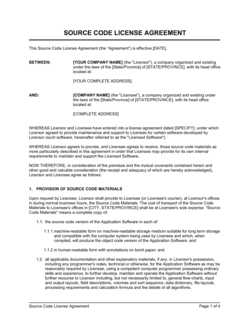
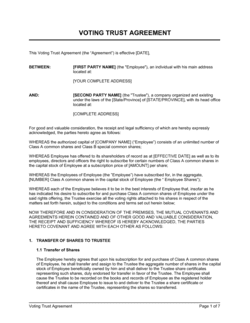
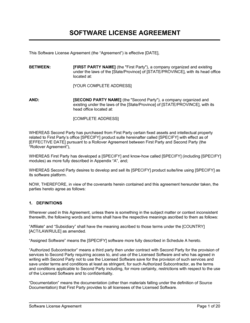
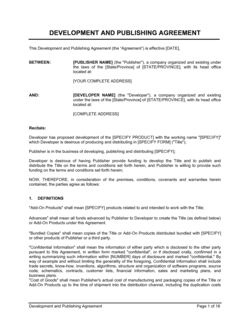
Source Code Trust Agreement Development Template

Free Word download • Edit online • Save & share with Drive • Export to PDF

18 pages35–45 min to fillDifficulty: ComplexSignature requiredLegal review recommended
Learn more ↓
FreeSource Code Trust Agreement Development Template

At a glance

What it is
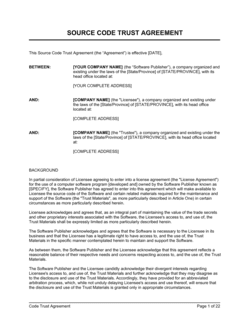
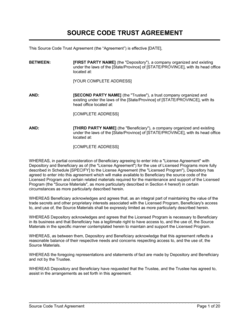
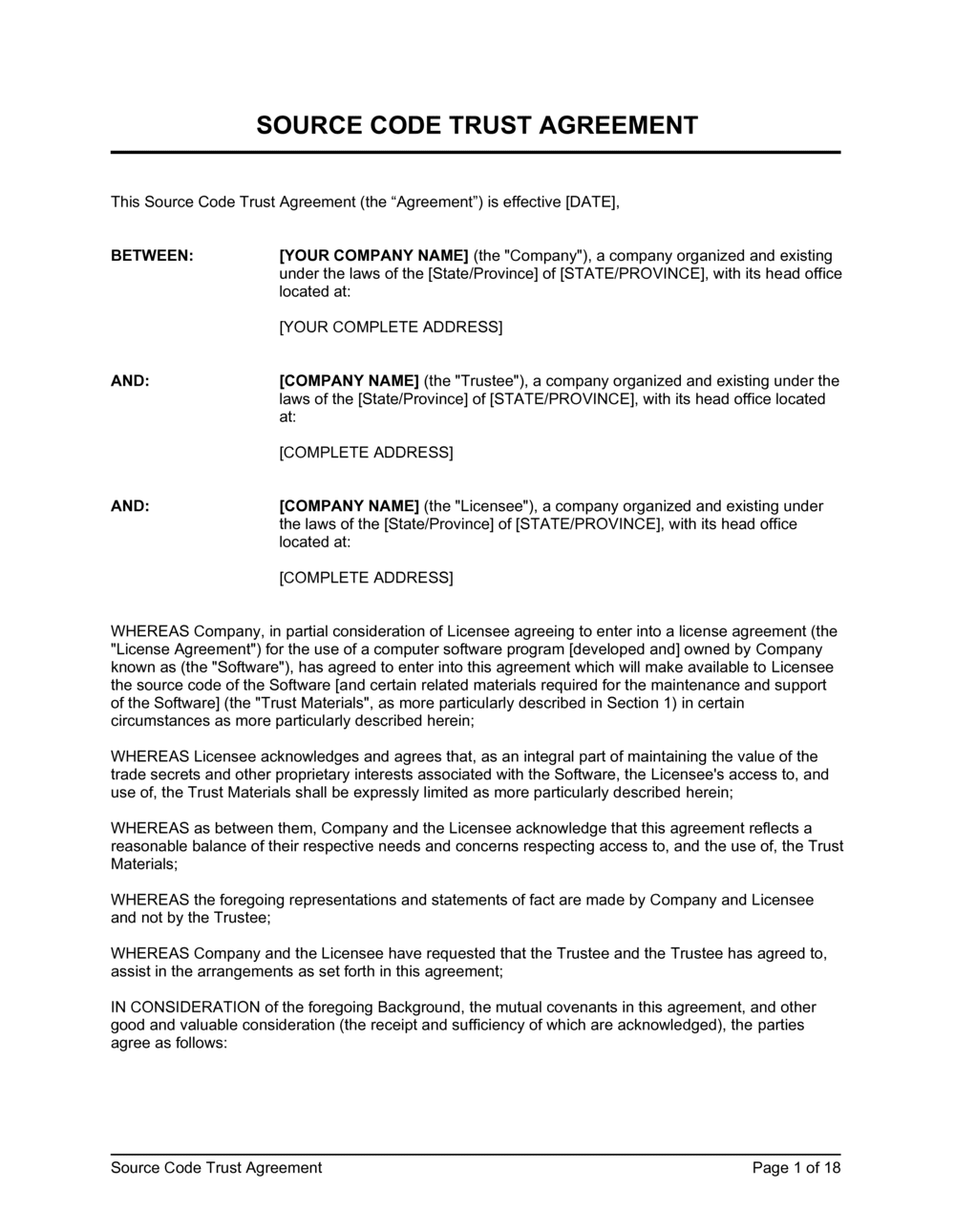
A Source Code Trust Agreement (Development) is a legally binding tripartite contract among a software developer, a licensee (end-user or customer), and a neutral trustee under which the developer deposits the application's source code — and related build documentation — with the trustee for safekeeping. This free Word download gives you a structured, attorney-ready starting point you can edit online and export as PDF to protect both sides of a software development or licensing relationship.
When you need it
Use it whenever a licensee relies on proprietary software critical to its operations and needs assurance that source code will remain accessible if the developer becomes insolvent, ceases support, or materially breaches the development agreement. It is also used during active development when milestone deposits are required as a condition of staged payments.
What's inside
Trustee appointment and duties, deposit obligations and acceptance procedures, release conditions and verification rights, IP ownership and license-back provisions, confidentiality obligations, trustee fees and liability limits, and termination mechanics covering all three parties.

What is a Source Code Trust Agreement (Development)?

A Source Code Trust Agreement (Development) is a legally binding tripartite contract among a software developer, a licensee, and a neutral trustee that governs the deposit, safekeeping, and conditional release of a software application's source code during and after active development. Unlike a standard software escrow tied to a finished product, the development variant structures ongoing milestone deposits throughout the build process, giving the licensee staged assurance that compilable, complete source code exists at every phase of the project. The trustee — typically a professional escrow service or law firm — holds the materials in trust and releases them to the licensee only when a defined triggering event occurs, such as developer insolvency, material breach, or permanent cessation of support. The developer retains full IP ownership throughout; the licensee receives only a limited, conditional license-back on release.

Why You Need This Document

Without a source code trust agreement, a licensee whose developer becomes insolvent, is acquired by a competitor, or simply stops maintaining the software faces a stark choice: rebuild the application from scratch or halt operations. Either outcome can cost six figures in emergency development spend or operational downtime. A trust agreement eliminates that exposure at a fraction of the cost by ensuring the code is held securely by a neutral party who will release it the moment a defined threshold is crossed. For developers, the agreement answers the licensee's continuity objection and closes deals that would otherwise stall on due diligence. This template gives both sides a professionally structured starting point — covering deposit schedules, verification obligations, release conditions, and license-back scope — that can be adapted to any software development arrangement without starting from a blank page.

Which variant fits your situation?

If your situation is…Use this template
Protecting a completed, deployed software product under a perpetual licenseSoftware Escrow Agreement
Active software development with staged milestone depositsSource Code Trust Agreement (Development)
Transferring full IP ownership of source code to a buyerSoftware IP Assignment Agreement
Licensing source code for modification without an escrow requirementSource Code License Agreement
Outsourcing development to a third-party contractor with IP assignmentSoftware Development Agreement
Protecting SaaS platform source code for a cloud-hosted productSaaS Escrow Agreement
Depositing firmware or embedded software with a hardware productTechnology Escrow Agreement

Common mistakes to avoid

❌ Defining deposit materials without build documentation

Why it matters: Raw source code files are worthless without the build scripts, environment specifications, and dependency lists needed to compile them. A licensee who receives incomplete materials cannot restore the application and the escrow fails its entire purpose.

Fix: Require Exhibit A to include a build manifest signed off by the developer's technical lead, specifying every file, library, and configuration needed to produce a deployable binary from scratch.

❌ Setting release conditions that require a court judgment before release

Why it matters: Requiring a final court judgment as the sole release trigger means the licensee cannot access the code for 12–36 months while litigation proceeds — by which time the business disruption is irreparable.

Fix: Include self-executing triggers for objectively verifiable events (bankruptcy filing, public cessation of operations) and reserve court-order requirements only for contested factual disputes.

❌ Omitting the change-of-control as a release trigger

Why it matters: The most common scenario where licensees need escrow protection is a developer acquisition by a competitor, not insolvency. Without a change-of-control trigger, the acquirer can discontinue the product with no release obligation.

Fix: Add a release condition covering any acquisition, merger, or change of control of the developer where the acquirer is a direct competitor of the licensee or announces discontinuation of the software.

❌ No verification obligation on the trustee

Why it matters: A trustee that merely stores whatever the developer uploads provides no assurance that the deposit is complete or compilable. The licensee discovers the deficiency only after a release event, when it is too late.

Fix: Mandate at least Level 2 verification within 30 days of each deposit and require the developer to cure any identified deficiency within 15 business days under penalty of material breach.

❌ Using a different governing law from the underlying development agreement

Why it matters: Conflicting governing laws create disputes about what standard applies to a 'material breach' release trigger — the trustee cannot safely release without a court order, negating the agreement's value.

Fix: Always match the governing law clause in the trust agreement to the governing law of the underlying software development or license agreement.

❌ Allowing developer-only termination rights during active development

Why it matters: If the developer can unilaterally terminate the escrow and retrieve the deposit materials at any time, the licensee has no protection during exactly the period — active development — when insolvency risk is highest.

Fix: During the active development term, restrict unilateral developer termination and require mutual consent or a defined notice period of no less than 90 days, with the licensee retaining the right to object and seek injunctive relief.

The 10 key clauses, explained

Recitals and definitions

In plain language: Identifies all three parties by legal name, establishes the underlying development or license agreement this escrow supports, and defines key terms used throughout the contract.

Sample language
This Source Code Trust Agreement ('Agreement') is entered into as of [DATE] among [DEVELOPER LEGAL NAME] ('Developer'), [LICENSEE LEGAL NAME] ('Licensee'), and [TRUSTEE LEGAL NAME] ('Trustee'). Capitalized terms not defined herein have the meanings given in the Software Development Agreement dated [DATE] ('Underlying Agreement').

Common mistake: Failing to cross-reference the underlying development or license agreement by full title and date, making it impossible to determine which software version the escrow covers.

Deposit obligations and schedule

In plain language: Specifies what the developer must deposit, when initial and subsequent deposits are due, and the format and media requirements for delivery to the trustee.

Sample language
Developer shall deliver to Trustee the Deposit Materials described in Exhibit A within [30] days of the Effective Date and within [5] business days of completing each Milestone identified in Exhibit B. All deposits shall be delivered on [MEDIA TYPE / secure upload portal] with a signed Deposit Certificate.

Common mistake: Defining deposit materials too narrowly — omitting build scripts, environment configuration files, or third-party component licenses — so the released code cannot be compiled by the licensee.

Trustee acceptance and verification

In plain language: Sets out the trustee's duty to acknowledge receipt, conduct or commission a technical verification of deposit completeness, and notify both parties of any deficiency.

Sample language
Upon receipt of Deposit Materials, Trustee shall issue a written Deposit Receipt within [3] business days. Within [30] days of each deposit, Trustee shall perform a Level [1 / 2 / 3] Verification and notify both Developer and Licensee of any identified deficiency. Developer shall cure deficiencies within [15] business days.

Common mistake: Skipping verification entirely or scheduling it only at initial deposit, leaving later milestone deposits unverified and potentially incomplete at the time they are most needed.

Release conditions

In plain language: Lists the specific events that entitle the licensee to request release of the deposit materials, and sets out the notice and response procedure before the trustee releases.

Sample language
Licensee may request release of the Deposit Materials upon the occurrence of any of the following: (a) Developer files for bankruptcy or is subject to an involuntary insolvency proceeding not dismissed within [60] days; (b) Developer commits a Material Breach of the Underlying Agreement and fails to cure within [30] days of written notice; (c) Developer permanently ceases to offer support for the Software.

Common mistake: Drafting release conditions so broadly that any minor breach triggers release, creating litigation risk, or so narrowly that legitimate business disruption events are excluded.

Release procedure and dispute resolution

In plain language: Defines how the licensee submits a release request, the notice period given to the developer to object, and how a disputed release is resolved before the trustee acts.

Sample language
To request release, Licensee shall deliver written notice to Trustee and Developer specifying the release condition. Developer may object within [10] business days. If no objection is timely received, Trustee shall release the Deposit Materials. If Developer objects, release shall be withheld pending resolution by [arbitration / court order] under Clause [X].

Common mistake: Omitting a developer objection window entirely, exposing the trustee to liability for premature release, or setting the window so long (30+ days) that the licensee cannot respond to an urgent operational failure.

License-back and permitted use after release

In plain language: Grants the licensee a limited, non-exclusive license to use, modify, and maintain the released source code solely for internal business continuity purposes — not for redistribution or competitive use.

Sample language
Upon release, Developer grants Licensee a non-exclusive, non-transferable, royalty-free license to use, reproduce, and modify the Deposit Materials solely to continue operating the Software for Licensee's internal business purposes. This license does not include the right to distribute, sublicense, or commercialize the Software or Deposit Materials.

Common mistake: Granting an unrestricted license on release, effectively giving the licensee commercial distribution rights the developer never intended to convey.

IP ownership and confidentiality

In plain language: Confirms that the developer retains all IP rights in the deposit materials at all times, and obligates the trustee and licensee to treat the materials as confidential proprietary information.

Sample language
All right, title, and interest in the Deposit Materials remains exclusively with Developer. Trustee and Licensee shall treat the Deposit Materials as Developer's Confidential Information, apply no less than reasonable security measures, and disclose them only as expressly permitted by this Agreement.

Common mistake: No explicit IP retention clause, leaving the legal status of ownership ambiguous after a release — which courts in some jurisdictions have construed against the developer.

Trustee fees, liability, and indemnification

In plain language: Allocates trustee fees between the parties, caps the trustee's liability for storage and release, and requires the developer and licensee to indemnify the trustee against third-party claims arising from a disputed release.

Sample language
Annual escrow fees of $[AMOUNT] shall be paid by [Licensee / Developer / equally]. Trustee's total liability under this Agreement shall not exceed the fees paid to Trustee in the preceding [12] months. Developer and Licensee shall jointly and severally indemnify Trustee against any third-party claims arising from a release made in good-faith compliance with this Agreement.

Common mistake: Omitting a trustee liability cap, making qualified trustees unwilling to accept the appointment and leaving the escrow unenforceable for lack of a willing agent.

Term and termination

In plain language: Sets the initial term, auto-renewal provisions, and the conditions under which any party may terminate — and what happens to the deposit materials on termination.

Sample language
This Agreement commences on the Effective Date and continues for [1 year], renewing automatically for successive [1-year] terms unless terminated by any party on [60] days' written notice. On termination without a pending release request, Trustee shall return the Deposit Materials to Developer or destroy them per Developer's written instruction within [30] days.

Common mistake: No provision for what happens to deposit materials on termination — leaving the trustee holding materials indefinitely with no authority to act and creating storage liability.

Governing law and dispute resolution

In plain language: Specifies the jurisdiction whose law governs the agreement and how disputes among any of the three parties are resolved — typically arbitration for speed and confidentiality in technology disputes.

Sample language
This Agreement is governed by the laws of [STATE / PROVINCE / COUNTRY]. Any dispute arising hereunder shall be resolved by binding arbitration under the [AAA / JAMS / ICC] rules in [CITY], conducted in [LANGUAGE], except that either party may seek injunctive relief in any court of competent jurisdiction.

Common mistake: Choosing a governing law that differs from the underlying software development agreement, creating conflicting legal standards for what constitutes a material breach triggering release.

How to fill it out

  1. 1

    Identify all three parties by their legal entity names

    Enter the developer's and licensee's full registered legal names, jurisdiction of incorporation, and principal addresses. Identify the trustee — a professional escrow company, law firm, or neutral third party — by its registered name and contact details.

    💡 Use a professionally accredited escrow agent such as an IP escrow service or technology escrow company rather than an individual, so the appointment survives personnel changes.

  2. 2

    Define the deposit materials in Exhibit A

    List every component required to compile and run the software: source code files with directory structure, build scripts, configuration files, database schemas, API keys management documentation, and third-party library license details.

    💡 Have your lead developer review Exhibit A before signing — a legal team alone will miss technical components that make the difference between compilable and useless code.

  3. 3

    Set the deposit schedule in Exhibit B

    For development escrows, tie each deposit date to a specific milestone in the underlying development agreement. For completed-software escrows, specify the initial deposit deadline and an annual or quarterly update schedule.

    💡 Align milestone deposit deadlines to payment milestones in the development agreement — if payment is withheld for a late deposit, both parties have a strong incentive to comply.

  4. 4

    Negotiate and draft the release conditions

    List each release trigger with precision: insolvency events by specific type, material breach with cure periods, and cessation of support with a defined notice threshold. Avoid vague triggers like 'failure to perform' without a specific cure mechanism.

    💡 Include a business-sale or change-of-control trigger if the licensee's concern is that the developer will be acquired and the new owner will discontinue the product.

  5. 5

    Specify the verification level required

    Level 1 verification confirms deposit existence; Level 2 confirms completeness against a specification; Level 3 is a full build and functional test. Higher levels cost more but provide meaningful assurance.

    💡 For mission-critical software, require at least Level 2 verification at initial deposit and after each major version update — Level 1 only confirms a file exists, not that it compiles.

  6. 6

    Draft the license-back scope carefully

    Define the permitted use after release: internal business continuity only, or including the right to engage a third-party maintenance contractor. Explicitly exclude commercial redistribution and sublicensing.

    💡 If the licensee needs to hire an outside developer to maintain the code after a release, the license-back clause must explicitly permit disclosure to and use by such a contractor.

  7. 7

    Confirm trustee fees and payment responsibility

    Enter the trustee's annual fee, who pays it, and what happens if payment lapses. Many escrow agents will suspend access or return materials if fees are not paid on time.

    💡 Structure the agreement so the licensee pays the trustee fee directly — placing it on the developer creates a scenario where a financially distressed developer may let the escrow lapse precisely when it is most needed.

  8. 8

    Execute all three counterparts before the first deposit

    All three parties — developer, licensee, and trustee — must sign before any deposit is made. Post-deposit signature creates an ambiguity about what materials are covered and whether the trustee's obligations have commenced.

    💡 Use timestamped electronic signatures so the execution date is indisputable if a release is ever disputed in arbitration or court.

Frequently asked questions

What is a source code trust agreement?

A source code trust agreement is a legally binding contract among a software developer, a licensee, and a neutral trustee under which the developer deposits the application's source code with the trustee for safekeeping. The trustee holds the materials and releases them to the licensee only if a defined triggering event occurs — such as developer insolvency, material breach, or cessation of support. It is the standard mechanism for protecting enterprise and government buyers against loss of access to mission-critical software.

What is the difference between a source code trust agreement and a software escrow agreement?

The terms are often used interchangeably, but a source code trust agreement in the development context specifically contemplates ongoing milestone deposits during active software development, whereas a standard software escrow agreement typically covers a completed, deployed product. The development variant includes deposit schedules tied to sprint or milestone completion, more detailed verification obligations, and release conditions calibrated to development-phase risks rather than post-deployment maintenance failures.

Who are the three parties to a source code trust agreement?

The three parties are the developer (who deposits the code), the licensee or end-user (who benefits from the escrow protection), and the trustee or escrow agent (a neutral third party who holds the materials and manages the release procedure). All three must sign the agreement for it to be binding and for the trustee's obligations to commence.

What events typically trigger the release of escrowed source code?

Common release triggers include: the developer filing for bankruptcy or entering insolvency proceedings, the developer committing a material breach of the underlying development or license agreement and failing to cure within a defined period, the developer permanently ceasing maintenance and support of the software, and — in well-drafted agreements — a change of control of the developer where the acquirer discontinues the product or is a direct competitor of the licensee.

Does a source code trust agreement transfer ownership of the source code to the licensee?

No. The developer retains full IP ownership of the source code at all times, including after a release. What the licensee receives on release is a limited, conditional license — typically for internal business continuity use only — not an assignment of IP rights. Any commercial redistribution or sublicensing of released code without a separate IP assignment agreement would typically constitute IP infringement.

What is source code verification and why does it matter?

Verification is a technical audit of the deposited materials to confirm they are complete, compilable, and match the production version of the software. Level 1 confirms a deposit was received; Level 2 checks completeness against a specification; Level 3 involves a full build and functional test. Without at least Level 2 verification, the licensee has no assurance the deposit would actually work in a release scenario, making the entire escrow arrangement commercially meaningless.

Is a source code trust agreement enforceable in bankruptcy?

In most jurisdictions, a properly structured source code trust agreement provides meaningful protection in a developer's bankruptcy, but the details matter. In the US, software licenses are treated as executory contracts under the Bankruptcy Code (11 U.S.C. § 365(n)), allowing licensees to retain their rights. A well-drafted escrow reinforces those rights by creating a separate legal obligation on the trustee that survives the developer's insolvency. Consider engaging a lawyer to confirm the agreement's structure is bankruptcy-remote under the applicable jurisdiction's law.

Who pays the trustee's fees?

Fee responsibility is negotiable but typically falls on the licensee, since the escrow primarily benefits them. Placing fee obligations on the developer creates a risk that a financially distressed developer — exactly the scenario the escrow is meant to address — allows fees to lapse and the escrow to terminate. Having the licensee pay directly ensures the arrangement remains in force regardless of the developer's financial condition.

Do I need a lawyer to prepare a source code trust agreement?

For straightforward domestic software licensing arrangements with a standard commercial trustee, a high-quality template reviewed by a technology lawyer is typically sufficient. Engage a lawyer independently when the software is highly valuable or mission-critical, when the developer or licensee operates across multiple jurisdictions, when the agreement needs to be bankruptcy-remote under specific insolvency laws, or when the release conditions involve complex technical or contractual definitions. A 2–4 hour review typically costs $600–$1,200 and is worthwhile for any enterprise deal.

How this compares to alternatives

vs Software Development Agreement

A software development agreement governs the entire development relationship — scope, deliverables, timelines, payment, and IP ownership. A source code trust agreement is a companion document that provides continuity protection by placing the code with a neutral trustee. The development agreement creates the obligation to build; the trust agreement protects the output. Both are typically executed simultaneously.

vs Source Code License Agreement

A source code license agreement grants the licensee direct access to and specified usage rights over the source code from day one. A trust agreement keeps the code held by a neutral trustee and releases it only on a triggering event. Use a license agreement when the licensee needs to modify or maintain the code actively; use a trust agreement when the goal is continuity protection without immediate code access.

vs IP Assignment Agreement

An IP assignment agreement permanently transfers full ownership of the source code and associated intellectual property to the buyer. A source code trust agreement leaves ownership with the developer and grants only a conditional, limited license on release. Use an assignment when the developer is selling the software outright; use a trust agreement when the developer retains the product and the licensee needs risk protection only.

vs Non-Disclosure Agreement

An NDA protects the confidentiality of source code shared directly between parties during negotiations, due diligence, or evaluation. A source code trust agreement is an operational continuity mechanism — it governs who holds the code, when it is released, and on what terms, not merely who may view it. A well-structured software deal typically requires both: an NDA for pre-contract disclosure and a trust agreement for post-execution protection.

Industry-specific considerations

Financial services and fintech

Regulatory continuity requirements mean financial institutions routinely require source code escrow for core banking, trading, and compliance software — often as a condition of vendor onboarding under DORA, OCC, and FCA operational resilience frameworks.

Healthcare and MedTech

FDA-regulated software and hospital EHR systems require source code continuity provisions to satisfy 21 CFR Part 11 and HIPAA audit obligations, and to ensure patient-care systems remain operable if a software vendor fails.

Government and public sector

Many government procurement frameworks in the US (FAR), UK (Crown Commercial Service), and EU mandate software escrow for mission-critical public-sector systems, with specific verification and release-condition standards written into contract requirements.

SaaS and enterprise software

Enterprise SaaS customers with data sovereignty or operational continuity requirements increasingly require source code trust agreements as a condition of multi-year licensing deals, particularly for on-premise or private-cloud deployments.

Jurisdictional notes

United States

US software licensees benefit from 11 U.S.C. § 365(n) of the Bankruptcy Code, which allows licensees to retain their rights under a software license even if the developer's trustee in bankruptcy rejects the contract. A source code escrow reinforces this protection by creating a separate obligation on the trustee. State UCC Article 9 may affect the trustee's security interest in deposit materials; choose a governing state carefully — Delaware and New York are common for technology contracts.

Canada

Canadian insolvency law under the Companies' Creditors Arrangement Act (CCAA) and the Bankruptcy and Insolvency Act (BIA) does not contain an equivalent to § 365(n), making a well-structured source code trust agreement more — not less — important for Canadian licensees. Quebec civil law may treat trust arrangements differently from common-law provinces; Quebec-based deals should be reviewed by a Quebec-licensed lawyer to confirm the trust structure is valid under the Civil Code.

United Kingdom

UK law treats software escrow as a standard commercial arrangement with no specific statutory framework — enforceability depends on the trust being properly constituted under the Trustee Act 2000 and the escrow not constituting a registrable charge under the Companies Act 2006. Post-Brexit, UK and EU arrangements require separate governing law clauses; UK contracts should specify English and Welsh law or Scots law explicitly. The UK Financial Conduct Authority and Prudential Regulation Authority expect source code escrow for critical third-party software in regulated financial firms under their operational resilience rules.

European Union

The EU Digital Operational Resilience Act (DORA), effective January 2025, requires financial entities to include source code access and continuity provisions in ICT contracts with third-party technology providers — making source code trust agreements a compliance obligation rather than a commercial option for many EU financial firms. GDPR may apply if source code includes or processes personal data; the trustee's data processing role should be addressed in a separate Data Processing Agreement. Member state insolvency laws vary significantly; cross-border EU deals should specify a single governing member state law to avoid conflicts.

Template vs lawyer — what fits your deal?

PathBest forCostTime
Use the templateStandard domestic software licensing deals with a professional escrow agent and straightforward release conditionsFree1–3 hours to complete, plus trustee onboarding time
Template + legal reviewEnterprise deals above $100K ACV, regulated industries, or cross-border arrangements with one jurisdiction$600–$1,200 for a 2–4 hour technology lawyer review3–7 business days
Custom draftedMission-critical financial, healthcare, or government software with complex release conditions, multi-jurisdiction enforcement, or bankruptcy-remote structuring requirements$2,000–$8,000+2–5 weeks

Glossary

Trustee (Escrow Agent)
A neutral third party that holds the deposited source code and release materials and releases them only upon a defined triggering event.
Deposit Materials
Everything placed in trust: source code, build scripts, technical documentation, third-party library licenses, and any other materials needed to compile and run the software.
Release Condition
A contractually defined event — such as developer insolvency, material breach, or cessation of support — that entitles the licensee to receive the deposited materials.
Verification
A technical audit performed by the trustee or an appointed specialist to confirm that the deposit materials are complete, compilable, and match the production version.
License-Back
A conditional, limited license the developer grants the licensee to use, modify, and maintain the released source code solely for the licensee's internal purposes following a release event.
Milestone Deposit
A scheduled deposit of updated source code tied to the completion of a defined development sprint, phase, or deliverable under the underlying development agreement.
Insolvency Event
A release trigger encompassing bankruptcy filing, receivership appointment, voluntary liquidation, or assignment for the benefit of creditors by the developer.
Continuity of Support Obligation
The developer's contractual commitment to maintain, update, and support the software for a defined period — breach of which may itself constitute a release condition.
Tripartite Agreement
A contract binding three parties simultaneously — here, the developer, the licensee, and the trustee — each with distinct rights and obligations.
Proprietary Information
Source code, algorithms, trade secrets, and technical know-how embedded in the deposit materials that the developer has not made publicly available.
Build Documentation
Written instructions, configuration files, and environment specifications sufficient for a competent developer to compile the source code into a working, deployable application.

Part of your Business Operating System

This document is one of 3,000+ business & legal templates included in Business in a Box.

  • Fill-in-the-blanks — ready in minutes
  • 100% customizable Word document
  • Compatible with all office suites
  • Export to PDF and share electronically

Create your document in 3 simple steps.

From template to signed document — all inside one Business Operating System.
1
Download or open template

Access over 3,000+ business and legal templates for any business task, project or initiative.

2
Edit and fill in the blanks with AI

Customize your ready-made business document template and save it in the cloud.

3
Save, Share, Send, Sign

Share your files and folders with your team. Create a space of seamless collaboration.

Save time, save money, and create top-quality documents.

★★★★★

"Fantastic value! I'm not sure how I'd do without it. It's worth its weight in gold and paid back for itself many times."

Managing Director · Mall Farm
Robert Whalley
Managing Director, Mall Farm Proprietary Limited
★★★★★

"I have been using Business in a Box for years. It has been the most useful source of templates I have encountered. I recommend it to anyone."

Business Owner · 4+ years
Dr Michael John Freestone
Business Owner
★★★★★

"It has been a life saver so many times I have lost count. Business in a Box has saved me so much time and as you know, time is money."

Owner · Upstate Web
David G. Moore Jr.
Owner, Upstate Web

Run your business with a system — not scattered tools

Stop downloading documents. Start operating with clarity. Business in a Box gives you the Business Operating System used by over 250,000 companies worldwide to structure, run, and grow their business.

Start free · No credit card required