Separation Agreement Template

Free Word download β€’ Edit online β€’ Save & share with Drive β€’ Export to PDF

4 pagesβ€’25–35 min to fillβ€’Difficulty: Complexβ€’Signature requiredβ€’Legal review recommended
Learn more ↓
FreeSeparation Agreement Template

At a glance

What it is
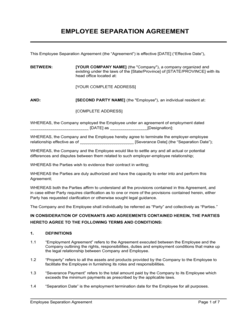
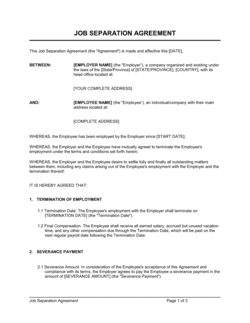
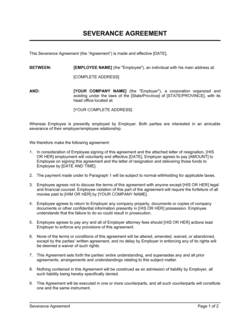
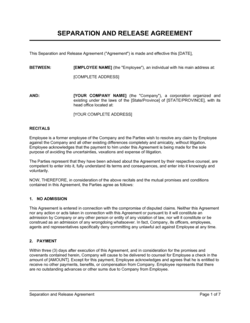
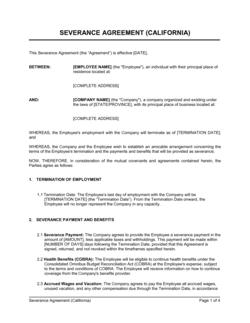
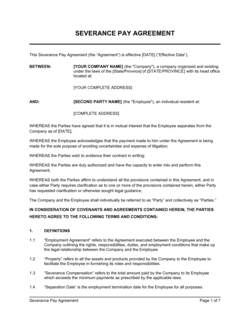
A Separation Agreement is a legally binding contract between an employer and a departing employee that formally ends the employment relationship on agreed terms. This free Word download covers severance pay, release of claims, confidentiality, non-disparagement, return of company property, and post-employment restrictions β€” all in a single document you can edit online and export as PDF for signature.
When you need it
Use it whenever an employee is terminated without cause, accepts a voluntary separation package, or is laid off as part of a reduction in force β€” any situation where the employer wants a clean, documented release of employment-related claims in exchange for consideration such as severance pay.
What's inside
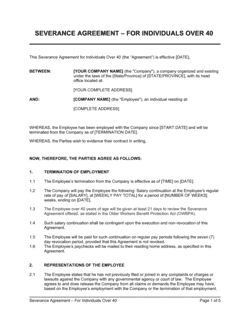
Parties and separation date, severance payment schedule, general release of claims, ADEA waiver (for employees 40 and older), confidentiality and non-disparagement obligations, return of company property, continuation of benefits, non-compete and non-solicitation restrictions, and governing law and dispute resolution clauses.

What is a Separation Agreement?

A Separation Agreement is a legally binding contract between an employer and a departing employee that formally ends the employment relationship on negotiated terms. In exchange for severance pay or other consideration the employee would not otherwise receive, the employee releases all employment-related legal claims β€” including wrongful termination, discrimination, harassment, and wage disputes β€” against the employer, its affiliates, officers, and directors. The agreement also establishes post-separation obligations on both sides: confidentiality of terms, non-disparagement, return of company property, continuation or termination of benefits, and any carried-forward non-compete or non-solicitation restrictions. When an employee is aged 40 or older, federal law in the United States (ADEA/OWBPA) imposes additional procedural requirements β€” a 21-day review period, written advice to consult an attorney, and a 7-day revocation window β€” that must be satisfied for the release to be enforceable.

Why You Need This Document

Without a signed separation agreement, a terminated employee retains the full right to sue for any employment law violation that occurred during their tenure β€” discrimination, harassment, unpaid wages, retaliation, or breach of contract β€” and the employer has no documented basis to enforce confidentiality or non-solicitation obligations after the employee walks out the door. Severance paid without a corresponding release is simply a gift: the employer receives nothing in return and remains exposed to the same litigation risk it was trying to eliminate. A properly executed separation agreement closes that exposure, creates an auditable record of agreed terms, and gives the employer enforceable leverage if the former employee violates post-separation obligations. This template gives HR managers, founders, and operations leaders a defensible starting point for the most common separation scenarios β€” reducing the time to a signed agreement and the risk of missing a jurisdictional requirement that voids the release entirely.

Which variant fits your situation?

If your situation is…Use this template
Terminating an employee aged 40 or older in the United StatesSeparation Agreement with ADEA Waiver
Laying off multiple employees simultaneously in a RIFOWBPA Group Separation Agreement
Separating a C-suite or VP-level executive with equity or enhanced severanceExecutive Separation Agreement
Ending an independent contractor relationship cleanlyContractor Termination Agreement
Mutual agreement to end employment by both partiesMutual Separation Agreement
Terminating an employee who signed an employment contract with cause provisionsEmployment Contract Termination Letter
Separating a remote employee working in a different jurisdictionRemote Employee Separation Agreement

Common mistakes to avoid

❌ Releasing severance before the revocation period expires

Why it matters: Under the ADEA, an employee aged 40 or older has 7 days to revoke their age-discrimination waiver after signing. Paying severance during this window means the employee can revoke and keep the money β€” the release is worthless.

Fix: Schedule the first severance payment for Day 8 after the employee signs, confirmed in writing in the agreement. Automate the payment date in payroll to prevent accidental early release.

❌ Omitting California Civil Code §1542 waiver language

Why it matters: In California, a general release does not cover unknown claims unless it explicitly waives Β§1542. Without this language, a former employee can later sue for claims they could not have known about at the time of signing.

Fix: Include the full Β§1542 waiver text in the release section for any California-based employee: 'Employee waives the protection of California Civil Code Β§1542, which provides that a general release does not extend to claims which the creditor does not know or suspect to exist...'

❌ Using a group-termination agreement without OWBPA disclosures

Why it matters: A reduction-in-force involving two or more employees requires a 45-day review period and a written disclosure listing the job titles, ages, and eligibility criteria of all employees in the decisional unit. Missing these invalidates every ADEA waiver in the group.

Fix: Prepare a separate OWBPA disclosure schedule before presenting agreements to any employee in a group RIF. Have employment counsel review the disclosure list before distribution.

❌ Including an unenforceable non-compete in the employee's jurisdiction

Why it matters: A non-compete clause that is void under state law does not simply disappear β€” courts in some jurisdictions treat overreaching restrictive covenants as evidence of bad faith and use them to challenge the enforceability of adjacent clauses including the release.

Fix: Check enforceability in the employee's work state before finalizing. Replace non-compete language with a tailored non-solicitation clause in states that ban post-employment competition restrictions.

❌ No specific deadline for return of company property

Why it matters: Without a defined date, the return obligation is practically unenforceable β€” the employer has no contractual trigger to demand equipment back, pursue legal remedies, or cut off system access.

Fix: State a specific calendar date β€” typically the separation date or within 5 business days β€” and list the categories of property by type so there is no ambiguity about what must be returned.

❌ Presenting the agreement on the last day of work and asking for immediate signature

Why it matters: Pressuring an employee to sign on separation day, especially if aged 40 or older, can invalidate the entire agreement. Courts have voided releases where the circumstances of signing showed coercion or insufficient time to review.

Fix: Present the agreement at least 21 days before you need the signature. Document the presentation date and remind the employee in writing of their right to consult an attorney before signing.

The 10 key clauses, explained

Parties, separation date, and recitals

In plain language: Identifies the employer and employee as legal entities, states the effective date of separation, and briefly recites the background β€” that employment is ending and the parties wish to resolve all outstanding matters.

Sample language
This Separation Agreement and General Release ('Agreement') is entered into as of [DATE] by and between [EMPLOYER LEGAL NAME], a [STATE] [ENTITY TYPE] ('Company'), and [EMPLOYEE FULL NAME] ('Employee'). Employee's last day of employment is [SEPARATION DATE].

Common mistake: Using a trade name instead of the registered legal entity name. If the entity name on the agreement doesn't match payroll records, enforcing the release against the correct legal party becomes contested.

Severance pay and schedule

In plain language: States the total severance amount, how it will be paid (lump sum or installments), the payment schedule, and confirms that severance is conditioned on signing and not revoking the agreement.

Sample language
In consideration of Employee's execution of this Agreement and expiration of the revocation period, Company shall pay Employee a severance amount of $[AMOUNT], less applicable withholdings, in [a lump sum on / [X] equal installments beginning] [DATE].

Common mistake: Releasing severance before the ADEA revocation period expires. Paying out during the 7-day window means the employee can revoke the waiver and keep the money β€” the release becomes worthless.

General release of claims

In plain language: The employee releases all known and unknown employment-related legal claims against the employer, its officers, directors, affiliates, and agents β€” covering federal, state, and local statutes as well as common-law claims.

Sample language
Employee, on behalf of themselves and their heirs, releases and forever discharges the Company and its affiliates from any and all claims arising out of or related to Employee's employment or separation, including but not limited to claims under Title VII, the ADA, the FLSA, and any applicable state or local law.

Common mistake: Using a release that lists specific statutes and accidentally omits a relevant one. Courts in some jurisdictions have held that a specific-enumeration release does not cover statutes not listed. Use a broad 'including but not limited to' formulation.

ADEA and OWBPA waiver

In plain language: For employees aged 40 or older, adds the legally required language waiving age-discrimination claims under the ADEA, confirms the 21-day review period and 7-day revocation right, and advises the employee in writing to consult an attorney.

Sample language
Employee acknowledges that: (a) this waiver specifically includes claims under the Age Discrimination in Employment Act; (b) Employee has been advised to consult with an attorney before signing; (c) Employee has [21] days to consider this Agreement; and (d) Employee may revoke this Agreement within 7 days of signing.

Common mistake: Applying the standard 21-day review period in a group layoff. Under OWBPA, group terminations require 45 days and a written disclosure of job titles and ages of all employees in the decisional unit β€” omitting this invalidates every age-discrimination waiver in the group.

Confidentiality of agreement terms

In plain language: Requires both parties to keep the existence and terms of the agreement β€” particularly the severance amount β€” confidential, with narrow carve-outs for legal advisors, tax preparers, and immediate family.

Sample language
Employee agrees to keep the terms of this Agreement strictly confidential and shall not disclose them to any third party except Employee's attorney, tax advisor, or immediate family members who agree to maintain the same confidentiality.

Common mistake: No carve-out for legally required disclosures. If the employee is subpoenaed or required by law to disclose, a confidentiality clause with no exception can expose them to sanctions β€” which courts view as an unenforceable overreach.

Non-disparagement

In plain language: Prohibits the employee from making negative, derogatory, or false statements about the company, its products, leadership, or employees β€” and, if mutual, binds the company's authorized spokespersons equally.

Sample language
Employee agrees not to make any disparaging, defamatory, or negative statements β€” written or oral β€” about the Company, its products, services, officers, directors, or employees. Company agrees that its officers and HR personnel will not make disparaging statements about Employee.

Common mistake: One-sided non-disparagement that binds only the employee. Courts and mediators increasingly read one-sided clauses as unconscionable, and some jurisdictions restrict them. A mutual clause is more defensible and signals good faith.

Return of company property

In plain language: Requires the employee to return all company property β€” hardware, software, credentials, documents, and confidential data β€” by the separation date or a defined deadline.

Sample language
On or before [DATE], Employee shall return to Company all property belonging to the Company, including laptops, mobile devices, access cards, documents, software, and any copies of Confidential Information in any medium.

Common mistake: No specific deadline for return of property. Without a date, the obligation is unenforceable as a practical matter β€” the employer has no trigger to demand return or pursue legal remedies.

Continuation of benefits and COBRA notice

In plain language: States when employer-sponsored benefits end, confirms the employee's right to COBRA continuation coverage, and references any agreed continuation of health, dental, or life insurance as part of the severance package.

Sample language
Employee's participation in Company benefit plans shall terminate on [DATE]. Employee may elect COBRA continuation coverage as described in the separate COBRA notice provided herewith. Company [will / will not] subsidize COBRA premiums for [X] months.

Common mistake: Committing to COBRA subsidies in the agreement without specifying the end date and premium amount. Vague benefit commitments become disputes when the employee's coverage needs change mid-subsidy.

Post-employment restrictions (non-compete and non-solicitation)

In plain language: Carries forward or confirms any non-compete and non-solicitation restrictions from the original employment agreement, or introduces proportionate new restrictions calibrated to the employee's seniority and access to competitive information.

Sample language
For [12] months following the Separation Date, Employee shall not (a) work for a Competing Business within [GEOGRAPHIC SCOPE], or (b) solicit any customer or employee of the Company with whom Employee had material contact during the [24] months prior to separation.

Common mistake: Copy-pasting non-compete language from the original employment contract without checking whether it remains enforceable post-separation and in the governing jurisdiction β€” particularly where the employee's state has changed since hire.

Governing law, dispute resolution, and integration

In plain language: Specifies the jurisdiction whose law governs the agreement, the forum for resolving disputes (arbitration or court), and confirms this agreement supersedes all prior communications, offer letters, and representations.

Sample language
This Agreement is governed by the laws of [STATE / PROVINCE]. Any dispute shall be resolved by binding arbitration in [CITY] under [AAA / JAMS] rules, except that either party may seek injunctive relief in court. This Agreement constitutes the entire agreement between the parties and supersedes all prior agreements.

Common mistake: Choosing a governing law with no real connection to where the employee worked. California, for instance, applies its own employment law regardless of a conflicting choice-of-law clause β€” selecting another state's law can void key provisions.

How to fill it out

  1. 1

    Identify the parties and confirm the separation date

    Enter the employer's full registered legal entity name, the employee's legal name, and the official last day of employment. Confirm the entity name matches payroll and HR records.

    πŸ’‘ Cross-check the entity name against your corporate registry filing β€” using a trade name instead of the registered name can create enforcement problems later.

  2. 2

    Determine whether the ADEA waiver applies

    If the departing employee is 40 or older, the agreement must include ADEA/OWBPA-compliant language, a 21-day review period (45 days for group layoffs), written advice to consult an attorney, and a 7-day revocation period.

    πŸ’‘ Never shorten the revocation period contractually β€” a clause that purports to waive it is void under federal law, and courts will sever it from the rest of the agreement.

  3. 3

    Set the severance amount, payment schedule, and conditions

    Enter the total severance, whether it pays as a lump sum or installments, and the first payment date. Confirm the payment is explicitly conditioned on the agreement being signed and the revocation period having expired.

    πŸ’‘ For employees subject to the ADEA waiver, schedule the first payment for Day 8 after signature β€” never before β€” to avoid releasing funds the employee could still recover through revocation.

  4. 4

    Tailor the release of claims to the jurisdiction

    Use a broad 'including but not limited to' formulation covering federal, state, and local statutes. Add state-specific carve-outs β€” for example, California requires an explicit waiver of Civil Code Β§1542 for unknown claims.

    πŸ’‘ If the employee works in California, include the Β§1542 waiver in full β€” omitting it means the release covers only known claims, significantly narrowing its scope.

  5. 5

    Confirm post-employment restriction enforceability

    Review the jurisdiction where the employee actually worked before including non-compete language. Remove or replace with a narrower non-solicitation clause if the employee is in California, Minnesota, or another state that bans post-employment non-competes.

    πŸ’‘ A non-compete clause that is void in the employee's state does not simply get ignored β€” courts in some jurisdictions treat it as evidence of overreaching and use it to narrow other provisions.

  6. 6

    Complete the property return and benefits sections

    Set a specific deadline for return of company property, list the categories of property by type, and confirm the benefits termination date. If subsidizing COBRA, state the exact dollar amount and end date.

    πŸ’‘ Send the COBRA notice as a separate document on the same day as the separation agreement β€” the two documents have different legal requirements and different delivery rules.

  7. 7

    Have both parties sign after the review period expires

    Present the agreement to the employee, confirm they have had adequate time to review it (minimum 21 days for ADEA, 45 days for group RIF), and collect countersignatures only after the revocation window closes.

    πŸ’‘ Use a timestamped e-signature platform so you have an auditable record of when the agreement was presented, signed, and when the revocation period expired.

Frequently asked questions

What is a separation agreement?

A separation agreement is a legally binding contract between an employer and a departing employee that formally ends the employment relationship on negotiated terms. It typically provides the employee with severance pay or other benefits in exchange for a release of all employment-related legal claims against the employer. It also sets post-separation obligations β€” such as confidentiality, non-disparagement, and return of property β€” that both parties must follow after the employee's last day.

Is a separation agreement required by law?

No. Employers are not legally required to offer a separation agreement. However, if an employer wants a legally enforceable release of claims β€” particularly age-discrimination claims β€” it must present a written agreement that meets specific statutory requirements. Without a signed agreement, a terminated employee retains the full right to sue for any applicable employment law violations.

What is the difference between a separation agreement and a severance agreement?

The terms are often used interchangeably, but they are technically distinct. A severance agreement focuses primarily on the payment terms upon termination. A separation agreement is the broader document that includes severance but also covers the release of claims, confidentiality, non-disparagement, property return, and post-employment restrictions. In practice, most employers use a single document that functions as both.

Does a separation agreement need to include an ADEA waiver?

Yes, if the departing employee is 40 years of age or older and the employer wants to release age-discrimination claims under the Age Discrimination in Employment Act. The ADEA waiver must be in plain language, specifically mention the ADEA, advise the employee to consult an attorney, provide at least 21 days to consider the agreement (45 days in a group layoff), and allow a 7-day revocation period after signing. Omitting any of these elements invalidates the age-discrimination waiver.

Can an employee be forced to sign a separation agreement?

No. Signing must be voluntary. Courts scrutinize the circumstances of signing β€” a release obtained through coercion, deception, or unreasonable time pressure is unenforceable. Presenting the agreement well before the separation date, advising the employee to consult counsel, and documenting the review period are the primary safeguards against a future challenge on involuntariness grounds.

What claims can a separation agreement release?

A properly drafted general release can cover most employment-related claims, including wrongful termination, discrimination (race, gender, age, disability), harassment, breach of contract, wage and hour violations, and retaliation. However, certain claims cannot be waived in most jurisdictions, including claims for workers' compensation benefits, unemployment insurance, vested pension or 401(k) benefits, and claims for wages already earned. EEOC charge-filing rights also generally cannot be waived, though the right to monetary recovery from a charge can be.

How much severance should a separation agreement include?

Severance is not legally mandated in the US absent a contract or policy that promises it. A common formula is 1–2 weeks per year of service with a minimum of 2–4 weeks. In Canada, severance must meet provincial Employment Standards Act minimums β€” typically 1 week per year of service, capped at 8 weeks under most statutes, plus potential common-law notice. The UK has statutory redundancy pay floors. Whatever the amount, it must exceed what the employee is already entitled to receive in order to constitute valid consideration for the release.

Can a separation agreement include a non-compete clause?

Yes, but enforceability depends entirely on the employee's jurisdiction and the scope of the restriction. California, Minnesota, North Dakota, and Oklahoma effectively ban post-employment non-competes. In states and countries where they are permitted, the restriction must be reasonable in duration, geographic scope, and breadth of prohibited activity. Overly broad non-competes are routinely struck down and, in some jurisdictions, can taint the enforceability of adjacent provisions in the same agreement.

What happens if an employee revokes a separation agreement?

Under the ADEA, an employee aged 40 or older has 7 days after signing to revoke their waiver of age-discrimination claims. If revoked, the entire agreement is typically voided β€” not just the age-discrimination waiver β€” and the employer is not required to pay severance. Some agreements contain a severability clause that attempts to preserve the non-disparagement and confidentiality obligations even if the release is revoked, but courts treat these provisions inconsistently.

How this compares to alternatives

vs Employment Contract

An employment contract governs the beginning and ongoing terms of the working relationship β€” duties, compensation, IP, and restrictions. A separation agreement governs the end of that relationship, providing a release of claims and severance in exchange for post-separation obligations. The separation agreement typically carries forward or confirms restrictions established in the original employment contract.

vs Termination Letter

A termination letter is a formal notice that employment is ending β€” it states the separation date, summarizes outstanding pay obligations, and may reference the reasons for termination. It does not provide a release of claims or severance terms. A separation agreement is the binding contract that follows the termination letter when the employer wants enforceable post-separation obligations from the employee.

vs Mutual Termination Agreement

A mutual termination agreement is used when both parties agree to end the relationship voluntarily and on equal footing β€” often without a monetary exchange. A separation agreement is typically employer-driven and involves the employer paying consideration in exchange for the employee's release of claims. The release mechanics, ADEA requirements, and consideration analysis differ significantly between the two.

vs Settlement Agreement

A settlement agreement resolves a specific legal dispute or claim β€” often after a complaint has been filed with the EEOC, a labor board, or a court. A separation agreement is a proactive document executed at the time of termination to prevent future claims from arising. Settlement agreements typically involve more negotiated consideration and are subject to greater regulatory scrutiny than standard separation agreements.

Industry-specific considerations

Technology / SaaS

IP assignment confirmation, source code and credential return, and equity treatment upon separation are critical additions given employee access to proprietary systems and unvested stock.

Financial Services

Regulatory reporting obligations (FINRA U5), clawback provisions for deferred compensation, and enhanced confidentiality covering client data and trading strategies require careful tailoring.

Healthcare

HIPAA obligations survive the separation date and must be expressly carried forward; patient non-solicitation clauses require careful geographic and temporal scoping to survive challenge.

Professional Services

Client non-solicitation is the most commercially critical clause; fee-based relationships mean a single client defection can exceed the severance value, making precise drafting essential.

Jurisdictional notes

United States

Federal law (ADEA/OWBPA) mandates specific procedural requirements for employees aged 40 or older β€” 21-day review, 7-day revocation, written advice to consult counsel. California requires an explicit Civil Code Β§1542 waiver for unknown claims and bans most post-employment non-competes. The FTC's proposed non-compete ban (challenged in court as of 2025) remains in flux β€” check current status before including competition restrictions.

Canada

Separation agreements must provide consideration that meets or exceeds provincial Employment Standards Act minimums β€” contractual severance that falls below the statutory floor is void to that extent. Ontario common-law notice can reach 1 month per year of service for long-tenured employees; courts routinely award 18–24 months for senior hires. Quebec employees are entitled to French-language agreements under provincial language law.

United Kingdom

Settlement agreements (the UK equivalent) must be in writing, and the employee must receive independent legal advice before signing β€” without this, the agreement cannot waive Employment Tribunal claims. Statutory redundancy pay applies in addition to any contractual severance. ACAS early conciliation is typically required before any claim reaches the Tribunal, and COT3 agreements through ACAS are an alternative to private settlement agreements.

European Union

Separation terms and minimum notice or severance obligations vary significantly by member state β€” France, Germany, and Spain impose some of the strictest employee protections. GDPR applies to any personal data included in or processed in connection with the agreement. Several member states require works council consultation before group separations can be finalized, and unilateral waivers of statutory rights are generally unenforceable without independent legal advice.

Template vs lawyer β€” what fits your deal?

PathBest forCostTime
Use the templateStraightforward single-employee separations below senior management in a single US state or Canadian province, where the employee is under 40 and no discrimination claims are anticipatedFree30–60 minutes to complete
Template + legal reviewSeparations involving employees aged 40 or older, group layoffs, employees in California or Ontario, or any situation involving equity, deferred compensation, or prior HR complaints$300–$700 for a 1–2 hour employment counsel review2–5 business days
Custom draftedC-suite or VP separations with material equity or severance, group RIF events requiring OWBPA disclosures, cross-border separations, or any termination where discrimination claims are anticipated or already filed$1,500–$5,000+1–3 weeks

Glossary

Release of Claims
A contractual provision in which the employee gives up the right to sue the employer for employment-related legal claims in exchange for severance or other consideration.
Severance Pay
Compensation paid to an employee upon separation beyond their final paycheck, typically calculated as a number of weeks' pay per year of service.
ADEA Waiver
A specific waiver required under the Age Discrimination in Employment Act when an employee aged 40 or older releases age-discrimination claims; requires a 21-day review period and a 7-day revocation window.
OWBPA
The Older Workers Benefit Protection Act, a US federal law that sets minimum procedural requirements β€” including review periods and written disclosure β€” for age-discrimination waivers in separation agreements.
Non-Disparagement Clause
A mutual or one-sided obligation preventing the parties from making negative public statements about each other after separation.
Consideration
Something of value given in exchange for a promise β€” in a separation agreement, typically severance pay that the employee would not otherwise be entitled to receive.
Revocation Period
Under the ADEA, a 7-day window after signing during which an employee aged 40 or older may cancel their waiver of age-discrimination claims, regardless of what the agreement says.
Constructive Dismissal
When an employer unilaterally changes employment conditions so significantly that the employee is effectively forced to resign β€” treated legally as a termination triggering separation obligations.
Integration Clause
A provision stating that the separation agreement is the complete and final agreement between the parties, superseding all prior communications, offers, and representations.
COBRA
The US federal law allowing separated employees to continue employer-sponsored health coverage at their own expense for up to 18 months after the separation date.
Without Cause Termination
A termination where the employer ends the employment relationship for business reasons β€” such as a layoff or restructuring β€” rather than for employee misconduct or performance failure.
Post-Employment Restriction
Any contractual obligation that limits the former employee's conduct after separation, including non-compete, non-solicitation, and confidentiality clauses.

Part of your Business Operating System

This document is one of 3,000+ business & legal templates included in Business in a Box.

  • Fill-in-the-blanks β€” ready in minutes
  • 100% customizable Word document
  • Compatible with all office suites
  • Export to PDF and share electronically

Create your document in 3 simple steps.

From template to signed document β€” all inside one Business Operating System.
1
Download or open template

Access over 3,000+ business and legal templates for any business task, project or initiative.

2
Edit and fill in the blanks with AI

Customize your ready-made business document template and save it in the cloud.

3
Save, Share, Send, Sign

Share your files and folders with your team. Create a space of seamless collaboration.

Save time, save money, and create top-quality documents.

β˜…β˜…β˜…β˜…β˜…

"Fantastic value! I'm not sure how I'd do without it. It's worth its weight in gold and paid back for itself many times."

Managing Director Β· Mall Farm
Robert Whalley
Managing Director, Mall Farm Proprietary Limited
β˜…β˜…β˜…β˜…β˜…

"I have been using Business in a Box for years. It has been the most useful source of templates I have encountered. I recommend it to anyone."

Business Owner Β· 4+ years
Dr Michael John Freestone
Business Owner
β˜…β˜…β˜…β˜…β˜…

"It has been a life saver so many times I have lost count. Business in a Box has saved me so much time and as you know, time is money."

Owner Β· Upstate Web
David G. Moore Jr.
Owner, Upstate Web

Run your business with a system β€” not scattered tools

Stop downloading documents. Start operating with clarity. Business in a Box gives you the Business Operating System used by over 250,000 companies worldwide to structure, run, and grow their business.

Start freeΒ Β·Β No credit card required