Sales Projections Template

Free Excel download β€’ Use online β€’ Print or share

1 pageβ€’20–30 min to useβ€’Difficulty: Standardβ€’Signature requiredβ€’Legal review recommended
Learn more ↓
FreeXLSSales Projections Template

At a glance

What it is
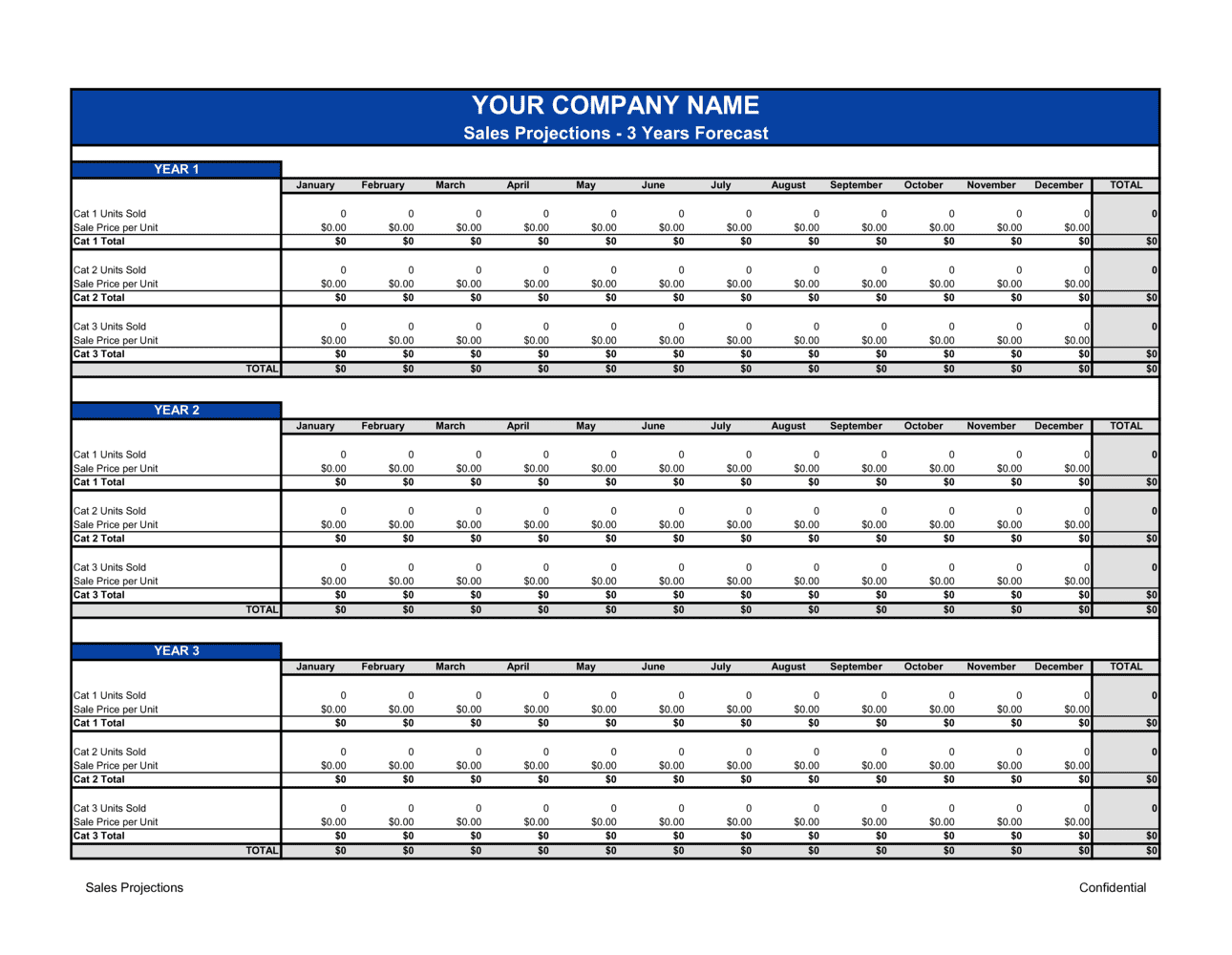
A Sales Projections document is a formally structured forecast that records expected revenue by product line, territory, or sales period, along with the specific assumptions and targets that underpin each number. This free Word download gives you a professionally formatted, editable template you can adapt for internal planning, investor reporting, or lender due diligence, then export as PDF and sign off on for formal adoption.
When you need it
Use it when preparing an annual operating budget, presenting revenue forecasts to a board or investors, applying for a business loan, or setting and communicating sales targets to a sales team. It is also required any time a financing or partnership agreement obligates you to deliver a formal signed revenue forecast.
What's inside
The template covers the forecast period, revenue assumptions by segment or product line, monthly and annual target schedules, growth rate rationale, variance tracking methodology, and signatory acknowledgment blocks for both the preparer and reviewing executive. Supporting schedules for units, pricing, and pipeline conversion rates are included as appendices.

What is a Sales Projections Document?

A Sales Projections document is a formally structured, signed revenue forecast that records a company's expected sales figures by segment, product line, or territory over a defined period, together with every material assumption that underpins those figures. Unlike a casual spreadsheet export or a verbal forecast, a sales projections document incorporates representation language, variance-tracking obligations, and an authorization block signed by an executive with authority to bind the company. It functions simultaneously as an internal planning commitment, an external deliverable for lenders and investors, and a reference point for measuring actual performance against agreed targets throughout the forecast period.

Why You Need This Document

Without a formally signed sales projections document, lenders cannot verify that your revenue targets are grounded in documented assumptions, and investors have no signed baseline against which to measure your performance commitments. A handshake forecast or an unsigned spreadsheet carries no contractual weight β€” and when actual results fall short of expectations, the absence of a documented, signed projection leaves you with no record of the assumptions that were reasonable at the time. Missing variance-reporting obligations in a financing agreement can trigger a technical default before any actual covenant threshold is even breached. This template gives you the structure to document every assumption, set enforceable variance thresholds, and execute a properly authorized projection document that satisfies lender requirements, supports investor due diligence, and gives your own leadership team a clear, signed revenue commitment to operate against.

Which variant fits your situation?

If your situation is…Use this template
Monthly sales targets broken down by individual sales repMonthly Sales Forecast
Product-level revenue projections for a new launchProduct Launch Sales Forecast
Three-year revenue model for investor due diligenceFinancial Projections (3-Year)
Weekly pipeline and deal-stage forecast for a sales teamSales Pipeline Report
Quarterly business review with variance analysis vs. actualsQuarterly Sales Report
Territory-based revenue allocation for a multi-region businessSales Territory Plan
Retail or e-commerce unit volume and revenue forecastRetail Sales Forecast

Common mistakes to avoid

❌ Using annual-only figures with no monthly breakdown

Why it matters: Lenders and investors use monthly schedules to track variance in real time against covenants. An annual-only forecast cannot be monitored and often renders the document non-compliant with financing agreement requirements.

Fix: Always build and attach a Schedule A with month-by-month revenue by segment. Even if recipients only review the annual total initially, the monthly schedule is the working document for compliance tracking.

❌ Embedding assumptions in narrative prose without a numbered list

Why it matters: When actuals diverge from projections, buried prose assumptions are easy to dispute or overlook. Reviewers miss them during due diligence, and the company loses the ability to point to a specific agreed input.

Fix: Present all material assumptions as a numbered or lettered list in the Revenue Assumptions clause, with each assumption on its own line and a source reference.

❌ Projecting growth materially above historical rates without naming the specific driver

Why it matters: Investors and lenders immediately apply a credibility discount to projections that show a sharp acceleration over historical performance with no named, specific cause β€” such as a new product launch or a signed distribution deal.

Fix: For every percentage point of growth above your trailing 2-year average, name the specific initiative, quantify its expected revenue contribution, and cite the evidence or contract that supports it.

❌ Omitting a representations and limitations clause

Why it matters: Without a limitations clause, a recipient who relies on the projections and suffers a loss may claim misrepresentation if actual results fall short β€” even if the assumptions were reasonable at the time of signing.

Fix: Include a standard good-faith representation clause that disclaims guarantee of results and identifies the key external risk factors that could cause actual results to differ.

❌ Referencing schedules that are not attached

Why it matters: A projection document that references 'Schedule C β€” Historical Actuals' but does not include it is incomplete and can raise doubts about whether the projections were properly substantiated.

Fix: Before signing, run through the body of the document and confirm every referenced schedule is attached and that the numbers in each schedule reconcile to the body.

❌ Collecting only one signature when dual authorization is required

Why it matters: Many loan agreements and investor term sheets require sign-off from both a financial officer and a CEO or board member. A single-signature submission under a dual-authorization covenant can trigger a technical default before any revenue numbers are even reviewed.

Fix: Check the governing financing or shareholder agreement for signature requirements before preparing the execution block, and build the correct number of signature lines into the template.

The 10 key clauses, explained

Parties and Authorization

In plain language: Identifies the company preparing the projections, the executive authorizing them, and any counterparty (lender, investor, or board) to whom they are being submitted.

Sample language
These Sales Projections are prepared by [COMPANY LEGAL NAME], a [STATE/PROVINCE] [ENTITY TYPE], and authorized by [AUTHORIZED SIGNATORY NAME], [TITLE], on behalf of the Company for submission to [RECIPIENT NAME / BOARD / LENDER].

Common mistake: Naming a department or team rather than the legal entity and an authorized officer. If projections are submitted to a lender and the signatory has no authority to bind the company, the document may be challenged as unexecuted.

Forecast Period and Scope

In plain language: States the exact calendar period covered by the projections, the product lines or business segments included, and any explicit exclusions.

Sample language
These projections cover the period from [START DATE] through [END DATE] and encompass revenue from the following segments: [SEGMENT A], [SEGMENT B]. Revenue from [EXCLUDED SEGMENT] is excluded and addressed in a separate schedule.

Common mistake: Leaving the forecast period vague ('fiscal year' without specifying start and end months). Ambiguous periods create disputes when actuals are compared to projections β€” particularly in lender covenants.

Revenue Assumptions

In plain language: Documents every material assumption driving the revenue estimates β€” unit volumes, average selling price, market growth rate, pipeline conversion rates, and seasonality adjustments.

Sample language
Revenue estimates are based on the following assumptions: (a) average selling price of $[X] per [UNIT/SEAT/CONTRACT]; (b) pipeline conversion rate of [X]%; (c) market growth rate of [X]% per annum (Source: [CITATION]); (d) seasonality index applied as per Schedule B.

Common mistake: Embedding assumptions in narrative prose rather than a numbered or lettered list. Buried assumptions are missed by reviewers, and when actuals diverge, the company cannot point to documented inputs that were agreed upon.

Monthly and Annual Revenue Targets

In plain language: Sets out the specific revenue figures the company expects to achieve in each month and for the full forecast year, by segment or product line.

Sample language
Projected monthly revenue by segment is set out in Schedule A. Total projected annual revenue for [YEAR] is $[AMOUNT], comprising $[X] from [SEGMENT A] and $[X] from [SEGMENT B].

Common mistake: Showing only annual totals without monthly breakdowns. Lenders and investors use monthly schedules to track variance in real time; a forecast with annual-only figures cannot be monitored or enforced against covenants.

Growth Rate Rationale

In plain language: Explains the basis for the year-over-year or period-over-period growth rates embedded in the projections, referencing historical performance, market data, or strategic initiatives.

Sample language
The projected [X]% year-over-year revenue growth is supported by: (a) [X]% organic growth consistent with the prior two fiscal years (Actuals: Schedule C); (b) $[X] incremental revenue from the [NEW PRODUCT/CHANNEL] launching in [MONTH/YEAR]; (c) [MARKET SOURCE] projecting [X]% industry growth.

Common mistake: Projecting growth rates materially higher than historical performance without explaining the specific driver. Unsupported hockey-stick assumptions are the single most common reason lenders and investors reject a projection document.

Variance Tracking and Reporting Obligations

In plain language: Specifies how often actual results will be compared to projections, who is responsible for producing the variance report, and what threshold triggers a formal notification or remediation plan.

Sample language
The Company shall prepare a monthly variance report comparing actual to projected revenue no later than [X] business days after month-end. Variances exceeding [X]% of projected monthly revenue shall be reported in writing to [RECIPIENT] within [X] days, accompanied by a written explanation and, where applicable, a revised forecast.

Common mistake: Omitting a variance threshold and notification obligation when the document is submitted to a lender or investor. Without this clause, the company has no contractual duty to disclose significant underperformance until a covenant breach occurs.

Underlying Data and Supporting Schedules

In plain language: Lists and incorporates by reference all schedules, spreadsheets, CRM exports, and market research reports that support the projection figures.

Sample language
The following schedules are attached and incorporated into these projections: Schedule A β€” Monthly Revenue by Segment; Schedule B β€” Seasonality Index; Schedule C β€” Historical Actuals ([YEAR]–[YEAR]); Schedule D β€” Pipeline Conversion Analysis.

Common mistake: Referencing schedules that are not actually attached. If a lender or investor later requests the supporting data and it is inconsistent with the projection figures, credibility is damaged and contractual obligations may be triggered.

Representations and Limitations

In plain language: States that the projections are prepared in good faith based on information available at the date of signing, and disclaims any guarantee of future results while representing that the assumptions are reasonable.

Sample language
The Company represents that these projections have been prepared in good faith using reasonable assumptions as of [DATE]. They are not a guarantee of future revenue. Actual results may differ materially due to factors outside the Company's control, including [LIST KEY RISK FACTORS].

Common mistake: Omitting any limitations language when submitting projections to an external party. Without it, a material shortfall can expose the company to claims of misrepresentation β€” even when the underlying assumptions were sound at the time of signing.

Governing Law and Dispute Resolution

In plain language: Specifies the jurisdiction whose law governs interpretation of the document and the mechanism β€” arbitration or litigation β€” for resolving disputes.

Sample language
This document is governed by the laws of [STATE/PROVINCE/COUNTRY]. Any dispute arising from these projections shall be resolved by [binding arbitration / litigation] in [CITY], [JURISDICTION].

Common mistake: Omitting a governing law clause entirely on the assumption that projections are 'just a planning document.' When projections are incorporated into a loan covenant or investment agreement, ambiguous governing law can mean costly jurisdictional disputes.

Signatures and Effective Date

In plain language: Records the signatures of the authorized preparer and the reviewing executive or counterparty, along with the date the document becomes effective.

Sample language
By signing below, the authorized representatives of [COMPANY NAME] confirm that these Sales Projections are accurate to the best of their knowledge as of [EFFECTIVE DATE]. Signed: [PREPARER NAME], [TITLE] | [REVIEWER NAME], [TITLE].

Common mistake: Collecting only one signature when two are required by a financing agreement or internal governance policy. A single-signature projection submitted under a dual-authorization covenant can trigger a technical default.

How to fill it out

  1. 1

    Identify the parties and confirm authorization

    Enter the company's full legal name, the name and title of the authorizing executive, and the name of the recipient (board, lender, or investor). Confirm that the signatory has authority to bind the company under its governing documents.

    πŸ’‘ Cross-reference the company's bylaws or operating agreement to confirm the signatory's authorization level before submitting to a lender.

  2. 2

    Define the forecast period and scope precisely

    Enter specific start and end dates for the forecast. List every product line, segment, or territory included, and explicitly exclude anything not covered. Vague scope is the most common source of projection disputes.

    πŸ’‘ If your fiscal year does not align to the calendar year, state both the fiscal period (e.g., Q1 FY2027) and the corresponding calendar dates.

  3. 3

    Document every revenue assumption in numbered form

    List each material assumption β€” average selling price, pipeline conversion rate, market growth rate, new customer count β€” as a numbered item with the source or basis for each figure. Use Schedule B for seasonality adjustments.

    πŸ’‘ Include the data source or internal reference for each assumption. 'Per Q4 2025 actuals' is more defensible than 'management estimate.'

  4. 4

    Build the monthly revenue schedule

    Complete Schedule A with projected revenue for each month of the forecast period, broken down by segment or product line. Sum to the annual total and confirm it is internally consistent with the assumption inputs.

    πŸ’‘ Build from the bottom up: unit volume Γ— ASP Γ— conversion rate = projected revenue per period. Never start from an annual target and back-allocate.

  5. 5

    State the growth rate rationale with supporting evidence

    Write a brief but specific explanation of the year-over-year growth rate, citing historical actuals, market research, or named strategic initiatives. Attach the relevant historical actuals as Schedule C.

    πŸ’‘ If your projected growth rate is more than 5 percentage points above your trailing 2-year average, flag it explicitly and name the specific initiative driving the delta.

  6. 6

    Set variance thresholds and reporting obligations

    Define the monthly variance percentage that triggers a formal notification, the number of business days after month-end for producing the report, and the name or role of the recipient. Confirm these align with any covenant terms in related financing agreements.

    πŸ’‘ A 10–15% monthly variance threshold is standard in most loan covenants β€” check the specific agreement before settling on a number.

  7. 7

    Attach and cross-reference all supporting schedules

    Attach Schedules A through D and any additional exhibits. Confirm that every figure referenced in the body of the document appears in a schedule, and that the schedule totals reconcile to the projections.

    πŸ’‘ Number every cell reference in the schedule tabs so auditors or reviewers can trace any figure back to a specific input within 60 seconds.

  8. 8

    Execute with the required signatures before the submission deadline

    Obtain signatures from both the preparer and the reviewing executive (or counterparty) and record the effective date. If the document is being submitted to a lender, confirm their required execution format β€” wet signature, electronic, or notarized copy.

    πŸ’‘ Use Business in a Box eSign to timestamp execution and retain a fully-executed copy in your document management system on the day of signing.

Frequently asked questions

What are sales projections?

Sales projections are documented estimates of expected future revenue over a defined period β€” monthly, quarterly, or annually β€” derived from specific stated assumptions about unit volumes, pricing, market conditions, and pipeline conversion rates. They differ from a casual forecast in that they are formally prepared, signed off on by an authorized executive, and used as binding inputs for budgeting, investor reporting, lender covenants, or internal quota-setting.

Why do sales projections need to be signed?

A signed sales projections document creates a formal record of the figures and assumptions that an authorized officer of the company has reviewed and approved. When projections are submitted to a lender or investor, the signature establishes accountability, supports a representations clause, and typically satisfies a documentary requirement in the financing agreement. Unsigned projections are often treated as informal estimates and carry no contractual weight.

What is the difference between a sales forecast and a sales projection?

The terms are often used interchangeably, but in formal financial and legal contexts, a sales projection is a structured, documented, and signed document incorporating specific stated assumptions, whereas a sales forecast is typically an operational or CRM-generated estimate used for internal planning. When a lender or investor requires a formal deliverable, they generally mean a signed projections document, not a spreadsheet export.

What assumptions should be included in a sales projections document?

At minimum, the assumptions section should document average selling price, unit volume or deal count, pipeline conversion rate, market growth rate with its source, seasonality adjustments, and any named strategic initiatives expected to drive incremental revenue. Each assumption should be stated as a discrete numbered item with a reference to the data source or historical basis β€” not embedded in narrative prose where it can be missed during review.

How far into the future should sales projections extend?

For operating budgets, 12 months with monthly detail is the standard. For bank loan applications, lenders typically require 2–3 years. For equity fundraising, investors expect 3–5 years of projections with the first year in monthly detail and subsequent years in annual totals. Projections beyond 5 years are rarely credible and generally not requested unless you are in a capital-intensive industry with long project timelines, such as real estate or infrastructure.

What variance threshold should trigger a formal notification?

Most commercial loan covenants use a 10–15% monthly variance as the threshold requiring a written notification to the lender. For investor reporting, a 15–20% negative variance is a common trigger for a formal update call. The exact threshold should be negotiated with the counterparty and written explicitly into the variance tracking clause β€” not left to judgment at the time the gap appears.

Can I use a sales projections template for a bank loan application?

Yes, provided the template is completed with real, documented assumptions, includes a monthly revenue schedule, attaches historical actuals as a supporting schedule, and is signed by an authorized officer. Most SBA lenders and commercial banks have specific formatting preferences β€” confirm their requirements before finalizing the document, and consider a review by your accountant before submission.

What risks does a company face if its projections are significantly wrong?

If projections are submitted to a lender and actual revenue falls materially short, the company may breach a financial covenant, triggering a default notice and accelerated repayment. If submitted to investors, a significant miss can damage credibility and affect future fundraising terms. Including a well-drafted representations and limitations clause β€” stating the projections are good-faith estimates based on reasonable assumptions, not a guarantee β€” provides meaningful protection in both scenarios.

Do sales projections need to be notarized?

In most commercial and investment contexts, notarization is not required β€” wet or electronic signatures from authorized officers are sufficient. However, some government grant programs, regulated lenders, or cross-border financing arrangements may require notarization or apostille. Check the specific requirements of the counterparty or program before executing.

How this compares to alternatives

vs Financial Projections (3-Year)

A financial projections document is a full three-statement model β€” P&L, cash flow, and balance sheet β€” covering multiple years. A sales projections document focuses specifically on the revenue line, documenting the assumptions, targets, and variance obligations that feed into the broader financial model. Use sales projections when a counterparty needs a standalone signed revenue forecast; use the financial projections template when they need the complete three-statement package.

vs Business Plan

A business plan is a comprehensive strategic and operational document that situates revenue projections within a market analysis, competitive landscape, and management team narrative. Sales projections are a self-contained, signable revenue forecast document. A business plan typically incorporates or references a sales projections document rather than replacing it.

vs Sales Pipeline Report

A sales pipeline report is an operational snapshot of deals by stage at a point in time, used for internal sales management. Sales projections are a formal, signed document stating expected future revenue with documented assumptions. The pipeline report is an input that informs the projections; it is not a substitute for a signed forecasting document required by lenders or investors.

vs Budget Template

A budget allocates expected revenue and expenses across cost centers for internal financial control. Sales projections focus exclusively on the revenue forecast and the assumptions behind it, often submitted externally. The approved sales projections feed directly into the revenue line of the budget, but the two documents serve different audiences and purposes.

Industry-specific considerations

SaaS / Technology

MRR and ARR projections by tier, net revenue retention assumptions, and new logo vs. expansion revenue split tracked against pipeline by deal stage.

Retail / E-commerce

Unit volume by SKU or category, average order value, seasonal demand curves, and online vs. in-store channel split with separate conversion assumptions.

Manufacturing

Production capacity constraints as a ceiling on revenue projections, contract backlog as a confirmed-revenue input, and raw material cost assumptions affecting net selling price.

Professional Services

Billable hours per consultant, average bill rate, utilization targets, and pipeline-weighted project probabilities used to build a services revenue forecast.

Financial Services

Regulatory limits on product volume, fee income assumptions tied to AUM or transaction counts, and mandatory disclosure requirements for forward-looking statements.

Healthcare / MedTech

Reimbursement rate assumptions, procedure volume tied to contracted provider networks, and regulatory approval timeline as a gating factor on new revenue lines.

Jurisdictional notes

United States

Sales projections submitted to investors in the US may constitute forward-looking statements subject to SEC safe harbor provisions under the Private Securities Litigation Reform Act of 1995 for public companies. Private companies should include a representations and limitations clause disclaiming any guarantee. State-level lender requirements vary β€” SBA lenders typically require 2–3 years of projections with a stated assumption methodology.

Canada

In Canada, forward-looking financial information provided to investors is governed by National Instrument 51-102 for public companies, which requires disclosure of material assumptions and risk factors. For private company financing, provincial lenders β€” particularly in Ontario and British Columbia β€” commonly require signed projections with historical actuals attached. French-language versions may be required for Quebec-regulated entities.

United Kingdom

In the UK, profit forecasts and revenue projections included in prospectuses or investor documents must comply with the FCA's Prospectus Regulation Rules and, for listed companies, the Listing Rules. For private transactions, projections submitted to lenders should include a clear basis-of-preparation statement and good-faith representations. The Financial Services and Markets Act 2000 applies to financial promotions that include forward-looking revenue claims.

European Union

EU Prospectus Regulation (EU 2017/1129) governs forward-looking statements in public offering documents and requires disclosure of key assumptions and sensitivity factors. For private financing, GDPR considerations apply if the projections document incorporates customer-level data as evidence. Member state requirements vary β€” German and French lenders often have specific formats for revenue projections in loan documentation packages.

Template vs lawyer β€” what fits your deal?

PathBest forCostTime
Use the templateInternal planning, board reporting, and standard bank loan applications where the lender does not require bespoke covenant languageFree2–4 hours to complete and sign
Template + legal reviewSBA loan applications, investor submissions, or any financing agreement that references the projections document as a deliverable in a covenant$300–$800 (accountant or financial advisor review)1–3 days
Custom draftedComplex multi-party financing with bespoke covenant language, cross-border investment agreements, or regulated industries requiring disclosure-compliant forward-looking statements$1,500–$5,000+1–3 weeks

Glossary

Sales Projection
An estimate of future revenue derived from documented assumptions about unit volume, pricing, conversion rates, and market conditions over a defined period.
Forecast Period
The specific span of time β€” monthly, quarterly, or annual β€” covered by the sales projection document.
Revenue Assumption
A stated, documented variable that underpins a revenue estimate, such as average selling price, win rate, or market growth rate.
Pipeline Conversion Rate
The percentage of sales opportunities in a given stage that are expected to close as won deals within the forecast period.
Average Selling Price (ASP)
The average revenue generated per unit sold or per contract closed, used as a core input in volume-based revenue calculations.
Variance
The difference between a projected revenue figure and the actual revenue recorded for the same period, expressed in dollars or as a percentage.
Top-Down Forecasting
A method that starts from a total market size and applies expected market share to derive a revenue estimate.
Bottom-Up Forecasting
A method that builds revenue estimates from individual sales rep quotas, pipeline deals, or unit volumes, aggregated to a total.
Quota
The revenue or unit target assigned to an individual salesperson, team, or region for a defined period.
Seasonality Adjustment
A modification to a baseline forecast that accounts for predictable fluctuations in demand tied to calendar periods, such as Q4 peaks or summer slowdowns.
Run Rate
An annualized revenue figure extrapolated from a shorter actual period β€” for example, multiplying one month's revenue by 12.
Sensitivity Analysis
A model showing how the projected revenue changes when one or more key assumptions β€” such as win rate or ASP β€” shift by a defined amount.
Part of your Business Operating System

This document is one of 3,000+ business & legal templates included in Business in a Box.

  • Fill-in-the-blanks β€” ready in minutes
  • 100% customizable Word document
  • Compatible with all office suites
  • Export to PDF and share electronically

Create your document in 3 simple steps.

From template to signed document β€” all inside one Business Operating System.
1
Download or open template

Access over 3,000+ business and legal templates for any business task, project or initiative.

2
Edit and fill in the blanks with AI

Customize your ready-made business document template and save it in the cloud.

3
Save, Share, Send, Sign

Share your files and folders with your team. Create a space of seamless collaboration.

Save time, save money, and create top-quality documents.

β˜…β˜…β˜…β˜…β˜…

"Fantastic value! I'm not sure how I'd do without it. It's worth its weight in gold and paid back for itself many times."

Managing Director Β· Mall Farm
Robert Whalley
Managing Director, Mall Farm Proprietary Limited
β˜…β˜…β˜…β˜…β˜…

"I have been using Business in a Box for years. It has been the most useful source of templates I have encountered. I recommend it to anyone."

Business Owner Β· 4+ years
Dr Michael John Freestone
Business Owner
β˜…β˜…β˜…β˜…β˜…

"It has been a life saver so many times I have lost count. Business in a Box has saved me so much time and as you know, time is money."

Owner Β· Upstate Web
David G. Moore Jr.
Owner, Upstate Web

Run your business with a system β€” not scattered tools

Stop downloading documents. Start operating with clarity. Business in a Box gives you the Business Operating System used by over 250,000 companies worldwide to structure, run, and grow their business.

Free Forever PlanΒ Β·Β No credit card required