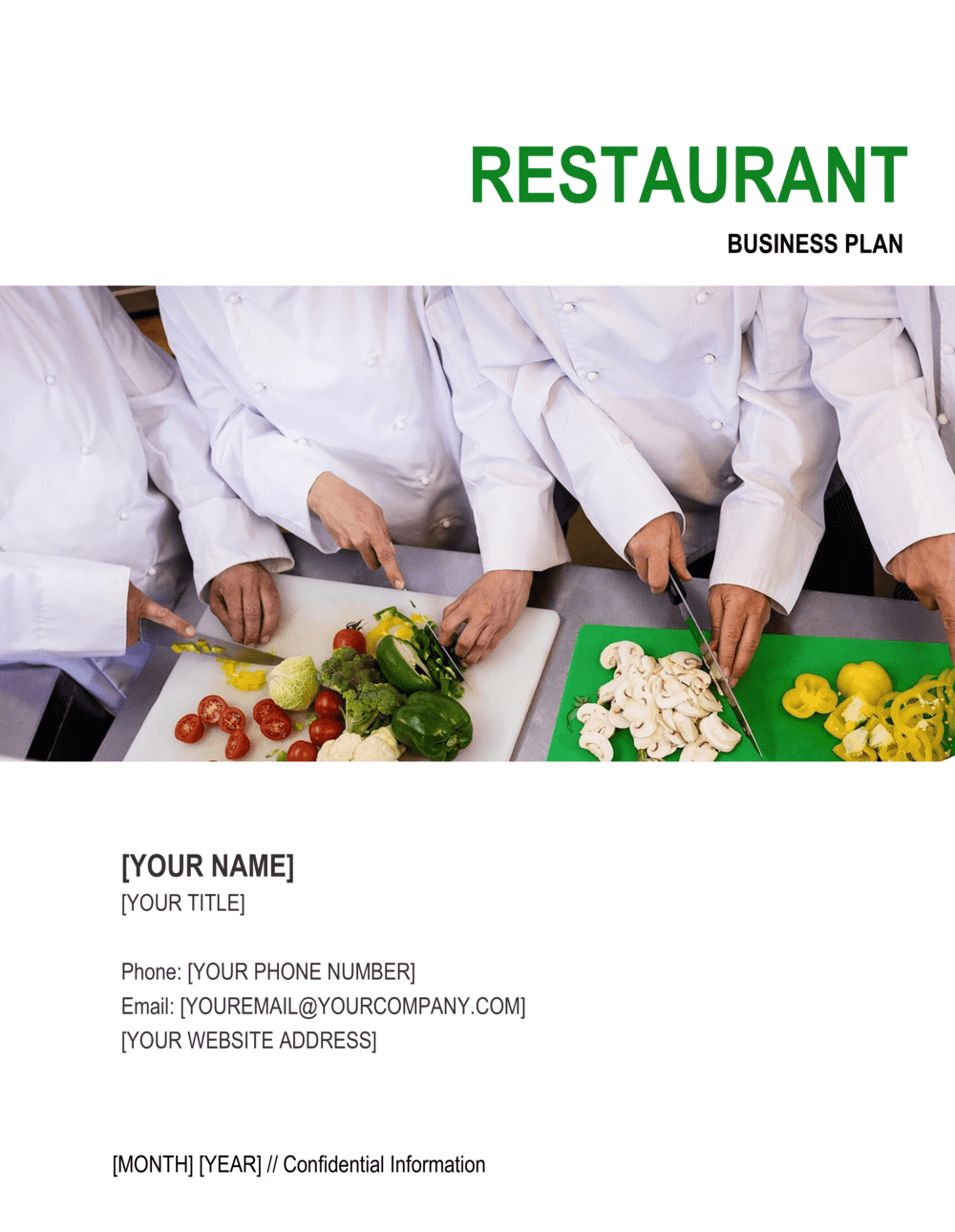
Restaurant Business Plan 4 Template

Free Word download β€’ Edit online β€’ Save & share with Drive β€’ Export to PDF

35 pagesβ€’2h 50m – 3h 50m to fillβ€’Difficulty: Expert
Learn more ↓
FreeRestaurant Business Plan 4 Template

At a glance

What it is
A Restaurant Business Plan is a structured operational document that maps your concept, target market, menu strategy, staffing model, location rationale, and 3-year financial projections into a single investor- and lender-ready file. This free Word download gives you a pre-structured starting point you can edit online and export as PDF to share with banks, investors, or franchise partners.
When you need it
Use it when applying for an SBA loan, seeking investor backing, negotiating a commercial lease, or preparing to open, expand, or reposition a restaurant concept.
What's inside
Executive summary, concept and brand overview, market and competitive analysis, menu and pricing strategy, location and facility plan, operations and staffing model, marketing strategy, and 3-year financial projections including P&L, cash flow, and startup cost breakdown.

What is a Restaurant Business Plan?

A Restaurant Business Plan is a structured operational document that defines your restaurant concept, target market, menu and pricing strategy, location and facility requirements, staffing model, and 3-year financial projections β€” including a full P&L, cash flow statement, and startup cost schedule β€” in a single investor- and lender-ready file. It functions both as an internal roadmap for building and operating the business and as an external document required by SBA lenders, commercial landlords, and equity investors before they commit capital or resources. Unlike a general business plan, a restaurant-specific plan incorporates food-and-beverage metrics β€” food cost percentage, covers per day, prime cost, and table turn rates β€” that determine whether the financial model holds up under professional scrutiny.

Why You Need This Document

Without a complete, structured restaurant business plan, SBA loan applications stall for missing financial schedules, landlords decline to negotiate leases with unproven operators, and investors pass before a second meeting. The consequences of skipping it are measurable: SBA 7(a) lenders require an itemized startup cost schedule and a use-of-funds breakdown on every application β€” a missing document halts the process entirely, not just slows it. More critically, the discipline of building the plan forces you to stress-test your daily cover projections, food cost assumptions, and working capital requirements before you spend money on a build-out. Operators who discover their break-even requires 85% seat occupancy in the planning stage can restructure the model; those who discover it six months after opening face a cash crisis instead. This template provides the structure, section sequence, and sample language to complete a lender-grade restaurant business plan without starting from a blank page.

Which variant fits your situation?

If your situation is…Use this template
Opening a fast-casual or quick-service restaurantRestaurant Business Plan
Launching a food truck or mobile food businessFood Truck Business Plan
Applying for an SBA 7(a) or 504 loanRestaurant Business Plan 4
Planning a bar, lounge, or nightclub conceptBar Business Plan
Pitching a restaurant concept to equity investorsInvestor Business Plan
Quick internal concept validation before a full planOne-Page Business Plan
Planning a catering or events-based food businessCatering Business Plan

Common mistakes to avoid

❌ Using national benchmarks instead of local market data

Why it matters: SBA loan officers and experienced investors evaluate the specific trade area, not the industry average. National figures cannot support a site-specific investment decision.

Fix: Pull demographic data, competitor pricing, and traffic counts for a 3–5 mile radius around your target location and cite your sources explicitly.

❌ Projecting full capacity from opening day

Why it matters: New restaurants typically reach 60–70% of stabilized covers 3–6 months after opening. Projecting full capacity in Month 1 produces cash flow overestimates that collapse under lender scrutiny.

Fix: Model a ramp curve: 40% capacity in Months 1–2, 55% in Months 3–4, and 65–70% from Month 6 onward. Adjust the working capital reserve to cover the gap.

❌ Omitting a line-item startup cost schedule

Why it matters: Lenders, especially SBA lenders, require an itemized breakdown of every pre-opening cost to approve financing. A lump-sum estimate triggers immediate follow-up and delays approval.

Fix: List every startup expense individually β€” construction, equipment, permits, deposits, pre-opening payroll, marketing, and a working capital reserve β€” with a dollar amount and source.

❌ Leaving the management team section generic

Why it matters: Restaurant loans fail or stall when the operator cannot demonstrate direct FOH or BOH management experience. General business credentials do not satisfy hospitality lenders.

Fix: Lead each bio with the most relevant restaurant-specific achievement β€” covers managed, revenue overseen, or kitchen roles held β€” and quantify it where possible.

❌ Treating the menu as decoration rather than a financial document

Why it matters: The menu drives food cost, ticket time, kitchen equipment requirements, and staffing levels. A plan with an untested menu produces unreliable financial projections.

Fix: Build a pricing matrix showing selling price, ingredient cost, and food cost percentage for each menu category before finalizing financial projections.

❌ Underbudgeting working capital

Why it matters: Most restaurant failures in Year 1 are cash flow failures, not concept failures. Insufficient working capital means missing payroll or vendor payments before revenue stabilizes.

Fix: Reserve a minimum of 3–4 months of projected fixed operating costs as working capital. Include this as a distinct line item in the funding schedule.

The 10 key sections, explained

Executive Summary

Concept and Brand Overview

Market and Competitive Analysis

Menu and Pricing Strategy

Location and Facility Plan

Operations and Staffing Model

Marketing and Guest Acquisition Strategy

Management Team and Ownership Structure

Financial Projections

Funding Requirements and Use of Funds

How to fill it out

  1. 1

    Write the concept and brand overview first

    Define cuisine type, service style, price point, and target guest before touching any other section. Every downstream assumption β€” menu pricing, staffing ratios, location requirements β€” flows from this foundation.

    πŸ’‘ Test your concept statement on five people outside the food industry. If they cannot describe your restaurant back to you accurately, it needs to be sharper.

  2. 2

    Research your specific trade area

    Gather local demographic data, foot traffic counts, and competitor pricing for a 3–5 mile radius around your target location. National industry benchmarks do not substitute for local evidence.

    πŸ’‘ County health department records and Google Maps review volumes are free proxies for local competitor traffic and average check estimates.

  3. 3

    Build the menu and pricing matrix

    List representative items by category with target selling prices and estimated ingredient costs. Calculate the food cost percentage for each category and confirm it hits your target range of 28–35%.

    πŸ’‘ Identify your two or three highest-margin items early β€” your marketing strategy should push traffic toward those items, not just the concept overall.

  4. 4

    Define the location and model build-out costs

    Select a specific target site or comparable property. Get at least two contractor quotes for build-out costs and include equipment costs from actual vendor catalogs, not rule-of-thumb estimates.

    πŸ’‘ Add a 15% contingency to all build-out estimates. Restaurant construction routinely runs over budget due to permitting delays and mechanical surprises.

  5. 5

    Model staffing and labor costs

    Create a staffing chart for each shift type β€” lunch, dinner, weekend brunch β€” with headcount and hourly rates. Calculate total weekly labor cost and express it as a percentage of projected weekly revenue.

    πŸ’‘ Model the first 60 days at 125% of steady-state labor hours to account for training, higher error rates, and the slower ticket times of a new kitchen crew.

  6. 6

    Build the financial model from unit economics up

    Start with daily covers at 40% capacity for Months 1–2, scaling to 65–70% by Month 6. Multiply by average check to get revenue, then apply your food cost and labor percentages to reach EBITDA.

    πŸ’‘ Run a break-even scenario: what daily cover count do you need to cover all fixed costs? If that number exceeds 70% of capacity, the model needs to be restructured.

  7. 7

    Complete the startup cost and funding schedule

    List every pre-opening expense line by line β€” construction, equipment, permits, deposits, pre-opening payroll, marketing, and working capital reserve. Total these and match them to your funding sources.

    πŸ’‘ SBA lenders require the owner equity injection (typically 10–30% of total project cost) to be documented before the loan is approved. Include this in the funding schedule.

  8. 8

    Write the executive summary last

    Compress the plan's key data points β€” concept, market opportunity, team credentials, funding ask, and projected returns β€” into 1–2 pages. Reference the specific numbers from your completed financial model.

    πŸ’‘ A lender's executive summary checklist includes: concept description, location, seating capacity, projected Year 1 revenue, total funding ask, and owner equity contribution. Confirm all six are stated explicitly.

Frequently asked questions

What is a restaurant business plan?

A restaurant business plan is a structured document that defines your concept, target market, menu and pricing strategy, location, operations model, staffing plan, and 3-year financial projections. It serves as both an internal operational roadmap and an external document for securing SBA loans, investor capital, or commercial lease approvals.

What financial projections should a restaurant business plan include?

A complete financial section includes a monthly P&L for Year 1 and annual P&L for Years 2–3, a cash flow statement, a projected balance sheet, a startup cost schedule, and a use-of-funds breakdown. Lenders also expect to see food cost percentage, labor cost percentage, prime cost, and a break-even analysis by daily cover count.

How much does it cost to open a restaurant?

Total startup costs vary widely by concept and market. A quick-service restaurant in a second-generation space may cost $150,000–$350,000. A full-service restaurant with a new build-out typically runs $500,000– $1,500,000 or more. Your business plan should itemize every cost line rather than rely on industry averages, since lenders evaluate the specific project budget.

Do I need a business plan to get an SBA loan for a restaurant?

Yes. SBA lenders require a complete business plan including financial projections, a startup cost schedule, and a use-of-funds breakdown as part of every loan application. The plan must demonstrate sufficient cash flow to service the debt, a credible market opportunity, and an operator with relevant experience.

How long should a restaurant business plan be?

A complete restaurant business plan runs 20–35 pages plus a financial model appendix. The financial model β€” P&L, cash flow, balance sheet, and startup cost schedule β€” is typically a separate Excel file referenced in the plan. Lenders and investors read the executive summary and financials first; the supporting sections provide evidence for the numbers.

What food cost percentage should I use in my projections?

Target food cost of 28–32% of revenue for full-service restaurants and 25–30% for fast-casual concepts. Fine dining may run slightly higher due to premium ingredients. These percentages must be validated against an actual ingredient cost analysis of your menu β€” using an industry average without menu-level cost data is a common mistake that lenders flag.

How do I estimate daily covers for my revenue projections?

Start with your physical seating capacity and your planned operating hours. Model a ramp curve β€” typically 40% of capacity in the first two months, rising to 65–70% by Month 6 as the concept builds a regular guest base. Multiply daily covers by your target average check to get daily revenue, then annualize. Cross-check by calculating the implied revenue per square foot and comparing to local market norms.

Can I write a restaurant business plan myself?

Yes. A structured template handles the format and section sequence, leaving your effort for the market research, menu costing, and financial modeling that require original data. Hire a restaurant consultant ($1,500–$5,000) when seeking SBA loans above $500K, approaching institutional investors, or entering a highly competitive market where detailed feasibility analysis is required.

What is prime cost and why does it matter?

Prime cost is the sum of food cost and labor cost β€” typically the two largest expense categories in a restaurant P&L. A healthy prime cost target is below 65% of revenue for full-service restaurants; fast-casual operators often target 55–60%. Your business plan financial projections should include a prime cost line for every year modeled, since lenders use it as a quick viability check.

How this compares to alternatives

vs Restaurant Business Plan

The standard Restaurant Business Plan is suited for new independent concepts presenting to local lenders or early-stage investors. Restaurant Business Plan 4 provides a more detailed operational and financial framework appropriate for SBA loan applications, multi-unit planning, or investor-grade diligence packages requiring itemized startup cost schedules and three-statement financial models.

vs One-Page Business Plan

A one-page plan is a rapid internal alignment tool for testing a concept before committing to a full document. It lacks the financial depth, market evidence, and operational detail that lenders and investors require. Use it to validate the idea, then build the full restaurant business plan before approaching any capital source.

vs Business Plan (General)

A general business plan covers market analysis, strategy, and financials for any industry. A restaurant-specific plan incorporates food-and-beverage metrics β€” food cost percentage, covers per day, prime cost, table turn rate, and build-out cost schedules β€” that a general template does not address. Using a generic plan for a restaurant application signals unfamiliarity with the industry to hospitality lenders.

vs Financial Projections Template

A standalone financial projections template covers the numbers but not the narrative context β€” concept rationale, market evidence, team credentials, and operational model β€” that lenders need to evaluate the assumptions. A complete restaurant business plan integrates the financial model with the strategic and operational story that explains why the projections are credible.

Industry-specific considerations

Full-Service Restaurants

Table turn rates, FOH staffing ratios, per-cover revenue targets, and kitchen equipment capital requirements drive the financial model structure.

Fast-Casual and QSR

Transaction volume per hour, drive-through or digital order percentages, and streamlined BOH staffing models differ materially from full-service projections.

Hospitality and Hotels

F&B revenue as a percentage of total hotel revenue, banquet and events capacity, and cross-sell from room bookings require integration with the broader property financials.

Franchising

Royalty and marketing fund fees (typically 5–8% of gross sales) must be built into the P&L, and the franchisor's FDD Item 19 financial performance representations inform the revenue ramp assumptions.

Template vs pro β€” what fits your needs?

PathBest forCostTime
Use the templateIndependent restaurant owners, first-time operators, and SBA loan applications under $500KFree3–5 weeks (50–80 hours including financial modeling)
Template + professional reviewSBA loans of $500K–$1.5M, franchise applications, or concepts in competitive urban markets$1,000–$3,000 for a restaurant consultant or SCORE advisor review4–6 weeks
Custom draftedMulti-unit expansion, institutional investors, or hospitality groups requiring full feasibility studies$3,000–$10,000 for a professional restaurant business plan writer6–10 weeks

Glossary

Food Cost Percentage
The ratio of ingredient costs to menu revenue, typically targeted between 28% and 35% in full-service restaurants.
Covers Per Day
The number of individual meals served in a single operating day β€” a core volume metric for projecting revenue.
Table Turn Rate
The number of times a table is occupied and cleared during a service period, directly affecting revenue per square foot.
Prime Cost
The sum of food cost and labor cost, typically the two largest expense categories; healthy full-service restaurants target prime cost below 65% of revenue.
Build-Out Cost
Total capital required to prepare a physical space for restaurant operations, including construction, equipment, fixtures, and permits.
Break-Even Point
The monthly revenue level at which total income equals total fixed and variable costs, with no profit or loss.
Average Check (or Average Cover)
Total revenue divided by number of guests served β€” used to model revenue at different volume scenarios.
RevPASH
Revenue Per Available Seat Hour β€” a capacity utilization metric calculated as total revenue divided by seats multiplied by hours open.
Front of House (FOH)
The guest-facing area of a restaurant including the dining room, bar, and host stand, staffed by servers, bartenders, and hosts.
Back of House (BOH)
The kitchen and prep areas where food is produced, staffed by cooks, prep staff, and dishwashers β€” invisible to most guests.
Concept Statement
A concise description of the restaurant's cuisine type, service style, target guest, price point, and brand personality.
Working Capital
Cash reserved to cover operating expenses β€” payroll, food orders, utilities, and rent β€” during the early months before revenue stabilizes.

Part of your Business Operating System

This document is one of 3,000+ business & legal templates included in Business in a Box.

  • Fill-in-the-blanks β€” ready in minutes
  • 100% customizable Word document
  • Compatible with all office suites
  • Export to PDF and share electronically

Create your document in 3 simple steps.

From template to signed document β€” all inside one Business Operating System.
1
Download or open template

Access over 3,000+ business and legal templates for any business task, project or initiative.

2
Edit and fill in the blanks with AI

Customize your ready-made business document template and save it in the cloud.

3
Save, Share, Send, Sign

Share your files and folders with your team. Create a space of seamless collaboration.

Save time, save money, and create top-quality documents.

β˜…β˜…β˜…β˜…β˜…

"Fantastic value! I'm not sure how I'd do without it. It's worth its weight in gold and paid back for itself many times."

Managing Director Β· Mall Farm
Robert Whalley
Managing Director, Mall Farm Proprietary Limited
β˜…β˜…β˜…β˜…β˜…

"I have been using Business in a Box for years. It has been the most useful source of templates I have encountered. I recommend it to anyone."

Business Owner Β· 4+ years
Dr Michael John Freestone
Business Owner
β˜…β˜…β˜…β˜…β˜…

"It has been a life saver so many times I have lost count. Business in a Box has saved me so much time and as you know, time is money."

Owner Β· Upstate Web
David G. Moore Jr.
Owner, Upstate Web

Run your business with a system β€” not scattered tools

Stop downloading documents. Start operating with clarity. Business in a Box gives you the Business Operating System used by over 250,000 companies worldwide to structure, run, and grow their business.

Start freeΒ Β·Β No credit card required