Real Estate Business Plan Template

Free Word download β€’ Edit online β€’ Save & share with Drive β€’ Export to PDF

47 pagesβ€’3h 40m – 4h 55m to fillβ€’Difficulty: Expert
Learn more ↓
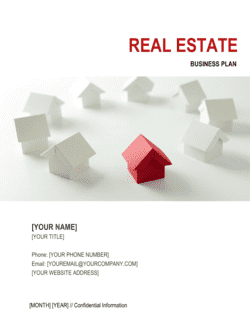
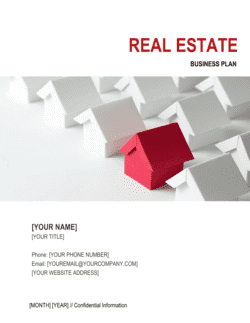
FreeReal Estate Business Plan Template

At a glance

What it is
A Real Estate Business Plan is a structured document that defines a real estate professional's or investor's market focus, acquisition or sales strategy, financial targets, and operational model in one place. This free Word download gives you a ready-to-edit framework you can tailor for an agency, brokerage, investment portfolio, or individual agent practice, then export as PDF to share with lenders, partners, or your own team.
When you need it
Use it when launching a new real estate business, applying for a commercial loan or line of credit, attracting private capital partners, or resetting your annual strategy with measurable targets and a clear execution roadmap.
What's inside
Executive summary, company overview, market and territory analysis, services and investment strategy, marketing and lead generation plan, operations and team structure, and 3-year financial projections including revenue, expenses, and cash flow.

What is a Real Estate Business Plan?

A Real Estate Business Plan is a structured document that defines a real estate professional's or investor's target market, business strategy, operational model, team structure, and financial projections β€” typically covering one to three years. It applies equally to individual agents setting annual GCI targets, investors documenting acquisition criteria and return models, and brokerages or property management firms planning growth and capital needs. Unlike a general business plan, it centers on hyper-local market data β€” absorption rates, median prices, days on market β€” and uses real estate-specific metrics like GCI, NOI, cap rate, and cash-on-cash return to make projections credible to industry-savvy readers.

Why You Need This Document

Operating a real estate business without a written plan means working toward vague production goals with no defined lead-generation budget, no transaction-count model, and no clear criteria for which deals or clients to pursue. The cost of that ambiguity is concrete: agents without a plan consistently close fewer transactions than those who commit specific targets to paper, lenders require a formal plan for any SBA loan or business line of credit application, and capital partners will not commit to a joint venture without documented acquisition criteria and projected returns. A well-built real estate business plan forces you to stress-test your conversion assumptions, validate your market sizing with local data, and tie every dollar of marketing spend to an expected transaction outcome β€” turning aspirational production goals into a system you can actually execute and measure.

Which variant fits your situation?

If your situation is…Use this template
Single agent planning annual transactions and GCIReal Estate Agent Business Plan
Investor focused on fix-and-flip or BRRRR strategyReal Estate Investment Business Plan
Opening a new brokerage or franchise locationReal Estate Brokerage Business Plan
Launching or scaling a property management companyProperty Management Business Plan
Residential or commercial development projectReal Estate Development Business Plan
Quick internal alignment or early-stage concept testingOne-Page Business Plan
Raising equity capital from institutional or private investorsInvestor Business Plan

Common mistakes to avoid

❌ Using national or state-level market data

Why it matters: Lenders and investors who operate locally will immediately spot figures that don't match ground-level conditions, undermining the entire market analysis section.

Fix: Pull MLS data, county recorder records, or a licensed data service for your specific ZIP codes or submarket and cite the source and date.

❌ Pursuing every real estate niche simultaneously

Why it matters: A plan covering listings, buyer clients, flips, rentals, and commercial leasing reads as unfocused. Readers cannot evaluate a business with no defined competitive positioning.

Fix: Choose one or two strategies for Year 1 with specific criteria, and note any planned expansion to additional niches only after defined milestones are met.

❌ Projecting revenue without a transaction-count model

Why it matters: A Year 2 GCI of $400,000 that isn't supported by a lead volume, conversion rate, and transaction count model is not a projection β€” it's a wish.

Fix: Build projections from the bottom up: leads per month Γ— conversion rate = transactions Γ— average commission = GCI. Show all assumptions.

❌ Omitting the operations and technology section

Why it matters: A plan that describes production targets with no workflow, CRM, or staffing model leaves readers wondering how the volume will actually be processed.

Fix: Describe your transaction management workflow, the tools you use, and the point at which you will add staff or a transaction coordinator to handle growth.

The 9 key sections, explained

Executive Summary

Company Overview

Market and Territory Analysis

Services and Investment Strategy

Marketing and Lead Generation Plan

Operations and Team Structure

Management Team and Qualifications

Financial Projections

Funding Requirements and Use of Funds

How to fill it out

  1. 1

    Complete the company overview and define your niche

    Enter your legal entity name, license numbers, formation date, and a one-sentence mission. Commit to a specific niche β€” residential listings, investment acquisitions, property management β€” before writing any other section.

    πŸ’‘ A clearly stated niche makes every subsequent section easier to write and more credible to the reader.

  2. 2

    Pull hyper-local market data for your territory

    Source median price, DOM, absorption rate, and inventory levels for your specific farm area or asset class from your MLS, county recorder, or a paid data service like CoStar or ATTOM. Use the most recent 12 months.

    πŸ’‘ Include the data source and pull date next to each statistic β€” lenders and partners check figures, and dated or unsourced data weakens your credibility.

  3. 3

    Define your acquisition or client criteria precisely

    Write out specific, numeric criteria for the deals or clients you pursue β€” price range, property type, ZIP codes, minimum return thresholds, or buyer profile. Avoid broad language like 'all residential properties.'

    πŸ’‘ Precise criteria signal professional discipline and make your marketing and operations sections internally consistent.

  4. 4

    Build the lead generation plan with cost and volume estimates

    For each marketing channel, estimate monthly spend, expected lead volume, and historical or industry-average conversion rate. Tie the total projected lead volume to the transaction count in your financial model.

    πŸ’‘ If your conversion assumptions are new or unproven, label them as targets and note the industry benchmark you are working toward.

  5. 5

    Build the financial model from transaction count up

    Start with a monthly transaction count for Year 1, multiply by average commission or NOI per unit, then subtract itemized expenses. Never start from a revenue target and work backward.

    πŸ’‘ Model a base case (100% of plan) and a conservative case (70% of plan). Showing downside awareness builds trust with lenders and partners.

  6. 6

    State the funding ask with a line-item use-of-funds table

    Enter total capital required, the instrument (personal equity, lender debt, or private investor), and break spending into at least four line items with dollar amounts and percentages.

    πŸ’‘ Tie each spending line to a measurable output β€” '$18,000 in lead-generation spend to produce 120 leads at a 5% conversion rate = 6 closed transactions.'

  7. 7

    Write the executive summary last

    Pull the single most compelling fact from each section β€” market opportunity, target production, team track record, and funding ask β€” and compress them into one to two pages.

    πŸ’‘ If a lender or partner reads only two pages, it will be the executive summary and the financial projections. Make both earn their attention.

Frequently asked questions

What is a real estate business plan?

A real estate business plan is a structured document that defines a real estate professional's or investor's target market, strategy, operations, team, and financial projections β€” typically covering 1–3 years. It serves as an internal operating roadmap and an external document for raising capital, securing a loan, or attracting joint-venture partners. The format applies to individual agents, teams, brokerages, investors, and developers.

What should a real estate business plan include?

A complete plan covers an executive summary, company overview, local market analysis, services or investment strategy, marketing and lead generation plan, operations and team structure, financial projections (P&L and cash flow), and a funding requirements section. For investment-focused plans, a deal criteria and returns model is also essential. Most complete real estate business plans run 15–25 pages plus a financial model.

Do real estate agents need a business plan?

Agents are not required to have one, but those who operate without a written plan consistently underperform peers who do. A plan forces you to commit to a GCI target, a lead-generation budget, and specific activities β€” turning vague production goals into a trackable system. Banks also require a formal business plan for any agent applying for a business line of credit or SBA loan.

How is a real estate business plan different from a general business plan?

The core structure is the same, but a real estate business plan uses industry-specific metrics: GCI, cap rate, NOI, absorption rate, average DOM, and cash-on-cash return replace generic revenue and margin figures. The market analysis section focuses on a specific MLS territory or asset class rather than a broad addressable market, and the strategy section defines acquisition criteria or client niche rather than product features.

How long should a real estate business plan be?

For external audiences β€” lenders, capital partners, or franchisor applications β€” 15–25 pages is standard. Internal planning documents can be shorter. A one-page plan works for personal annual goal-setting but is insufficient for any capital raise or formal approval process. The financial model and supporting data are typically included as an appendix and do not count toward the page target.

What financial projections should a real estate business plan include?

For agents and brokerages: a monthly transaction count model for Year 1, GCI projections, itemized operating expenses, and net income for Years 1–3. For investors: NOI and cash-on-cash return per property, portfolio-level cash flow, and a debt-service coverage calculation. Both types should include a conservative scenario at 70% of base-case projections.

Can I use this template to apply for an SBA loan?

Yes. SBA lenders require a formal business plan that includes a company overview, market analysis, management team credentials, and 3-year financial projections. This template covers all of those sections. For loan amounts above $350,000, consider having a financial advisor review your projections and assumptions before submission.

How often should a real estate business plan be updated?

Review and update your plan at the start of each fiscal year and whenever market conditions shift materially β€” a significant change in interest rates, inventory levels, or commission structures warrants an immediate revision. A plan older than 12 months is effectively a historical snapshot, not an active strategy document. Agents in growth mode should do a quarterly check against actual transaction count and GCI.

What makes a real estate business plan credible to a lender or investor?

Three things: hyper-local market data with cited sources, financial projections built from a transaction-count or unit model rather than a top-line revenue guess, and a management section with quantified production history β€” dollar volume closed, units sold, or assets under management. Vague market statistics, unsupported revenue numbers, and credential lists without deal track records are the three fastest ways to lose a lender's confidence.

How this compares to alternatives

vs General Business Plan

A general business plan covers any industry with broad market sizing and product or service descriptions. A real estate business plan uses industry-specific metrics β€” GCI, cap rate, NOI, absorption rate β€” and centers the market analysis on a specific MLS territory or asset class. Use the real estate version when your audience knows the market and will test your local data.

vs One-Page Business Plan

A one-page plan is a rapid alignment tool for personal goal-setting or early ideation. It lacks the financial depth, market evidence, and operational detail that lenders, franchise applications, and capital partners require. Use it to draft your strategy quickly, then build the full plan before any formal submission.

vs Marketing Plan

A marketing plan covers lead generation channels, budgets, and conversion goals in detail β€” it is one section of a business plan, not a substitute for it. A business plan situates the marketing strategy within a full operational and financial context. Use a standalone marketing plan when you already have a business plan and need to build out a detailed campaign calendar.

vs Financial Projections Template

A financial projections template produces the revenue, expense, and cash flow numbers. A business plan contextualizes those numbers with market analysis, strategy, and team credentials β€” the narrative that explains why the projections are believable. Lenders and investors require both; the numbers alone are not sufficient without the supporting story.

Industry-specific considerations

Residential Real Estate

GCI targets by transaction side, farm-area lead generation budgets, and median price trend analysis for a defined MLS territory.

Commercial Real Estate

NOI and cap rate modeling by asset class, tenant mix strategy, leasing commission structures, and CoStar-sourced market vacancy data.

Real Estate Investment and Development

Acquisition criteria by return threshold, rehab budget and ARV analysis, BRRRR or fix-and-flip cycle modeling, and equity partner return waterfalls.

Property Management

Units under management growth targets, management fee income projections, maintenance cost ratios, and owner retention rate benchmarks.

Template vs pro β€” what fits your needs?

PathBest forCostTime
Use the templateIndividual agents, small teams, and investors creating an internal annual plan or applying for an SBA loan under $350KFree1–2 weeks (20–40 hours)
Template + professional reviewBrokerages seeking franchise approval, investors raising private capital up to $500K, or first-time loan applicants$500–$2,000 for a financial advisor or business coach review2–3 weeks
Custom draftedDevelopers raising institutional equity, commercial brokerages seeking large SBA or bank loans, or multi-market expansion plans$3,000–$8,000 for a professional business plan writer with real estate experience4–6 weeks

Glossary

GCI (Gross Commission Income)
Total commissions earned before deducting splits, fees, or expenses β€” the primary revenue metric for agents and brokerages.
Cap Rate
Net operating income divided by a property's current market value, used to compare the income-generating potential of investment properties.
NOI (Net Operating Income)
Annual rental income minus operating expenses, before mortgage payments and depreciation β€” the core profitability measure for income-producing properties.
Cash-on-Cash Return
Annual pre-tax cash flow divided by the total cash invested, expressed as a percentage β€” a key metric for evaluating leveraged real estate investments.
BRRRR Strategy
Buy, Rehab, Rent, Refinance, Repeat β€” an investment method that uses refinancing to pull out equity and redeploy capital into the next acquisition.
Absorption Rate
The rate at which available homes in a market are sold in a given period, used to gauge supply-demand balance and price trajectory.
Farm Area
A defined geographic territory or neighborhood that an agent systematically targets for listings through consistent marketing and relationship-building.
Average Days on Market (DOM)
The average number of days a listed property sits on the market before going under contract β€” a leading indicator of local market heat.
Conversion Rate
The percentage of leads that progress to a signed buyer agreement, listing appointment, or closed transaction at each stage of the sales funnel.
Sphere of Influence (SOI)
An agent's personal and professional network β€” past clients, family, friends, and colleagues β€” treated as a structured lead-generation database.
IRR (Internal Rate of Return)
The annualized return rate that makes the net present value of all cash flows from an investment equal to zero, used to compare real estate deals on a time-adjusted basis.


Part of your Business Operating System

This document is one of 3,000+ business & legal templates included in Business in a Box.

  • Fill-in-the-blanks β€” ready in minutes
  • 100% customizable Word document
  • Compatible with all office suites
  • Export to PDF and share electronically

Create your document in 3 simple steps.

From template to signed document β€” all inside one Business Operating System.
1
Download or open template

Access over 3,000+ business and legal templates for any business task, project or initiative.

2
Edit and fill in the blanks with AI

Customize your ready-made business document template and save it in the cloud.

3
Save, Share, Send, Sign

Share your files and folders with your team. Create a space of seamless collaboration.

Save time, save money, and create top-quality documents.

β˜…β˜…β˜…β˜…β˜…

"Fantastic value! I'm not sure how I'd do without it. It's worth its weight in gold and paid back for itself many times."

Managing Director Β· Mall Farm
Robert Whalley
Managing Director, Mall Farm Proprietary Limited
β˜…β˜…β˜…β˜…β˜…

"I have been using Business in a Box for years. It has been the most useful source of templates I have encountered. I recommend it to anyone."

Business Owner Β· 4+ years
Dr Michael John Freestone
Business Owner
β˜…β˜…β˜…β˜…β˜…

"It has been a life saver so many times I have lost count. Business in a Box has saved me so much time and as you know, time is money."

Owner Β· Upstate Web
David G. Moore Jr.
Owner, Upstate Web

Run your business with a system β€” not scattered tools

Stop downloading documents. Start operating with clarity. Business in a Box gives you the Business Operating System used by over 250,000 companies worldwide to structure, run, and grow their business.

Start freeΒ Β·Β No credit card required