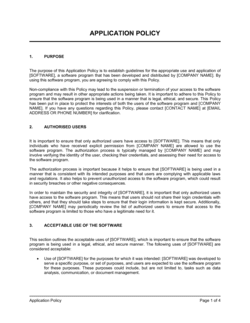
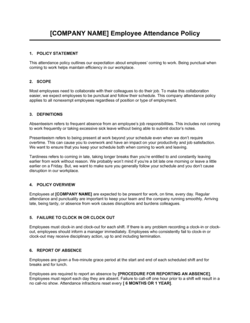
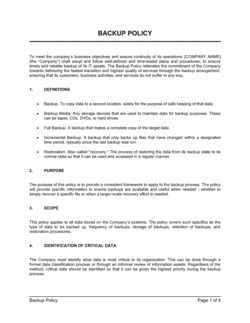
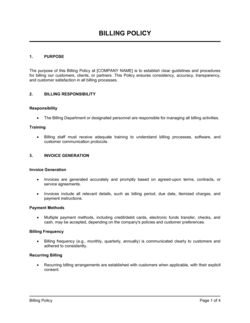
Parking Policy Template

Free Word download β€’ Edit online β€’ Save & share with Drive β€’ Export to PDF

4 pagesβ€’20–30 min to fillβ€’Difficulty: Standard
Learn more ↓
FreeParking Policy Template

At a glance

What it is
A Parking Policy is an operational document that defines how an organization allocates, manages, and enforces the use of on-site parking spaces for employees, visitors, and contractors. This free Word download gives you a ready-to-edit template you can customize to your facility and export as PDF to distribute to staff on day one.
When you need it
Use it when opening a new office or facility, when parking disputes or congestion become a recurring issue, or when leasing space that includes shared or limited parking. Any site with more drivers than guaranteed spaces needs a written policy.
What's inside
Purpose and scope, eligible users and space allocation, assigned and unassigned parking rules, visitor and contractor parking procedures, accessibility and reserved space requirements, permit and registration process, prohibited conduct, enforcement, and violation consequences.

What is a Parking Policy?

A Parking Policy is an operational document that defines how an organization allocates, administers, and enforces the use of on-site parking for employees, visitors, and contractors. It identifies who is eligible to park, how spaces are assigned or shared, what conduct is prohibited, and what consequences apply to violations. Beyond resolving everyday disputes over spaces, a written parking policy ensures accessible space requirements are met, fire lanes remain clear, and enforcement decisions are consistent and defensible across every employee and seniority level.

Why You Need This Document

Without a written parking policy, space allocation defaults to whoever arrives earliest or complains loudest β€” and accessible space compliance is left to chance. A single unaddressed parking dispute can escalate into a formal HR complaint; an undersupplied visitor lot costs the company client relationships before meetings even begin. Organizations that charge for parking without documenting the arrangement may also trigger tax or wage compliance questions in some jurisdictions. A clear, formally adopted policy eliminates all of these problems at the source: it gives facilities and HR teams documented grounds for every enforcement action, ensures every permit holder has acknowledged the rules before receiving a pass, and creates a review process that keeps the policy current as the workforce and facility evolve. This template gives you a complete, ready-to-customize starting point so you can go from informal notice-board rules to a professional policy in under two hours.

Which variant fits your situation?

If your situation is…Use this template
Small office with a single lot and no assigned spacesBasic Parking Policy
Multi-building campus with tiered permit zonesCampus Parking Policy
Retail or customer-facing location with limited staff parkingRetail Parking Policy
Shared commercial building with parking managed by landlordTenant Parking Addendum
Organization adding electric vehicle charging station rulesEV Charging and Parking Policy
Remote-first company formalizing rules for hybrid office daysHybrid Office Parking Policy
Healthcare facility managing patient, staff, and emergency vehicle accessHealthcare Facility Parking Policy

Common mistakes to avoid

❌ Posting informal parking rules on a notice board instead of a written policy

Why it matters: Notice-board rules cannot be enforced consistently, are easily removed or ignored, and provide no evidence that an employee was informed before a violation.

Fix: Replace any informal signage with a formally adopted policy distributed through HR onboarding and signed off by every permit holder.

❌ Failing to account for ADA-minimum accessible space requirements

Why it matters: The ADA sets a minimum number of accessible spaces based on total lot size. Falling short creates legal exposure even if the omission was unintentional.

Fix: Calculate required accessible spaces using the ADA's lot-size formula before finalizing the policy, and confirm at least one van-accessible space is included.

❌ Defining consequences without naming who enforces them

Why it matters: A violation procedure with no named enforcer means violations are reported to whoever happens to be nearby, leading to inconsistent outcomes and discrimination claims.

Fix: Name the specific role (e.g., Facilities Manager) responsible for issuing notices, processing appeals, and initiating tows β€” and ensure that person has documented authority.

❌ Never updating the policy after a facility change or headcount increase

Why it matters: A policy written for 40 employees and 50 spaces becomes unenforceable when you scale to 90 employees β€” the space math no longer works and the rules no longer reflect reality.

Fix: Add a review trigger to your annual HR calendar: reassess the parking policy whenever headcount changes by more than 20% or when a facility move or renovation occurs.

❌ Writing the policy without confirming physical lot signage matches it

Why it matters: Employees follow physical signs, not documents. A policy that designates spaces as visitor-only but has no corresponding signage in the lot cannot be enforced fairly.

Fix: Do a physical walkthrough of the lot with the draft policy in hand before finalizing it, and budget for any new signage needed before the effective date.

❌ Ignoring EV charging station usage in the prohibited conduct section

Why it matters: Employees who occupy EV charging spaces beyond the time limit block access for others, create unplanned electricity costs, and generate resentment without a clear rule to point to.

Fix: Add a specific time limit for EV charging space use (typically two hours during business hours) and include extended occupancy as an enforceable violation.

The 10 key sections, explained

Purpose and scope

Eligibility and user categories

Space allocation and assignment

Visitor and contractor parking

Accessibility and ADA-compliant spaces

Permit registration process

Prohibited conduct and restricted areas

Enforcement and violation consequences

Special programs and exceptions

Policy updates and acknowledgment

How to fill it out

  1. 1

    Complete the facility and contact details

    Fill in the facility address, total number of parking spaces, and the name and contact information of the person responsible for administering the policy (facilities manager or HR contact).

    πŸ’‘ If multiple buildings or lots are covered, list each separately with its space count β€” combining them into a single number creates confusion during enforcement.

  2. 2

    Define your user categories and eligibility

    Decide how many tiers of parking users you need (e.g., employees, executives, contractors, visitors) and document the eligibility criteria for each. Tie eligibility to employment status or role, not individual names.

    πŸ’‘ Avoid creating more than four tiers β€” overly complex hierarchies are hard to administer and generate more disputes than they resolve.

  3. 3

    Assign and document specific spaces

    Map assigned spaces to roles or individuals and record the allocation in a separate parking register. Reference the register in the policy so users know where to find current assignments.

    πŸ’‘ Keep the parking register as a separate spreadsheet rather than embedding names in the policy document β€” this lets you update assignments without re-issuing the full policy.

  4. 4

    Designate visitor and contractor areas

    Identify which spaces are reserved for visitors and contractors, set time limits, and specify how guests register their vehicle on arrival. Confirm that physical signage at the lot matches what the policy says.

    πŸ’‘ Walk the lot before finalizing this section β€” policies written entirely at a desk often designate spaces that are physically inaccessible or poorly placed for visitors.

  5. 5

    Verify accessible space compliance

    Check your jurisdiction's minimum accessible space requirements based on total lot size. Confirm the spaces in your policy meet ADA (or local equivalent) dimension and signage standards.

    πŸ’‘ The ADA requires at least one van-accessible space per accessible lot β€” confirm your lot has this before publishing the policy.

  6. 6

    Write specific prohibited conduct rules

    List every prohibited behavior as a concrete action rather than a general standard. Each rule should be specific enough to appear on a violation notice without additional interpretation.

    πŸ’‘ Review your last six months of parking complaints β€” the most common real-world infractions at your site should drive this list.

  7. 7

    Set enforcement consequences and an appeal process

    Define a clear escalation path (warning, suspension, towing, revocation) and name the person who handles appeals. Ensure the consequences are applied consistently regardless of seniority.

    πŸ’‘ Include a response deadline on appeals (e.g., within 5 business days) β€” open-ended appeal processes generate more conflict than they resolve.

  8. 8

    Obtain acknowledgment signatures before distributing permits

    Add an acknowledgment form or digital sign-off step so that no permit is issued until the employee confirms they have read the policy. Retain signed copies in personnel or facilities files.

    πŸ’‘ Tie permit issuance to acknowledgment in your HR onboarding checklist so new hires complete it before their first day on-site.

Frequently asked questions

What is a parking policy?

A parking policy is a written operational document that defines how an organization allocates and manages on-site parking for employees, visitors, and contractors. It specifies who is eligible to park, how spaces are assigned or shared, what conduct is prohibited, and the consequences for violations. A formal policy replaces informal arrangements and gives facilities or HR teams a consistent basis for enforcement.

Why does a business need a formal parking policy?

Without a written policy, parking disputes are resolved ad hoc β€” typically by whoever complains loudest or holds the most seniority. A formal policy ensures spaces are allocated fairly, accessible space requirements are met, and enforcement is consistent. It also protects the organization if an employee challenges a parking-related decision, because the policy provides documented grounds for any action taken.

How many accessible parking spaces does a company lot require?

Under the ADA, the minimum number of accessible spaces depends on total lot size: for example, lots with 1–25 spaces require 1 accessible space; lots with 26–50 require 2; lots with 51–75 require 3. At least one space per accessible lot must be van-accessible. Local building codes may set higher minimums. Confirm requirements with your municipality or a facilities consultant before finalizing the policy.

Should employees be required to sign the parking policy?

Yes. Requiring a signed acknowledgment β€” or a documented digital sign-off β€” before issuing a parking permit ensures that every permit holder can be held to the policy's rules. Without a record of acknowledgment, employees can claim they were unaware of a rule at the time of a violation, making consequences difficult to impose fairly.

How should parking violations be handled?

Best practice is a documented escalation path: a written warning for the first offense, a temporary suspension of parking privileges or administrative fee for the second, and permanent revocation for a third. Vehicles blocking fire lanes or tow-away zones should be subject to immediate towing. All violations should be documented in writing by a named enforcer, and an appeal process with a defined response window should be available.

Can a company charge employees for parking?

Yes, employer-provided parking can be offered free, subsidized, or at full cost to employees. In the US, employer-provided parking benefits above $315 per month (2025 IRS limit) may be taxable to the employee. Some jurisdictions β€” including certain cities in California β€” require employers who subsidize parking to offer a comparable cash allowance to employees who do not drive. Review local requirements before setting any paid parking structure.

What should a parking policy say about visitors?

The policy should designate specific spaces for visitors, state the maximum permitted stay (typically 2–4 hours), explain how visitors register their vehicle on arrival, and clarify whether visitor spaces are available after hours. Physical signage at the lot must match the written policy β€” spaces labeled visitor-only in the document but not in the lot cannot be enforced consistently.

How often should a parking policy be reviewed and updated?

Review the policy annually as part of your HR or facilities calendar, and trigger an off-cycle review whenever headcount changes by more than 20%, a facility move or renovation occurs, a new EV charging station is installed, or a pattern of unresolved parking complaints emerges. Distribute and re-obtain employee acknowledgment any time a material change is made.

Does a parking policy need to address carpooling?

Not strictly required, but including a carpool program section is worthwhile if parking supply is constrained. Offering a reserved or priority space to employees who carpool reduces overall lot demand, supports sustainability goals, and demonstrates that the policy rewards cooperative behavior rather than purely penalizing violations.

How this compares to alternatives

vs Vehicle Use Policy

A vehicle use policy governs how employees operate company-owned vehicles β€” covering authorized drivers, maintenance responsibilities, accident reporting, and personal use rules. A parking policy governs the use of the physical parking facility, regardless of vehicle ownership. Organizations with a company fleet need both; a company without fleet vehicles still needs a parking policy if they have an on-site lot.

vs Workplace Health and Safety Policy

A health and safety policy covers the full range of workplace hazards and regulatory compliance obligations. A parking policy addresses one specific physical area of the workplace. Parking-related safety requirements β€” fire lane clearance, accessible space compliance, lighting adequacy β€” are often mentioned in a health and safety policy but require the operational detail of a dedicated parking document to be actionable.

vs Employee Handbook

An employee handbook is a comprehensive reference document covering all major HR policies. Parking rules are often summarized in one or two paragraphs within a handbook. A standalone parking policy is appropriate when the facility has enough complexity β€” multiple lots, tiered permits, enforcement consequences β€” to warrant a dedicated document that can be updated independently of the full handbook.

vs Facilities Management Policy

A facilities management policy covers the broader governance of physical workspace β€” building access, maintenance requests, space allocation, and vendor management. A parking policy is narrower, addressing only the parking facility. Large organizations typically maintain a facilities policy that references the parking policy as an appendix or linked document rather than embedding the full parking rules within it.

Industry-specific considerations

Corporate offices

Tiered permit zones by seniority or role, carpool incentive programs, and visitor registration at the reception desk for client-facing locations.

Healthcare

Strict accessible space minimums, designated emergency vehicle access lanes, staff shift-change overflow management, and patient drop-off zone rules.

Retail and hospitality

Customer-priority parking enforced during business hours, employee parking relocated to overflow lots, and time-limit signage to maximize customer turnover.

Manufacturing

Shift-based parking allocation for multiple crews, designated zones for delivery vehicles and forklifts, and strict fire-lane enforcement near loading docks.

Template vs pro β€” what fits your needs?

PathBest forCostTime
Use the templateSmall to mid-sized businesses with a single lot and straightforward space allocation needsFree1–2 hours to customize and finalize
Template + professional reviewOrganizations with complex tiered permits, EV charging infrastructure, or shared lots governed by a lease$100–$400 for a facilities consultant or HR advisor review2–5 business days
Custom draftedLarge multi-site organizations, campuses with regulated parking programs, or facilities subject to local parking ordinances$500–$2,000 for a professional policy writer or facilities consultant1–3 weeks

Glossary

Assigned Parking Space
A numbered or labeled space reserved exclusively for a specific employee or role, typically allocated by seniority, disability status, or job function.
Unassigned Parking
First-come, first-served parking available to any eligible user within a defined area, without a reserved designation.
Parking Permit
A physical hang-tag, sticker, or digital registration that authorizes a specific vehicle to park on company premises.
Visitor Parking
Spaces designated exclusively for clients, customers, and other non-employee guests, typically located near the main entrance and time-limited.
ADA/Accessible Space
A parking space meeting Americans with Disabilities Act (or equivalent local code) dimensions and signage requirements, reserved for users with a qualifying disability placard or plate.
Tow-Away Zone
An area on the property where unauthorized vehicles are subject to immediate towing at the vehicle owner's expense.
Parking Violation Notice
A written warning or citation issued to a vehicle parked in violation of the policy, documenting the infraction and applicable consequence.
Carpool Program
A formal arrangement that grants priority or reserved parking to employees who share a ride to work with at least one other colleague.
Parking Lot Attendant
A designated staff member or contractor responsible for monitoring lot access, issuing permits, and documenting violations.
Fire Lane
A clearly marked access corridor required by fire code to remain clear of parked vehicles at all times to allow emergency vehicle access.

Part of your Business Operating System

This document is one of 3,000+ business & legal templates included in Business in a Box.

  • Fill-in-the-blanks β€” ready in minutes
  • 100% customizable Word document
  • Compatible with all office suites
  • Export to PDF and share electronically

Create your document in 3 simple steps.

From template to signed document β€” all inside one Business Operating System.
1
Download or open template

Access over 3,000+ business and legal templates for any business task, project or initiative.

2
Edit and fill in the blanks with AI

Customize your ready-made business document template and save it in the cloud.

3
Save, Share, Send, Sign

Share your files and folders with your team. Create a space of seamless collaboration.

Save time, save money, and create top-quality documents.

β˜…β˜…β˜…β˜…β˜…

"Fantastic value! I'm not sure how I'd do without it. It's worth its weight in gold and paid back for itself many times."

Managing Director Β· Mall Farm
Robert Whalley
Managing Director, Mall Farm Proprietary Limited
β˜…β˜…β˜…β˜…β˜…

"I have been using Business in a Box for years. It has been the most useful source of templates I have encountered. I recommend it to anyone."

Business Owner Β· 4+ years
Dr Michael John Freestone
Business Owner
β˜…β˜…β˜…β˜…β˜…

"It has been a life saver so many times I have lost count. Business in a Box has saved me so much time and as you know, time is money."

Owner Β· Upstate Web
David G. Moore Jr.
Owner, Upstate Web

Run your business with a system β€” not scattered tools

Stop downloading documents. Start operating with clarity. Business in a Box gives you the Business Operating System used by over 250,000 companies worldwide to structure, run, and grow their business.

Free Forever PlanΒ Β·Β No credit card required