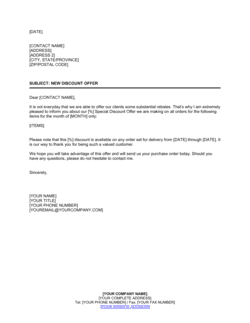
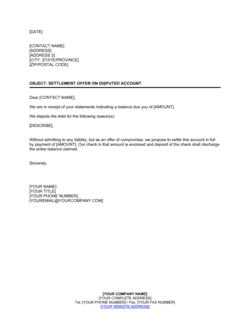
Offer of 2% Discount for Speedy Payments Template

Word (DOC/DOCX)•1 page•20–30 min to fill•Difficulty: Standard•Signature required•Legal review recommended
Learn more ↓

The full editable document opens in Business in a Box.

At a glance

What it is
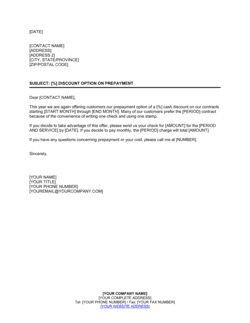
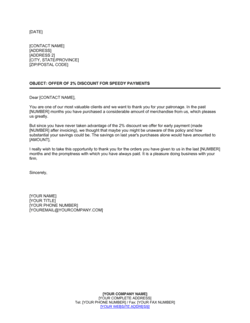
An Offer of 2% Discount for Speedy Payments is a formal written notice — and binding contractual addendum — that a seller issues to a buyer offering a 2% reduction on the invoice total in exchange for payment within a defined accelerated window, typically 10 days rather than the standard 30 or 60. This Word template gives you a professionally structured template you can edit online, attach to existing invoices or contracts, and export as PDF for immediate distribution to customers or accounts-payable contacts.
When you need it
Use it whenever you want to accelerate receivables, reduce days-sales-outstanding, or reward long-standing customers who are willing to pay early. It is equally useful when cash flow is tight and you need liquidity faster than your standard payment terms allow.
What's inside
Parties and effective date, the specific discount rate and qualifying payment window, eligible invoices or account scope, acceptance mechanism, expiry of the offer, governing terms, and signature blocks for both parties.

Which variant fits your situation?

If your situation is…Use this template
Offering a sliding discount based on how many days early payment is receivedTiered Early Payment Discount Offer
Offering a discount only on a single overdue invoice to resolve a collection issueSettlement Offer Letter
Codifying standing 2/10 net 30 terms across all future invoices in a supply agreementSales Agreement with Payment Terms
Notifying a customer that a previously offered discount has expiredExpiry of Payment Discount Notice
Offering a discount to settle a disputed invoice at reduced valueDebt Settlement Agreement
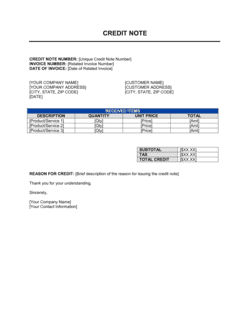
Issuing a formal credit note after an early-payment discount has already been takenCredit Note
Providing a full suite of payment terms in a new customer onboarding packetTerms and Conditions of Sale

What is an Offer of 2% Discount for Speedy Payments?

An Offer of 2% Discount for Speedy Payments is a formal written notice — and binding contractual addendum — in which a seller offers a buyer a 2% reduction on the gross invoice total in exchange for payment within an accelerated window, typically 10 calendar days from the invoice date. Commonly notated as "2/10 Net 30," the arrangement is one of the oldest and most widely used tools in commercial finance: the seller trades a small margin concession for faster access to cash, while the buyer earns an effective annualized return of approximately 36.7% on the capital deployed early. Unlike an informal email or a notation on an invoice face, a properly drafted offer letter defines the eligible invoices, the settlement-date rule, acceptance mechanics, forfeiture consequences for late claimants, and the governing law — giving both parties an enforceable document rather than a gentlemen's agreement.

Why You Need This Document

Relying on an invoice notation alone to communicate early-payment discount terms creates predictable and costly problems. Without a signed offer letter, buyers who pay late but still deduct the 2% have no contractual basis to stand on — but neither do you when you try to recover the shortfall, because the discount was never formally authorized or conditioned. Disputes over whether the window ran from invoice date or receipt date, whether a partially disputed invoice qualifies, and whether the offer is still standing six months after it was first mentioned in an email are all avoidable with a single one-page document. For businesses running discount programs across a large accounts-receivable portfolio, inconsistent documentation is also an audit risk: tax authorities in the UK, Canada, and EU member states require accurate records of discounts taken to support VAT or GST adjustments. This template closes every one of those gaps — it takes 20 minutes to complete, creates an enforceable record, and gives your AR team a clear policy to enforce when buyers claim discounts they did not earn.

Common mistakes to avoid

❌ Using 'days from receipt' instead of 'days from invoice date'

Why it matters: Buyers and sellers rarely agree on when an invoice was received, especially for emailed invoices that land in a spam folder or are forwarded internally. This ambiguity produces disputes on nearly every early-payment transaction.

Fix: Define the discount window as 'calendar days from the invoice date' and print the invoice date prominently on the face of every invoice. This gives both parties an unambiguous start date.

❌ No expiry date on the offer

Why it matters: An open-ended discount offer can be accepted months after issuance on invoices you never intended to discount, or invoked by the buyer as evidence of a modified course of dealing that applies to all future invoices.

Fix: Always include a specific expiry date — typically 30 to 60 days from the offer date — and a clause confirming the offer can be renewed only in writing.

❌ Failing to exclude disputed invoices from the discount scope

Why it matters: A buyer who withholds a disputed portion of an invoice and pays the remainder early may claim the 2% discount on the entire invoice amount, creating an underpayment that is difficult to recover without litigation.

Fix: Add an explicit exclusion: 'Invoices or portions of invoices subject to a bona fide written dispute are not Qualifying Invoices until the dispute is resolved in writing by both parties.'

❌ No forfeiture clause for buyers who deduct the discount but pay late

Why it matters: Without a forfeiture clause, a buyer who pays on Day 15 but deducts 2% has effectively obtained unsanctioned credit. Recovering the deducted amount requires a separate demand and potentially legal action, which most sellers absorb as a cost.

Fix: Include a clause stating that any discount deducted on a payment received after the discount window shall be reversed, added to the outstanding balance, and subject to late-payment interest from the original due date.

❌ Offering the discount verbally or only in an email without a signed document

Why it matters: An informal discount offer creates an implied modification to the invoice terms that is hard to revoke and generates inconsistent treatment across your customer base, complicating tax reporting and audit trails.

Fix: Use this template for every discount offer, require countersignature or a formal acceptance act, and file executed copies in your AR system.

❌ Setting a discount window shorter than your internal invoice-posting cycle

Why it matters: If your accounts receivable team takes 3–4 days to post incoming payments, a 10-day window effectively becomes a 6-day window from the buyer's perspective — generating disputes about whether payment was timely.

Fix: Map your internal cash-posting timeline before setting the window. If same-day posting is not guaranteed, use a 15-day window or define settlement by the bank's value date rather than your internal posting date.

The 9 key clauses, explained

Parties and recitals

In plain language: Identifies the seller and buyer by legal name and establishes the commercial relationship that gives rise to the offer.

Sample language
This Offer of Early Payment Discount is made by [SELLER LEGAL NAME] ('Seller') to [BUYER LEGAL NAME] ('Buyer') in connection with outstanding and future invoices issued under [CONTRACT / ACCOUNT REFERENCE] dated [DATE].

Common mistake: Using a trade name instead of the registered legal entity name. If the seller entity on the offer differs from the entity on the invoice, the buyer's accounts-payable system may reject the discounted payment, creating a reconciliation dispute.

Discount rate and qualifying payment window

In plain language: States the exact percentage discount and the number of days from the invoice date within which payment must be received to qualify.

Sample language
Seller hereby offers Buyer a discount of two percent (2%) on the net invoice total of each Qualifying Invoice, provided that full payment of the discounted amount is received by Seller within [10] calendar days of the invoice date ('Discount Window').

Common mistake: Writing 'within 10 days of receipt' instead of 'within 10 days of invoice date.' Buyer and seller often disagree on when the invoice was received, creating disputes about whether the window was met.

Eligible invoices and account scope

In plain language: Defines which invoices, accounts, or order references are covered by the offer — preventing ambiguity about whether a disputed or partial invoice qualifies.

Sample language
This offer applies to all invoices issued by Seller to Buyer on or after [EFFECTIVE DATE] bearing the notation '2/[10] Net [30],' unless otherwise excluded in writing. Invoices subject to a pending dispute are not Qualifying Invoices until the dispute is resolved.

Common mistake: Leaving the scope open to 'all invoices' without excluding disputed amounts. A buyer who withholds a disputed line item and pays the rest early may claim the full 2% discount on the entire invoice.

Payment method and settlement date

In plain language: Specifies how payment must be made to qualify for the discount and confirms that the settlement date — not the send date — determines eligibility.

Sample language
Payment must be made by [ACH / wire transfer / check] to the account designated on the invoice. The date funds are credited to Seller's account constitutes the settlement date for purposes of determining whether the Discount Window has been met.

Common mistake: Omitting the settlement-date clause. Buyers who mail a check on Day 10 that arrives on Day 14 will assert the discount applies; without this clause, the seller has no documented basis to refuse.

Acceptance mechanism

In plain language: Explains how the buyer formally accepts the offer — either by countersigning and returning this document, or by submitting payment at the discounted amount within the window.

Sample language
Buyer may accept this offer by (a) returning a countersigned copy of this letter to Seller within [15] days of the date hereof, or (b) submitting payment of the discounted amount within the Discount Window, which act shall constitute acceptance.

Common mistake: Relying solely on payment as acceptance without a countersignature option. If the buyer pays the discounted amount on an invoice that does not expressly carry the 2/10 notation, the seller may dispute whether the discount was ever validly offered or accepted.

Expiry and revocation

In plain language: States the date on which the offer lapses if not accepted, and reserves the seller's right to withdraw the offer before acceptance.

Sample language
This offer expires on [EXPIRY DATE] unless accepted in writing before that date. Seller reserves the right to revoke this offer at any time before acceptance by written notice to Buyer, provided that such revocation shall not affect Qualifying Invoices already paid at the discounted amount.

Common mistake: No expiry date at all. An open-ended discount offer may be accepted months later on invoices the seller never intended to discount, or cited by the buyer as a standing course of dealing that modifies all future invoice terms.

Effect on existing agreements

In plain language: Clarifies that this offer supplements — but does not replace — any existing credit terms, master service agreement, or purchase order.

Sample language
This offer is supplemental to the payment terms set out in [MASTER AGREEMENT / PURCHASE ORDER / TERMS AND CONDITIONS] and does not modify any other term of those agreements. In the event of conflict between this offer and existing payment terms, this offer shall govern solely with respect to the discount.

Common mistake: No integration clause. Without it, a buyer may argue that the discount offer implicitly extended the net-30 window to net-40, or that it waived late-payment interest provisions in the underlying contract.

Late payment and forfeiture of discount

In plain language: Confirms that payment received after the discount window closes is subject to the full net invoice amount, plus any late-payment interest stated in the underlying agreement.

Sample language
If Buyer fails to remit payment within the Discount Window, the full net invoice amount is due by the original due date stated on the invoice. Any underpayment resulting from an improperly claimed discount shall bear interest at [X]% per month from the original due date until paid in full.

Common mistake: Failing to address what happens when a buyer deducts the 2% but pays late. Without an explicit forfeiture clause, the seller must rely on general breach principles to recover the deducted amount, which is slower and harder to enforce.

Governing law and dispute resolution

In plain language: Specifies which jurisdiction's law applies and how disagreements over the discount — including improper deductions — are resolved.

Sample language
This offer and any dispute arising from it shall be governed by the laws of [STATE / PROVINCE / COUNTRY]. Disputes shall be resolved by [binding arbitration / litigation in the courts of [VENUE]], and the prevailing party shall be entitled to recover reasonable legal fees.

Common mistake: Omitting a governing-law clause because the document 'feels minor.' Improper discount deductions can accumulate into significant amounts over a long customer relationship, and the absence of a governing-law clause complicates collection.

How to fill it out

  1. 1

    Enter both parties' legal entity names

    Use the full registered name of your business as the seller and the buyer's exact legal or trade name as shown on the invoice. Include account numbers or contract references if available.

    💡 Cross-check the buyer's name against the most recent invoice or their vendor-registration form to avoid the reconciliation delays that come from a name mismatch.

  2. 2

    Set the discount rate and discount window

    Fill in '2%' as the discount rate and specify the number of days — typically 10 — from the invoice date within which payment must be received. Confirm that '10 days from invoice date' aligns with your internal cash-posting timeline.

    💡 If your invoices are emailed rather than mailed, 10-day windows are realistic. For mailed invoices, consider 15 days to avoid disputes about delivery timing.

  3. 3

    Define the eligible invoice scope

    List specific invoice numbers, a date range, or a standing account reference to define exactly which invoices are covered. Add an exclusion for disputed invoices.

    💡 If you intend this as a standing offer, state a clear effective date and note that it applies to all invoices bearing the '2/10 Net 30' notation going forward.

  4. 4

    Specify the accepted payment method and settlement-date rule

    State whether ACH, wire transfer, or check is accepted, and confirm that the settlement date is the date funds are credited to your account — not the date the buyer initiates the transfer.

    💡 ACH settlement typically takes 1–2 business days; build this into your window calculation if buyers regularly pay by ACH on Day 9 or 10.

  5. 5

    Choose your acceptance mechanism

    Decide whether acceptance requires a countersignature, payment at the discounted amount, or both. For new customers or large accounts, require a countersignature. For established relationships, payment-as-acceptance is more practical.

    💡 For high-volume accounts where countersigning every offer is impractical, add the 2/10 notation to your invoice template and reference this document as the standing authorization.

  6. 6

    Set the offer expiry date

    Enter a specific calendar date — typically 30 to 60 days from the offer date — after which the discount is no longer available unless renewed in writing.

    💡 An expiry date also creates a natural touchpoint: if the buyer hasn't accepted by the expiry date, you can follow up or renegotiate terms.

  7. 7

    Add forfeiture and late-payment interest language

    Enter the interest rate (typically 1–1.5% per month) that applies to improperly claimed discounts or overdue balances. Confirm this rate does not exceed the usury limit in the governing jurisdiction.

    💡 State the interest rate as a monthly rate and its annual equivalent to avoid ambiguity: '1.5% per month (18% per annum)' is clearer than '18% annual interest.'

  8. 8

    Execute before distributing to the buyer

    Sign the document as the seller before sending it to the buyer for countersignature. For recurring programs, retain executed copies indexed by buyer account number.

    💡 Store the countersigned copy in the same system as your invoices so any AR dispute can be resolved by pulling both documents simultaneously.

Frequently asked questions

What is a 2% discount for speedy payments?

A 2% discount for speedy payments is a formal offer from a seller to a buyer reducing the invoice total by 2% if the buyer pays within a defined accelerated window — typically 10 days rather than the standard 30 or 60. The arrangement is commonly notated as '2/10 Net 30' on invoices, meaning a 2% discount is available if paid within 10 days, with the full net amount due within 30 days. It is one of the most widely used tools for improving seller cash flow without requiring external financing.

Is a 2% early payment discount legally binding?

Yes, when documented in a signed offer letter or contract addendum, an early payment discount offer is generally enforceable as a binding modification to the invoice terms. The buyer's acceptance — either by countersignature or by paying the discounted amount within the window — creates a binding agreement. Verbal or email-only discount offers may also create enforceable obligations under some jurisdictions' contract law, which is why formalizing the offer in writing with a signed document is strongly recommended.

What does 2/10 Net 30 mean?

2/10 Net 30 is a standardized shorthand for payment terms meaning the buyer may deduct 2% from the invoice total if payment is made within 10 calendar days of the invoice date; otherwise, the full (net) amount is due within 30 days. It is one of several common early-payment discount structures — others include 1/10 Net 30 and 2/15 Net 45. The effective annual rate of not taking a 2/10 Net 30 discount is approximately 36.7%, making it a financially significant decision for buyers with access to cheaper capital.

Can I offer an early payment discount to just one customer?

Yes. An early payment discount offer can be tailored to a single buyer, a specific account, or a defined set of invoices. There is no legal requirement to offer identical terms to all customers, though businesses subject to specific industry regulations — such as certain government contractors in the US — may have requirements around uniform payment terms. Documenting the offer per customer with a signed letter is the clearest way to avoid disputes about who was offered what.

What happens if a buyer deducts the discount but pays late?

If the buyer pays after the discount window has closed but still deducts the 2%, this constitutes an underpayment. A well-drafted discount offer letter will include a forfeiture clause stating that the discount is void if payment is received after the window, and that the deducted amount plus late-payment interest becomes immediately due. Without a forfeiture clause, the seller must rely on general breach-of-contract principles to recover the shortfall, which is slower and more costly to enforce.

How is an early payment discount different from a settlement discount?

An early payment discount is a prospective incentive offered before payment is due — it rewards prompt payment on current invoices. A settlement discount is typically offered on an existing overdue balance as a concession to resolve a collection problem, often for less than the full amount owed. Early payment discounts appear on invoices before they are past due; settlement discounts usually arise after an invoice is overdue or disputed. Each requires a different document — this template covers early payment; a debt settlement agreement covers post-due balances.

Does taking an early payment discount affect the buyer's VAT or tax position?

In most jurisdictions, the buyer's VAT or sales tax input credit must be adjusted to reflect the discounted amount actually paid rather than the gross invoice amount. In the UK, HMRC requires that VAT is accounted for on the amount actually received after the discount. In the EU, member state rules vary but generally require the credit note or invoice to reflect the actual consideration paid. Sellers should consult a tax adviser to ensure invoice corrections or credit notes are issued correctly when discounts are taken.

Do I need a lawyer to draft an early payment discount offer?

For straightforward domestic B2B discount offers on standard commercial invoices, a well-structured template is typically sufficient. Consider engaging a lawyer if the discount program is large-scale (covering hundreds of accounts or millions in receivables), if your underlying contracts contain conflicting payment terms that need to be expressly addressed, or if you operate across multiple jurisdictions with different prompt-payment laws. A one-hour legal review typically costs $150–$400 and is worthwhile for programs exceeding $500K in annual receivables.

Can an early payment discount offer be revoked after it is sent?

Generally yes — an offer can be revoked before the buyer formally accepts it, provided the offer has not already been acted upon. Under common-law contract principles applicable in the US, Canada, and the UK, revocation is effective when communicated to the buyer before acceptance. However, if the buyer has already paid at the discounted amount — constituting acceptance by performance — the revocation has no effect on that payment. Including an explicit revocation clause in the offer letter removes ambiguity about the seller's rights before acceptance.

How this compares to alternatives

vs Debt Settlement Agreement

A debt settlement agreement resolves an existing overdue or disputed balance at a reduced amount — it is a reactive document used after payment has already failed. An early payment discount offer is proactive, issued before any default, as an incentive for on-time or accelerated payment. The two documents address different stages of the receivables lifecycle and should not be used interchangeably.

vs Credit Note

A credit note is issued after an early payment discount has already been taken, to formally reduce the invoice balance in the seller's accounting system and adjust the buyer's VAT or tax position. The discount offer letter is the agreement that authorizes the deduction; the credit note is the accounting instrument that records it. Both documents are needed for a complete audit trail when discounts are applied.

vs Sales Agreement

A sales agreement governs the entire commercial relationship — product specifications, warranties, delivery, and payment terms — often including a standing 2/10 Net 30 clause. A standalone early payment discount offer is used when existing agreements do not include such terms, or when you want to add a time-limited discount program without renegotiating the full agreement. For new customers, building the discount terms into the sales agreement is cleaner; for existing customers, a standalone offer letter is the practical choice.

vs Invoice

An invoice records the specific amounts owed for goods or services delivered and typically notes payment terms in shorthand (e.g., '2/10 Net 30'). The early payment discount offer letter is the binding document that authorizes and defines those terms in full legal detail — including what happens if the discount is improperly claimed. Invoices alone are insufficient to enforce forfeiture of an improperly taken discount; the offer letter provides the contractual foundation.

Industry-specific considerations

Wholesale and distribution

High-volume buyers with large purchase orders benefit most from documented 2/10 Net 30 terms that apply consistently across all accounts, reducing DSO on bulk shipments.

Professional services

Consultants and agencies use per-project discount offers to accelerate payment on milestone invoices, particularly where project timelines extend over multiple billing cycles.

Construction and trades

Subcontractors and material suppliers offer early-payment discounts to general contractors to improve cash flow during long project payment cycles, where standard terms can run 45–90 days.

Retail and e-commerce

Suppliers to retail chains use formal early-payment programs to offset the leverage large retailers hold over payment timing, converting net-60 terms into net-10 funded positions.

Jurisdictional notes

United States

No federal law mandates early-payment discounts, but the Prompt Payment Act requires federal agencies to take discounts offered by suppliers when it is economically advantageous. State usury laws cap late-payment interest rates — confirm the rate stated in the forfeiture clause does not exceed the applicable state limit, which ranges from 10% per annum in some states to 18–24% in others. UCC Article 2 governs payment terms in goods transactions and generally permits discount arrangements if clearly documented.

Canada

Early payment discounts are a matter of contract in Canada and are generally enforceable when documented in writing. Provincial consumer protection legislation (such as Ontario's Consumer Protection Act) does not typically apply to B2B commercial transactions. Interest on overdue balances is subject to the Criminal Code interest cap of 60% per annum — the stated late-payment rate must not exceed this limit. Quebec civil law applies in that province and may require slightly different offer and acceptance formalities.

United Kingdom

HMRC requires that VAT is accounted for on the net amount actually paid when a prompt payment discount is taken, meaning the seller must issue a credit note or adjusted invoice reflecting the discounted consideration. The Late Payment of Commercial Debts (Interest) Act 1998 provides a statutory interest rate of 8% above the Bank of England base rate on overdue B2B invoices — the forfeiture clause should reference this or a contractually agreed rate. The Prompt Payment Code encourages large businesses to pay SME suppliers within 30 days.

European Union

The EU Late Payment Directive (2011/7/EU) establishes a maximum 30-day payment period for B2B transactions (60 days by agreement) and entitles creditors to statutory interest at the ECB reference rate plus 8 percentage points on overdue balances. VAT treatment of prompt payment discounts varies by member state — Germany, France, and the Netherlands each have specific rules about whether a credit note must be issued when a discount is taken. For cross-border EU transactions, confirm the applicable member state's VAT adjustment rules before distributing the offer.

Template vs lawyer — what fits your deal?

PathBest forCostTime
Use the templateSmall and mid-sized businesses offering standard 2% early-payment discounts on domestic invoices to established customersIncluded with Business in a Box15–30 minutes per customer
Template + legal reviewBusinesses running a multi-customer discount program with significant receivables exposure or existing contracts with conflicting payment terms$150–$400 for a one-hour lawyer or accountant review1–3 days
Custom draftedLarge-scale early-payment programs, cross-border accounts, regulated industries, or integration with supply-chain financing platforms$800–$3,000+1–2 weeks

Glossary

2/10 Net 30
A shorthand payment term meaning a 2% discount is available if the invoice is paid within 10 days; the full amount is due within 30 days.
Early Payment Discount
A reduction in the invoice amount offered by the seller to the buyer as an incentive for paying before the standard due date.
Days Sales Outstanding (DSO)
The average number of days it takes a company to collect payment after a sale has been made — a key measure of receivables efficiency.
Prompt Payment
Payment made within the discount window specified in the offer, qualifying the buyer for the stated reduction.
Net Amount
The full invoice total before any early-payment discount is applied — the amount owed if payment is made after the discount window closes.
Discount Window
The specific number of days from the invoice date (or offer date) within which the buyer must pay to earn the discount.
Accounts Receivable (AR)
Money owed to a business by customers for goods or services already delivered but not yet paid for.
Effective Annual Rate (EAR)
The annualized cost to the buyer of not taking an early payment discount, calculated as the discount rate divided by the days saved, scaled to 365 days.
Settlement Date
The specific calendar date by which funds must be received — not merely sent — for the discount to apply.
Acceptance Mechanism
The method by which the buyer formally agrees to the discount offer, such as returning a signed copy or submitting payment at the discounted amount within the stated window.
Qualifying Invoice
An invoice explicitly included within the scope of the discount offer, as defined by invoice number, date range, or account reference.

Part of your Business Operating System

This document is one of 3,000+ business & legal templates included in Business in a Box.

  • Fill-in-the-blanks — ready in minutes
  • 100% customizable Word document
  • Compatible with all office suites
  • Export to PDF and share electronically

Browse related collections

Create your document in 3 simple steps.

From template to signed document — all inside one Business Operating System.

1
Download or open template

Access over 3,000+ business and legal templates for any business task, project or initiative.

2
Edit and fill in the blanks with AI

Customize your ready-made business document template and save it in the cloud.

3
Share with your team

Share your files and folders with your team. Create a space of seamless collaboration.

Save time, save money, and create top-quality documents.

★★★★★

"Fantastic value! I'm not sure how I'd do without it. It's worth its weight in gold and paid back for itself many times."

Managing Director · Mall Farm
Robert Whalley
Managing Director, Mall Farm Proprietary Limited
★★★★★

"I have been using Business in a Box for years. It has been the most useful source of templates I have encountered. I recommend it to anyone."

Business Owner · 4+ years
Dr Michael John Freestone
Business Owner
★★★★★

"It has been a life saver so many times I have lost count. Business in a Box has saved me so much time and as you know, time is money."

Owner · Upstate Web
David G. Moore Jr.
Owner, Upstate Web

Run your business with a system — not scattered tools

Stop downloading documents. Start operating with clarity. Business in a Box gives you the Business Operating System used by over 250,000 companies worldwide to structure, run, and grow their business.

Start free · No credit card required