Return of Late Payment and Denial of Discount Template

Free Word download β€’ Edit online β€’ Save & share with Drive β€’ Export to PDF

1 pageβ€’20–30 min to fillβ€’Difficulty: Standardβ€’Signature requiredβ€’Legal review recommended
Learn more ↓
FreeReturn of Late Payment and Denial of Discount Template

At a glance

What it is
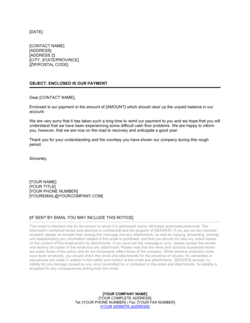
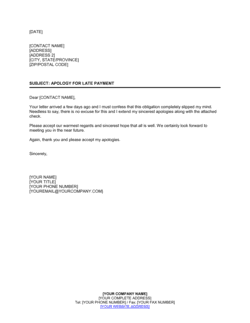
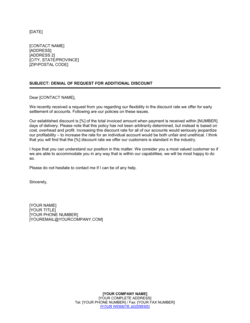
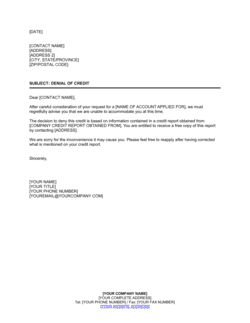
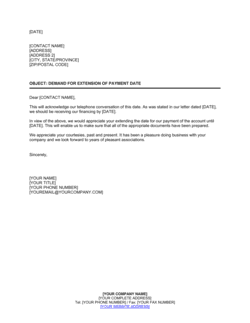
A Return of Late Payment and Denial of Discount is a formal business letter that notifies a customer or debtor that their payment was received after the agreed due date, that any early-payment or prompt-payment discount they attempted to claim is hereby denied, and that the full outstanding balance remains due. This free Word download is editable online and exports as PDF, giving creditors a professional, legally grounded communication they can send immediately when a short-paid or late-paid invoice arrives.
When you need it
Use it when a customer remits payment after the contractual due date while deducting an early-payment discount they were no longer entitled to claim, or when a payment arrives late and the creditor needs to formally document the breach of payment terms before escalating to collections or legal action.
What's inside
Identification of both parties and the original invoice, a clear statement that the payment was received late, an explicit denial of any discount claimed, the calculation of the remaining balance owed, a deadline for remitting the shortfall, and notice of applicable late charges or interest going forward.

What is a Return of Late Payment and Denial of Discount?

A Return of Late Payment and Denial of Discount is a formal written notice issued by a creditor to a debtor that serves two simultaneous legal purposes: it places the debtor on official record that their payment was received after the contractual due date, and it explicitly disallows any early-payment or prompt-payment discount the debtor deducted from the remittance. Unlike an informal reminder, this document identifies the specific invoice, restates the agreed payment terms, calculates the remaining balance with any accrued late-payment interest, sets a firm deadline for remittance of the shortfall, and preserves every legal remedy available to the creditor β€” from credit suspension to legal proceedings. It functions as the first enforceable link in a documented escalation chain and is admissible evidence of timely objection should the dispute reach a collections agency or court.

Why You Need This Document

When a customer short-pays an invoice by deducting an unearned discount, silence is the most expensive response a creditor can give. In many jurisdictions, repeatedly accepting short payments without written objection creates a course of dealing that effectively modifies your contractual payment terms β€” making it progressively harder to enforce them against the same customer in the future. Beyond the legal exposure, every uncontested deduction sets an internal precedent: accounts-payable departments at large buyers routinely apply early-pay discounts to all invoices regardless of timing, knowing that most vendors will not push back. This notice stops that pattern immediately by creating a written record that you identified the breach, calculated the shortfall precisely, and demanded cure by a specific date. For businesses operating on thin margins β€” distributors, manufacturers, service providers β€” the cumulative value of recovered discount amounts and late-payment interest across a year can be material. This template gives your AR team a professional, legally sound document they can issue in under 30 minutes, without waiting for legal counsel on every individual short-paid invoice.

Which variant fits your situation?

If your situation is…Use this template
Customer paid late but did not deduct a discount β€” only the late date mattersLate Payment Notice
Customer deducted a discount and the payment is also late β€” full enforcement neededReturn of Late Payment and Denial of Discount
Account is more than 60 days overdue and needs a formal collections warningCollections Demand Letter
Customer disputes the invoice amount entirely rather than just the discountInvoice Dispute Response Letter
Creditor needs to charge contractual interest on the overdue balanceLate Payment Interest Notice
Creditor is suspending future credit terms pending full paymentCredit Hold Notice
The shortfall has gone unresolved and legal action is imminentDemand for Payment Letter

Common mistakes to avoid

❌ Accepting short payments without formal objection

Why it matters: In many jurisdictions, repeatedly accepting discounted or late payments without written objection can constitute a course of dealing that modifies your contractual payment terms, making future enforcement much harder.

Fix: Send this notice every time a short or late payment is received, even if it is a small amount. Consistent written objection preserves your contractual rights.

❌ Omitting the exact receipt date of the payment

Why it matters: Without the precise receipt date, you cannot prove the payment arrived outside the discount window, and the debtor can claim the discount was legitimately earned.

Fix: Record the payment receipt date from your bank statement or payment system and state it explicitly in the confirmation-of-late-receipt clause.

❌ Stating an interest rate that exceeds the legal maximum

Why it matters: If the late-payment interest rate in your notice or underlying contract exceeds the usury ceiling or statutory cap in the applicable jurisdiction, a court may void the interest provision entirely β€” leaving you with no late-charge remedy.

Fix: Verify the maximum allowable late-interest or late-fee rate in the governing jurisdiction before completing the notice. In the US, this varies by state; in the UK, the Late Payment of Commercial Debts Act sets a statutory rate.

❌ Sending the notice to the wrong contact

Why it matters: A notice sent to a project manager or general inbox instead of accounts payable can sit unprocessed while your deadline passes, and the debtor may later argue they never received proper notice.

Fix: Confirm the accounts-payable contact name and email before sending, and send copies to both AP and the debtor's primary business contact.

❌ Failing to reserve rights explicitly

Why it matters: Sending a payment-dispute notice without a reservation-of-rights clause can be read as limiting the creditor to the remedies mentioned in the letter, potentially waiving the right to pursue collections or interest.

Fix: Include a standard reservation-of-rights paragraph in every notice, confirming that sending the letter does not waive any remedy available under the contract or at law.

❌ Providing no clear escalation timeline

Why it matters: A notice with no stated consequence for non-payment by the deadline is easily ignored β€” the debtor has no incentive to prioritize your balance over other payables.

Fix: State explicitly what happens if the deadline is missed: account placed on credit hold, referral to collections, or commencement of legal proceedings within a specified number of days.

The 9 key clauses, explained

Identification of Parties and Original Invoice

In plain language: Names the creditor and the debtor, references the specific invoice by number, date, and original amount, and establishes the factual record the letter is responding to.

Sample language
This notice is issued by [CREDITOR LEGAL NAME] ('Creditor') to [DEBTOR LEGAL NAME] ('Debtor') regarding Invoice No. [INVOICE NUMBER] dated [INVOICE DATE] in the original amount of [ORIGINAL INVOICE AMOUNT].

Common mistake: Referencing only the invoice number without stating the original amount. If the debtor disputes the balance, a vague reference makes the creditor's demand harder to substantiate.

Statement of Payment Terms

In plain language: Restates the contractual payment terms β€” due date, discount window, and discount percentage β€” that the debtor agreed to at the time of purchase or in the underlying contract.

Sample language
Pursuant to the terms agreed between the parties, payment was due in full by [DUE DATE]. An early-payment discount of [DISCOUNT PERCENTAGE]% was available only if payment was received on or before [DISCOUNT CUTOFF DATE].

Common mistake: Failing to cite the source of the payment terms β€” the purchase order, credit agreement, or invoice face. Without a reference, the debtor can claim the terms were never agreed.

Confirmation of Late Receipt

In plain language: Documents the date on which payment was actually received, establishing that it arrived after both the discount window and the payment due date.

Sample language
Payment in the amount of [AMOUNT REMITTED] was received by Creditor on [DATE RECEIVED], which is [NUMBER] days after the due date of [DUE DATE] and [NUMBER] days after the discount cutoff date of [DISCOUNT CUTOFF DATE].

Common mistake: Stating only that payment was 'late' without recording the exact receipt date. An exact date is required to calculate interest and to rebut any claim that payment was timely.

Denial of Discount

In plain language: Explicitly states that the early-payment discount deducted by the debtor is disallowed because the discount window had closed before payment was received.

Sample language
Because payment was not received within the discount period, the early-payment discount of [DISCOUNT PERCENTAGE]% ([DISCOUNT DOLLAR AMOUNT]) claimed by Debtor is hereby denied and disallowed in full.

Common mistake: Omitting the dollar amount of the denied discount. The debtor needs the exact figure to reconcile and remit the correct shortfall β€” a percentage alone invites further disputes.

Calculation of Outstanding Balance

In plain language: Shows the arithmetic clearly: original invoice total, less amount actually paid, plus any late-payment interest accrued to the date of the notice, equals the total balance now due.

Sample language
Original invoice amount: [ORIGINAL AMOUNT]. Amount received: [AMOUNT RECEIVED]. Unauthorized discount deducted: [DISCOUNT AMOUNT]. Late payment interest accrued at [RATE]% per month from [DUE DATE] to [NOTICE DATE]: [INTEREST AMOUNT]. Total balance now due: [TOTAL DUE].

Common mistake: Presenting only the shortfall without showing the full calculation. A debtor who cannot verify the arithmetic is more likely to dispute or delay rather than pay promptly.

Demand for Remittance and Payment Deadline

In plain language: Demands that the debtor remit the outstanding balance by a specific date and states the payment method or instructions to use.

Sample language
Debtor is hereby required to remit the outstanding balance of [TOTAL DUE] no later than [PAYMENT DEADLINE DATE] by [PAYMENT METHOD β€” bank transfer / check / online portal] to the account or address specified in Schedule A.

Common mistake: Setting a deadline without specifying the payment method or account details. This gives the debtor a procedural excuse β€” 'I didn't know how to pay' β€” that delays resolution further.

Notice of Continuing Late Charges

In plain language: States that interest or late fees will continue to accrue on the unpaid balance from the due date forward until full payment is received, at the rate set out in the contract or applicable statute.

Sample language
Interest will continue to accrue on the unpaid balance at the rate of [RATE]% per [month / annum] from [DUE DATE] until the date of full payment, pursuant to [CONTRACT REFERENCE / APPLICABLE STATUTE].

Common mistake: Citing only a contractual late-fee rate without checking whether the rate exceeds the statutory maximum in the applicable jurisdiction. An unlawfully high rate can void the late-fee provision entirely.

Reservation of Rights and Escalation Warning

In plain language: Preserves all of the creditor's legal remedies β€” including suspension of credit terms, referral to collections, and legal proceedings β€” without waiving any right by sending this notice.

Sample language
Creditor expressly reserves all rights and remedies available under the agreement and at law or equity, including the right to suspend credit privileges, refer the account to a collections agency, and commence legal proceedings to recover the outstanding balance plus costs.

Common mistake: Omitting the reservation of rights after sending prior notices. Courts have found in some jurisdictions that repeated acceptance of late payment without objection constitutes a waiver of the right to enforce payment terms.

Governing Law and Contact Information

In plain language: States which jurisdiction's law governs the notice and any resulting dispute, and provides the creditor's contact details for the debtor to respond or make payment arrangements.

Sample language
This notice is governed by the laws of [STATE / PROVINCE / COUNTRY]. For payment arrangements or to dispute this notice, contact [NAME], [TITLE], at [EMAIL] or [PHONE] within [X] business days of the date of this letter.

Common mistake: Omitting a response channel or contact for the debtor. A letter with no clear way to respond signals a one-way communication, which can escalate disputes rather than resolve them efficiently.

How to fill it out

  1. 1

    Enter both parties' full legal names and addresses

    Insert the creditor's registered legal name, business address, and contact information at the top, then the debtor's legal name and billing address below. Match the names exactly to the underlying contract or purchase order.

    πŸ’‘ Use the debtor's accounts-payable contact name in the salutation β€” addressed letters get processed faster than generic 'Dear Sir/Madam' communications.

  2. 2

    Reference the specific invoice

    Enter the invoice number, invoice date, and original invoice total. If multiple invoices are involved, list each separately in a schedule rather than lumping them together in the body.

    πŸ’‘ Attach a copy of the original invoice as an exhibit to eliminate any 'I never received it' defense.

  3. 3

    Restate the agreed payment terms

    Write out the exact payment terms β€” due date, discount percentage, and discount cutoff date β€” citing the contract, purchase order, or invoice face where those terms appear.

    πŸ’‘ If the terms are on the invoice face only, note that the debtor received the invoice and had the opportunity to review these terms before remitting payment.

  4. 4

    Record the actual receipt date of payment

    Enter the exact date the payment was credited to your account or received in your office β€” not the date on the debtor's check or the date they claim to have mailed it. Most payment-terms clocks run on receipt, not postmark.

    πŸ’‘ Bank confirmation timestamps or payment-portal records are the strongest evidence of receipt date if the debtor later disputes timing.

  5. 5

    Calculate and state the outstanding balance

    Complete the balance calculation section: original invoice amount minus amount received, plus the denied discount amount, plus any late-payment interest accrued to the notice date. Show each line separately.

    πŸ’‘ Double-check that your late-interest rate does not exceed the legal maximum in your jurisdiction before including it β€” overstating interest can undermine the entire demand.

  6. 6

    Set a clear payment deadline

    Insert a specific calendar date by which the shortfall must be received β€” typically 7 to 14 business days from the notice date β€” and specify the accepted payment methods and account details.

    πŸ’‘ Shorter deadlines (7 days) signal urgency and are appropriate when the account has a history of slow payment; 14 days is standard for a first notice.

  7. 7

    Sign and send by a documented method

    Have an authorized signatory sign the letter, then send it by a method that creates a delivery record β€” certified mail, courier with tracking, or email with read receipt β€” and retain a copy for your AR file.

    πŸ’‘ Send to both the debtor's accounts-payable email address and their physical billing address to maximize the chance of prompt receipt by the right contact.

  8. 8

    Log the notice in your AR system

    Record the notice date, the outstanding balance demanded, the payment deadline, and the delivery confirmation in your accounts-receivable system against the relevant invoice.

    πŸ’‘ A documented escalation trail β€” reminder, this notice, demand letter β€” strengthens any subsequent collections or legal action considerably.

Frequently asked questions

What is a return of late payment and denial of discount letter?

A return of late payment and denial of discount letter is a formal written notice from a creditor to a debtor stating that payment was received after the contractual due date and that any early-payment discount the debtor attempted to deduct is disallowed. It calculates the remaining balance owed, demands remittance by a specific date, and preserves the creditor's right to charge late-payment interest and pursue further remedies. It serves both as a collections tool and as a legally admissible record of the creditor's timely objection to the short payment.

When should I send this letter?

Send it as soon as you identify that a payment was received after the discount cutoff date or invoice due date and that the debtor deducted a discount they were no longer entitled to claim. The faster you send it, the stronger your position β€” delay can be interpreted as acceptance. In practice, most AR departments aim to send this notice within 3 to 5 business days of the late payment clearing the account.

Can a customer legally deduct an early-payment discount if they pay late?

No. An early-payment discount β€” such as 2/10 Net 30 β€” is a conditional benefit that expires if payment is not received within the specified window. Once the discount period closes, the full invoice amount is due. A debtor who deducts the discount after the cutoff has underpaid the invoice, and the creditor is entitled to demand the shortfall. Courts in most common-law jurisdictions have consistently held that the discount right is forfeited by late remittance.

Does sending this letter preserve my right to charge late-payment interest?

Yes, provided the letter references your contractual right to charge interest and includes a reservation-of-rights clause. If your contract specifies an interest rate for overdue balances, sending this notice formally activates that provision and documents the date from which interest is running. In jurisdictions with a statutory late-payment interest rate β€” such as the UK's Late Payment of Commercial Debts (Interest) Act 1998 β€” you are entitled to statutory interest even if your contract is silent on the rate.

What happens if the debtor ignores this letter?

If the debtor does not remit the outstanding balance by the stated deadline, your next steps typically include placing the account on credit hold, issuing a formal demand for payment, referring the debt to a collections agency, or commencing legal proceedings in the appropriate small-claims or civil court. This letter forms the first documented link in that escalation chain and demonstrates that you gave the debtor reasonable notice and an opportunity to cure before escalating.

Is this letter the same as a demand for payment?

No β€” they are related but distinct. This letter notifies the debtor that their payment was late and that the discount they took is denied, then demands payment of the shortfall. A formal demand for payment is typically used when the full invoice balance is overdue, often as a final step before legal action. This notice is generally sent earlier in the escalation sequence and is more specific to the discount-denial scenario.

Do I need a lawyer to send this letter?

For most standard B2B disputes involving a single short-paid invoice, a well-drafted template is sufficient. Consider involving a lawyer if the disputed amount is material (typically above $10,000), the debtor has responded with a counter-dispute, the debtor is in a jurisdiction with complex debt-recovery rules, or the underlying contract contains unusual payment terms that require legal interpretation.

Can I use this letter for consumer debts?

This template is designed for B2B (business-to-business) payment disputes. Consumer debt collection β€” where the debtor is an individual rather than a business β€” is governed by separate consumer-protection statutes in most jurisdictions (the FDCPA in the US, the Consumer Credit Act in the UK). Using a commercial collection notice for consumer debts may violate those statutes. Consult a lawyer before pursuing a consumer debtor with this document.

How many times should I send this type of notice before escalating?

Typically once. This letter is a first formal notice, not a series of reminders. If the debtor does not respond or pay by the stated deadline, escalate to a formal demand for payment or collections referral rather than re-sending the same notice. Repeated notices without escalation signal that the consequences are not real, which undermines your collections position.

How this compares to alternatives

vs Late Payment Notice

A late payment notice addresses only the timing breach β€” payment arrived after the due date. It does not address a discount that was incorrectly deducted. Use a late payment notice when the full invoice amount was paid but paid late. Use this template when a discount was taken in addition to or instead of a timely payment, since both the timing and the discount denial must be formally communicated in a single document.

vs Demand for Payment Letter

A demand for payment letter is used when the full invoice balance is entirely unpaid and typically represents a final step before legal action. This template is earlier in the escalation sequence and more specific: it addresses a partial payment scenario where the debtor remitted something but deducted an unearned discount. Send this notice first; escalate to a demand letter if the shortfall remains unpaid after the deadline.

vs Credit Note

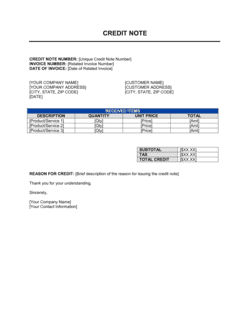
A credit note is issued by the creditor to reduce an invoice balance β€” for returns, errors, or agreed adjustments. This template is the opposite: it rejects a reduction the debtor took without authorization. A credit note is a voluntary concession; a return of late payment and denial of discount is an enforcement action. Confusing the two in your AR records can misstate revenue and create audit problems.

vs Invoice Dispute Response Letter

An invoice dispute response addresses a debtor who contests the validity of the charge itself β€” wrong amount, wrong goods, or missing deliverables. This template applies when the debtor does not dispute the invoice amount but has simply paid late and taken a discount they were not entitled to. The legal argument and tone differ significantly: one defends the debt's validity; the other enforces the payment terms.

Industry-specific considerations

Wholesale and Distribution

High-volume buyers routinely take 2/10 Net 30 discounts regardless of payment date; this notice is a standard AR tool for enforcing discount windows across large customer bases.

Professional Services

Law firms, consulting firms, and accounting practices use this notice to reclaim prompt-payment discounts deducted by corporate clients who process invoices through slow AP cycles.

Manufacturing

Component and parts suppliers face short-payment patterns from large OEM customers who routinely deduct early-pay discounts despite Net 45 or Net 60 remittances arriving late.

Retail and E-commerce

Vendors supplying retail chains encounter automatic deduction programs where buyers apply discount codes regardless of payment timing; this notice creates the paper trail needed to dispute chargebacks.

Jurisdictional notes

United States

Late-payment interest rates are governed by state law and vary significantly β€” California caps judgment interest at 10% per annum, while some states allow contractual rates up to 18–24% per annum. Always verify that the rate in your contract does not exceed the applicable state usury limit. The UCC governs many commercial sale-of-goods disputes and generally supports a seller's right to enforce stated payment terms.

Canada

In Canada, payment terms and the right to deny discounts are primarily governed by contract law as interpreted provincially. The federal Interest Act limits certain interest charges and requires annual-rate disclosure. Quebec's Civil Code applies different principles for B2B payment disputes than common-law provinces. Late-payment interest in commercial contracts is generally enforceable if clearly stated at the time of sale.

United Kingdom

The Late Payment of Commercial Debts (Interest) Act 1998 entitles B2B creditors to statutory interest at 8% above the Bank of England base rate on overdue invoices, even if the contract is silent on interest. The Prompt Payment Code encourages but does not legally mandate 30-day payment terms. Debt recovery proceedings for small commercial claims typically use the County Court Money Claims Centre, and a documented letter before action is generally required.

European Union

EU Directive 2011/7/EU on combating late payment in commercial transactions requires member states to allow creditors to charge interest at a minimum of 8 percentage points above the European Central Bank reference rate on overdue B2B invoices. Member states may apply stricter rules β€” Germany's BGB and France's Code de Commerce both contain specific late-payment interest provisions. Cross-border EU recovery can proceed through the European Payment Order procedure for undisputed claims.

Template vs lawyer β€” what fits your deal?

PathBest forCostTime
Use the templateB2B creditors handling a straightforward short-paid invoice where the discount window and receipt date are clearly documentedFree15–30 minutes
Template + legal reviewDisputes involving amounts above $5,000, repeat offenders, or contracts with non-standard payment terms$150–$400 for a one-hour lawyer review1–2 business days
Custom draftedMaterial disputes above $25,000, cross-border debtors, or situations where litigation is likely$500–$2,000+3–7 business days

Glossary

Early-Payment Discount
A percentage reduction off the invoice total offered to a buyer who pays within a specified accelerated window β€” for example, 2% if paid within 10 days under 2/10 Net 30 terms.
2/10 Net 30
A common payment term shorthand meaning the buyer may deduct 2% of the invoice total if payment is made within 10 days; the full amount is due within 30 days regardless.
Short Payment
A remittance in which the buyer pays less than the full invoiced amount β€” typically by deducting a discount, a chargeback, or an unauthorized offset.
Prompt-Payment Discount
Another name for an early-payment discount, used interchangeably in trade credit contexts; the discount is earned only if the payment clears by the stated cutoff date.
Discount Window
The specific number of days from invoice date during which a buyer is contractually entitled to deduct the agreed discount percentage.
Net Terms
The total number of days from invoice date by which full payment is due β€” e.g., Net 30 means the full balance is due 30 days after the invoice date.
Late Payment Interest
Contractual or statutory interest charged on overdue invoices, typically expressed as a monthly percentage rate β€” e.g., 1.5% per month β€” applied from the due date until the balance is paid in full.
Accounts Receivable (AR)
Money owed to a business by its customers for goods or services already delivered and invoiced but not yet paid.
Remittance Advice
A document or electronic notification sent by a buyer alongside a payment that identifies which invoices the payment covers and any deductions taken.
Credit Terms
The agreed conditions under which a seller extends credit to a buyer, including the payment due date, any available discounts, and the consequences of late or short payment.
Dunning
The systematic process of contacting a debtor through progressively firmer communications β€” reminder, notice, demand β€” to recover an overdue balance.
Part of your Business Operating System

This document is one of 3,000+ business & legal templates included in Business in a Box.

  • Fill-in-the-blanks β€” ready in minutes
  • 100% customizable Word document
  • Compatible with all office suites
  • Export to PDF and share electronically

Create your document in 3 simple steps.

From template to signed document β€” all inside one Business Operating System.
1
Download or open template

Access over 3,000+ business and legal templates for any business task, project or initiative.

2
Edit and fill in the blanks with AI

Customize your ready-made business document template and save it in the cloud.

3
Save, Share, Send, Sign

Share your files and folders with your team. Create a space of seamless collaboration.

Save time, save money, and create top-quality documents.

β˜…β˜…β˜…β˜…β˜…

"Fantastic value! I'm not sure how I'd do without it. It's worth its weight in gold and paid back for itself many times."

Managing Director Β· Mall Farm
Robert Whalley
Managing Director, Mall Farm Proprietary Limited
β˜…β˜…β˜…β˜…β˜…

"I have been using Business in a Box for years. It has been the most useful source of templates I have encountered. I recommend it to anyone."

Business Owner Β· 4+ years
Dr Michael John Freestone
Business Owner
β˜…β˜…β˜…β˜…β˜…

"It has been a life saver so many times I have lost count. Business in a Box has saved me so much time and as you know, time is money."

Owner Β· Upstate Web
David G. Moore Jr.
Owner, Upstate Web

Run your business with a system β€” not scattered tools

Stop downloading documents. Start operating with clarity. Business in a Box gives you the Business Operating System used by over 250,000 companies worldwide to structure, run, and grow their business.

Start freeΒ Β·Β No credit card required