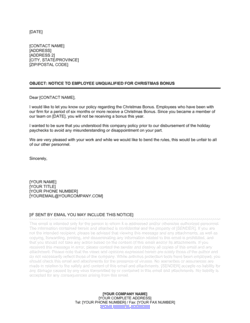
Notice to Employees of Unsatisfactory Behavior Template

Free Word download β€’ Edit online β€’ Save & share with Drive β€’ Export to PDF

1 pageβ€’15–25 min to fillβ€’Difficulty: Standard
Learn more ↓
FreeNotice to Employees of Unsatisfactory Behavior Template

At a glance

What it is
A Notice to Employees of Unsatisfactory Behavior is a formal written communication from an employer to an employee documenting a specific instance of misconduct, poor conduct, or a policy violation. This free Word download gives managers a ready-to-edit letter they can complete, print, and deliver in under 15 minutes β€” creating a clear, dated record of the issue and the corrective action expected.
When you need it
Use it when an employee's behavior β€” such as repeated tardiness, disrespectful conduct toward colleagues, or violation of a workplace policy β€” needs to be formally addressed in writing after a verbal warning has not resolved the issue, or when the severity of the incident warrants skipping straight to a written notice.
What's inside
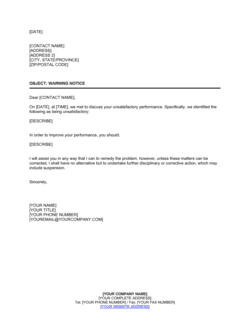
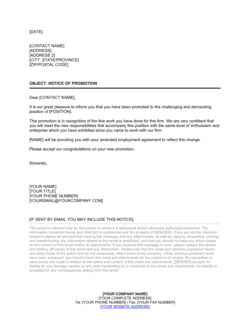
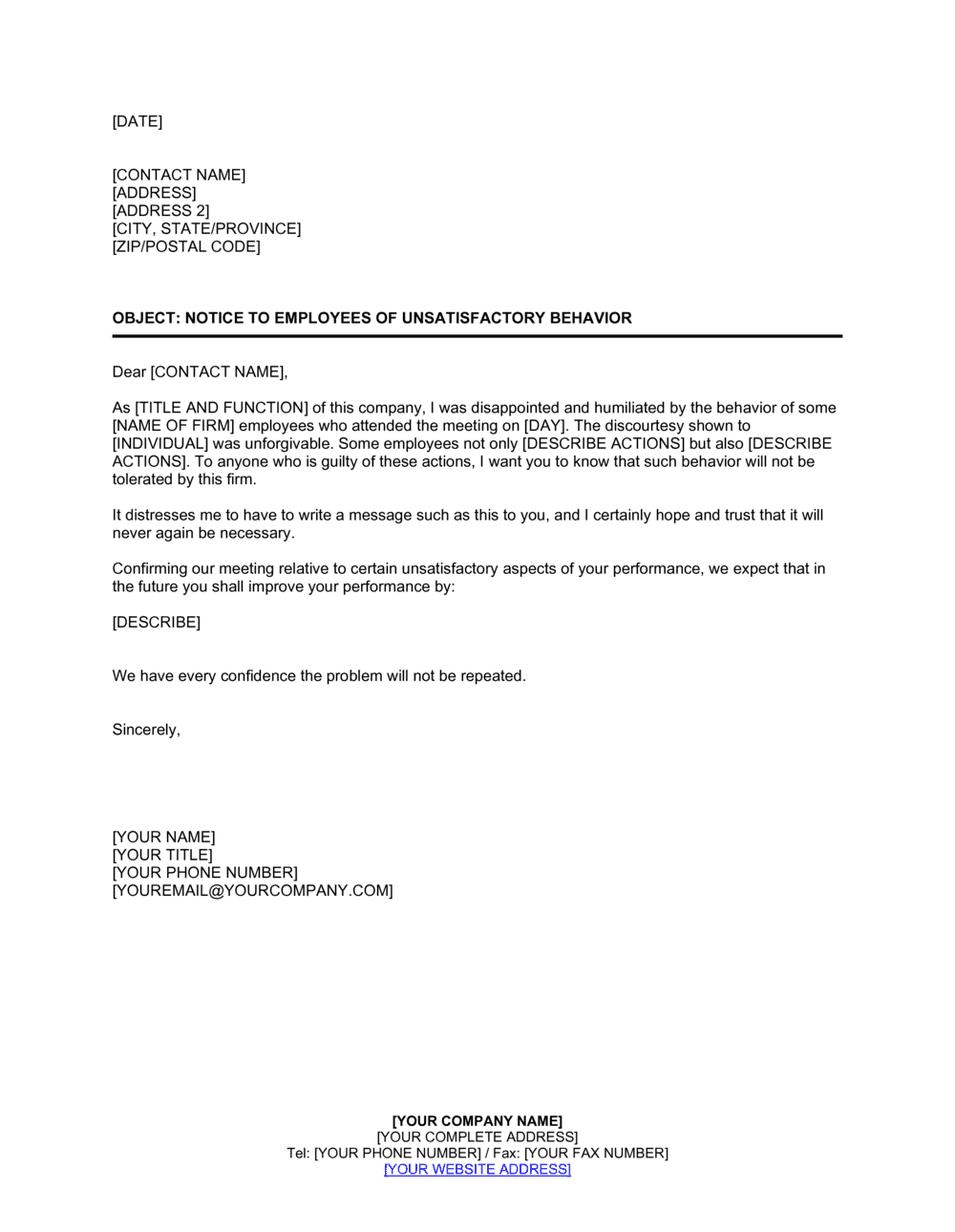
The letter covers the employee's details and the date of the notice, a factual description of the specific behavior observed, reference to the policy or standard violated, the corrective action required, and the consequences of continued noncompliance. It is written in a direct, professional tone designed to inform rather than antagonize.

What is a Notice to Employees of Unsatisfactory Behavior?

A Notice to Employees of Unsatisfactory Behavior is a formal written letter issued by an employer to an employee documenting a specific incident of misconduct or a violation of workplace policy. It describes the behavior factually, identifies the company standard or policy that was breached, states the corrective action required, and warns of consequences if the behavior continues or recurs. Unlike a verbal warning, this notice creates a dated, signed record in the employee's HR file that can support further disciplinary steps β€” including termination β€” if the situation escalates.

Why You Need This Document

Handling conduct issues informally β€” through conversation alone β€” leaves employers with no paper trail when a situation escalates to termination or a legal dispute. Employment tribunals and courts consistently ask whether the employer communicated expectations clearly, gave the employee a fair opportunity to correct the behavior, and followed a consistent process. A written notice answers all three questions at once. Without it, even a well-founded termination can be challenged successfully. This template gives managers a structured, professionally worded starting point so that every formal notice your business issues is factually grounded, policy-anchored, and legally defensible β€” regardless of whether you have a dedicated HR team.

Which variant fits your situation?

If your situation is…Use this template
First incident of minor misconduct following a verbal warningNotice to Employees of Unsatisfactory Behavior
Second or third offense requiring escalation within a discipline processFinal Written Warning Letter
Persistent or severe attendance and punctuality problemsEmployee Warning Letter for Attendance
Performance deficiencies rather than behavioral misconductPerformance Improvement Plan
Gross misconduct or policy breach requiring immediate formal actionEmployee Termination Letter
Informal coaching prior to any written noticeVerbal Warning Documentation Form

Common mistakes to avoid

❌ Using subjective or emotional language

Why it matters: Phrases like 'your attitude is unacceptable' or 'you were disrespectful as always' are opinion-based and easy to dispute β€” they shift focus from the behavior to a perceived personal attack.

Fix: Replace every subjective characterization with a specific, observable action: what the employee said, did, or failed to do, at a specific time and place.

❌ Omitting the policy or standard violated

Why it matters: Without a written standard to anchor the notice, the employee can argue the expectation was never communicated β€” and a tribunal or court may agree.

Fix: Always cite the specific handbook section, code of conduct clause, or documented workplace standard that the behavior breached.

❌ Issuing the notice without a prior documented verbal warning

Why it matters: Skipping steps in a progressive discipline process can expose the employer to claims of unfair treatment, particularly if the employee is in a protected class or jurisdiction with strong employee protections.

Fix: Follow your policy's discipline ladder. If the incident warrants bypassing verbal warning, document the reason explicitly in the notice: 'Due to the severity of this incident, this written notice is issued without a prior verbal warning.'

❌ Filing the notice without getting a signed receipt

Why it matters: An unsigned notice is difficult to prove was delivered β€” the employee can deny receipt, negating the documentation trail entirely if the matter escalates to termination or litigation.

Fix: Always include an acknowledgment line, obtain the employee's signature or a witness attestation if they refuse, and keep a copy in the employee's HR file.

The 9 key clauses, explained

Header and recipient details

In plain language: States the employee's full name, job title, department, and the date of the notice β€” establishing an unambiguous record of who received it and when.

Sample language
Date: [DATE] | To: [EMPLOYEE FULL NAME], [JOB TITLE], [DEPARTMENT] | From: [MANAGER NAME], [MANAGER TITLE]

Common mistake: Using only the employee's first name or nickname. If the notice ends up in a legal file, an informal address creates unnecessary ambiguity about which employee is referenced.

Subject line

In plain language: A brief, direct subject line that identifies this as a formal notice of unsatisfactory behavior rather than a general communication.

Sample language
Subject: Formal Notice of Unsatisfactory Behavior β€” [DATE OF INCIDENT]

Common mistake: Using a vague subject like 'Important HR Matter.' A clear subject line signals the letter's purpose from the outset and removes any later claim that the employee did not understand its seriousness.

Opening statement of purpose

In plain language: The first paragraph states plainly that the letter is a formal notice and identifies the nature of the behavioral issue without yet providing full detail.

Sample language
This letter serves as a formal written notice regarding your conduct on [DATE OF INCIDENT], which did not meet the standards of behavior expected of employees at [COMPANY NAME].

Common mistake: Opening with an apology or hedging language such as 'We regret to inform you.' This undermines the authority of the notice and can later be interpreted as reluctance on the employer's part.

Description of the specific behavior

In plain language: A factual, objective account of exactly what occurred β€” including date, time, location, and any witnesses β€” without editorial commentary or assumptions about intent.

Sample language
On [DATE] at approximately [TIME], in [LOCATION], you [DESCRIPTION OF BEHAVIOR]. This incident was observed by [WITNESS NAME / TITLE] and is documented in [SOURCE, if applicable].

Common mistake: Using subjective language like 'you had a bad attitude' instead of describing specific observable actions. Vague characterizations are difficult to defend and easy for the employee to dispute.

Policy or standard violated

In plain language: Identifies the specific company policy, handbook section, or workplace standard that the behavior breached, giving the notice a concrete anchor beyond the manager's personal judgment.

Sample language
Your conduct on this occasion is in violation of Section [X] of the [COMPANY NAME] Employee Handbook, which states: '[POLICY LANGUAGE].'

Common mistake: Omitting any policy reference entirely. A notice that relies solely on a manager's opinion rather than a written standard is far harder to defend if the employee files a complaint or legal challenge.

Reference to prior warnings or incidents

In plain language: Notes any previous verbal or written warnings related to the same or similar behavior, establishing a pattern and demonstrating that the employee has been given prior notice.

Sample language
This follows a verbal warning issued on [DATE] by [MANAGER NAME] regarding [RELATED BEHAVIOR]. A record of that discussion is on file.

Common mistake: Referencing prior warnings that were never documented. If a verbal warning was not recorded at the time, avoid claiming it occurred β€” the omission creates more credibility risk than simply treating this as a first notice.

Required corrective action and timeline

In plain language: States clearly what the employee must do differently, by when, and what support or resources the employer is providing β€” turning the notice into an actionable directive rather than a reprimand alone.

Sample language
Effective immediately, you are required to [SPECIFIC BEHAVIOR CHANGE]. Progress will be reviewed on [DATE]. The company will provide [SUPPORT / RESOURCE] to assist you in meeting this expectation.

Common mistake: Stating only what the employee must stop doing without defining what acceptable behavior looks like. Employees need a positive behavioral target, not just a prohibition.

Consequences of continued noncompliance

In plain language: Clearly states what will happen if the behavior continues or recurs β€” typically escalation to a final written warning, suspension, or termination β€” so the employee understands the stakes.

Sample language
Failure to meet the expectations outlined above may result in further disciplinary action, up to and including termination of employment, in accordance with [COMPANY NAME] policy.

Common mistake: Threatening consequences the company is not actually prepared to follow through on. If you state 'immediate termination' as a consequence but the company's policy requires a final warning first, the notice undermines your own process.

Acknowledgment and signature block

In plain language: A brief closing paragraph inviting the employee to discuss the notice, followed by a signature line for the issuing manager and an acknowledgment line for the employee.

Sample language
Please sign below to acknowledge receipt of this notice. Your signature indicates receipt only and does not necessarily indicate agreement with its contents. If you wish to discuss this matter, please contact [HR CONTACT / MANAGER NAME] at [CONTACT DETAILS].

Common mistake: Omitting the acknowledgment line entirely and simply handing over the letter. Without a signed or dated receipt, the employee can later claim they never received it β€” eliminating the documentation trail entirely.

How to fill it out

  1. 1

    Complete the header with full, accurate details

    Enter the employee's full legal name, job title, department, the date of the notice, and your name and title as the issuing manager. Cross-check spelling against the employee's HR file.

    πŸ’‘ Use the date the notice is delivered, not the date of the incident β€” these are often different, and misdating the notice creates timeline confusion.

  2. 2

    Write a factual description of the incident

    Describe the specific behavior using observable facts: date, time, location, what was said or done, and any witnesses. Avoid interpretive language, adjectives about character, or assumptions about motive.

    πŸ’‘ Apply the 'security camera' test β€” if a camera had recorded the incident, would your description match the footage? If not, revise until it would.

  3. 3

    Cite the specific policy or standard violated

    Open the employee handbook or code of conduct and identify the exact section number and language that applies to the behavior. Paste or paraphrase it directly into the notice.

    πŸ’‘ If no written policy covers the behavior, reference the general workplace conduct standard and add a note to update the handbook β€” issuing the notice without any standard anchor is still better than not issuing one.

  4. 4

    Note any prior warnings or related incidents

    If a verbal or prior written warning was issued for the same or similar conduct, reference it with the date and the manager who issued it. Confirm the prior record is on file before referencing it.

    πŸ’‘ Never reference a verbal warning that was not documented at the time β€” it creates a credibility gap that the employee can exploit.

  5. 5

    State the required corrective action clearly

    Define the specific behavioral change expected, give a timeline for improvement, and note any support the company will provide. Make the standard concrete enough that both parties can later agree on whether it was met.

    πŸ’‘ Phrases like 'improve your attitude' are unenforceable. Use specific, observable actions: 'Arrive at your scheduled start time of 8:00 a.m. on all working days.'

  6. 6

    State the consequences of noncompliance

    Reference the next step in your progressive discipline process β€” final written warning, suspension, or termination β€” and confirm this is consistent with your company's actual policy before including it.

    πŸ’‘ Match the severity of the consequence to your company's documented discipline ladder. Overstating consequences you cannot legally deliver weakens your position in any later dispute.

  7. 7

    Deliver the notice and obtain acknowledgment

    Deliver the notice in person where possible, with an HR representative or second manager present as a witness. Ask the employee to sign the acknowledgment line and provide them with a copy.

    πŸ’‘ If the employee refuses to sign, note 'Employee declined to sign β€” delivered in person on [DATE] in the presence of [WITNESS NAME]' on the employer's copy before filing it.

Frequently asked questions

What is a notice to employees of unsatisfactory behavior?

A notice to employees of unsatisfactory behavior is a formal written letter from an employer to an employee documenting a specific incident of misconduct or a violation of workplace policy. It describes the behavior factually, identifies the standard that was breached, states what corrective action is required, and warns of consequences if the behavior continues. It is typically used as part of a progressive discipline process.

When should I issue a written notice rather than a verbal warning?

Issue a written notice when a verbal warning has already been given and the behavior has not improved, when the severity of the incident warrants immediate formal documentation, or when your company policy specifies written notice for certain categories of misconduct. Written notices are also appropriate when you need a clear, dated record for your HR file before considering further disciplinary action.

Does the employee have to sign the notice?

The employee's signature on the acknowledgment line confirms receipt only β€” it does not mean they agree with the notice's contents. If an employee refuses to sign, note the refusal on the employer's copy along with the delivery date and the name of any witness present, then file it. The refusal itself does not invalidate the notice.

Can a notice of unsatisfactory behavior be used as evidence in a termination dispute?

Yes β€” a properly dated and factually written notice is one of the most useful pieces of documentation in a termination dispute. It demonstrates that the employer identified the issue, communicated expectations clearly, and gave the employee an opportunity to correct the behavior before any termination decision was made. Courts and employment tribunals look favorably on employers who followed a documented, consistent process.

What is the difference between a notice of unsatisfactory behavior and a performance improvement plan?

A behavior notice addresses a specific conduct issue β€” tardiness, policy violation, disrespectful conduct β€” and is typically a shorter, more immediate document. A performance improvement plan (PIP) addresses ongoing performance deficiencies β€” output quality, productivity, skill gaps β€” with a structured 30- to 90-day improvement program. Some employees receive both: a notice for a conduct incident and a concurrent PIP for underlying performance issues.

How many written notices should I issue before terminating an employee?

Most progressive discipline policies involve one to two written notices before a final warning, with termination as the last step. The right number depends on your company's documented policy, the severity of the conduct, and the jurisdiction. For gross misconduct β€” violence, theft, serious harassment β€” a single notice (or none) before termination is often defensible. For minor recurring issues, two to three documented steps are standard practice before termination.

Should I have HR present when delivering a behavior notice?

Having an HR representative or a second manager present when delivering a written notice is strongly recommended. It provides a witness to the delivery, reduces the likelihood of a heated confrontation, and demonstrates that the process was handled professionally. If HR is not available, a second manager or department lead can serve the same function.

What should I do if the employee denies the behavior described in the notice?

Allow the employee to provide their account in writing if they wish β€” this is good practice and, in some jurisdictions, a procedural requirement. File their response alongside the notice in the HR file. The notice itself does not require the employee's agreement to be valid; it requires only that it was delivered and that the facts it contains were documented accurately and in good faith.

How this compares to alternatives

vs Performance Improvement Plan

A performance improvement plan addresses ongoing gaps in output, skill, or productivity over a 30- to 90-day structured period. A behavior notice addresses a specific conduct incident and is typically a shorter, immediate document. Use a notice for conduct; use a PIP for performance. Both can run concurrently when an employee has issues in both areas.

vs Employee Termination Letter

A termination letter formally ends the employment relationship after a decision has been made. A behavior notice is issued earlier in the discipline process to give the employee an opportunity to correct the problem before termination is considered. Issuing a notice before a termination letter strengthens the employer's documented record significantly.

vs Verbal Warning Documentation Form

A verbal warning documentation form records an informal spoken conversation about a conduct issue β€” it is the first step in a progressive discipline ladder and is not delivered to the employee. A written behavior notice is a formal document delivered to the employee, and it carries more weight in any subsequent disciplinary or legal proceeding.

vs Employee Disciplinary Action Form

A disciplinary action form is an internal HR checklist or record used to log discipline decisions and approvals within the organization. A notice to employees of unsatisfactory behavior is the outward-facing document delivered directly to the employee. Both should be completed and filed together for any formal discipline incident.

Industry-specific considerations

Retail and hospitality

High staff turnover and customer-facing roles make consistent written documentation of conduct issues essential for defending termination decisions.

Construction and trades

Safety-related behavioral violations β€” ignoring PPE requirements, verbal aggression on site β€” require immediate written notice given the direct link to liability and regulatory compliance.

Healthcare

Conduct affecting patient safety or dignity demands a formal written record aligned to both HR policy and any professional licensing body's standards of practice.

Professional services

Client-facing misconduct β€” inappropriate communication, breach of confidentiality protocols β€” must be documented in writing to protect the firm's professional reputation and client relationships.

Template vs pro β€” what fits your needs?

PathBest forCostTime
Use the templateManagers and small business owners handling standard conduct issues with a documented company policy in placeFree10–15 minutes per notice
Template + professional reviewNotices involving protected-class employees, unionized workplaces, or conduct that may precede termination$100–$300 for an HR consultant or employment lawyer review1–2 business days
Custom draftedComplex misconduct cases involving potential legal claims, regulatory investigations, or senior executives$500–$1,500+ for employment counsel2–5 business days

Glossary

Progressive Discipline
A structured HR process that applies increasingly serious corrective steps β€” verbal warning, written notice, final warning, termination β€” proportionate to repeated or escalating misconduct.
Written Notice
A formal letter delivered to an employee documenting a specific policy violation or behavioral issue and stating the expected corrective action.
Misconduct
A specific action or pattern of behavior by an employee that violates a workplace policy, code of conduct, or reasonable standard of professional behavior.
Corrective Action
The specific change in behavior or performance an employer requires from the employee, stated clearly and with a defined timeline.
Acknowledgment of Receipt
A line or section at the bottom of a notice where the employee signs or initials to confirm they received and read the document β€” not necessarily that they agree with it.
At-Will Employment
An employment arrangement in the US where either party may end the relationship at any time for any lawful reason β€” written notices help document the record before any termination decision.
Code of Conduct
A company's written set of behavioral standards and expectations that employees are required to follow, often referenced in a behavior notice.
Documentation Trail
A chronological file of written records β€” notices, performance reviews, disciplinary letters β€” that supports an employer's decision-making and provides evidence if a termination is later disputed.
Probationary Period
A defined initial employment window β€” typically 30–90 days β€” during which behavior and performance are closely evaluated and disciplinary standards may differ.
HR File
The employer's confidential record of an employee's employment history, including performance reviews, disciplinary notices, and compensation changes.

Part of your Business Operating System

This document is one of 3,000+ business & legal templates included in Business in a Box.

  • Fill-in-the-blanks β€” ready in minutes
  • 100% customizable Word document
  • Compatible with all office suites
  • Export to PDF and share electronically

Create your document in 3 simple steps.

From template to signed document β€” all inside one Business Operating System.
1
Download or open template

Access over 3,000+ business and legal templates for any business task, project or initiative.

2
Edit and fill in the blanks with AI

Customize your ready-made business document template and save it in the cloud.

3
Save, Share, Send, Sign

Share your files and folders with your team. Create a space of seamless collaboration.

Save time, save money, and create top-quality documents.

β˜…β˜…β˜…β˜…β˜…

"Fantastic value! I'm not sure how I'd do without it. It's worth its weight in gold and paid back for itself many times."

Managing Director Β· Mall Farm
Robert Whalley
Managing Director, Mall Farm Proprietary Limited
β˜…β˜…β˜…β˜…β˜…

"I have been using Business in a Box for years. It has been the most useful source of templates I have encountered. I recommend it to anyone."

Business Owner Β· 4+ years
Dr Michael John Freestone
Business Owner
β˜…β˜…β˜…β˜…β˜…

"It has been a life saver so many times I have lost count. Business in a Box has saved me so much time and as you know, time is money."

Owner Β· Upstate Web
David G. Moore Jr.
Owner, Upstate Web

Run your business with a system β€” not scattered tools

Stop downloading documents. Start operating with clarity. Business in a Box gives you the Business Operating System used by over 250,000 companies worldwide to structure, run, and grow their business.

Start freeΒ Β·Β No credit card required