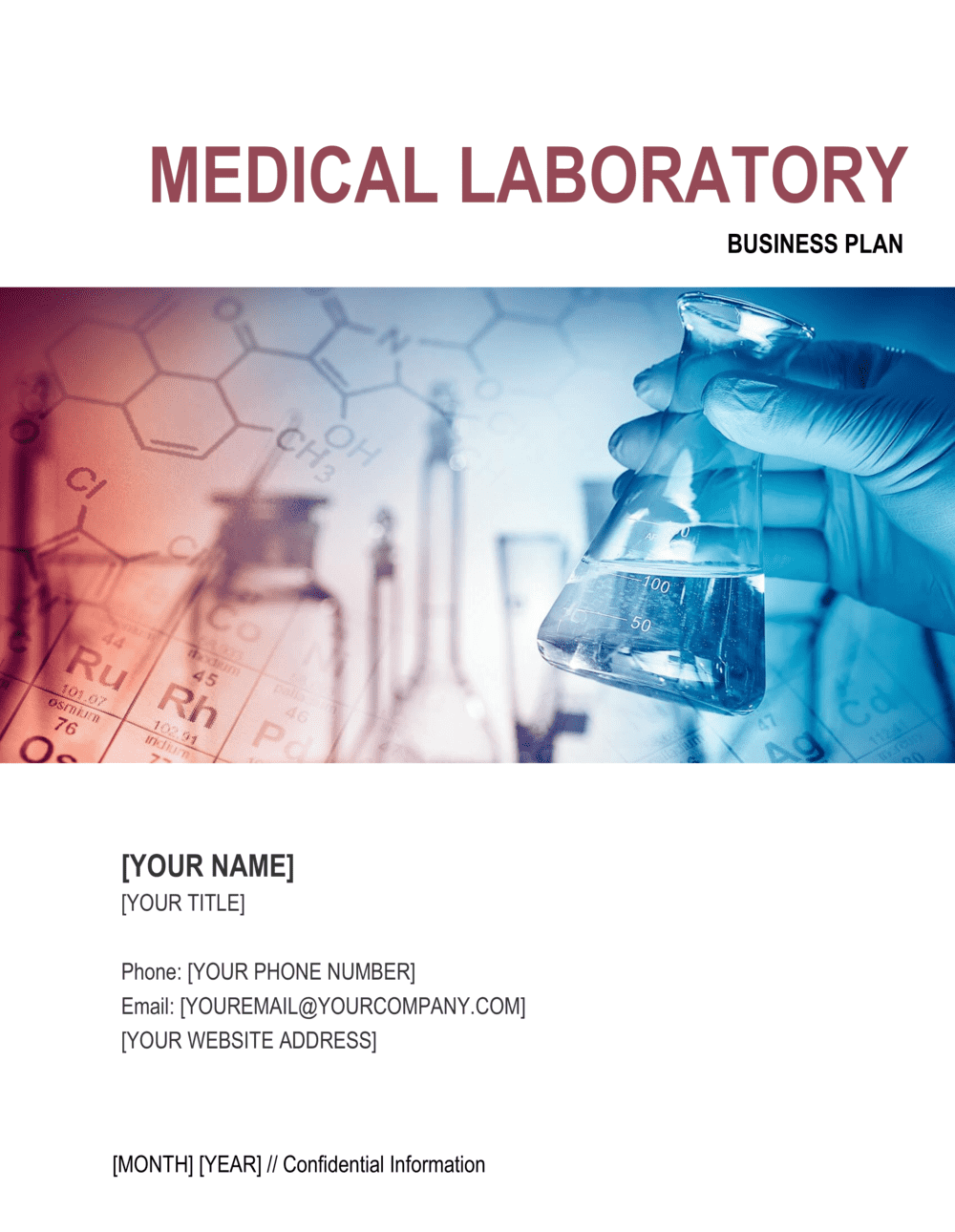
Medical Laboratory Business Plan Template

Free Word download β€’ Edit online β€’ Save & share with Drive β€’ Export to PDF

34 pagesβ€’2h 50m – 3h 50m to fillβ€’Difficulty: Expert
Learn more ↓
FreeMedical Laboratory Business Plan Template

At a glance

What it is
A Medical Laboratory Business Plan is a structured document that maps the clinical, operational, and financial blueprint for launching or expanding a diagnostic or pathology lab. This free Word download gives you a sector-specific framework covering accreditation strategy, test menu, equipment, staffing, reimbursement model, and 3–5 year financial projections β€” ready to edit online and export as PDF for investors, lenders, or regulatory reviewers.
When you need it
Use it when applying for CLIA certification, raising capital to open a new laboratory, presenting an expansion to a hospital board, or securing an SBA loan for equipment and build-out. It is also used when adding a laboratory service line to an existing healthcare practice.
What's inside
Executive summary, laboratory concept and service menu, market and competitive analysis, regulatory and accreditation plan, operations and equipment plan, staffing and quality management, marketing and referral strategy, and three-statement financial projections including equipment financing schedules and reimbursement rate assumptions.

What is a Medical Laboratory Business Plan?

A Medical Laboratory Business Plan is a sector-specific planning document that defines the clinical, regulatory, operational, and financial blueprint for launching or expanding a diagnostic laboratory. Unlike a general business plan, it addresses the requirements unique to clinical testing environments: CLIA certification strategy, test menu design with CPT codes and reimbursement rates, CLIA-mandated personnel roles, instrumentation and reagent cost modeling, payer-mix revenue projections, and accounts-receivable timing. It functions simultaneously as an internal operating roadmap and an external document for presenting to SBA lenders, healthcare investors, hospital boards, or accreditation bodies.

Why You Need This Document

Without a laboratory-specific business plan, lenders will not process a capital application, accreditation bodies have no regulatory timeline to evaluate, and investors cannot assess whether the projected revenue is grounded in actual Medicare and commercial reimbursement rates. Generic business plans omit the cost drivers that make or break a lab's economics β€” reagent minimums, send-out fees, director contracts, and the 60–90 day insurance payment lag that creates cash insolvency even in technically profitable labs. A completed medical laboratory business plan forces you to resolve those variables before spending capital, and gives every external stakeholder the specific, verifiable information they need to move forward. This template provides the structure to do that work in one document, ready for editing in Word and export as PDF.

Which variant fits your situation?

If your situation is…Use this template
Launching a full-service reference laboratoryMedical Laboratory Business Plan
Opening a single-specialty pathology or cytology labPathology Laboratory Business Plan
Adding an in-office lab to an existing medical practiceMedical Practice Business Plan
Launching a mobile phlebotomy or specimen collection serviceMobile Healthcare Business Plan
Opening a direct-to-consumer wellness testing labHealth and Wellness Business Plan
Seeking SBA financing for equipment and lab build-outBank Loan Business Plan
Presenting a hospital lab expansion to a boardHealthcare Strategic Plan

Common mistakes to avoid

❌ Underestimating the regulatory timeline

Why it matters: CLIA certification plus state licensure plus CAP accreditation can take 6–12 months. A business plan that projects a 60-day regulatory runway will burn through capital before the first specimen is processed.

Fix: Map every regulatory step to a calendar with realistic processing times from CMS and your state agency, then add a 30-day buffer to each milestone.

❌ Using a single blended reimbursement rate without a payer-mix breakdown

Why it matters: Medicare CLFS rates for common panels can be 40–60% lower than commercial rates. A plan built on an optimistic blended rate will overstate revenue and produce a cash flow shortfall within the first year.

Fix: Build a payer-mix table with the percentage of volume from Medicare, Medicaid, commercial, and self-pay, and apply the applicable rate to each. Pull Medicare rates directly from the current CMS Clinical Laboratory Fee Schedule.

❌ Omitting reagent rental minimums from the cost model

Why it matters: Instruments placed under reagent rental agreements carry monthly reagent purchase minimums. At low specimen volumes, cost-per-reportable can exceed reimbursement per test, creating a negative gross margin on individual panels.

Fix: Request the full contract terms β€” including monthly minimums and per-test reagent costs β€” from every vendor before finalizing the equipment plan, and model cost-per-reportable at 50%, 75%, and 100% of projected volume.

❌ No working capital reserve for accounts-receivable lag

Why it matters: Clinical labs bill after testing, and payers take 30–90 days to reimburse. A lab that reaches accession breakeven in Month 6 may still be cash-insolvent in Month 9 without a receivables bridge.

Fix: Include at least 90 days of projected operating expenses as a working capital reserve in the funding requirements, and model monthly cash flow separately from the P&L to identify the cash trough.

❌ Building the test menu around available equipment, not physician demand

Why it matters: Purchasing a high-complexity molecular analyzer without confirming that local physicians actively order those tests results in expensive idle capacity and reagent minimum penalties.

Fix: Conduct a physician-need assessment with five to ten potential referring providers before finalizing the test menu, then select instrumentation that matches confirmed demand.

❌ Treating the laboratory director as a formality rather than a budgeted cost

Why it matters: CLIA requires a qualified laboratory director for all moderate and high-complexity labs. Contracted director fees typically run $2,000–$8,000 per month β€” excluding this from the P&L produces materially incorrect operating cost projections.

Fix: Get a written fee proposal from your proposed laboratory director before completing the financial model and include it as a fixed monthly contracted-services expense.

The 9 key sections, explained

Executive Summary

Laboratory Concept and Service Menu

Market and Competitive Analysis

Regulatory and Accreditation Plan

Facility and Equipment Plan

Staffing and Quality Management

Marketing, Sales, and Referral Strategy

Financial Projections

Funding Requirements and Use of Funds

How to fill it out

  1. 1

    Define the laboratory type and test menu

    Specify your CLIA certificate category (waived, moderate complexity, or high complexity) and list the test panels you intend to offer. Group tests by clinical category β€” chemistry, hematology, microbiology, molecular β€” and flag any tests that will initially be sent out.

    πŸ’‘ Survey three to five potential referring physicians before finalizing the test menu. Their top five unmet testing needs should anchor your launch menu.

  2. 2

    Build the regulatory and accreditation timeline

    Map every required permit, license, and inspection to a calendar. Include CLIA application, state laboratory licensure, chosen accreditation body inspection, and any specialty permits. Identify the critical path item that determines your earliest opening date.

    πŸ’‘ Add a 30-day buffer to every regulatory milestone. Inspectors reschedule; paperwork gets returned for correction. Build the delay in before it surprises you.

  3. 3

    Develop the local market analysis

    Estimate monthly outpatient specimen volume in your target geography using physician density data, hospital discharge statistics, and insurer enrollment figures. Identify the two to three competing labs by name with their TATs and known weaknesses.

    πŸ’‘ Your county health department and state hospital association often publish utilization data that can anchor your bottom-up volume estimate.

  4. 4

    Complete the facility and equipment plan

    Detail the laboratory square footage, layout by functional zone, and each major instrument with its acquisition method (purchase, capital lease, or reagent rental). Include the LIS and any middleware in the technology section.

    πŸ’‘ Request reagent rental proposals from at least two analyzer vendors before finalizing the equipment plan β€” terms vary significantly and affect your cost-per-reportable at low volume.

  5. 5

    Build the staffing plan by CLIA role

    List every required position with CLIA-defined role title, FTE or contracted status, estimated annual compensation, and hire date relative to opening. Include the laboratory director fee as a separate contracted-services line.

    πŸ’‘ Verify that your proposed laboratory director meets the CLIA personnel qualifications for your certificate level before finalizing β€” a director who does not qualify will trigger a citation on your first inspection.

  6. 6

    Model the financial projections from specimen volume up

    Build your P&L starting from a monthly accession ramp, then multiply by blended reimbursement per accession using a payer-mix table. Derive cost of goods (reagents, controls, send-outs) as a percentage of revenue, then layer in fixed operating costs by category.

    πŸ’‘ Download the current Medicare Clinical Laboratory Fee Schedule from CMS.gov and use it as your Medicare rate floor β€” commercial contracts are typically negotiated at a multiplier of CLFS.

  7. 7

    State the funding ask with specific milestones

    Specify the total capital required, the proposed instrument (SBA 7(a) loan, equipment lease, equity, or a combination), and the milestones each tranche funds β€” regulatory approval, equipment delivery, staff hire, first patient specimen, and EBITDA breakeven.

    πŸ’‘ SBA lenders require a minimum of two years of projected financials and personal financial statements from all owners with 20% or more equity β€” prepare these before approaching a bank.

  8. 8

    Write the executive summary last

    Once every section is complete, distill the plan into a 1–2 page summary covering the lab concept, market opportunity, regulatory pathway, team, financial highlights, and funding ask.

    πŸ’‘ If a lender or investor reads only the executive summary and the financial projections, they should have enough information to schedule a follow-up meeting. If those two sections cannot stand alone, the plan needs more work.

Frequently asked questions

What is a medical laboratory business plan?

A medical laboratory business plan is a structured document that defines the clinical concept, regulatory pathway, operational model, staffing structure, and financial projections for a new or expanding diagnostic laboratory. It covers the specific requirements of the lab sector β€” CLIA certification, accreditation, test menu, payer mix, and reimbursement modeling β€” that a generic business plan template does not address. Investors, SBA lenders, and hospital boards require it before committing capital to a lab project.

What certifications does a medical laboratory need to open?

In the United States, any laboratory that tests human specimens for clinical purposes must hold a CLIA certificate issued by CMS, categorized by test complexity: waived, moderate, or high. Most full-service labs also pursue voluntary accreditation through CAP, COLA, or a state accreditation body, which satisfies CLIA requirements and is often required for hospital and commercial insurance contracts. State laboratory licensure requirements vary β€” some states require a separate state license in addition to CLIA certification.

How long does it take to open a medical laboratory?

From initial planning to first patient specimen, most new clinical laboratories take 9–18 months. CLIA application processing runs 8–12 weeks; state licensure inspections add further time depending on the state; CAP accreditation inspections are typically scheduled 3–6 months after an application is submitted. Facility build-out, equipment installation and validation, and staff hiring run in parallel. A plan that projects a 90-day opening is almost always unrealistic.

How much does it cost to start a medical laboratory?

Startup costs for a moderate-complexity clinical laboratory typically range from $200,000 to $500,000, covering leasehold improvements, instrumentation, LIS software, regulatory fees, initial reagent inventory, and working capital to fund the accounts-receivable lag. High-complexity molecular or specialty labs can exceed $1,000,000 in initial capital requirements. The largest variables are equipment acquisition strategy (reagent rental vs. purchase) and the build-out condition of the chosen facility.

What financial projections should a medical lab business plan include?

A complete financial section includes a monthly P&L for Year 1 and annual projections for Years 2–5, a monthly cash flow statement that models accounts-receivable lag separately from the P&L, a projected balance sheet, and a use-of-funds schedule. The model should be built from a monthly accession volume ramp multiplied by a payer-mix table using current Medicare CLFS rates and estimated commercial contract rates, with cost of goods derived from per-test reagent costs and monthly send-out expenses.

What is a CLIA certificate and how does it affect the business plan?

A CLIA certificate is a federal license issued by CMS that authorizes a laboratory to test human specimens. The certificate level β€” waived, moderate complexity, or high complexity β€” determines personnel qualification requirements, quality control obligations, and proficiency testing enrollment. The business plan must specify the intended CLIA complexity level because it directly drives staffing costs, personnel qualifications, regulatory timeline, and operating procedures throughout the document.

How do I estimate revenue for a new medical laboratory?

Revenue is best modeled from specimen volume multiplied by blended reimbursement per accession. Build a monthly accession ramp based on the number of signed referral accounts, average requisitions per account per month, and tests per requisition. Then apply a payer-mix table β€” the percentage of volume from Medicare, Medicaid, commercial insurance, and self-pay β€” and multiply each segment by the applicable reimbursement rate. Medicare rates are publicly available on the CMS Clinical Laboratory Fee Schedule; commercial rates are typically 120–200% of Medicare for most routine panels.

Do I need a laboratory director before writing the business plan?

You do not need a signed laboratory director agreement to write the plan, but you should have a confirmed candidate and a written fee proposal before finalizing the financial projections. CLIA requires a qualified laboratory director for all moderate and high-complexity laboratories, and director fees are a material fixed cost β€” typically $2,000–$8,000 per month for contracted arrangements. A plan that omits this line item or uses an unrealistic figure will have a credibility problem with any sophisticated reviewer.

How is a medical laboratory business plan different from a general business plan?

A standard business plan covers market, competitive positioning, team, and financials. A medical laboratory business plan adds a regulatory and accreditation roadmap (CLIA, CAP, state licensure), a test menu with CPT codes and reimbursement rates, a CLIA-role staffing structure, equipment plans with reagent rental analysis, a payer-mix revenue model using the Clinical Laboratory Fee Schedule, and a working capital model that accounts for insurance accounts-receivable lag. These sector-specific elements cannot be adequately covered by a generic business plan template.

Can I use this template for a specialty laboratory such as toxicology or genetics?

Yes. The template structure applies to any laboratory type β€” clinical chemistry, toxicology, molecular diagnostics, genetics, pathology, or microbiology. Specialty labs should adapt the test menu, regulatory section (adding DEA registration for toxicology or CAP molecular pathology checklist for genetics), and equipment plan to reflect their specific instrumentation and workflow. The financial modeling framework β€” accession ramp, payer mix, cost-per-reportable β€” applies equally across all laboratory disciplines.

How this compares to alternatives

vs Medical Practice Business Plan

A medical practice business plan focuses on clinical service delivery, provider credentialing, patient volume, and billing for physician services. A medical laboratory business plan adds CLIA certification, test menu design, equipment and reagent modeling, and reimbursement rates from the Clinical Laboratory Fee Schedule. Use the medical practice plan when the lab is an ancillary add-on; use this template when the laboratory is the primary business.

vs General Business Plan

A general business plan template covers market, competition, team, and financials without sector-specific structure. It lacks CLIA regulatory timelines, CPT-based revenue modeling, payer-mix tables, and personnel qualification requirements. A medical laboratory cannot present a credible plan to a healthcare lender or accreditation body using a generic template.

vs Health and Wellness Center Business Plan

A health and wellness center business plan covers retail health services, memberships, and consumer wellness programs. It is not designed for regulated clinical testing environments. A medical laboratory business plan is required when the business involves CLIA-regulated specimen testing, insurance billing, and physician referral relationships.

vs Strategic Plan

A strategic plan is an internal roadmap for goal-setting and resource allocation within an existing organization. A medical laboratory business plan is an external-facing capital-raising and regulatory document that establishes the full operational and financial case for a new or expanding lab. Existing labs typically need both: the business plan to raise capital, and the strategic plan to execute against annual milestones.

Industry-specific considerations

Healthcare / Clinical Diagnostics

Reference and independent clinical laboratories use this plan to secure CLIA certification, negotiate payer contracts, and present to SBA lenders or private equity with a reimbursement-based revenue model.

Hospital and Health Systems

Hospital laboratory directors use it to present a new testing department or outreach laboratory expansion to a board, including cost-per-reportable analysis and breakeven volume thresholds.

Physician Practices and Ambulatory Care

Multi-specialty and primary care practices use it to evaluate the financial feasibility of adding an in-office moderate-complexity laboratory for ancillary revenue generation.

Biotechnology and Life Sciences

Biotech and genomics companies launching a CLIA-certified laboratory services division use it to define the clinical operations model alongside their research and development strategy.

Template vs pro β€” what fits your needs?

PathBest forCostTime
Use the templateFounders and practice owners planning a single-site clinical lab seeking SBA financing or initial investor conversationsFree3–5 weeks (50–80 hours)
Template + professional reviewLabs with complex payer negotiations, multi-site expansion, or high-complexity molecular testing requiring financial model validation$1,000–$3,000 for a healthcare financial consultant or lab operations advisor4–6 weeks
Custom draftedInstitutional investors, private equity acquisitions, or hospital-system laboratory expansions above $2M in capital requirements$5,000–$15,000 for a healthcare business plan consultancy6–10 weeks

Glossary

CLIA (Clinical Laboratory Improvement Amendments)
US federal regulations under which all laboratories testing human specimens must be certified, categorized by test complexity: waived, moderate, or high.
CAP Accreditation
Voluntary accreditation by the College of American Pathologists that is recognized by CMS as meeting CLIA requirements and is widely required by hospital and insurance contracts.
Test Menu
The defined catalog of diagnostic tests a laboratory offers, organized by clinical category such as hematology, chemistry, microbiology, or molecular diagnostics.
CPT Code
Current Procedural Terminology code assigned to each laboratory test, used to bill Medicare, Medicaid, and private insurers for reimbursement.
Reimbursement Rate
The amount a payer β€” Medicare, Medicaid, or a commercial insurer β€” pays the laboratory per test, typically set by the Clinical Laboratory Fee Schedule (CLFS) or negotiated contracts.
LIS (Laboratory Information System)
Software that manages specimen tracking, test ordering, result reporting, quality control data, and billing workflows within a laboratory.
TAT (Turnaround Time)
The elapsed time from specimen receipt to verified result delivery β€” a key operational metric and competitive differentiator for clinical labs.
Send-Out Test
A test a laboratory cannot perform in-house and routes to a reference laboratory, incurring a pass-through cost that affects gross margin.
Revenue per Accession
Total laboratory revenue divided by the number of specimens processed β€” a unit-economics metric used to benchmark lab efficiency and pricing.
Quality Management System (QMS)
The documented set of policies, procedures, and controls a laboratory uses to ensure test accuracy, regulatory compliance, and continuous improvement.
Proficiency Testing (PT)
A mandatory CLIA program in which laboratories test externally provided unknown samples and submit results to demonstrate ongoing accuracy.
Payer Mix
The proportion of a laboratory's revenue derived from each payment source β€” Medicare, Medicaid, commercial insurance, and self-pay β€” which directly drives average reimbursement and cash-flow timing.

Part of your Business Operating System

This document is one of 3,000+ business & legal templates included in Business in a Box.

  • Fill-in-the-blanks β€” ready in minutes
  • 100% customizable Word document
  • Compatible with all office suites
  • Export to PDF and share electronically

Create your document in 3 simple steps.

From template to signed document β€” all inside one Business Operating System.
1
Download or open template

Access over 3,000+ business and legal templates for any business task, project or initiative.

2
Edit and fill in the blanks with AI

Customize your ready-made business document template and save it in the cloud.

3
Save, Share, Send, Sign

Share your files and folders with your team. Create a space of seamless collaboration.

Save time, save money, and create top-quality documents.

β˜…β˜…β˜…β˜…β˜…

"Fantastic value! I'm not sure how I'd do without it. It's worth its weight in gold and paid back for itself many times."

Managing Director Β· Mall Farm
Robert Whalley
Managing Director, Mall Farm Proprietary Limited
β˜…β˜…β˜…β˜…β˜…

"I have been using Business in a Box for years. It has been the most useful source of templates I have encountered. I recommend it to anyone."

Business Owner Β· 4+ years
Dr Michael John Freestone
Business Owner
β˜…β˜…β˜…β˜…β˜…

"It has been a life saver so many times I have lost count. Business in a Box has saved me so much time and as you know, time is money."

Owner Β· Upstate Web
David G. Moore Jr.
Owner, Upstate Web

Run your business with a system β€” not scattered tools

Stop downloading documents. Start operating with clarity. Business in a Box gives you the Business Operating System used by over 250,000 companies worldwide to structure, run, and grow their business.

Start freeΒ Β·Β No credit card required