Manager Evaluation Template

Free Word download β€’ Edit online β€’ Save & share with Drive β€’ Export to PDF

3 pagesβ€’25–30 min to fillβ€’Difficulty: Standardβ€’Signature requiredβ€’Legal review recommended
Learn more ↓
FreeManager Evaluation Template

At a glance

What it is
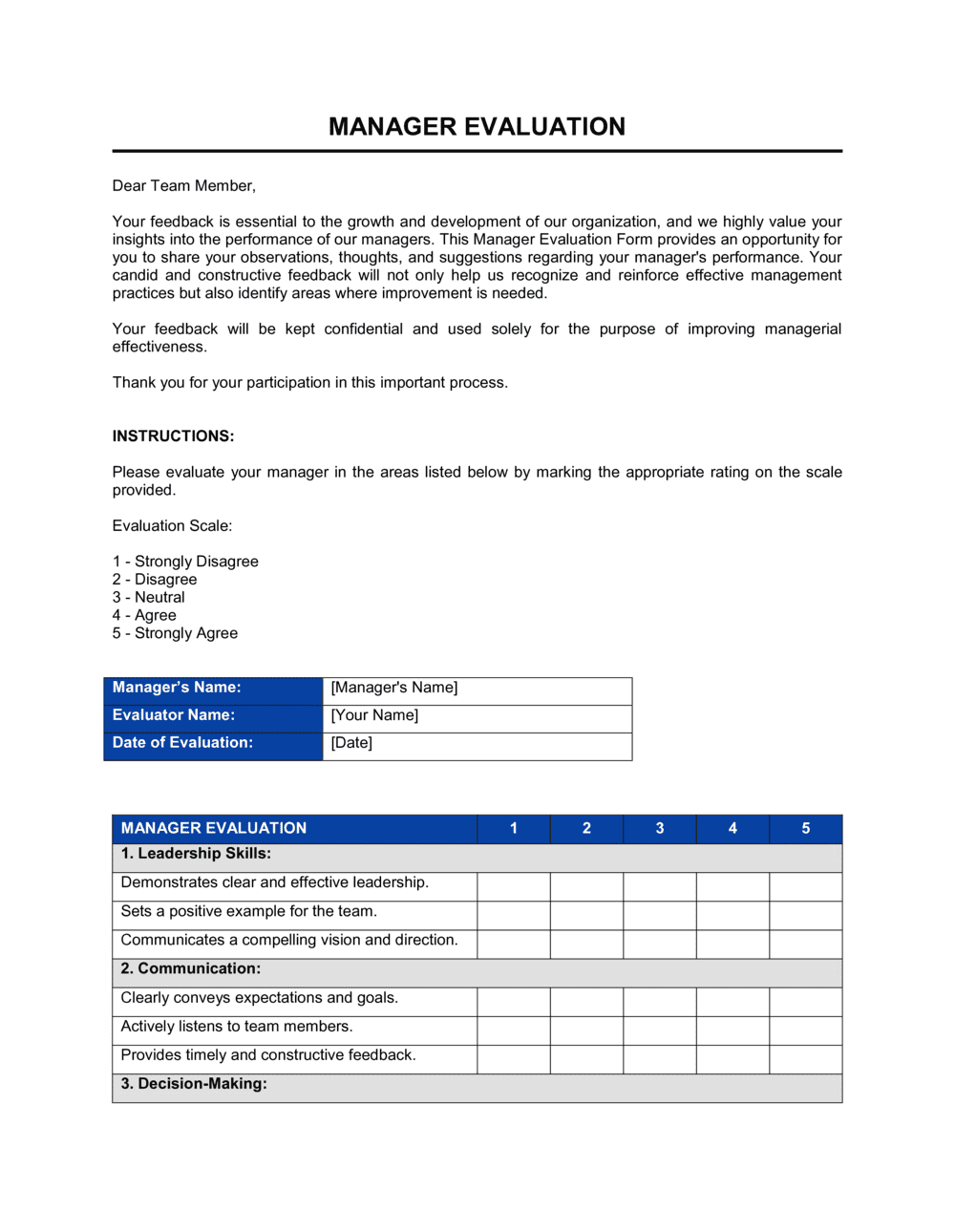
A Manager Evaluation is a formal written assessment document used by organizations to measure a manager's performance against defined competencies, leadership behaviors, and role-specific objectives. This template is a free Word download you can edit online and export as PDF β€” covering goal achievement, team leadership, communication, decision-making, and development planning in a structured, legally defensible format.
When you need it
Use it during annual or mid-year performance cycles, before a promotion or compensation review decision, or when documenting performance concerns that may support a demotion or disciplinary action. A signed evaluation creates a formal record that protects both the employer and the manager being assessed.
What's inside
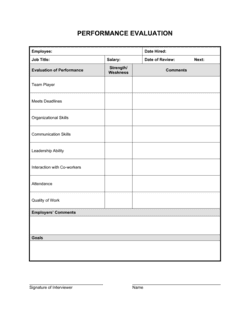
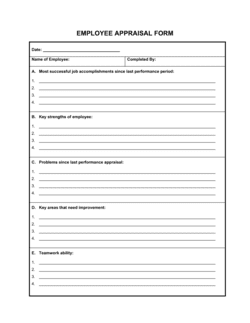
Evaluator and manager details, review period, performance ratings against competencies, goal achievement summary, leadership and team management assessment, areas for development, overall performance rating, and signatures from both the reviewer and the manager acknowledging receipt.

What is a Manager Evaluation?

A Manager Evaluation is a formal written performance assessment document used by organizations to measure a manager's effectiveness against defined competencies, goal outcomes, and leadership behaviors over a specified review period. It records structured ratings with behavioral evidence, documents areas for development with a concrete action plan, and is signed by both the evaluating party and the manager being assessed. Unlike an informal check-in or verbal feedback session, a completed and signed manager evaluation creates a legally defensible performance record that forms part of the employee's personnel file and can support or defend employment decisions ranging from promotions and compensation adjustments to disciplinary actions and terminations.

Why You Need This Document

Without a formal written manager evaluation, performance conversations exist only in memory β€” and memory is unreliable, inconsistent, and inadmissible. When a promotion is contested, a demotion is challenged, or a termination escalates to an employment tribunal or court, the first document every employment lawyer and adjudicator asks for is the performance record. Organizations that cannot produce signed, evidence-based evaluations covering the period in question routinely face wrongful dismissal and discrimination claims they cannot defend, regardless of the underlying merit. Beyond legal exposure, evaluations without behavioral specifics or consistent rating standards produce compensation and promotion decisions that erode trust and trigger regrettable attrition among high performers who see subjective outcomes rewarded. This template gives you a structured, jurisdiction-aware framework that produces evaluations credible enough to survive legal challenge and substantive enough to actually improve manager performance.

Which variant fits your situation?

If your situation is…Use this template
Evaluating a manager's performance across a full annual cycleAnnual Manager Evaluation
Assessing a new manager at the end of a 90-day probationary periodProbationary Period Review
Collecting upward feedback from direct reports about their manager360-Degree Employee Feedback Form
Documenting a formal performance improvement process for a managerPerformance Improvement Plan
Evaluating an employee below management levelEmployee Evaluation Form
Reviewing a manager's performance mid-year against set targetsMid-Year Performance Review
Assessing an executive or C-suite leader's strategic performanceExecutive Performance Review

Common mistakes to avoid

❌ Rating without documented behavioral evidence

Why it matters: Ratings unsupported by specific examples are the primary basis for successful unfair appraisal claims. A court or tribunal will ask for the evidence behind every rating.

Fix: For each competency rating, record at least one specific observed behavior with a date, context, and outcome before finalizing the evaluation.

❌ Giving identical ratings to avoid difficult conversations

Why it matters: Rating inflation β€” where everyone receives 'Meets Expectations' β€” defeats the purpose of the evaluation and creates legal exposure when a termination or demotion contradicts a pattern of positive reviews.

Fix: Use your pre-defined rating definitions as the standard, not the anticipated reaction. If a manager's performance was below expectations, the written record must reflect that.

❌ Omitting the manager's response section

Why it matters: In several jurisdictions, denying an employee the formal right to respond to a performance evaluation can weaken or void the document's evidentiary value in an employment dispute.

Fix: Always include a dedicated comments and acknowledgment section for the manager being reviewed, and allow at least 48 hours after sharing the draft for them to prepare a written response.

❌ Making binding compensation commitments in the evaluation form

Why it matters: Language like 'Manager will receive a 10% raise effective July 1' in a signed evaluation can be treated as a contractual commitment independent of the formal compensation approval process.

Fix: Reference compensation adjustments by category only β€” 'merit increase commensurate with overall rating' β€” and process specific amounts through a separate approval workflow.

❌ Using the same evaluation form for all management levels

Why it matters: A team lead and a VP have fundamentally different scope of responsibility. Applying identical competency criteria produces ratings that are neither accurate nor legally defensible for either role.

Fix: Maintain at least two versions of the evaluation form β€” one for frontline managers and one for senior or strategic leaders β€” with competency criteria calibrated to the actual scope of each level.

❌ Filing the evaluation without collecting acknowledgment signatures

Why it matters: An unsigned evaluation cannot prove it was communicated to the manager, which is a prerequisite for using it as a foundation for a disciplinary action, demotion, or termination.

Fix: Collect signatures from both the evaluator and the manager before filing. If the manager refuses to sign, note the refusal in writing and have a witness countersign.

The 10 key clauses, explained

Parties and review period

In plain language: Identifies the manager being evaluated, the evaluator or reviewer, their respective roles and departments, and the exact dates the review period covers.

Sample language
This Manager Evaluation documents the performance of [MANAGER FULL NAME], [JOB TITLE], [DEPARTMENT], for the review period from [START DATE] to [END DATE], as assessed by [EVALUATOR NAME], [EVALUATOR TITLE].

Common mistake: Using a generic date like 'FY 2025' without specifying exact start and end dates. Ambiguous periods create disputes about which goals and incidents fall inside the review window.

Performance rating scale and definitions

In plain language: Sets out the scoring system used throughout the evaluation and defines what each rating level means in plain language, so the manager understands the standard being applied.

Sample language
Performance is rated on a 5-point scale: 1 β€” Below Expectations (performance consistently falls short of defined role requirements); 3 β€” Meets Expectations (performance reliably meets role requirements); 5 β€” Exceptional (performance significantly and consistently exceeds role requirements).

Common mistake: Omitting definitions for each rating level and leaving the scale open to subjective interpretation. Undefined scales produce inconsistent ratings that are difficult to defend in a legal challenge.

Goal achievement summary

In plain language: Documents the specific goals or objectives set at the start of the review period, the manager's actual results against each goal, and the resulting rating.

Sample language
Goal 1: Reduce team attrition rate from [X]% to [Y]% by [DATE]. Result: Attrition reached [Z]% as of [DATE]. Rating: [RATING]. Supporting evidence: [DESCRIPTION OF EVIDENCE].

Common mistake: Listing goals without documenting supporting evidence for the outcome rating. Unsupported ratings are the most common basis for successful unfair appraisal complaints.

Leadership and team management competencies

In plain language: Evaluates the manager's effectiveness in areas such as team development, delegation, conflict resolution, and creating a productive team environment.

Sample language
Leadership Effectiveness Rating: [RATING]. Comments: [MANAGER NAME] [DEMONSTRATED / DID NOT DEMONSTRATE] effective delegation by [SPECIFIC EXAMPLE]. Team engagement score for their department in [PERIOD]: [SCORE] vs. company average of [SCORE].

Common mistake: Using vague praise or criticism like 'good with people' or 'needs to communicate better' without a specific, observed behavioral example to support each rating.

Communication and stakeholder management

In plain language: Assesses how effectively the manager communicates upward to leadership, laterally to peers, and downward to their team, including clarity, timeliness, and professional impact.

Sample language
Communication Rating: [RATING]. Comments: During [PROJECT / PERIOD], [MANAGER NAME] [EXAMPLE OF COMMUNICATION BEHAVIOR β€” e.g., 'proactively escalated the budget overrun risk to the VP of Finance two weeks before the deadline, enabling a revised plan'].

Common mistake: Rating communication only on style β€” 'good presenter' β€” rather than on documented outcomes and impact, which are far more defensible if contested.

Decision-making and problem-solving

In plain language: Documents the manager's ability to make timely, well-reasoned decisions, manage risk, and resolve operational or people-related problems effectively.

Sample language
Decision-Making Rating: [RATING]. Supporting observations: [MANAGER NAME] resolved the [ISSUE] in [TIMEFRAME] by [ACTION TAKEN], resulting in [OUTCOME]. This [MEETS / EXCEEDS / FALLS SHORT OF] the expected standard for a [TITLE] role.

Common mistake: Conflating outcome quality with decision quality. A good decision with a bad outcome β€” or vice versa β€” should be evaluated based on the quality of the reasoning and process, not just the result.

Development areas and action plan

In plain language: Identifies the two to four specific competencies or behaviors where the manager needs to improve, with a concrete action plan, resources, and a timeline for each.

Sample language
Development Area 1: [COMPETENCY]. Action: [MANAGER NAME] will complete [SPECIFIC ACTION β€” e.g., 'a structured coaching program on financial management'] by [DATE]. Progress will be reviewed at the [NEXT REVIEW DATE / CHECKPOINT].

Common mistake: Listing development areas without a concrete action plan or timeline. Vague development goals are not actionable and cannot serve as a baseline for a future performance improvement plan if needed.

Overall performance rating and recommendation

In plain language: States the aggregate performance rating for the review period and documents any formal recommendation β€” continuation, promotion, compensation adjustment, or performance improvement plan.

Sample language
Overall Rating: [RATING / SCORE]. Based on this evaluation, the Company recommends: [PROMOTION TO / MERIT INCREASE OF / CONTINUATION IN / PERFORMANCE IMPROVEMENT PLAN FOR] [MANAGER NAME], effective [DATE], subject to [CONDITIONS IF ANY].

Common mistake: Making a compensation or promotion recommendation in the evaluation without a formal approval process in place. An unsigned recommendation can be treated as a binding commitment by a court.

Manager's response and comments

In plain language: Provides a designated section for the manager being evaluated to record their own comments, areas of agreement or disagreement, and any context they wish to add to the record.

Sample language
Manager's Comments (optional): [MANAGER NAME] acknowledges receipt of this evaluation and provides the following response: [MANAGER'S COMMENTS]. Manager's Signature: ___________ Date: ___________

Common mistake: Omitting the manager's response section entirely. In several jurisdictions, failing to give an employee the opportunity to respond to a formal performance assessment can undermine the document's legal standing.

Signatures and date of acknowledgment

In plain language: Captures signatures from both the evaluating manager or HR representative and the manager being reviewed, confirming the evaluation was conducted and received β€” not that the subject agrees with it.

Sample language
Evaluator Signature: ___________ Date: ___________ | Manager Acknowledged: ___________ Date: ___________ | HR Representative (if applicable): ___________ Date: ___________

Common mistake: Using a single signature line that implies the manager's signature indicates agreement with the evaluation. This can be used to argue the evaluation was not communicated or was disputed β€” always use separate acknowledgment and agreement blocks.

How to fill it out

  1. 1

    Enter party details and the review period

    Record the manager's full legal name, job title, department, and employment start date. Enter the evaluator's name and title. Set an exact start and end date for the review period β€” not a fiscal year label.

    πŸ’‘ Confirm the manager's current job title against your HRIS before entering it. A mismatch between the evaluation and payroll records creates administrative complexity during any subsequent employment action.

  2. 2

    Define and document the rating scale

    Select a rating scale β€” typically 1–5 or a descriptive four-level scale β€” and record the definition of each level directly in the form. Ensure the same scale is used for every competency section.

    πŸ’‘ Run a calibration session with peer evaluators before filling in ratings to ensure consistent interpretation of each level across departments.

  3. 3

    Complete the goal achievement section with evidence

    For each goal set at the start of the period, enter the original target, the actual result, a rating, and a brief description of supporting evidence β€” metrics, project outcomes, or documented observations.

    πŸ’‘ Pull data from your HR system, project tracking tool, or quarterly check-in notes rather than relying on memory. Specific numbers replace subjective impressions and make the evaluation much harder to dispute.

  4. 4

    Rate each leadership competency with a behavioral example

    Work through each competency β€” leadership, communication, decision-making β€” assigning a rating and recording at least one specific, observed behavioral example for each. Use the STAR format: Situation, Task, Action, Result.

    πŸ’‘ If you cannot recall a specific example for a competency, check your one-on-one meeting notes or performance journals from the review period before assigning a rating.

  5. 5

    Write the development action plan

    Identify two to four areas for growth and write a concrete action for each β€” a course, a stretch assignment, a coaching engagement β€” with a specific completion date and a checkpoint for measuring progress.

    πŸ’‘ Frame development areas as skills to build rather than failures to correct. Language like 'expand financial reporting capability' produces better outcomes and fewer legal risks than 'fails to understand the numbers.'

  6. 6

    Record the overall rating and formal recommendation

    Enter the aggregate performance rating and document any associated recommendation β€” merit increase, promotion, continuation, or performance improvement plan. Ensure the recommendation language is conditional on formal approval where required.

    πŸ’‘ Do not enter a specific salary figure in the evaluation form. Reference only the percentage or band adjustment, and process the dollar amount through a separate compensation action form requiring leadership sign-off.

  7. 7

    Conduct the review meeting and collect signatures

    Share the draft evaluation with the manager at least 48 hours before the review meeting so they can prepare a response. After the discussion, collect signatures from both the evaluator and the manager being reviewed.

    πŸ’‘ Send the evaluation via a tracked delivery method β€” Business in a Box eSign, email with read receipt, or a physical acknowledgment form β€” so you have a timestamped record of delivery.

  8. 8

    File the signed evaluation and schedule the next review

    Store the fully signed evaluation in the employee's personnel file and your HR system. Immediately schedule the next formal review date or a development checkpoint, and document the agreed development actions in your task management system.

    πŸ’‘ Set a calendar reminder 30 days before the next review period opens to begin gathering performance notes. Real-time documentation eliminates recency bias and cuts preparation time by half.

Frequently asked questions

What is a manager evaluation?

A manager evaluation is a formal written document used to assess a manager's performance against defined competencies, goals, and leadership behaviors over a specific review period. It records ratings with supporting evidence, documents development areas and action plans, and is signed by both the evaluator and the manager being reviewed. When properly completed, it creates a legally defensible performance record that supports promotion, compensation, disciplinary, and termination decisions.

Why does a manager evaluation need to be signed?

Signatures confirm that the evaluation was conducted, communicated, and received by the manager being reviewed. Without signed acknowledgment, an employer cannot demonstrate that formal performance feedback was given β€” a prerequisite for defending disciplinary actions or terminations in most jurisdictions. The manager's signature does not indicate agreement with the contents; it confirms receipt.

What competencies should a manager evaluation cover?

A complete manager evaluation typically covers goal achievement, leadership and team development, communication (upward, lateral, and downward), decision-making and problem-solving, operational execution, and people management. Senior leaders are also assessed on strategic thinking, stakeholder management, and organizational impact. The specific competencies should align with the role level and the company's leadership framework.

How is a manager evaluation different from an employee performance review?

A manager evaluation includes all standard performance dimensions but adds leadership-specific competencies β€” team development, delegation, conflict resolution, and people management β€” that are not applicable to individual contributors. It also typically includes team-level metrics such as engagement scores and attrition rates as evidence of leadership effectiveness. The evidentiary standard is higher because manager evaluations more frequently underpin consequential employment decisions.

Can a manager evaluation be used in a termination or demotion proceeding?

Yes, and this is one of its primary legal functions. A signed evaluation documenting below-expectations performance with specific behavioral evidence forms part of the documentation trail supporting a termination or demotion decision. In most jurisdictions, a single evaluation is insufficient β€” employers are expected to show a pattern of documented performance concerns over multiple review periods, ideally combined with a performance improvement plan.

What rating scale should I use for a manager evaluation?

The most common scales are a 5-point numeric scale (1–5) or a four-level descriptive scale (Below Expectations, Meets Expectations, Exceeds Expectations, Exceptional). Either works provided each level is defined in the form. Avoid scales with more than five levels β€” granularity beyond that is difficult to calibrate consistently and rarely survives a legal challenge. Run a calibration session across evaluators before ratings are finalized.

How often should managers be formally evaluated?

Annual evaluations are the minimum standard in most organizations. Best practice includes a formal mid-year checkpoint to review goal progress and adjust development plans, plus regular documented one-on-one feedback throughout the year. Organizations in performance-sensitive or high-turnover environments often move to quarterly formal check-ins with a full annual evaluation. Frequency should be consistent across all management levels to avoid discrimination claims.

What should I do if a manager refuses to sign the evaluation?

Document the refusal in writing on the evaluation form itself β€” note the date, the manager's stated reason for refusal if given, and have a witness countersign. Then deliver the evaluation via a tracked method (email with read receipt or certified mail) to create an independent delivery record. In most jurisdictions, refusal to sign does not invalidate the evaluation β€” what matters is that it was communicated.

Do I need a lawyer to create a manager evaluation process?

For straightforward single-jurisdiction organizations, a well-structured template is typically sufficient. Engage an employment lawyer when the evaluation will directly support a termination, demotion, or significant compensation reduction, when your workforce spans multiple jurisdictions with different employment law requirements, or when your industry is heavily regulated. A one-to-two hour legal review of your template and process typically costs $300–$600 and significantly reduces exposure.

How this compares to alternatives

vs Employee Evaluation Form

An employee evaluation form assesses individual contributors against role-specific outputs and behaviors. A manager evaluation adds leadership-specific competencies β€” team development, delegation, people management β€” and team-level evidence such as engagement scores and attrition rates. Using an employee evaluation for a manager omits the most legally and strategically important dimensions of the role.

vs Performance Improvement Plan

A performance improvement plan is issued reactively when a manager's performance has already fallen below an acceptable threshold. A manager evaluation is a proactive, scheduled assessment used throughout the normal performance cycle. The evaluation often provides the documented evidence base that makes a subsequent performance improvement plan legally defensible.

vs 360-Degree Feedback Form

A 360-degree feedback form collects structured input from a manager's direct reports, peers, and superiors β€” multiple perspectives rather than a single evaluator's view. A manager evaluation is the authoritative formal document signed by the designated reviewer. The two are complementary: 360 feedback informs the evaluation but does not replace it as the legal performance record.

vs Job Offer Letter

A job offer letter documents the terms under which a manager is hired. A manager evaluation documents their performance once in role. Together they form the beginning and ongoing chapters of the employment record. Performance evaluations that contradict the role expectations set in the offer letter create inconsistency risk in employment disputes.

Industry-specific considerations

Technology / SaaS

Engineering and product managers are evaluated against delivery velocity, team retention, and cross-functional stakeholder management in addition to standard leadership competencies.

Financial Services

Regulatory conduct and compliance adherence are mandatory evaluation components; performance records are subject to regulator review in FCA, SEC, and FINRA-regulated environments.

Healthcare

Clinical and operational managers are assessed against patient safety metrics, staff licensing compliance, and accreditation standards in addition to standard leadership behaviors.

Professional Services

Client relationship management, billable team utilization, and business development contribution are added as competency dimensions for practice managers and engagement leads.

Manufacturing

Safety compliance record, production efficiency against targets, and labor relations management are core evaluation criteria for plant and operations managers.

Retail / Hospitality

Store and shift managers are evaluated against sales-per-hour, shrinkage, customer satisfaction scores, and compliance with scheduling and labor law requirements.

Jurisdictional notes

United States

No federal law mandates written performance evaluations, but documented performance records are critical evidence in wrongful termination, discrimination, and retaliation claims under Title VII, the ADA, and the ADEA. Evaluations should be consistent across similarly situated employees to avoid disparate treatment claims. Several states β€” including California and New York β€” require employers to permit employees to review and respond to personnel file documents including evaluations.

Canada

Canadian employment law places significant weight on documented performance management as a prerequisite to just-cause termination. Without a clear record of documented performance concerns, progressive discipline steps, and manager acknowledgment, terminations are frequently treated as dismissals without cause β€” triggering common-law notice obligations. Quebec employers must comply with Act Respecting Labour Standards provisions on psychological harassment, which can affect how performance feedback is documented and delivered.

United Kingdom

UK employment tribunals scrutinize performance management processes closely in unfair dismissal claims. Employers must demonstrate a fair and consistent procedure, including documented reviews, opportunity to improve, and right of appeal. Under the ACAS Code of Practice, employees must be informed of performance concerns and given a reasonable opportunity to respond before formal action is taken. Performance evaluations that pre-date a disciplinary process carry significant weight as tribunal evidence.

European Union

GDPR applies to personal data collected in performance evaluations β€” ratings, behavioral observations, and development notes are personal data under Article 4 of the GDPR. Employers must have a lawful basis (typically legitimate interest or contractual necessity) for processing this data, must store it securely with defined retention periods, and must provide access to employees who request it. Several member states β€” including Germany and France β€” require works council or employee representative consultation before implementing or changing formal performance evaluation systems.

Template vs lawyer β€” what fits your deal?

PathBest forCostTime
Use the templateSingle-jurisdiction employers running standard annual or mid-year review cycles for frontline or mid-level managersFree30–60 minutes per evaluation
Template + legal reviewEvaluations that will directly support a demotion, compensation reduction, or performance improvement plan$300–$600 (1–2 hours of employment lawyer review)2–5 business days
Custom draftedMulti-jurisdiction employers, heavily regulated industries (finance, healthcare), or organizations with union agreements governing evaluation processes$1,000–$3,500+1–3 weeks

Glossary

Competency Framework
A defined set of behaviors, skills, and knowledge areas against which an employee's performance is measured in a formal review.
Rating Scale
A numeric or descriptive scoring system β€” such as 1–5 or 'Below Expectations / Meets / Exceeds' β€” used to quantify performance observations.
Review Period
The defined calendar window β€” typically 12 months for annual reviews or 6 months for mid-year cycles β€” covered by the evaluation.
Acknowledgment Signature
The manager's signature confirming they received and reviewed the evaluation, which does not necessarily indicate agreement with its contents.
Performance Improvement Plan (PIP)
A formal written plan issued when performance falls below expectations, specifying measurable targets and a timeline for improvement.
360-Degree Feedback
A performance input method that collects assessments from a manager's direct reports, peers, and superiors rather than from a single evaluator.
OKR (Objective and Key Result)
A goal-setting framework pairing a qualitative objective with two to five measurable outcomes used to track progress over a defined period.
Calibration Session
A meeting in which multiple evaluators align on rating standards to ensure consistent performance scores across departments or teams.
Forced Ranking
A performance management approach that requires evaluators to distribute ratings across a predetermined curve, such as top 20%, middle 70%, bottom 10%.
Recency Bias
The tendency for evaluators to weight recent performance events more heavily than those from earlier in the review period, skewing the overall rating.
Documentation Trail
The accumulated written record of performance feedback, check-in notes, and evaluations used to support employment decisions such as promotions or terminations.

Part of your Business Operating System

This document is one of 3,000+ business & legal templates included in Business in a Box.

  • Fill-in-the-blanks β€” ready in minutes
  • 100% customizable Word document
  • Compatible with all office suites
  • Export to PDF and share electronically

Create your document in 3 simple steps.

From template to signed document β€” all inside one Business Operating System.
1
Download or open template

Access over 3,000+ business and legal templates for any business task, project or initiative.

2
Edit and fill in the blanks with AI

Customize your ready-made business document template and save it in the cloud.

3
Save, Share, Send, Sign

Share your files and folders with your team. Create a space of seamless collaboration.

Save time, save money, and create top-quality documents.

β˜…β˜…β˜…β˜…β˜…

"Fantastic value! I'm not sure how I'd do without it. It's worth its weight in gold and paid back for itself many times."

Managing Director Β· Mall Farm
Robert Whalley
Managing Director, Mall Farm Proprietary Limited
β˜…β˜…β˜…β˜…β˜…

"I have been using Business in a Box for years. It has been the most useful source of templates I have encountered. I recommend it to anyone."

Business Owner Β· 4+ years
Dr Michael John Freestone
Business Owner
β˜…β˜…β˜…β˜…β˜…

"It has been a life saver so many times I have lost count. Business in a Box has saved me so much time and as you know, time is money."

Owner Β· Upstate Web
David G. Moore Jr.
Owner, Upstate Web

Run your business with a system β€” not scattered tools

Stop downloading documents. Start operating with clarity. Business in a Box gives you the Business Operating System used by over 250,000 companies worldwide to structure, run, and grow their business.

Start freeΒ Β·Β No credit card required