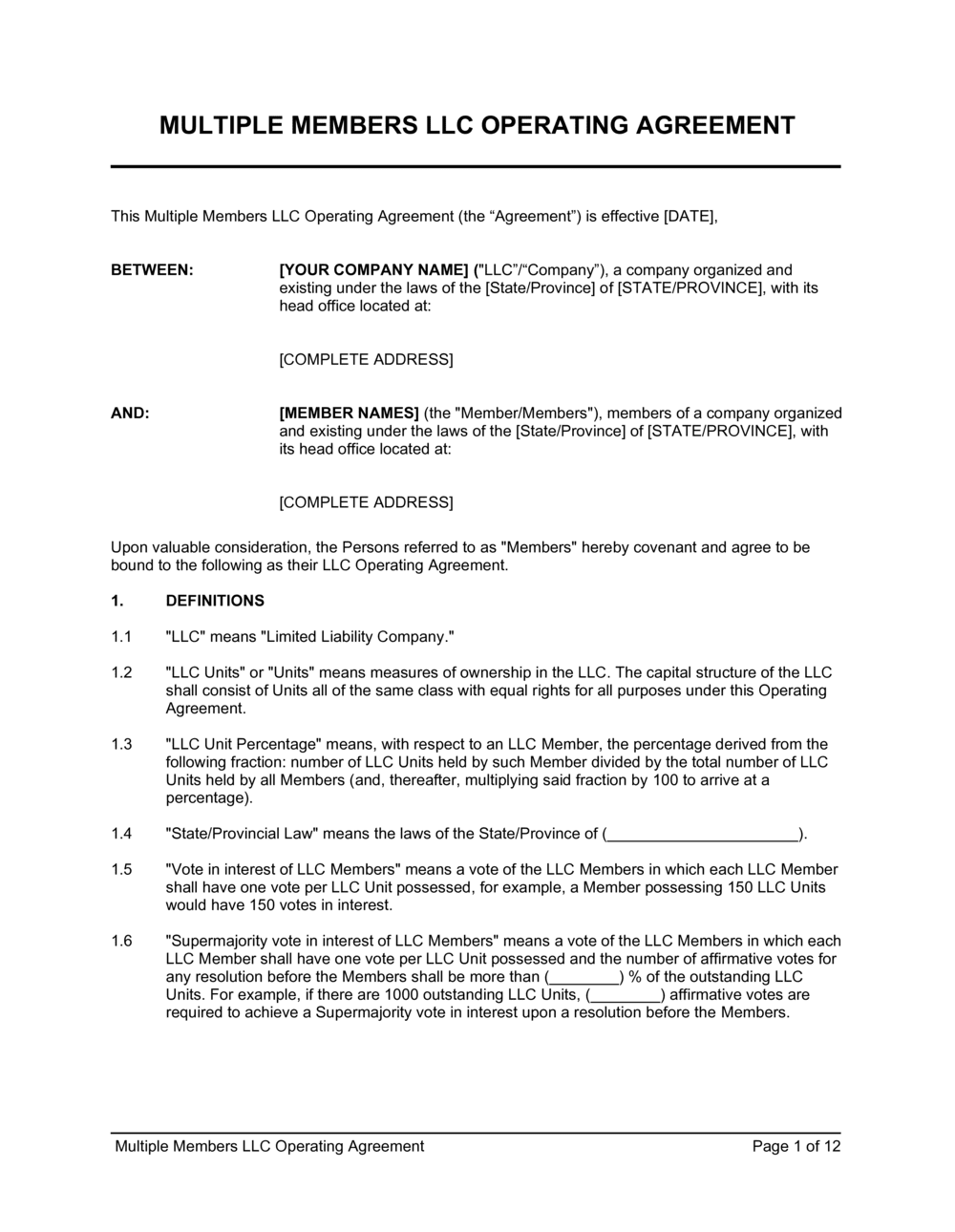
LLC Multiple Members Operating Agreement Template

Free Word download β€’ Edit online β€’ Save & share with Drive β€’ Export to PDF

12 pagesβ€’30–40 min to fillβ€’Difficulty: Complexβ€’Signature requiredβ€’Legal review recommended
Learn more ↓
FreeLLC Multiple Members Operating Agreement Template

At a glance

What it is
A Multi-Member LLC Operating Agreement is a legally binding contract among two or more owners (members) of a limited liability company that governs how the business is owned, managed, and operated. This free Word download gives you a structured, attorney-reviewed starting point you can edit online and export as PDF β€” covering ownership percentages, voting rights, profit distributions, member duties, and exit procedures in a single document.
When you need it
Use it when forming a new LLC with two or more members, when bringing a new member into an existing LLC, or when your current operating agreement no longer reflects how the business actually runs. Many states require a written operating agreement as a condition of maintaining LLC status.
What's inside
Member names and ownership percentages, capital contribution schedules, management structure (member-managed vs. manager-managed), voting thresholds, profit and loss allocations, distribution policies, transfer restrictions, buyout and buy-sell provisions, dissolution procedures, and governing law.

What is an LLC Multiple Members Operating Agreement?

An LLC Multiple Members Operating Agreement is a legally binding contract among two or more owners of a limited liability company that establishes how the business is owned, governed, and operated on an ongoing basis. It defines each member's ownership percentage, capital contribution obligations, voting rights, share of profits and losses, authority to act on behalf of the LLC, and the procedures that apply when a member wants to leave, is forced out, or dies. Unlike a corporation's mandatory governance documents, an LLC operating agreement is a private contract β€” meaning members can customize almost every term to match their actual business arrangement rather than accepting rigid state-law defaults.

Why You Need This Document

Operating a multi-member LLC without a written operating agreement means every governance question β€” who can sign contracts, how profits are split, what happens when a member wants out β€” gets answered by your state's default LLC statute, which was written for a generic business, not yours. State defaults frequently require unanimous consent for all decisions, split profits equally regardless of how much each member contributed, and can force dissolution of the entire LLC on the death or bankruptcy of a single member. Beyond governance gaps, banks and investors routinely require a signed operating agreement before opening accounts or funding the business. A properly drafted agreement, signed before the LLC conducts its first transaction, protects every member's investment, prevents deadlocks from becoming litigation, and gives the business a clear operational framework that scales as the company grows.

Which variant fits your situation?

If your situation is…Use this template
LLC with a single owner onlySingle Member LLC Operating Agreement
Members want a professional manager to run day-to-day operationsManager-Managed LLC Operating Agreement
LLC formed solely to hold real estate assetsReal Estate LLC Operating Agreement
Two members with equal 50/50 ownership and voting50/50 LLC Operating Agreement
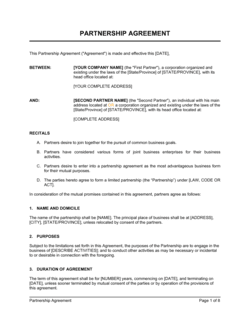
Partners prefer a general partnership structure without LLC liability shieldGeneral Partnership Agreement
Members want to convert the LLC to a corporation in the futureLLC to Corporation Conversion Agreement
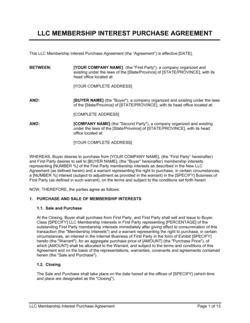
Adding a new investor member to an existing LLCLLC Membership Interest Purchase Agreement

Common mistakes to avoid

❌ No deadlock resolution mechanism for equal-ownership LLCs

Why it matters: A 50/50 LLC with no tiebreaker can become completely paralyzed β€” unable to approve budgets, hire staff, or sign contracts β€” whenever the two members disagree.

Fix: Include a deadlock clause specifying a sequence of remedies: first mediation, then a buy-sell trigger or arbitration. Even a basic shotgun buy-sell provision resolves most deadlocks without litigation.

❌ Omitting a tax distribution requirement

Why it matters: LLC profits pass through to members' personal tax returns whether or not cash is distributed. A member with a 40% interest in a profitable LLC owes tax on 40% of profits even if the other member controls distributions and holds all the cash.

Fix: Add a mandatory quarterly tax distribution clause requiring the LLC to distribute at least enough cash to cover each member's estimated federal and state tax liability on their allocated share of LLC income.

❌ No valuation formula in the buy-sell provision

Why it matters: When a triggering event occurs β€” death, divorce, or a member demanding exit β€” and no valuation method is written in, the parties default to litigation to determine price. Legal fees routinely exceed the value of the interest at stake.

Fix: Specify a valuation method at signing: a fixed formula (e.g., 5Γ— trailing EBITDA), a book value calculation, or a process for selecting an independent appraiser. Update it every two to three years as the business grows.

❌ Signing the operating agreement after the LLC has already operated

Why it matters: Transactions, debts, and tax elections made before the operating agreement was signed may not be covered by its terms, creating gaps that state default rules β€” often unfavorable β€” fill instead.

Fix: Execute the operating agreement on or before the date the LLC first conducts business. If the LLC has already been operating without one, document a retroactive effective date and have all members acknowledge the gap period explicitly.

❌ Using a single-member template for a multi-member LLC

Why it matters: Single-member agreements omit voting rights, deadlock procedures, transfer restrictions, and buy-sell provisions entirely β€” leaving multi-member disputes with no contractual framework.

Fix: Use a purpose-built multi-member template that includes all member governance provisions, and verify it covers the specific number of members and management structure of your LLC.

❌ Relying solely on state default rules by not drafting an agreement at all

Why it matters: State default LLC statutes rarely reflect what members actually want β€” many states require unanimous consent for any action, split profits equally regardless of contribution, or mandate dissolution on a member's death.

Fix: A written operating agreement supersedes state defaults in virtually every US jurisdiction. Even a basic agreement tailored to the members' actual intentions is significantly better than no agreement at all.

The 10 key clauses, explained

Member identification and ownership percentages

In plain language: Lists every member's full legal name, address, and exact ownership percentage, along with the initial capital each member contributes.

Sample language
The Members of [LLC NAME] and their respective Membership Interests are: [MEMBER 1 NAME], [ADDRESS] β€” [X]%; [MEMBER 2 NAME], [ADDRESS] β€” [X]%. Initial capital contributions are set out in Exhibit A.

Common mistake: Listing ownership percentages that do not sum to 100%. Even a rounding error creates ambiguity that can void distribution calculations and trigger disputes at exit.

Capital contributions and additional funding

In plain language: Specifies each member's initial contribution, whether additional contributions can be required, and what happens if a member fails to make a required contribution.

Sample language
Each Member shall contribute the amount set forth in Exhibit A on or before [DATE]. No Member shall be required to make additional capital contributions without unanimous written consent. A Member who fails to contribute within [X] days shall be subject to [DILUTION / BUYOUT REMEDY].

Common mistake: Omitting a remedy for a member who fails to make a required additional contribution. Without one, the LLC may be underfunded with no clear enforcement mechanism.

Management structure and authority

In plain language: Establishes whether the LLC is member-managed or manager-managed, identifies who can bind the LLC on contracts and bank accounts, and sets spending limits requiring member approval.

Sample language
The LLC shall be member-managed. Each Member is authorized to act on behalf of the LLC in the ordinary course of business up to $[X]. Expenditures exceeding $[X] or contracts with a term exceeding [X] months require approval by Members holding at least [X]% of Membership Interests.

Common mistake: Leaving the management structure blank or defaulting to state law. Most state defaults make every member a full agent of the LLC, which means any one member can bind the company to contracts without the others' consent.

Voting rights and decision thresholds

In plain language: Sets the default voting percentage for ordinary decisions, the higher thresholds for major decisions, and the list of actions requiring unanimous consent.

Sample language
Ordinary decisions require approval of Members holding more than [50]% of Membership Interests. Major decisions β€” including admission of new Members, amendment of this Agreement, sale of substantially all LLC assets, or incurrence of debt exceeding $[X] β€” require approval of Members holding at least [X]% of Membership Interests. The following actions require unanimous written consent: [LIST].

Common mistake: Using a simple majority threshold for all decisions. A deadlock between two equal members with no tie-breaking mechanism or defined escalation path can paralyze the LLC.

Profit and loss allocation

In plain language: States how net profits and losses are allocated among members for tax purposes β€” typically pro rata by membership interest unless a special allocation is agreed.

Sample language
The LLC's net profits and net losses for each fiscal year shall be allocated among the Members in proportion to their respective Membership Interests, unless the Members unanimously agree to a different allocation in writing.

Common mistake: Confusing profit allocation with distributions. Allocation determines each member's taxable share of LLC income on their K-1; distributions are actual cash payments and may differ in timing and amount.

Distributions policy

In plain language: Defines when and how cash is distributed to members β€” the frequency, priority (tax distributions first, then discretionary), and whether distributions require a vote.

Sample language
The LLC shall make tax distributions to Members quarterly in an amount sufficient to cover each Member's estimated federal and state income tax liability on allocated income, assuming a combined rate of [X]%. Additional distributions shall be made at such times and in such amounts as determined by Members holding at least [X]% of Membership Interests.

Common mistake: No tax distribution clause. Members of a pass-through LLC owe income tax on their allocated share of LLC profits whether or not cash is actually distributed β€” leaving them with a tax bill and no cash to pay it.

Transfer restrictions and right of first refusal

In plain language: Restricts a member from selling or transferring their interest to an outsider without first offering it to existing members at the same price and terms.

Sample language
No Member may transfer all or any portion of their Membership Interest without the prior written consent of Members holding at least [X]% of Membership Interests. Prior to any proposed transfer, the transferring Member shall offer the Interest to the remaining Members pro rata at the proposed transfer price, with a [X]-day acceptance window.

Common mistake: Omitting transfer restrictions entirely and relying on state law defaults. Most states permit free transfer of economic rights; without a restriction, a departing member can sell their economic interest to a stranger.

Buy-sell and buyout provisions

In plain language: Establishes the procedure and pricing mechanism for buying out a member who dies, becomes disabled, files for bankruptcy, or voluntarily withdraws β€” including who can trigger a buyout and how the purchase price is determined.

Sample language
Upon the death, disability, bankruptcy, or voluntary withdrawal of a Member, the LLC shall have the right, exercisable within [X] days of the triggering event, to purchase such Member's Interest at the price determined by [AGREED FORMULA / INDEPENDENT APPRAISAL / BOOK VALUE]. Payment shall be made in [LUMP SUM / X EQUAL INSTALLMENTS].

Common mistake: No valuation methodology specified. When a buyout is triggered and members disagree on value, the absence of a formula leads to litigation that can cost more than the interest itself.

Dissolution and winding up

In plain language: Sets out the events that trigger dissolution, the process for winding up operations, and the order in which assets are distributed β€” creditors first, then members pro rata.

Sample language
The LLC shall dissolve upon: (a) unanimous written consent of all Members; (b) entry of a judicial dissolution order; or (c) any other event requiring dissolution under [STATE] law. Upon dissolution, the LLC's assets shall be applied in the following order: (1) creditors, (2) Members in respect of unpaid distributions, (3) Members in proportion to Membership Interests.

Common mistake: Triggering dissolution automatically on the death or withdrawal of one member without a continuation clause. This can force a wind-down even when the remaining members want to continue operating.

Governing law and dispute resolution

In plain language: Specifies the state whose LLC law governs the agreement and sets the mechanism β€” arbitration, mediation, or litigation β€” for resolving disputes among members.

Sample language
This Agreement shall be governed by the laws of the State of [STATE]. Any dispute arising under this Agreement shall be submitted to binding arbitration administered by [AAA / JAMS] in [CITY, STATE], except that either party may seek injunctive relief in a court of competent jurisdiction.

Common mistake: Choosing a governing state different from the state where the LLC is actually formed and operating. Courts may apply the law of the operating state regardless, creating a conflict that voids dispute-resolution clauses.

How to fill it out

  1. 1

    Enter the LLC's legal name, state of formation, and effective date

    Use the exact name as registered with the secretary of state, including 'LLC' or 'L.L.C.' at the end. Confirm the state of formation matches the state where you filed Articles of Organization.

    πŸ’‘ The effective date should be the date all members sign β€” not the date the LLC was formed β€” to avoid gaps in governance coverage.

  2. 2

    List all members with legal names, addresses, and ownership percentages

    Use each member's full legal name as it appears on government-issued ID. Enter ownership percentages that sum precisely to 100% and document each member's initial capital contribution in Exhibit A.

    πŸ’‘ If any member is contributing non-cash property or services, assign a dollar value and document the valuation basis β€” this matters for both tax purposes and buyout calculations later.

  3. 3

    Choose member-managed or manager-managed structure

    Select member-managed if all owners will participate in daily operations. Select manager-managed if one member or a hired professional will run the business while other members are passive investors.

    πŸ’‘ If the LLC has more than four members or any passive investors, manager-managed is typically cleaner β€” it prevents every member from inadvertently acting as the LLC's agent.

  4. 4

    Set voting thresholds for ordinary and major decisions

    Define a simple majority (over 50%) for routine decisions and a supermajority (66–75%) or unanimous consent for major actions such as admitting new members, taking on debt, or selling assets.

    πŸ’‘ For two-member LLCs with equal 50/50 ownership, include a deadlock-resolution clause β€” a mediation step, a coin-flip buy-sell, or a designated tiebreaker β€” to prevent the LLC from becoming ungovernable.

  5. 5

    Define profit allocation and distributions

    Set profit and loss allocation pro rata by membership interest unless you have specific reasons for a special allocation. Add a mandatory tax distribution clause requiring quarterly cash distributions to cover each member's estimated tax liability.

    πŸ’‘ Special allocations (non-pro-rata) must have 'substantial economic effect' under IRS rules or they will be disregarded and reallocated β€” consult a CPA before using them.

  6. 6

    Draft transfer restrictions and the right of first refusal

    Require written consent of a defined majority before any member can transfer their interest. Set a specific acceptance window (30–60 days is standard) for remaining members to exercise their right of first refusal.

    πŸ’‘ Distinguish between transferring economic rights (profit entitlement) and transferring voting/governance rights β€” some operating agreements allow economic transfers but not membership transfers.

  7. 7

    Complete the buy-sell and buyout provisions

    Choose a valuation method β€” agreed formula, book value, or independent appraisal β€” and set the payment terms. Define the triggering events: death, disability, voluntary withdrawal, bankruptcy, and involuntary transfer.

    πŸ’‘ A shotgun clause (either member can name a price; the other must buy or sell at that price) is a simple and effective deadlock-breaker for two-member LLCs.

  8. 8

    Sign before the LLC conducts any business

    All members must sign before the LLC enters any contracts, opens bank accounts, or takes on obligations. Post-formation signatures without fresh consideration can leave early-period transactions ungoverned.

    πŸ’‘ Keep one fully executed original per member plus a copy in the LLC's registered office records. Many states require the agreement to be kept at the principal place of business.

Frequently asked questions

What is a multi-member LLC operating agreement?

A multi-member LLC operating agreement is a legally binding contract among two or more LLC owners that governs ownership percentages, management authority, voting rights, profit distributions, member transfers, and dissolution procedures. It functions as the LLC's internal constitution, replacing state default rules with terms the members have actually agreed to. Without one, disputes are resolved by state LLC statutes that rarely reflect the members' intentions.

Is an LLC operating agreement required by law?

Requirements vary by state. California, New York, Maine, Missouri, and Delaware require LLCs to have a written operating agreement. Most other states strongly recommend one but do not mandate it. Regardless of state requirements, operating without an agreement means all disputes and governance gaps are resolved by your state's default LLC statute β€” which is almost always less favorable than a tailored agreement would be.

What is the difference between a single-member and multi-member LLC operating agreement?

A single-member agreement focuses on the owner's management authority, tax treatment, and dissolution procedure. A multi-member agreement adds voting rights and thresholds, deadlock resolution, profit and loss allocation among members, transfer restrictions, right of first refusal, and buy-sell provisions β€” all of which are irrelevant when there is only one owner. Using a single-member template for a multi-member LLC leaves all of those governance issues unaddressed.

How are profits split in a multi-member LLC?

By default, most state LLC statutes allocate profits pro rata by membership interest β€” a member with 40% ownership receives 40% of profits. The operating agreement can override this with a custom allocation, but non-pro-rata (special) allocations must meet IRS substantial economic effect rules to be respected for tax purposes. Distributions β€” the actual cash paid out β€” can be timed and structured differently from allocations, which is why both provisions need to be clearly written in the agreement.

Can a member sell their interest in a multi-member LLC?

Without a written operating agreement, most states allow members to transfer their economic rights (entitlement to profits) freely but require consent of existing members to admit a transferee as a full voting member. A well-drafted operating agreement adds a right of first refusal requiring the departing member to offer their interest to existing members before any outside sale, protecting the remaining owners from having a stranger forced into the LLC.

What happens to a multi-member LLC when one member dies?

Without specific language in the operating agreement, most states default to allowing the deceased member's economic interest to pass to their heirs but not granting those heirs voting rights. The operating agreement should explicitly address death as a buyout trigger, specify the valuation method, and state whether the LLC continues or requires a vote to continue. Life insurance funded buy-sell arrangements β€” where each member holds a policy on the other β€” are a common mechanism for funding the buyout.

Does a multi-member LLC operating agreement need to be notarized?

Notarization is not required for an LLC operating agreement to be legally valid in any US state. All members simply need to sign the agreement. However, if any member is contributing real property to the LLC as a capital contribution, the deed transfer associated with that contribution will typically require notarization and recording in the county where the property is located.

How do I handle a 50/50 deadlock in a two-member LLC?

A 50/50 deadlock is one of the most common and costly LLC disputes. The operating agreement should include a staged resolution process: first, a mandatory mediation period (typically 30–60 days); if that fails, a shotgun buy-sell clause where either member names a price and the other must buy or sell at that price. Some agreements designate a neutral third-party tiebreaker for operational decisions while reserving the buy-sell for fundamental disagreements. The key is to write the mechanism in before a dispute arises β€” courts are reluctant to impose one after the fact.

Can we amend the operating agreement after the LLC is formed?

Yes β€” most operating agreements allow amendment by a specified vote threshold, typically a supermajority (66–75%) or unanimous written consent of all members. The agreement should state the amendment procedure explicitly. Informal changes β€” emails, verbal agreements, or side letters β€” generally do not amend a written operating agreement unless the agreement itself permits non-written modifications, which is rarely advisable.

How this compares to alternatives

vs Single Member LLC Operating Agreement

A single-member agreement governs one owner's relationship with their LLC and focuses on management authority, tax treatment, and asset protection. A multi-member agreement adds voting rights, profit-sharing among owners, transfer restrictions, and buy-sell provisions β€” none of which apply when there is only one member. Using the wrong template creates governance gaps that courts fill with state defaults.

vs General Partnership Agreement

A general partnership agreement governs co-owners in a structure with no liability shield β€” each partner is personally liable for all partnership debts. A multi-member LLC operating agreement provides the same co-ownership governance but within an LLC structure where members' personal assets are generally protected from LLC liabilities. For most new multi-owner businesses, the LLC structure with an operating agreement is preferable to a general partnership.

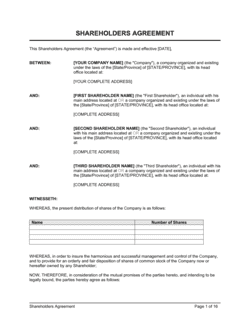
vs Shareholder Agreement

A shareholder agreement governs owners of a corporation (stock) rather than an LLC (membership interests). Corporations have mandatory governance structures β€” boards of directors, officer roles, annual meetings β€” that do not apply to LLCs. An LLC operating agreement is more flexible and simpler to administer for small multi-owner businesses that do not need the formal corporate structure required for institutional venture capital.

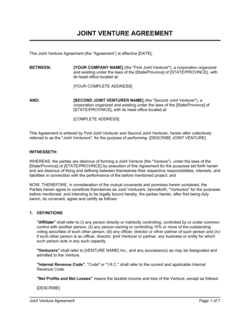
vs Joint Venture Agreement

A joint venture agreement governs a temporary collaboration between two or more parties for a specific project, often without creating a new legal entity. A multi-member LLC operating agreement governs an ongoing legal entity with indefinite existence. Choose a joint venture agreement for a defined project with a fixed end date; choose an LLC operating agreement when the intention is to operate an ongoing business together.

Industry-specific considerations

Real estate investment

Multi-member LLCs are the dominant vehicle for co-ownership of investment properties; the operating agreement must address property management authority, capital call obligations, refinancing consent thresholds, and forced-sale procedures on member exit.

Professional services

Law firms, accounting practices, and consulting groups use multi-member LLCs to share profits and governance; the agreement typically includes non-compete and non-solicitation clauses and addresses what happens when a member loses their professional license.

Technology / SaaS

Tech co-founders use multi-member LLCs before incorporating; the operating agreement must cover IP assignment to the entity, vesting schedules for membership interests, and conversion rights if the LLC later converts to a C-corporation for VC fundraising.

Food and beverage / restaurant

Restaurant groups commonly use multi-member LLCs per location; key provisions address management authority (which member oversees operations), revenue distributions relative to capital invested, and procedures if a member wants to exit a single-location LLC within a larger group.

Jurisdictional notes

United States

California, New York, Maine, Missouri, and Delaware mandate written operating agreements. All other states strongly recommend one but do not legally require it. Multi-member LLCs are taxed as partnerships by default under the IRS check-the-box rules, requiring annual Form 1065 filing and K-1s to each member. Non-compete clauses within operating agreements are enforceable in most states but void in California.

Canada

Canada does not use the LLC entity form β€” the functional equivalent is a limited partnership or a private corporation governed by a shareholders' agreement. Canadian businesses seeking similar multi-owner flexibility typically use a Limited Partnership Agreement or a unanimous shareholders' agreement under the relevant provincial Business Corporations Act. Quebec-based entities must ensure all governance documents comply with the Civil Code of Quebec.

United Kingdom

The UK does not recognize the US LLC form. The closest equivalents are a Limited Liability Partnership (LLP), governed by an LLP Agreement, or a private limited company (Ltd), governed by a shareholders' agreement and articles of association. LLPs are common for professional firms; private limited companies are standard for trading businesses. Neither structure uses an operating agreement in the US sense.

European Union

EU member states each have their own equivalent of a limited liability entity β€” Germany's GmbH, France's SARL, Spain's SL β€” all governed by articles of association and shareholder agreements rather than operating agreements. US LLCs doing business in the EU may face entity classification issues for local tax purposes; the OECD's BEPS framework and EU anti-tax-avoidance directives can affect how LLC distributions are treated in the member state where business is conducted.

Template vs lawyer β€” what fits your deal?

PathBest forCostTime
Use the templateTwo- to four-member LLCs with straightforward equal or proportional ownership, domestic US formation, and no complex assets or IPFree1–2 hours
Template + legal reviewLLCs with unequal ownership, passive investors, real property contributions, or special allocation needs$500–$1,500 for a one-hour attorney review and markup3–7 days
Custom draftedLLCs with five or more members, complex capital structures, convertible interests, or members in multiple states or countries$2,000–$6,000+2–4 weeks

Glossary

Operating Agreement
A contract among LLC members that sets out the rules governing the LLC's ownership, management, and operations β€” the functional equivalent of corporate bylaws.
Member
An owner of an LLC, identified by their membership interest percentage and the rights and obligations attached to that interest.
Membership Interest
An owner's proportional share of the LLC, expressed as a percentage and typically tied to capital contributions and voting rights.
Capital Contribution
Cash, property, or services a member contributes to the LLC in exchange for their membership interest.
Distributions
Payments of LLC profits or capital to members, allocated according to membership interest percentages or a custom distribution schedule in the agreement.
Member-Managed LLC
An LLC in which all members participate directly in day-to-day management and bind the company through their actions.
Manager-Managed LLC
An LLC in which members appoint one or more managers β€” who may or may not be members β€” to handle operations and bind the company.
Buy-Sell Agreement
A provision within the operating agreement that sets the price and process for transferring a member's interest when they die, become disabled, withdraw, or are forced out.
Right of First Refusal
A clause requiring a departing member to offer their interest to existing members before selling to a third party.
Dissolution
The formal winding down of the LLC, including liquidating assets, paying creditors, and distributing remaining proceeds to members.
Unanimous Consent
A voting threshold requiring all members to agree before certain major decisions β€” such as admitting new members or amending the operating agreement β€” can be taken.

Part of your Business Operating System

This document is one of 3,000+ business & legal templates included in Business in a Box.

  • Fill-in-the-blanks β€” ready in minutes
  • 100% customizable Word document
  • Compatible with all office suites
  • Export to PDF and share electronically

Create your document in 3 simple steps.

From template to signed document β€” all inside one Business Operating System.
1
Download or open template

Access over 3,000+ business and legal templates for any business task, project or initiative.

2
Edit and fill in the blanks with AI

Customize your ready-made business document template and save it in the cloud.

3
Save, Share, Send, Sign

Share your files and folders with your team. Create a space of seamless collaboration.

Save time, save money, and create top-quality documents.

β˜…β˜…β˜…β˜…β˜…

"Fantastic value! I'm not sure how I'd do without it. It's worth its weight in gold and paid back for itself many times."

Managing Director Β· Mall Farm
Robert Whalley
Managing Director, Mall Farm Proprietary Limited
β˜…β˜…β˜…β˜…β˜…

"I have been using Business in a Box for years. It has been the most useful source of templates I have encountered. I recommend it to anyone."

Business Owner Β· 4+ years
Dr Michael John Freestone
Business Owner
β˜…β˜…β˜…β˜…β˜…

"It has been a life saver so many times I have lost count. Business in a Box has saved me so much time and as you know, time is money."

Owner Β· Upstate Web
David G. Moore Jr.
Owner, Upstate Web

Run your business with a system β€” not scattered tools

Stop downloading documents. Start operating with clarity. Business in a Box gives you the Business Operating System used by over 250,000 companies worldwide to structure, run, and grow their business.

Free Forever PlanΒ Β·Β No credit card required